This site is supported by our readers. We may earn a commission, at no cost to you, if you purchase through links.

Most dog trainers spend weeks debating which marker to use before they ever teach their dog a single behavior. And honestly, I get it—the clicker training versus verbal markers debate has been going on since positive reinforcement training went mainstream, with passionate advocates on both sides.
What the argument usually misses, though, is that the tool matters far less than how consistently you use it. Research from Chiandetti and Dorey found no meaningful difference in how quickly dogs learned with either method. So the real question isn’t which marker is better—it’s which one fits the way you and your dog actually train together.
Table Of Contents
- Key Takeaways
- Clicker Versus Verbal Markers
- How Clicker Training Works
- How Verbal Markers Work
- Clicker Vs Verbal Results
- Top 7 Training Tools
- Choosing Your Best Marker
- Frequently Asked Questions (FAQs)
- What are the disadvantages of clicker training?
- Can clicker training work for fearful rescue dogs?
- Do cats respond well to clicker or verbal markers?
- Should markers change as dogs age or progress?
- Can multiple handlers use the same marker consistently?
- Is clicker training effective for deaf or blind dogs?
- Conclusion
Key Takeaways
- Research shows clickers and verbal markers produce the same learning speed, so your consistency matters far more than which tool you pick.
- Clickers win on timing precision for complex or sport-level training, but verbal markers hold the edge for distance work, noise-sensitive dogs, and everyday convenience.
- Noise-sensitive or anxious dogs often respond better to a calm voice than a sharp mechanical click, so your dog’s temperament should drive the decision.
- You don’t have to choose just one — start with the clicker to build timing awareness, then layer in a verbal marker and gradually fade the clicker as your dog catches on.
Clicker Versus Verbal Markers
Before you pick a side, it helps to understand what separates these two tools in the first place. Both work as event markers, but the way they deliver that signal — and when each one shines — makes all the difference. Here’s what you need to know about how clickers and verbal markers stack up across the things that matter most.
If you want a deeper look at how each option plays out in real training sessions, marker training techniques for dogs breaks down the practical tradeoffs between clickers and verbal cues.
Core Training Difference
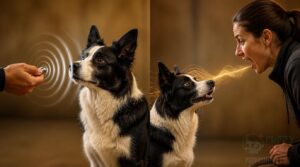
Essentially, the difference comes down to one thing: timing precision gap.
A clicker delivers a sharp, consistent mechanical sound the instant your dog nails the behavior. A verbal marker—"Yes!" or "Good!"—works too, but your voice naturally shifts with your mood. Both are valid auditory cues, but each fits different moments in training.
Event Marker Purpose

Think of an event marker as a precision timing signal — a camera shutter that captures the exact moment your dog does something right. It tells your dog, "That. Right there." Without it, you’re left waving at a moving train.
- Bridges behavior to reward clearly
- Removes guesswork from your dog’s learning
- Builds auditory cue consistency over sessions
- Reduces training errors from delayed feedback
- Strengthens training efficiency gains over time
Reward Timing Role
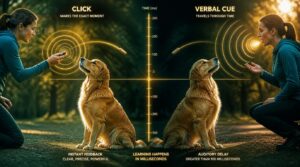
Timing isn’t just a detail — it’s everything. The moment after your marker fires is where learning either locks in or falls apart.
Deliver the reward fast, ideally within one to two seconds, and your dog’s brain makes a clean connection. Wait too long, and that connection quietly fades, replaced by whatever your dog did nearest the reward. This timing is critical for effective positive reinforcement to shape behavior.
Positive Reinforcement Basics

Solid timing sets the stage, but timing alone doesn’t drive learning — positive reinforcement does. Fundamentally, it’s simple: a dog repeats what gets rewarded. That’s operant conditioning in everyday clothes.
Three things make it work:
- Target behavior definition — know exactly what you’re rewarding
- Reinforcer menu options — find what your dog actually values
- Immediate reward delivery — deliver it fast, every time
Best Use Cases
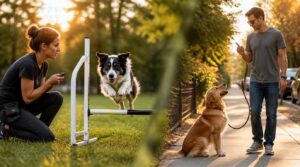
Neither method wins every situation — it depends on what you’re training, where you are, and what your dog needs.
| Scenario | Best Marker | Why It Works |
|---|---|---|
| Complex behavior shaping | Clicker | Millisecond precision captures exact moments |
| Basic obedience training | Verbal markers | Always available, no tools required |
| Distance communication needs | Verbal markers | Voice carries farther than a click |
How Clicker Training Works

Clicker training sounds simple—you click, you treat, your dog learns. But there’s a bit more happening under the hood that makes it so effective. Here’s a closer look at the key pieces that make it all click (pun intended).
Mechanical Sound Precision
What makes a clicker so effective comes down to pure physics. The device emits a crisp mechanical sound — commonly between 1.5 and 3.0 kHz — lasting under 20 milliseconds.
That consistency is everything. Your dog hears the exact same signal every single time, with no emotional coloring, no tonal drift, no accent. Auditory discrimination happens fast, cutting cleanly through background noise.
Shaping New Behaviors
Shaping new behaviors is where the clicker genuinely shines. Instead of waiting for your dog to nail the final behavior, you reward successive approximations — small, progressive steps toward your goal. Each click celebrates a little more accuracy, nudging your dog forward without overwhelming them.
Keep sessions short and frequent. Motivation stays high, and your dog keeps winning.
Marking Exact Actions
Think of a click as a camera shutter — it freezes the exact moment your dog did something right. That’s the magic of precision timing benefits in clicker training.
- Mark the behavior the instant it happens
- Use consistent marker delivery every single repetition
- Build strong behavior boundary signals through clarity
- Develop sharp handler observation skills
- Tackle distance marking challenges with practice
Reward Bridging
The click means nothing without what follows it. Reward bridging is the invisible thread connecting that sharp mechanical sound to the treat landing in your dog’s mouth — and getting it right is everything in marker training.
The faster you can close that gap between click and treat, the clearer the message — something experienced dog trainers will tell you makes all the difference when shaping new behaviors.
When you click, your dog isn’t instantly rewarded. There’s a brief timing gap — maybe two or three seconds — and your dog must hold that mental connection across it.
Clicker Charging Process
Before your clicker does anything useful, it needs to mean something to your dog. That’s what charging the clicker is all about — building a rock-solid click sound association through simple, deliberate treat pairing timing.
- Keep sessions short — 10–15 clicks maximum
- Use tiny, high-value treats your dog finishes quickly
- Click once, treat immediately, every single time
- Watch for conditioned reinforcer development: anticipation after the click
- Test readiness by clicking when your dog isn’t looking — if they spin toward you, you’re done
How Verbal Markers Work

Verbal markers are about as low-tech as training gets — just your voice, your dog, and the right word at the right moment. No gear to forget, no batteries to die, and no excuses not to practice during your morning walk. Here’s what makes them tick.
Common Marker Words
Most trainers settle on three go-to verbal markers: "Yes," "Good," or "Bravo." Short syllable preference matters here — one crisp word lands faster than a two-second phrase.
Your marker word functions as a reward prediction signal, telling your dog reinforcement is coming. Keep pronunciation consistent so it stays distinct from everyday speech.
Voice Tone Consistency
Your marker word only works if it sounds the same every time. That means keeping your pitch stable, your volume consistent, and your vocal timbre uniform across sessions.
If "Yes" sounds bright and crisp on Monday but breathy and rushed on Thursday, your dog is basically hearing two different cues.
Distance Communication Benefits
One big acoustic advantage verbal markers have over clickers is pure range and flexibility. Raise your voice, and your dog can hear "Yes!" from across a field, another room, or a crowded agility ring.
That remote cue consistency keeps reinforcement timing tight even at distance — no sprinting over required, just your voice doing the work.
Everyday Training Convenience
Here’s the thing — you already carry your best training tool everywhere. No clicker needed, no fumbling through pockets mid-walk.
A quick "Yes!" during your morning stroll or a calm "Good" while cooking keeps positive reinforcement flowing naturally. Verbal markers slot effortlessly into everyday moments, making consistency genuinely easy, even on your busiest days.
Handler-dog Connection
Saying your dog’s name with a warm "Yes!" does something a clicker simply can’t — it builds emotional connection through your unique voice. Your dog learns to associate you with every reward, strengthening communication consistency and trust over time.
Here’s what verbal markers naturally offer:
- Bonding through warmth with your tone
- Stress management partnership during anxious moments
- Handler-recognized voice as a comfort cue
- Synchronization strategies through daily interaction
Clicker Vs Verbal Results

So which one actually wins? Honestly, the answer might surprise you. Here’s what the research and real-world training experience reveal about speed, timing, sensitivity, and the mistakes most beginners make.
Learning Speed Comparison
Here’s the honest truth: regarding learning speed, neither the clicker nor the verbal marker pulls ahead by a mile.
| Factor | Clicker | Verbal Marker |
|---|---|---|
| Timing Precision Impact | Millisecond-accurate | Slight natural drift |
| Feedback Loop Efficiency | Tight, consistent loop | Variable with handler pace |
| Marker Consistency Benefits | Identical each repetition | Pitch and tone can shift |
What actually drives handler reaction speed — and your dog’s progress — is how consistently you mark the right moment, whatever tool you’re holding.
Research on Effectiveness
Research keeps pointing to the same conclusion: no marker wins outright. Studies by Chiandetti (2016) and Dorey (2020) found dogs trained with clickers, verbal markers, or food alone reached identical proficiency. Early claims of a 60% clicker advantage were never replicated.
What the data consistently shows is that positive reinforcement and timing matter far more than which tool delivers it.
Positive reinforcement and timing drive learning far more than whichever tool delivers the mark
Timing Accuracy Differences
Here’s where the two methods actually diverge. A clicker fires in a single sharp instant — marker release latency is virtually zero. A verbal marker unfolds over syllables, introducing small but real delays.
| Factor | Clicker | Verbal Marker |
|---|---|---|
| Timing onset | Immediate | Slightly delayed |
| Reinforcement moment precision | High | Moderate |
| Handler consistency challenges | Low | Higher |
| Chaining precision impact | Excellent | Variable |
That gap compounds fast in multi-step training.
Dog Sensitivity Factors
Not every dog hears the click the same way. A highly sensitive or noise-sensitive dog may flinch at the sharp mechanical snap — and once that association sours, you’re working against yourself.
| Factor | Clicker | Verbal Marker |
|---|---|---|
| Noise Sensitivity Impact | Higher risk | Lower risk |
| Emotional Reactivity Management | Emotional neutrality | Voice tone dependent |
| Touch Handling Tolerance | Gear-free interaction | Closer proximity needed |
Your anxious pup often responds better to a calm, familiar voice. Past experiences shape everything — auditory stimuli paired with stress can create lasting avoidance, making verbal markers the smarter, gentler bridge.
Novice Handler Mistakes
Even experienced trainers slip up here — beginners slip up constantly.
The most common culprit is timing drift: you click a half-second late, and your dog just learned the wrong thing. Pair that with marker trigger confusion — marking a look instead of a sit — and you’re building a shaky foundation fast.
Top 7 Training Tools
The right tools can make or break your training sessions, no matter which marking method you prefer. I’ve pulled together seven options that cover everything from clickers to remote collars, so there’s something here for every handler and every dog. Here’s what made the cut.
1. Educator Mini Dog Training E Collar
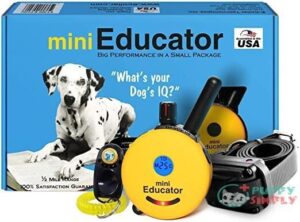
The Educator Mini E Collar is one of those tools serious trainers keep reaching for, and it’s easy to see why. It covers a half-mile wireless range, fits dogs as small as five pounds, and delivers 100 precise stimulation levels — so you’re never guessing.
Vibration and tone modes let you sequence signals before stimulation, building clear associations fast. Add waterproof construction and a night locating light, and you’ve got a collar built for real-world training, not just the backyard.
| Best For | Dog owners and serious trainers who want precise, reliable off-leash control — especially in challenging environments like rain, low light, or open fields. |
|---|---|
| Product Type | E-collar system |
| Training Feedback | Stimulation, tone, vibration |
| Build Material | Plastic and rubber |
| Portability | Remote and wearable collar |
| Skill Level | Intermediate to advanced |
| Primary Target | Dogs 15 lbs and up |
| Additional Features |
|
- 100 stimulation levels give you real precision, so you can dial in exactly what works for your dog without overdoing it.
- Waterproof down to 500 feet and built with a night light — it holds up wherever training actually happens.
- Tone and vibration modes let you build clear signal sequences before stimulation, which speeds up learning.
- The collar needs a snug, consistent fit to work properly — a loose fit means inconsistent results.
- There’s a learning curve; without proper conditioning, you won’t get the most out of it.
- It supports training, but it’s not a replacement for real obedience work — you still have to put in the reps.
2. Bousnic Long Range Dog Training Collar
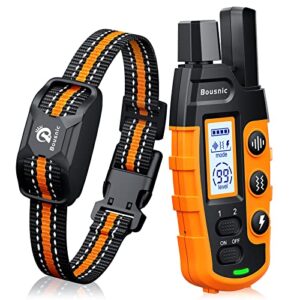
If you need distance and durability without breaking the bank, the Bousnic Long Range Dog Training Collar is worth a serious look. It reaches up to 3,300 feet, accommodates dogs from 5 to 120 pounds, and offers beep, vibration, and shock modes.
The IP67 waterproof receiver holds up in rain or mud, and one charge lasts up to 15 days. Plus, one remote trains two dogs simultaneously — a quiet win for multi-dog households.
| Best For | Owners training one or two dogs across large properties or open spaces who want solid range and all-weather reliability at a reasonable price. |
|---|---|
| Product Type | E-collar system |
| Training Feedback | Beep, vibration, shock |
| Build Material | Plastic |
| Portability | Remote and wearable collar |
| Skill Level | Beginner to advanced |
| Primary Target | Dogs 5 to 120 lbs |
| Additional Features |
|
- Reaches up to 3,300 feet — plenty of room for off-leash work or wide-open spaces
- One remote handles two dogs, which is a nice bonus for multi-dog households
- IP67 receiver shrugs off rain and mud, and the battery lasts up to 15 days
- The remote isn’t waterproof, so you’ll need to keep it dry when the weather turns
- No belt clip on the remote makes it harder to keep close during active training sessions
- Shock levels go up to 99, so new users need to be careful not to overcorrect
3. Coachi Multi-Clicker Adjustable Volume Dog Clicker
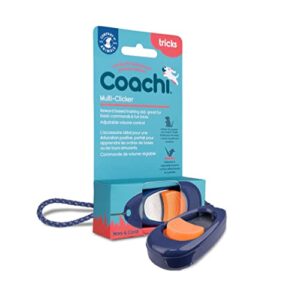
Switching gears from remote collars, sometimes the most powerful training tool fits in your palm. The Coachi Multi-Clicker is a standout for one smart reason: three adjustable volume settings. That means you can dial down for a noise-sensitive pup or crank it up for a high-energy dog in a busy park.
The raised thumb piece makes one-handed clicking smooth, and the adjustable wrist strap keeps it secure whether you’re a seasoned trainer or just starting out.
| Best For | Puppy owners, child handlers, and anyone training a sound-sensitive or high-energy dog who wants a clicker that adapts to the situation. |
|---|---|
| Product Type | Handheld clicker |
| Training Feedback | Auditory click |
| Build Material | Plastic |
| Portability | Elastic wrist strap |
| Skill Level | Beginner |
| Primary Target | Dogs, cats, birds |
| Additional Features |
|
- Three volume settings give you real flexibility—quiet for sensitive dogs, loud for distracting environments
- The raised thumb piece makes clicking feel natural, even with one hand
- The reflective wrist strap keeps it handy and secure during training sessions
- Even the softest setting might be too loud for highly sensitive dogs
- The loudest setting carries far enough to potentially startle nearby dogs or people
- Results still depend on whether your dog responds well to sound-based training
4. Cat School Clicker Training Kit
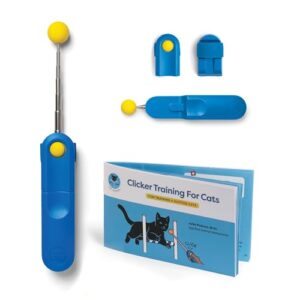
Dogs aren’t the only ones who benefit from clicker training — and the Cat School Clicker Training Kit is proof of that.
Designed by a feline behaviorist, this all-in-one kit pairs a quiet, low-sound clicker with a 22-inch retractable target stick, making it ideal for cats who startle easily. The included illustrated booklet walks beginners through 15 guided lessons, so you’re never guessing.
It’s compact, thoughtfully built, and a genuinely smart pick for multi-pet households.
| Best For | Cat owners — especially beginners — who want a low-stress, structured way to train their cats and strengthen that bond. |
|---|---|
| Product Type | Handheld clicker |
| Training Feedback | Auditory click |
| Build Material | Plastic |
| Portability | Wrist strap and keyring |
| Skill Level | Beginner |
| Primary Target | Dogs, cats, birds, horses |
| Additional Features |
|
- Quiet clicker is perfect for noise-sensitive cats who startle easily
- 15 guided lessons plus video tutorials make it genuinely beginner-friendly
- The 22-inch target stick keeps your hand out of the way during training
- Won’t work as well for cats with hearing impairments
- The target stick tip has had some durability complaints from users
- Experienced trainers may find the instruction booklet too basic
5. Dr.Trainer T1sPro Remote Dog Training Collar
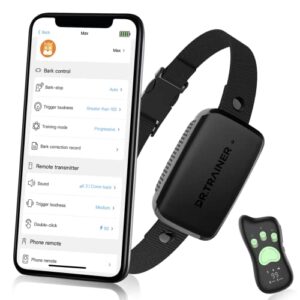
If you’re working on obedience beyond the backyard, the Dr.Trainer T1sPro is worth a serious look. It combines remote training, automatic bark correction, and a companion app into one collar — with a reach of up to 3,000 feet. You can use sound, vibration, or static shock at adjustable levels, and even record your own voice commands.
It fits dogs from 8 to 150 lbs, charges in just 40 minutes, and carries an IP68 waterproof rating.
| Best For | Dog owners who want one collar that handles both remote training and automatic bark correction — especially useful if you’re working with your dog at a distance or need hands-free control on the go. |
|---|---|
| Product Type | Handheld clicker |
| Training Feedback | Adjustable-volume click |
| Build Material | Plastic |
| Portability | Adjustable wrist strap |
| Skill Level | Beginner to advanced |
| Primary Target | Dogs of all sizes |
| Additional Features |
|
- Tons of flexibility — use the remote, the app, or even your Apple Watch to control training from up to 3,000 feet away
- Humane options built in, with sound and vibration modes so you’re not locked into using static shock
- Fast 40-minute charge and a solid IP68 waterproof rating make it easy to keep up with an active dog
- Bluetooth can be spotty, and some users have run into app stability issues that get in the way
- Battery life on the receiver doesn’t always match what’s advertised in real-world use
- A few durability concerns, particularly around the rivets that attach the device to the collar
6. Aramith Jim Rempe Training Cue Ball
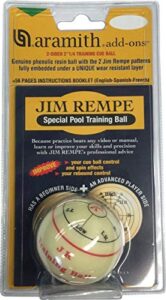
Now, this one’s a bit of an outlier on the list. The Aramith Jim Rempe Training Cue Ball is a billiards training tool, not a dog training product.
It’s a dual-sided phenolic resin practice ball designed to improve spin control and cue accuracy for pool players. If you landed here researching dog training markers, this one doesn’t belong in your toolkit — but it’s a well-regarded product in its own lane.
| Best For | Pool players at any skill level who want to sharpen their spin control and cue ball accuracy through visual feedback. |
|---|---|
| Product Type | Clicker and target stick |
| Training Feedback | Auditory click |
| Build Material | Plastic |
| Portability | Handheld with finger loop |
| Skill Level | Beginner to intermediate |
| Primary Target | Cats and dogs |
| Additional Features |
|
- The chalk-receptive surface shows you exactly where you’re hitting the cue ball — no guessing
- Dual-sided design grows with you, so it works whether you’re just starting out or already pretty serious about your game
- Phenolic resin construction means it holds up well and plays just like a regulation ball
- It costs more than a standard cue ball, so it’s a bit of an investment for casual players
- The included manual is a nice touch, but don’t expect it to replace a proper lesson or in-depth guide
- If you’re already an advanced player, the learning curve here is pretty flat — you may not get as much out of it
7. Starmark Pro Training Ergonomic Pet Clicker
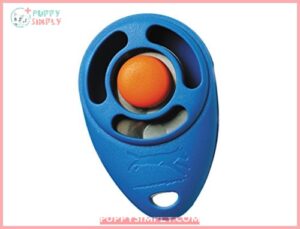
The Starmark Pro Training Clicker is the one I’d hand to most dog owners without hesitation. It’s ergonomic, fits naturally in your palm, and the raised button means you’re never fumbling mid-session. The stainless steel mechanism delivers a crisp, consistent click every time — no muffling, no double-clicks.
It even comes with a step-by-step training guide built around positive reinforcement, which is a genuine bonus for newer trainers. Compact, durable, and wrist-strap included. Solid all-around tool.
| Best For | Dog owners and newer trainers who want a reliable, easy-to-hold clicker that takes the guesswork out of positive reinforcement training. |
|---|---|
| Product Type | Smart e-collar system |
| Training Feedback | Sound, vibration, shock |
| Build Material | Plastic and nylon |
| Portability | Remote and wearable collar |
| Skill Level | Intermediate to advanced |
| Primary Target | Dogs 8 to 150 lbs |
| Additional Features |
|
- Ergonomic shape sits comfortably in your hand, so long training sessions don’t wear you out
- Rust-resistant stainless steel clicker gives you a crisp, consistent click every time
- Comes with a step-by-step training guide — genuinely helpful if you’re just starting out
- It’s loud, which can spook noise-sensitive pets or annoy anyone nearby indoors
- Takes a specific bottom-press technique to work right — there’s a small learning curve
- Performance can vary between batches, so you might notice differences if you buy multiples
Choosing Your Best Marker

The right marker isn’t one-size-fits-all — it really comes down to your dog, your goals, and how you train. A few key scenarios can point you in the right direction before you ever pick up a clicker or open your mouth. Here’s what works best in each situation.
Puppies and Beginners
If you’re brand new to this — fresh puppy in hand, zero experience — start with your voice. A verbal marker like "Yes!" is always with you, costs nothing, and fits naturally into your first week routine.
Puppies between 3 and 14 weeks absorb everything fast, so ease of use genuinely matters when you’re still finding your rhythm.
Noise-sensitive Dogs
Some dogs flinch at a click the same way they’d flinch at a firecracker.
If your dog is noise-sensitive, the clicker isn’t your friend — a calm, consistent verbal marker like "Yes!" keeps sessions stress-free. Pair it with positive reinforcement in a safe space setup, especially during fireworks management or thunderstorm desensitization work, and you’ll build confidence without the edge.
Agility and Sports
In agility and dog sports, milliseconds matter. Clicker precision wins here — that sharp, consistent click marks the exact footfall, turn, or obstacle response you want, right as it happens. Reactive decision-making, tight footwork, and rapid directional changes demand that level of accuracy.
A verbal marker, however natural it feels, can’t consistently match that timing.
Basic Obedience Training
For everyday obedience — sit, stay, heel, come — verbal markers work beautifully. You’ve already got your voice with you, and that’s genuinely enough.
Say "Yes!" the moment your dog’s bottom hits the floor, then reward immediately. That reward timing precision is what drives learning, not the tool delivering the mark.
Combining Both Methods
You don’t have to pick one and ditch the other. A smart Marker Progression Strategy starts with the clicker for precision, then layers in a verbal marker once your dog understands the timing.
- Click, then say "Yes!" simultaneously to pair both signals
- Gradually fade the clicker, keeping the verbal
- Use the clicker again whenever you’re shaping something new
Reward Consistency seals it together.
Frequently Asked Questions (FAQs)
What are the disadvantages of clicker training?
Clicker training has real drawbacks. Timing errors can teach the wrong behavior, equipment hassle interrupts spontaneous sessions, noise-sensitive dogs may startle, and misuse risks reinforcing accidents. Consistency demands more than most beginners expect.
Can clicker training work for fearful rescue dogs?
Yes, clicker training works well for fearful rescue dogs. The timing precision benefits help mark calm moments instantly, building rescue dog confidence through clear, immediate feedback — no confusing delays, no emotional pressure in your voice.
Do cats respond well to clicker or verbal markers?
Cats are like tiny scientists — they reward precision, not guesswork. Clicker training works well because the emotionally neutral signal cuts through distractions and tells your cat exactly what earned the treat.
Should markers change as dogs age or progress?
Not really. Marker consistency aging matters more than swapping tools. The same marker word or click stays effective as long as your dog can still hear it and you stay consistent.
Can multiple handlers use the same marker consistently?
Absolutely — if everyone agrees on the same word, timing, and reward follow-through. Shared cue protocol and handler coordination keep the marker meaningful, so your dog isn’t left guessing who’s actually running the show.
Is clicker training effective for deaf or blind dogs?
For deaf dogs, visual marker success is real. A thumbs-up paired with treats works just like a click. Blind dogs thrive with consistent sound cues. Sensory adaptation strategies make marker training effective for both.
Conclusion
Think of clicker training versus verbal markers like choosing between a hammer and a screwdriver—both drive results, but one just fits your hand better. The research is refreshingly clear: consistency beats equipment every single time.
So pick the marker that feels most natural to you, stick with it long enough to build real training rhythm, and your dog will meet you more than halfway. The best tool is always the one you’ll actually use.
- https://dogsdayoutseattle.com/use-clicker-marker
- https://spiritdogtraining.com/behavior/clicker-training-vs-yes-verbal-marker
- https://havendogtraining.com/blog/clicker-training-your-dog
- https://journal.iaabcfoundation.org/does-clicker-training-lead-to-faster-acquisition-of-behavior-for-dog-owners-it-depends-on-the-behavior
- https://scentsabilitiesnw.com/blog/verbal-marker-or-clicker-and-the-role-of-emotion