This site is supported by our readers. We may earn a commission, at no cost to you, if you purchase through links.

Most dog owners spend months repeating commands, wondering why nothing sticks. The disconnect isn’t the dog—it’s the missing signal between the behavior you want and the reward that follows.
A marker solves this. It’s a precise, consistent sound or gesture that tells your dog, "That exact thing you just did—that’s what earned your treat." When paired correctly with a reward, it becomes a promise your dog learns to trust completely.
Marker training step by step is less about drilling repetitions and more about building a clear language between you and your dog—one that makes every lesson faster, cleaner, and far less frustrating for both of you.
Table Of Contents
Key Takeaways
- The marker is a promise — every click or ‘yes’ must be followed by a reward, every single time, or the whole system falls apart.
- Timing is the real skill: mark within one second of the behavior, or you’re reinforcing whatever your dog did next.
- Charge the marker first — your dog needs 30 repetitions of mark-then-treat before the signal means anything at all.
- Don’t add a cue, fade prompts, or reduce treats until your dog hits 80% reliability — rushing any of these steps quietly unravels the behavior.
What is Marker Training?

Marker training is one of the most effective ways to communicate clearly with your dog — and once you understand how it works, everything clicks. At its foundation, it’s built on a few key ideas that work together to speed up learning and build real trust. Here’s what you need to know before you start.
If you want to dig deeper into the mechanics, this guide on marker training techniques for dogs breaks down each concept in a way that’s easy to apply from day one.
Marker Meaning for Dogs
Your dog doesn’t speak English — but they’re fluent in association. A marker signal is a precise, consistent sound or gesture that tells your dog, "That exact behavior just earned you a reward."
It’s not praise. It’s not a command. It’s a marker as a promise — one your dog learns to trust completely through repetition and consistency.
A clear consistent marker predicts reinforcement and speeds learning.
Behavior-reward Bridge
The marker doesn’t just mark — it bridges the gap between behavior and reward. That split-second signal travels across the delay, telling your dog the reward is already on its way.
Think of it as an intermediate reward link: the behavior happened, the bridge stimulus fired, and now the treat follows.
That sequence is the entire foundation of marker training.
Conditioned Reinforcer Basics
A conditioned reinforcer is a neutral stimulus that becomes meaningful through repeated pairing with something the dog already values — like food or play. On its own, it means nothing. But after enough marker-treat pairings, it gains real predictive power.
That predictive value is everything:
- The stronger the association, the faster your dog responds
- Inconsistent pairing weakens the signal over time
- Charging the marker builds that association from scratch
Positive Reinforcement Role
Positive reinforcement is the engine behind everything the marker does. When your dog performs the right behavior and a reward follows immediately, that outcome increases the chance they’ll repeat it.
Immediate reward delivery is what seals the deal — not the praise, not the petting alone, but a high-value reinforcer arriving fast enough that your dog connects action to outcome without guessing.
Choose Your Dog’s Marker

Not every dog reacts to the same signal, and that’s exactly why choosing the right marker matters from the start. Your dog’s hearing, environment, and sensitivity all play a role in what will work best. Here are the main marker types to evaluate.
Clicker Versus Marker Word
Both options work — but they’re not equal. A clicker wins on sound consistency: every press sounds identical, no matter how you’re feeling. A verbal marker shifts with your mood, volume, and breathing.
For timing precision, a click fires in under 200 milliseconds — faster than speaking any word clearly. In noisy environments or during fast behaviors, that difference matters.
Best Verbal Marker Words
Words carry weight — pick the wrong one and you’ll hear it a dozen times mid-conversation without meaning to. "Yes," "good," and "bingo" are the most reliable verbal marker words because they’re short, distinct, and rarely slip into everyday speech accidentally. Stick with one.
Your consistent tone delivery matters just as much as the word itself — same pitch, same energy, every single time.
Visual Markers for Deaf Dogs
Deaf dogs don’t miss a beat — they just read a different language. Instead of a click or a word, your visual marker cue does the heavy lifting.
Two popular options: the hand flash technique, where you open a fisted hand into a flat palm, or a thumbs up signal.
Both work. Pick one, stay consistent.
Tactile Marker Options
Some dogs can’t hear a click or a verbal cue — but they can feel one. A tactile marker solves that problem instantly.
Vibrating handheld devices deliver a split-second signal directly through touch, giving your dog an instantaneous cue that’s easy to pair with a reward. Marker consistency is everything here — use the same vibration pattern every time.
Match Marker to Environment
Your training space shapes which marker works best. Outdoors, competing noise and distance can swallow a soft click — switch to a louder clicker or a sharp verbal marker.
Indoors on hard flooring, even a quiet click carries well. For low-light or visually cluttered spaces, a visual marker loses reliability fast.
Match your marker to the conditions, and your dog stays connected.
Pick High-Value Rewards
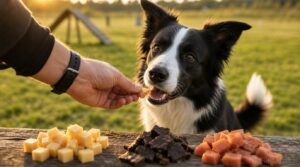
The marker tells your dog when they got it right — but the reward is what makes them want to do it again. Not all rewards hit the same, and choosing the wrong one can stall your progress before it starts. Here’s what actually works.
Soft Pea-sized Treats
The treat you reach for matters more than you think.
Small, soft, pea-sized pieces — roughly 5 to 8 millimeters — are the preferred choice for marker training. They’re consumed in seconds, keeping your dog’s focus locked on you rather than chewing.
Chicken, liver, and turkey flavors work best because the strong aroma pulls attention fast.
Seal the bag after every session to keep them fresh.
Toys as Reinforcers
Not every dog goes wild for a treat — some light up the moment a toy appears.
For high-drive dogs, a quick tug or squeaky toy after the marker hits harder than any chicken piece. The toy becomes the reward. Rotate toy types across sessions to keep novelty high and motivation sharp — familiarity kills drive fast.
Praise and Gentle Touch
Toys aren’t the only way to connect — sometimes a calm "yes" and a steady hand do the job just as well.
Praise and gentle touch work best when they’re consistent and predictable. Use a familiar touch spot, like the chest or shoulder, every time. Keep your body language soft — no sudden moves, no hovering.
- Deliver calm praise timing right after the marker
- Apply gentle hand pressure — light, slow, same direction
- Watch for consent: if your dog leans away, stop
That consistency builds a positive feedback loop your dog can trust.
Reward Delivery Timing
Praise is powerful — but only if it lands at the right moment. The same rule applies to every reward you use.
Reward timing window is tight: deliver within one second of the marker. Any longer, and your dog may link the reward to whatever they did after the click — not the behavior you meant to reinforce.
Keep latency minimal. Pre-load treats in your hand before the rep begins. That one habit alone eliminates the reach-and-fumble delay most handlers don’t even notice. Consistent reward delivery — same hand, same position, same speed — helps your dog stay focused and builds a rhythm they can predict.
Avoid Overfeeding Treats
Marker training can rack up a surprising number of treats fast. Keep each piece pea-sized and stay within the 10 percent daily calorie limit — for a 500-calorie-per-day dog, that’s just 50 treat calories total.
Count every piece. Once your dog is reliable, shift to variable ratio reinforcement to stretch rewards further without losing motivation.
Charge The Marker First

Before your dog can learn from the marker, it needs to mean something — and right now, it means nothing. Charging is the process of building that meaning, and it’s the one step you can’t skip. Here’s how to do it right.
Marker Then Treat
Think of the marker as a promise. The moment you click or say "yes," your dog expects a reward to follow — every single time.
That’s marker-to-reward pairing, and it’s non-negotiable. Deliver your high-value treat within one second of the marker. This tight sequence is what builds the behavior bridge and jumpstarts marker conditioning.
Repeat Thirty Times
Thirty repetitions is the foundation of marker conditioning. During charging, you’re not shaping behavior yet — you’re simply teaching your dog that the click or "yes" predicts something good. Mark, then treat. That’s it.
Here’s what strong pairing frequency builds:
- Reliable anticipation — your dog starts orienting toward you at the sound alone
- Consistent association — the marker becomes a conditioned reinforcer through repetition
- Training consistency — each pairing strengthens the reward prediction
Keep Sessions Short
Keep charging sessions under three minutes. That’s your sweet spot — long enough to build the association, short enough to keep your dog sharp. Mini sessions of 10–20 pairings work especially well early on, when the concept is still new.
| Session Stage | Ideal Length | Reps Per Session |
|---|---|---|
| Early charging | 1–2 minutes | 10–20 |
| Mid charging | 2–3 minutes | 20–30 |
| Maintenance | 1–2 minutes | 10–15 |
End on success — stop while your dog is still engaged, not after focus drops.
Watch for Happy Anticipation
Your dog will tell you when charging is working — you just have to know what to look for. Happy anticipation shows up as a forward lean, a lifted head, or sudden stillness right after the marker sounds. That’s your dog connecting the click to something good. When you see it consistently, the association has landed.
Never Skip The Reward
The marker only works if it keeps its promise. Every single time you click or say your marker word, a reward must follow — no exceptions during this stage.
Skip it once, and your dog starts wondering if the signal even means anything. That doubt is hard to undo. Zero delay, zero skips — that’s the rule.
Practice Your Timing

Timing is everything in marker training — get it wrong, and you’re rewarding the wrong thing. Your dog can only connect the mark to whatever they were doing in that exact moment, so a one-second delay changes everything. Here’s what to focus on to keep your timing sharp and your feedback accurate.
Mark Within One Second
Timing is everything — and in marker training, "everything" means one second or less. The instant your dog performs the correct behavior, the split-second signal must land. Wait even two seconds and you’re marking the sniff that followed, not the sit itself.
Here’s why immediate marker delivery changes everything:
- It tells your dog exactly which action earned the reward.
- It strengthens the neural connection between behavior and outcome.
- It builds timing precision you can rely on in any environment.
- It keeps the reward connection timing tight and predictable.
Think of the marker as a camera shutter — it captures one precise moment. Zero delay isn’t a preference; it’s the whole point.
Avoid Delayed Marking
One second sounds generous — until you’re watching a live dog. Late timing is the most common mistake new trainers make, and it quietly rewires the wrong behavior.
Delayed marking breaks the feedback loop. Your dog doesn’t connect the reward to the sit — they connect it to whatever happened next.
| Delay | What Gets Marked | Result |
|---|---|---|
| 0–1 sec | The correct behavior | Instant Feedback, accurate learning |
| 1–2 sec | The behavior that followed | Confused dog, slow progress |
| 2+ sec | Something unrelated entirely | Error Prevention fails completely |
| Inconsistent timing | Random actions | No reliable Consistent Marker signal |
| Prompt Marking absent | Movement or sniffing | Timing window collapses entirely |
Punctual marking isn’t perfectionism — it’s the contract your dog trusts.
Try Timing Drills
Fixing late marks starts before you ever work with your dog. Timing drills train your reflexes offline — drop a pen, click the moment it hits the floor.
It sounds simple, but it sharpens your rapid mark decision into a reflex. That split‑second signal becomes automatic, so your timing window stays tight when it counts.
Reward The Exact Behavior
Drills sharpen your reflexes — but the real test is what happens right after you click. The clicker only works as a conditioned reinforcer if the treat follows immediately. That’s the contract.
Reward timing must stay within half a second of the mark. Deliver the treat at nose level, right where the behavior happened.
Prevent Accidental Reinforcement
Good timing gets the click right — but sloppy marker habits can quietly train the wrong thing. Accidental reinforcement happens when your dog earns a reward for something you didn’t intend.
If you mark while your dog is already moving away, you’ve rewarded the departure.
Keep sessions short, control distractions, and never let the marker fire casually.
Train One Behavior Step-by-Step
This is where theory becomes action. Knowing how markers work is one thing — actually using one to shape a behavior is another. Here’s how to train your first behavior, step by step.
Start With Easy Behaviors

The best first behavior is one your dog already offers on their own. Sitting, hand targeting, or nose touches are ideal easy behavior selections — your dog knows the movement, so you’re just marking what’s already there.
That means faster wins, less frustration, and a dog that stays engaged from the very first training session.
Wait for The Action

Patience here isn’t passive — it’s strategic. Wait for the action means you hold back the marker until your dog is actively performing the behavior, not already finishing it. Define your criteria before the session starts: what exactly counts? Four paws still? Nose held on target? Get that picture clear in your mind first.
Structure each trial so your dog gets repeated chances to earn reinforcement. Reset between attempts. Keep it clean and predictable — dogs learn fastest when the pattern is consistent.
Mark The Correct Moment

The clicker is only as effective as the moment you press it. Exact moment marking means the signal lands when the target behavior is complete — not a breath before, not a beat after. If you want a sit, mark when the dog’s rear touches the ground. That split-second signal is your entire message.
Reward Immediately After

The marker is your message — but the treat is your promise. Once you’ve clicked, deliver the reward within half a second.
That instant feedback tells your dog exactly what earned the treat. Hold food ready in your hand before each repetition.
Prompt reward access removes the gap where confusion creeps in and keeps your dog locked into the training moment.
Repeat Until Reliable

Repetition isn’t busywork — it’s how the behavior gets wired in. Aim for ~80% success rate across multiple trials before moving on.
If your dog hits that standard consistently, the behavior is reliable. If errors creep back in, tighten your criteria by repeating the same step until the success rate climbs again.
Consistency builds confidence — in both of you.
Add Cues and Fade Prompts

Once your dog hits that 80% reliability mark, it’s time to layer in the real language of training. Adding cues and fading prompts is where raw behavior becomes a polished, on-command skill. Here’s how to do it without losing momentum.
Add Cues After Reliability
You don’t add a cue until the behavior is already solid. That’s the reliability threshold check — your dog should succeed consistently across multiple sessions before any cue word enters the picture. Once errors are low and the marker rate stays high, you’re ready. Introduce the behavioral cue just before the behavior occurs, so it becomes a true predictor:
- Your dog learns the cue means something — not just noise
- Cue timing shapes the whole cue association from day one
- Rushed cue introduction breaks the behavior-cue pairing permanently
Say Cues Only Once
Once the cue is in place, say it once — then stop. One-time cue delivery is non-negotiable. If you repeat the cue word, you’re not reinforcing the dog; you’re training it to wait for the second attempt. That’s cue repetition avoidance in practice: one clear signal, then silence.
| Cue Delivered | What Your Dog Learns |
|---|---|
| Once, clearly | First signal = act now |
| Repeated twice | Wait for the second cue |
| Said with extra prompts | Cue loses meaning fast |
| Inconsistent tone | Signal becomes unclear |
| Paired with neutral body | Dog reads the cue alone |
If your dog doesn’t respond, don’t cue again — use the cue reset protocol and restart the trial fresh. Your split-second signal only works when it stays singular and consistent.
Fade Hand Prompts Gradually
Once your dog responds reliably to a cue, your hands need to step back. Hand Guidance Reduction isn’t optional — it’s the whole point. If your hand keeps showing the way, your dog is following your body, not the cue.
Fade physical help in this order:
- Guide fully, then support lightly at the wrist
- Shift to a forearm touch, then a brief elbow tap
- Withdraw contact entirely — let the cue do the work
Each step down in Physical Prompt Fade should only happen after your dog succeeds consistently at the current level. Rush it, and you’ll see errors climb. That’s your signal to slow down, not push forward. Independent Response Building takes patience — but every prompt you remove is a rep your dog owns.
Reduce Treat Frequency Slowly
Prompts aren’t the only thing you phase — treats follow the same path.
Once your dog responds reliably, shift from rewarding every correct repetition to rewarding every other one. Then every third.
This variable ratio schedule keeps motivation high because your dog never knows exactly when the reward lands — and that unpredictability actually strengthens the behavior over time.
Keep Praise Consistent
Treats shift. Praise doesn’t.
Your verbal praise should sound identical every single repetition — same word, same tone, same delivery. Not "good boy" today and "yes, great!" tomorrow. Pick one phrase and own it. Your dog builds a reliable feedback loop from that consistent sound, and breaking the pattern — even slightly — weakens the signal you’ve spent sessions building.
Fix Common Marker Mistakes

Even experienced trainers slip into habits that quietly unravel their dog’s progress. Most mistakes aren’t obvious in the moment — they build up over time and leave you wondering why your dog seems confused. Here are the most common ones to watch for.
Using Markers for Attention
Using the marker to get your dog’s attention is one of the most common mistakes trainers make. The marker has one job — to signal a correct behavior.
Repurposing it as an attention cue corrupts that meaning fast. When your dog hears the marker, it should expect a reward for something it just did, not simply turn and look at you.
Clicking Without Rewarding
Every click is a promise. Break it once, and you’ve introduced doubt into a system that runs entirely on trust.
Every click is a promise, and breaking it even once plants doubt in a system built entirely on trust
- Empty click impact — a click without a treat teaches your dog the marker means nothing.
- Marker reliability drops when reward gaps appear too often.
- Partial click consequences include confusion and reduced attention.
- Click consistency rebuilds the feedback loop fast — restart pairing immediately.
Training Sessions Too Long
More isn’t better — it’s one of the most common mistakes in marker training. Keep sessions short: five to ten minutes maximum.
Past that point, your dog’s focus drops, your timing drifts, and the marker loses its precision. Fatigue kills training efficiency faster than almost anything else.
End while your dog still wants more.
Practicing Around Distractions
Distractions expose every weak link in your marker training. Start far from the trigger — gradual distraction increase is non-negotiable. Your dog must hear your cue word and respond before you close the distance.
Keep focus burst sessions short. The moment your dog disengages and chooses you anyway, reward after distraction immediately. That split-second signal is everything.
Generalizing in New Places
Your dog isn’t broken — the context is just new. A behavior learned at home doesn’t automatically transfer to the park.
Generalization takes practice. Start in slightly different spots, like a new room, then the yard, then a quiet street.
Keep your cues consistent and your marker reliable. The behavior follows when the training does.
Frequently Asked Questions (FAQs)
Can marker training fix existing behavioral problems?
Marker training can absolutely transform even the most stubborn behavioral issues. By using consistent feedback loops and reinforcement timing precision, you replace unwanted actions with better ones — systematically, clearly, and without confusion.
At what age should puppies start marker training?
Start marker training when your puppy can take treats reliably and stay briefly engaged — usually 8 to 16 weeks old.
Can marker training work for cats or other pets?
Yes — marker training works across species. Cats, rabbits, and birds all respond to it. The core principle is the same: mark the exact moment, then reward. Consistent timing is everything.
How long until marker training results become permanent?
There’s no finish line — just a point where it clicks. Most dogs lock in behaviors within weeks of consistent daily repetitions, but true permanence comes from practicing across environments and maintaining your reinforcement schedule long-term.
Conclusion
Imagine this: your dog holds a perfect sit—busy park, birds overhead, strangers passing.
You haven’t said a word twice. You haven’t repeated yourself once.
That moment didn’t happen by accident. It happened because you built a language your dog trusts completely.
Marker training step by step is how you get there—one precise signal, one well-timed reward, one reliable behavior at a time.
Start today. Your dog is already waiting.
- https://www.akc.org/expert-advice/training/clicker-training-your-dog-mark-and-reward
- https://www.provendogtraining.com/clicker-training-and-marker-based-systems
- https://dogsdayoutseattle.com/use-clicker-marker
- https://nativepet.com/blogs/health/how-to-clicker-train-your-dog
- https://newrattitude.org/your-new-dog/marker-training