This site is supported by our readers. We may earn a commission, at no cost to you, if you purchase through links.
Most dogs flip their food bowl at least once, and owners usually chalk it up to stubbornness or bad manners. The real picture is more interesting.
That single flipped bowl can trace back to ancient survival instincts, a design flaw in the bowl itself, or even a hidden dental problem your dog can’t tell you about.
Knowing why my dog tips over his food bowl matters because the fix depends entirely on the cause—and guessing wrong means the behavior keeps happening.
The reasons range from simple to surprising, and so do the solutions.
Table Of Contents
- Key Takeaways
- Dogs Tip Bowls for Several Reasons
- Instincts Can Drive Bowl Tipping
- Boredom Turns Bowls Into Toys
- Anxiety Can Affect Mealtime Behavior
- Bowl Problems May Be The Cause
- Health Issues Can Trigger Tipping
- Stop Food Bowl Flipping
- When to Call Your Veterinarian
- Frequently Asked Questions (FAQs)
- Conclusion
Key Takeaways
- Bowl tipping usually traces back to one of five root causes — instinct, boredom, anxiety, a poorly designed bowl, or an underlying health issue — and the fix only works if you identify the right one.
- Something as simple as switching to a heavier, wider bowl or placing a non-slip mat underneath can stop the behavior immediately, no training required.
- If your dog is also refusing food, losing weight, drooling, or suddenly clumsy, that’s not a quirk — it’s a signal to call your vet, not adjust the bowl.
- Calm, consistent reinforcement shapes eating habits faster than correction does; ignoring the tipping and rewarding stillness is the behavioral reset most dogs actually respond to.
Dogs Tip Bowls for Several Reasons
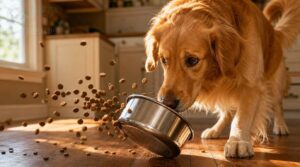
If your dog keeps flipping his food bowl, there’s usually a reason behind it — and often more than one. Dogs tip bowls for a mix of instincts, emotions, and physical discomfort that’s worth understanding before you try to fix it. Here are the most common causes to look at first.
Some dogs also develop food-related anxiety and aggressive eating habits that can quietly fuel the bowl-flipping behavior you’re seeing.
Instinctive Food Hiding
Some dogs tip their bowls simply because something older than habit is telling them to. Food caching instinct runs deep — it’s a survival behavior passed down from wild ancestors who buried surplus food to protect it.
Even a well‑fed dog can feel that pull. It’s not about hunger; it’s about resource protection baked into their instincts.
Attention-seeking Behavior
Sometimes the bowl flip isn’t about food at all — it’s about you. Attention-seeking behavior is one of the more common reasons dogs tip their bowls, and it works because most owners react immediately.
Your dog learns fast: flip the bowl, get a response. A dog behaviorist would call this accidental positive reinforcement. Research shows that the low self‑esteem drive often underlies this behavior.
Boredom or Playfulness
Not every bowl flip is a cry for help — some dogs are just having fun.
Boredom and playfulness are surprisingly common culprits, especially in puppies and high-energy breeds. Without enough scheduled playtime, interactive games, or mental challenges, your dog may turn mealtime into its own little game.
Bowl Discomfort
The bowl itself might be the problem. If the rim presses against your dog’s whiskers during eating, that repeated contact — known as whisker fatigue — can make mealtime uncomfortable enough that he’d rather push the bowl away. A wider, shallower dish often fixes this instantly.
Stress During Meals
Stress can make mealtime feel unsafe for your dog. A noisy or high-traffic feeding area puts him on edge, making it harder to settle and eat calmly.
Feeding anxiety may also stem from other pets nearby — resource guarding kicks in fast when competition feels real.
A quiet environment, consistent routine, and separate feeding areas go a long way.
Instincts Can Drive Bowl Tipping
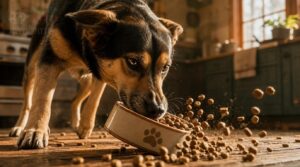
Your dog’s wild roots didn’t disappear just because he eats from a ceramic bowl in your kitchen. Some tipping behavior traces straight back to instincts dogs have carried for thousands of years. Here’s what those instincts actually look like at mealtime.
Burying Leftover Food
When your dog finishes most of his meal but leaves a little behind, he may start pawing or nudging the bowl. This is the leftover burial instinct at work.
Dogs are wired to hide surplus food, and scent-based food relocation drives much of it — if the leftovers still smell strong, he’ll keep engaging with them.
Caching for Later
Sometimes, your dog doesn’t flip their food bowl out of mischief — he’s following a deep-rooted food burying instinct called caching. Wild ancestors stored food for later, and that drive didn’t disappear.
- He selects a cache site he considers safe.
- He uses scent memory to find it again.
- Hunger triggers delayed retrieval.
- Strong-smelling food leaves stronger environmental cues.
- Competition from other pets activates resource guarding instincts.
Moving Food Elsewhere
Your dog isn’t being dramatic — he’s following his nose. Scent-guided placement drives dogs to nudge food toward corners, walls, or familiar spots where smells feel stronger and safer. Some push kibble onto cooler tile for comfort, or away from shiny surfaces that feel unstable.
Dogs don’t tip their bowls out of mischief — they follow their nose to where food feels safer
Competition from other pets can also trigger this, putting distance between themselves and a dog they see as dominant.
Floor Eating Preference
For some dogs, the floor is the bowl. Once your dog learns that tipping releases scattered kibble, floor foraging appeal takes over — pieces spread out, surface area increases, and scent intensifies.
If your dog’s floor-foraging habit turns frantic or you spot signs of oral distress in dogs, it’s worth checking whether scattered treats are causing more stress than enrichment.
- Ground scent preference draws dogs to eat where smells linger
- Scattered food mimics natural scavenging
- Texture differences make floor pieces easier to pick up
- Meal location consistency fades once floor eating is rewarded
- Tipping becomes a reliable, self-reinforcing routine
Boredom Turns Bowls Into Toys
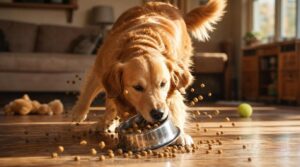
A bored dog doesn’t just sit around doing nothing — he finds something to do, and your dog’s bowl is an easy target. When there’s too much pent-up energy and not enough to keep his mind busy, mealtime can turn into playtime fast. Here’s what’s usually going on when boredom is the real culprit.
Too Much Unused Energy
A dog with pent-up energy doesn’t always bark or chew furniture — sometimes the food bowl becomes the outlet. If your dog isn’t getting enough daily exercise, that restless physical energy has to go somewhere.
Bowl tipping is quick, satisfying, and produces movement, which is exactly what an under-exercised dog craves during a high-anticipation moment like mealtime.
Lack of Mental Stimulation
Physical energy isn’t the only thing that needs an outlet. Mental stimulation matters just as much — and when it’s missing, your dog starts improvising.
Here’s what a mentally under-stimulated dog might do at mealtime:
- Skip the puzzle feeder and rush straight to tipping
- Ignore food entirely and treat the bowl as a food-dispensing toy
- Finish eating fast, then nudge the bowl around out of restlessness
- Resist cognitive exercise routines because stillness feels unrewarding
Playful Pawing and Nudging
When mental stimulation runs low, your dog doesn’t just sit quietly — they start using whatever’s nearby as entertainment. That often means the food bowl.
A gentle paw tap or nose nudge toward the bowl isn’t random. It’s your dog communicating: *something should be happening here.
*
- That nudging can quickly turn into flipping when no response comes.
Excitement Before Meals
Nudging can escalate fast once your dog’s excitement peaks. Before the bowl is even filled, their body is already primed — ghrelin surges before meals, ramping up hunger hormones and focus. Three signs that pre-meal excitement is driving the tipping:
- Spinning or pacing near the bowl
- Pawing before food arrives
- Knocking the bowl immediately at feeding time
Need for Enrichment
When excitement fades and the bowl is still the most interesting thing around, that’s a sign your dog needs more to do. Scatter feeding, puzzle feeders, and sniffing games give dogs a real job at mealtime.
Even short daily exercise sessions help burn off pent-up energy before food arrives, making calm eating far more likely.
Anxiety Can Affect Mealtime Behavior
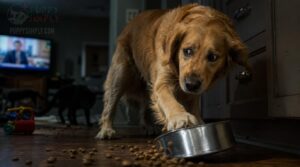
Sometimes the problem isn’t your dog — it’s the environment around him. A stressful feeding setup can make even a calm dog act out at mealtime. Here are a few common anxiety triggers worth looking at.
Noisy Feeding Areas
Mealtime should feel calm and predictable — but a noisy kitchen can turn it into something stressful. Noise triggers like clattering dishes, cabinet slams, or cutlery sounds can startle your dog mid-meal. That startle shifts their posture suddenly, and the bowl gets knocked over.
- Sound startle responses can cause quick, reactive movements near the bowl
- Feeding clatter from nearby drawers or doors conditions dogs to expect disruption
- Collar tags clinking on metal bowls add another layer of aversive noise
- Moving to a quiet stable location reduces unpredictable sound exposure
Noise management and a consistent feeding location go a long way toward creating a stable and quiet environment where your dog can focus on eating.
High-traffic Locations
Where your dog eats matters more than most people realize. High-traffic locations — think hallways, kitchen entrances, or busy common areas — create constant footfall pressure, visual distractions, and competing stimulation that make calm eating nearly impossible.
When people move past repeatedly, your dog may pause, reposition, or tip over his food bowl just trying to track the activity around him.
Tag Clanging Sounds
Something as small as a collar tag can quietly sabotage your dog’s mealtime. When your dog lowers his head toward the food bowl, the tag swings and strikes the bowl rim, producing a sharp, piercing clang. That sudden sound can startle him mid-bite, causing him to jerk back or tip over his food bowl trying to escape the noise.
Silicone collar sleeves or tag silencers wrap around the tag and muffle impact noise, making meals calmer without any major changes to your routine.
Fear of Reflections
A shiny metal bowl can act like a tiny mirror — and for some dogs, that’s genuinely unsettling. Mirror phobia and reflection anxiety are real behavioral responses. When your dog sees movement or a distorted image in the bowl, his brain may read it as a threat.
Signs your dog may be experiencing visual distortion stress:
- Hesitating or circling before eating
- Pawing or nosing the bowl away
- Eating only after the bowl moves or tips
- Refusing food near reflective surfaces
Avoidance behavior like this is a behavioral cue worth noticing. Switching to a matte ceramic or opaque bowl often resolves it quickly.
Stress Around Other Pets
Having another pet nearby can quietly unravel your dog’s sense of safety at the bowl. Resource competition and social hierarchy tension are common stress triggers — and bowl tipping is often the result.nn| Stress Signal | What It May Mean |n|—|—|n| Scanning the room while eating | Environmental crowding anxiety |n| Eating too fast or refusing food | Food aggression response |n| Body blocking the bowl | Resource guarding behavior |n| Tipping before another pet approaches | Dominance hierarchy tension |nnPredictable routines and separation strategies — like feeding pets in different rooms — help greatly.
Bowl Problems May Be The Cause
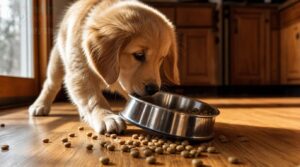
Sometimes the bowl itself is the problem. The wrong design, material, or placement can make mealtime frustrating enough that your dog would rather dump it than eat from it. Here are a few common bowl-related issues worth checking.
Lightweight Sliding Bowls
The bowl itself might be the problem. Lightweight sliding bowls move easily across smooth floors because they lack the weight and friction to stay put. When your dog pushes with his snout, the sliding mechanism sends the bowl skidding — and tipping follows.
Choosing a nontip food bowl with a nonslip surface solves this instantly.
Shiny Metal Surfaces
Stainless steel is one of the most popular food bowl designs out there — but polished bowl shine can genuinely unsettle some dogs. Your dog sees his own reflection shifting as he moves, and that unfamiliar "face" staring back can trigger enough unease to tip over his food bowl entirely.
Surface grease film from handling also builds up, making the bowl feel slick and strange underfoot.
Deep Narrow Bowls
Some food bowl designs work against your dog from the start. Deep narrow bowls force him to reach down and angle his head awkwardly just to get to the food.
The narrow rim grip limits tongue access, so he starts pawing. That pawing builds leverage on the rim, and a lightweight bowl with poor base contact tips over his food bowl almost instantly.
Slippery Floor Placement
Where the bowl sits matters more than most people think. Tile, laminate, and vinyl floors offer almost no grip, so even a gentle nose‑nudge sends the bowl sliding — and a sliding bowl tips.
Placing a nonslip feeding mat directly under the bowl, or choosing a rubberized bottom bowl, creates enough floor friction increase to stop that chain reaction before it starts.
Uncomfortable Bowl Height
Floor grip isn’t the only physical factor worth checking. Bowl height matters too. If your dog has to strain downward or awkwardly raise his head, that posture discomfort can cause fidgeting, pawing, and — eventually — a tipped bowl. Consider these signs the height is off:
- He eats slowly or seems tense
- He repositions his front paws repeatedly
- He nudges the bowl before eating
Health Issues Can Trigger Tipping
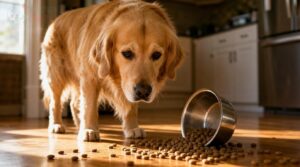
Sometimes the bowl isn’t the problem at all — your dog’s body is. Pain, nausea, and other health issues can quietly change how a dog feels about mealtime, and tipping the bowl is often the only way they can tell you something’s off. Here are the most common health-related reasons to watch for.
Dental Pain
Dental pain is easy to miss in dogs. Issues like tooth root inflammation, cracked teeth, or a dental abscess can make eating genuinely painful.
When pressure hits a sore tooth, your dog may knock the bowl away instead of pushing through it.
A vet consultation, including imaging, can identify what’s hurting before it gets worse.
Nausea or Stomach Upset
A queasy stomach can make the bowl feel like the last place your dog wants to be. Gastrointestinal discomfort — from indigestion, nausea, or inflammatory bowel disease — can cause your dog to reject a meal by tipping it over.
Watch for vomiting, drooling, or bloating alongside the tipping. If those signs appear, a vet consultation is the right next step.
Neck or Joint Pain
Reaching down into a bowl takes more effort than it looks. Dogs with neck arthritis, cervical disc issues, or general joint stiffness can find that low head posture genuinely painful.
Rather than push through it, they nudge or flip the bowl to move food somewhere easier to reach. A veterinary checkup can confirm whether a painful eating posture is behind the behavior.
Vision Problems
Poor vision is often overlooked as a cause of bowl tipping.
Blurry vision or depth perception errors can make it hard for your dog to judge the bowl’s exact position, causing them to bump or nudge the rim instead of eating cleanly. Reduced contrast between the bowl and floor makes targeting even harder.
Dogs with light sensitivity may also shift angles repeatedly, increasing the chance of an accidental tip.
Sudden Behavior Changes
Sometimes, bowl tipping appears overnight — and a change in routine is often the trigger. A vet visit, a car trip, or even rearranged furniture can quietly shift your dog’s sense of safety at mealtime.
Stress-related behavior like flipping the bowl may follow. If nothing in the bowl or environment changed, look at what changed in your dog’s day.
Stop Food Bowl Flipping
The good news is that most bowl-flipping habits are fixable with a few simple changes. You don’t need to overhaul your dog’s entire routine — small adjustments often make a real difference. Here’s what usually works.
Use a Heavier Bowl
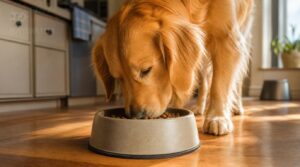
The simplest fix for food bowl tipping is switching to a heavier or weighted food bowl.
A bowl with a low center of gravity is much harder for your dog to flip — when they nudge or paw the edge, it barely moves.
Ceramic and wide-base stainless steel options with a nonslip bottom stay grounded, reduce food spillage, and help your dog eat without chasing the dish around.
Try a Slow Feeder
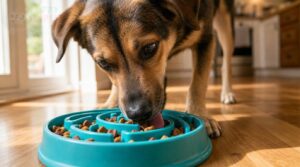
A slow feeder bowl takes things a step further. Instead of just staying put, it turns mealtime into a light puzzle — your dog has to nudge and nose around ridges and mazes to reach the food.
That slows eating down naturally and keeps their brain busy. Pick a size that fits your dog, and the flipping urge often fades on its own.
Add a Non-slip Mat
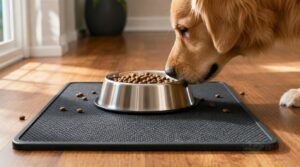
A non-slip mat under the bowl adds one more layer of stability. Rubber or natural rubber options grip smooth floors best — they don’t migrate when your dog nudges the dish.
Look for a mat that extends 6 to 12 inches beyond the bowl to catch any spills. Rinse it regularly with mild detergent so the grip stays effective.
Feed in a Quiet Spot
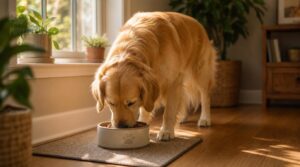
Once the mat is in place, the next piece of the puzzle is where you feed. Where you place the bowl matters more than most people expect.
A noisy, busy spot can make your dog anxious enough to tip the bowl just to escape the stress. Pick a low-traffic, quiet corner where foot traffic, loud appliances, and other pets won’t interrupt the meal.
Reward Calm Eating
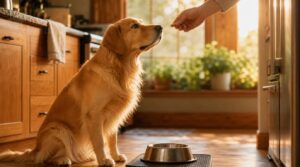
Location mitigates stress, but behavior is the other half of the equation.
Reward calm behavior the moment your dog eats without nudging or flipping. Mark that stillness — a quiet "yes" works — then reward it.
Positive reinforcement shapes habits faster than correction ever will.
Ignore the flipping entirely. Calm gets the treat. That’s the rule.
When to Call Your Veterinarian
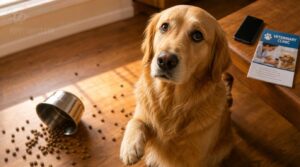
Most of the time, bowl flipping is quirky but harmless. Occasionally, though, it’s your dog’s way of telling you something hurts. Watch for these signs that it’s time to call your vet.
Refusing Meals
If your dog is walking up to the bowl, sniffing it, and walking away — that’s not picky eating in dogs. That’s a signal worth paying attention to.
Selective food rejection, especially when it’s new and consistent, can point to a medical issue like mouth pain or gastrointestinal issues in dogs. Consult with your veterinarian if meal refusal lasts more than a day.
Weight Loss
Unexpected weight loss is worth watching closely. If your dog consistently tips his food bowl, eats less, and you’re seeing visible weight loss, that’s not just a quirk — it could signal nutritional deficiencies or an underlying medical issue.
Sustained calorie deficit from reduced intake affects lean mass over time. A veterinary diagnosis can rule out what’s really going on.
Drooling or Pawing Mouth
Drooling or pawing at the mouth during meals is a clear signal something’s off. When your dog flips their food bowl and you also notice excessive drooling or repeated mouth pawing, that combination points to a possible medical issue — not just a behavioral quirk.
Watch for these oral pain signals:
- Pawing at the mouth repeatedly
- Drooling more than usual
- Flinching when touched near the face
- Bad breath alongside visible discomfort
A foreign object, dental pain, or swallowing difficulty can all trigger this. Don’t wait — call your vet.
Vomiting or Diarrhea
Vomiting or diarrhea alongside bowl tipping is your body telling you to pay attention. When your dog throws up or has loose, watery stools — especially three or more times — that’s not a minor stomach blip. Dehydration sets in fast, particularly in puppies and senior dogs, and it can quietly make everything worse.
The cause could be viral gastroenteritis, food poisoning, a sensitivity, or something more serious like inflammatory bowel disease. Call your vet promptly.
New Clumsiness
Sometimes, new clumsiness is the quiet sign you almost miss. If your dog suddenly stumbles, misjudges the bowl, or seems off-balance at meals, that’s worth noting.
- Coordination decline near the food area
- Gait changes like stumbling or dragging paws
- Neurological signs such as head tilting or circling
- Balance problems during routine movement
Call your vet — these aren’t quirks.
Frequently Asked Questions (FAQs)
What is the 7 7 7 rule for dogs?
The 7 7 7 rule outlines three adjustment stages: 7 days of decompression, 7 weeks of routine learning, and 7 months to reach a full bonding phase with stable behavior.
Can puppies outgrow bowl-tipping behavior on their own?
Some puppies do outgrow bowl tipping naturally as they mature. But if the behavior gets attention or reliably moves food, it is likely to stick — consistent routines and calm responses matter more than simply waiting it out.
Does bowl-tipping happen more with certain dog breeds?
Yes, certain breeds tip bowls more often. High energy breeds, herding instinct breeds, whisker-sensitive dogs, and territorial guarding breeds all show higher rates of this behavior due to their natural temperament and drive.
Should I hand-feed my dog instead of using a bowl?
Hand-feeding works like a reset button. It puts you in control of the pace, the portion, and the moment — no bowl needed. For a tipping dog, that shift alone can change everything.
Is bowl-tipping ever a sign of dominance issues?
It can be, but it’s rarely the main cause. Dominance-related bowl tipping usually comes with other behavioral cues — growling, stiffening, or blocking access — not tipping alone.
Conclusion
A thousand different reasons can stand behind why my dog tips over his food bowl, but the answer is almost always findable. Start with the bowl itself, then consider the environment, then rule out health concerns with your vet.
Dogs don’t make things complicated—they just react to what’s in front of them.
Once you identify the real cause, the fix usually takes minutes, not months. That’s a problem worth solving.
- https://www.dogster.com/dog-behavior/why-does-my-dog-flip-his-food-bowl
- https://americatcompany.com/blogs/news/cat-whisker-fatigue-is-real
- https://www.felliofficial.com/products/oblik-shallow-sapphire-pet-bowl
- https://www.dutch.com/blogs/dogs/dog-flips-food-bowl
- https://www.boosie.co/en-us/blogs/journal/why-does-my-dog-flip-his-food-bowl