This site is supported by our readers. We may earn a commission, at no cost to you, if you purchase through links.
Dinner hits the floor before your dog takes his third bite—kibble everywhere, water soaking the mat, bowl spinning across the tile. Frustrating, yes.
But it’s also information. Dogs don’t tip their bowls out of spite or bad manners; they tip them because something is driving the behavior, and that something is almost always identifiable.
It might be a caching instinct left over from their wild ancestors, a bowl that’s too light or too narrow, low-grade dental pain, or a simple discovery that chaos gets your attention fast. Once you know the cause, the fix is usually straightforward.
Table Of Contents
Key Takeaways
- Bowl tipping is almost always driven by a specific cause — instinct, stress, physical pain, or a poorly designed bowl — and once you identify it, the fix is usually simple.
- If your dog suddenly starts tipping his bowl and nothing has changed, get a vet check — dental pain, joint stiffness, nausea, and vision problems are all real culprits that won’t resolve on their own.
- Switching to a heavy, wide, non-slip bowl and feeding in a calm, consistent spot eliminates the most common triggers without any behavior training required.
- Your dog’s attention-seeking loop is real — every reaction you give after a bowl flip, even frustration, reinforces the behavior, so withholding the response breaks the cycle faster than any correction will.
Dogs Tip Bowls for Clear Reasons
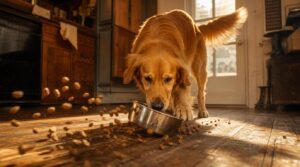
Your dog isn’t just being dramatic at dinnertime — there’s usually a real reason behind the bowl flip. Most causes fall into a handful of clear categories, from hardwired instincts to physical discomfort. Here’s what’s likely driving the behavior.
If your dog is turning their nose up at mealtime, switching to one of the best dog food brands for picky eaters might be the simplest fix worth trying first.
Instinctive Food Hiding
Your dog’s food caching instinct goes back thousands of years. Wild ancestors buried surplus food to protect it — and that deep-rooted food burying instinct didn’t disappear when dogs moved indoors.
When your dog tips his bowl, he may be attempting to scatter or relocate kibble, mimicking leftover burial instinct without any actual dirt to dig into.
This behavior also reflects the dog’s evolutionary food hiding instinct.
Attention-Seeking Behavior
Sometimes the instinct to flip a bowl isn’t ancient — it’s surprisingly social. Your dog may have discovered, probably by accident, that tipping his bowl gets your eyes on him fast. That’s a social feedback loop in action.
- Eye contact follows the crash almost immediately
- You lean in, speak, or move toward him
- That response acts as positive reinforcement
- He files it away — this works
- The reinforcement cycle repeats at the next meal
Even a frustrated "hey, stop that!" counts as owner attention. Dogs don’t always need praise — they need a reaction. If tipping reliably produces one, expect it to continue.
Boredom or Play
Not every dog tips over his food bowl out of instinct or attention-seeking behavior. Sometimes it’s just fun.
Boredom in dogs is a genuine driver — when your dog doesn’t have enough outlets, mealtime becomes the entertainment. Scattered kibble turns into a foraging game, a playful foraging hunt across the kitchen floor that’s genuinely self-rewarding.
Feeding Stress
Boredom and play can explain a lot — but sometimes the bowl goes flying because your dog is simply stressed.
Feeding anxiety is more common than most owners realize. Here are four stress triggers that quietly disrupt mealtime:
- Meal timing uncertainty — irregular feeding schedules create anticipatory agitation, and that tension often spills into bowl pushing.
- Social pressure — another pet nearby raises your dog’s stress, triggering resource-guarding instincts that can move the bowl.
- Sensory overload — loud noises, bright reflections, or heavy foot traffic turn eating into a threat-assessment exercise.
- Learned anxiety — if past mealtimes involved scolding or interruptions, your dog may develop a default stress coping response — tipping the bowl before anything unpleasant happens.
Environmental stress during meals compounds quickly. One trigger alone might not cause tipping, but combine two or three and you’ve got a dog that can’t settle.
Pain or Discomfort
Pain is an overlooked but real trigger. Dental pain, neck arthritis, or gastrointestinal discomfort can all make eating feel threatening rather than rewarding. A dog with mouth pain drops food; one with joint pain tilts awkwardly and bumps the bowl. Stomach upset causes restless shifting mid-meal. Watch for these three warning signs:
| Signal | Possible Cause | What You’ll See |
|---|---|---|
| Pawing at mouth | Mouth Pain Indicators | Lip licking, one-sided chewing |
| Head tilting to reach bowl | Joint Stiffness/Neck Pain | Slow, guarded posture |
| Turning away mid-meal | Digestive Discomfort Signals | Pacing, air licking, nausea |
Instinct May Drive Food Moving
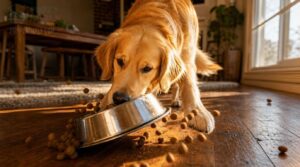
Sometimes your dog isn’t being difficult — he’s just listening to instincts older than the bowl itself. Dogs are wired to cache food, scatter it, and save it for later, much like their wild ancestors did. Here’s what’s actually driving that behavior.
Even the bowl plays a role — a poorly sized dog food bowl can actually amplify these instincts, making your dog more likely to nose food around or walk away mid-meal.
Air Caching Behavior
Your dog isn’t making a mess on purpose — he’s following a deep-rooted food burying instinct. This is called air caching: attempting to "bury" food without any actual substrate like soil or grass.
He’ll tip the bowl, nudge kibble aside, and reposition pieces — a multi-step relocation sequence that mirrors what wolves do with surplus prey.
Saving Food for Later
That deep-rooted food burying instinct isn’t random — it’s your dog acting on an ancient survival drive to hide or rearrange their food for later.
Wild canines cached surplus prey against future scarcity.
Your dog carries that same wiring.
Even with a full bowl, food insecurity encoded over thousands of years can trigger food dumping as a "save it" response.
Oversized Meal Portions
Too much food in the bowl can actually trigger bowl tipping. When portion size exceeds what your dog expects, the extra volume activates that caching drive — their brain signals, "surplus, hide it."
Heaped portions also shift weight unevenly, making the bowl physically easier to tip.
Cutting meals to the correct measured amount often stops the behavior immediately.
Foraging and Scattering
When your dog tips the bowl and scatters kibble across the floor, they’re not being difficult — they’re foraging. Scatter feeding enrichment engages with a natural foraging instinct that makes searching for food more satisfying than eating from a pile.
Each piece becomes its own small find, and that floor foraging pattern — nose down, moving piece to piece — is deeply rewarding on a neurological level.
For dogs, scattered kibble isn’t chaos — it’s a neurologically rewarding hunt, one piece at a time
Indoor Digging Substitute
Think of bowl tipping as your dog’s attempt to dig — just without the dirt.
Some dogs use their bowl as an indoor digging substitute, pushing and scattering food to replicate caching behavior.
A coir or sand dig box with hidden treats buried inside satisfies that same urge far more effectively than any puzzle feeder or slow feeder alone.
Bowl Problems Can Cause Tipping
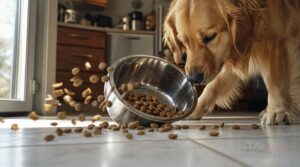
Sometimes the bowl itself is the problem — not your dog. The wrong material, shape, or placement can make tipping almost inevitable. Here’s what to look at.
Lightweight Bowl Materials
The bowl itself is often the culprit. A regular plastic dog bowl — made from polypropylene — weighs almost nothing, and that’s a genuine bowl design flaw. Lightweight materials make tipping simple.
- Polypropylene is durable but slides easily
- Silicone stays flexible — better grip potential
- Stainless steel can be surprisingly light with thin walls
- Aluminum conducts heat and dents easily
- Bioplastics resist heat poorly, warping over time
Slick Floor Surfaces
Even the heaviest bowl struggles when the floor underneath offers zero grip. Floor friction loss is real — tile, laminate, and vinyl all reduce resistance, turning a nudge into a full tip.
A nonslip mat placed under the bowl is the simplest fix, adding surface texture where the floor fails.
Deep Narrow Bowls
The bowl’s shape itself can be the culprit. Deep narrow bowls force your dog to angle their head downward and reach deeper — and that awkward posture shifts pressure toward the rim, making the bowl unstable. The narrow opening limits how naturally they can scoop food, so they push, paw, or nudge instead.
- Interior walls that are straight rather than flared cause kibble to pile at the center, encouraging your dog to dig in rather than eat smoothly
- A lightweight base can’t counteract the force when your dog’s muzzle presses against the rim
- Poor base stability means even minor nudges send the bowl sliding
- Limited food access near the bottom prompts paw-hooking, which tips the bowl entirely
- A narrow rim design gives your dog little surface to stabilize against while eating
Switching to a wide, shallow nonslip bowl removes most of these problems immediately.
Reflective Metal Bowls
Shiny surfaces do more than catch your eye — they can unsettle your dog. Reflective metal bowls, particularly stainless steel and polished aluminum, mirror movement and light directly into your dog’s face. That reflection can trigger reflection anxiety, causing dogs to paw or nudge the bowl away instinctively.
Despite their durability and easy cleaning, the shiny metal surface may quietly be working against calm mealtimes.
Poor Bowl Placement
Where you place the bowl matters more than most owners realize. A bowl shoved against a wall, squeezed near furniture, or set in a high-traffic location gives your dog almost no room to eat comfortably — so he pushes it.
Three placements that quietly cause tipping:
- Against a wall — forces forward pressure while eating
- On slick tile without a nonslip surface underneath
- Off-center from his stance — makes him lean and nudge
A clear path, stable orientation, and dedicated calm spot fix most of it.
Stress Can Disrupt Mealtime
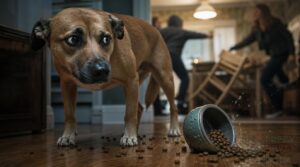
Even the calmest dog can struggle to eat when the environment feels chaotic. Stress during mealtime is more common than most owners realize — and it often shows up as bowl tipping. Here are the key triggers worth knowing.
Noisy Feeding Areas
Sound is one of the most overlooked mealtime stressors.
Loud kitchen sounds — clanging dishes, a rattling blender, a sudden door slam — trigger a startle response that pulls your dog’s focus away from eating. Noise masking effects make it harder for him to process his surroundings, so he may push the bowl aside as a reflexive reset.
High-Traffic Rooms
Feeding your dog in a busy room sets him up to fail. Doorway paths and foot traffic pass too close — a brush against the bowl or a sudden shadow crossing his line of sight is enough to break focus.
Lightweight bowls slide on worn flooring. Move the bowl away from entryways and high-traffic lanes entirely.
Other Pets Nearby
Other animals sharing the space can quietly unravel your dog’s mealtime focus. A cat strolling past, a second dog hovering nearby, or even a rabbit hopping across the room pulls his attention — and split attention means restless movement. That restlessness transfers directly to the bowl: nudging, pawing, tipping.
Separate pets during meals whenever possible.
Resource Guarding Tension
Resource guarding is a survival instinct — your dog isn’t being aggressive out of nowhere. When another animal lingers near his bowl, he may freeze, growl, or body-block to protect what he sees as his.
That tension builds fast, and tipping the bowl is often the first visible sign. Separate feeding areas break the trigger before guarding escalates.
Inconsistent Feeding Routine
Your dog’s gut runs on a clock — and when that clock breaks, mealtime behavior follows. Irregular feeding times trigger hunger fluctuations that make dogs lunge at the bowl, tip it, or frantically paw at it before the first bite.
That urgency isn’t bad behavior. It’s a stress response to unpredictability.
A consistent feeding schedule is one of the simplest fixes available.
Health Issues May Be Involved
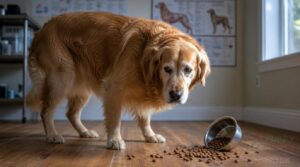
Sometimes the bowl isn’t the problem — your dog is. If your dog suddenly started tipping his bowl and nothing else changed, his body might be telling you something. Here are the health issues worth considering.
Dental or Mouth Pain
Sometimes the real culprit is hiding inside your dog’s mouth. Dental pain, gum disease, or a dental abscess can make chewing genuinely uncomfortable — so your dog pushes the bowl away instead of eating normally. A cracked tooth, oral infection, or mouth ulcer causes sharp pain on contact.
That’s why sudden bowl tipping in an adult dog always warrants a vet check.
Neck or Joint Pain
Mouth pain isn’t the only physical reason your dog might be tipping his bowl. Neck or joint pain changes how he arranges his body during meals.
Lowering the head toward a low bowl puts real strain on a stiff neck or arthritic shoulders — and that discomfort can trigger awkward repositioning that sends the bowl sliding.
Vision Problems
Vision plays a bigger role in mealtime accuracy than most owners realize. Refractive errors, depth perception loss, or peripheral vision gaps can all make it harder for your dog to line his mouth up with the bowl — leading to repeated nudges and accidental tips.
Sudden vision loss warrants a vet visit right away.
Nausea or Stomach Upset
Pain isn’t the only reason a dog pushes his bowl away. Nausea or stomach upset can kill appetite just as effectively — and bowl tipping is often how that discomfort shows up at mealtime.
- Nausea often comes before vomiting, acting as an early warning sign
- Digestive problems like indigestion or infection can trigger the urge to avoid food
- Vomiting and diarrhea together raise dehydration risk quickly
- Gastrointestinal upset may stem from eating too fast, stress, or a stomach bug
- Medical causes of bowl flipping like these warrant a vet evaluation if they persist
Sudden Behavior Changes
When a well-behaved dog suddenly starts tipping his bowl, don’t chalk it up to quirks.
Sudden behavior changes at mealtime can signal neurologic episodes, dental pain, or serious medical emergencies.
Wobbliness, tremors, or confusion alongside bowl tipping means you should call your vet — fast.
Even anxiety or resource guarding can spike overnight. Trust the change; it’s telling you something.
Stop Food Bowl Tipping
The good news is that most bowl-tipping habits are completely fixable with a few targeted changes. You don’t need to overhaul your whole routine — just address the right triggers. Here’s what actually works.
Use Heavy Non-Slip Bowls
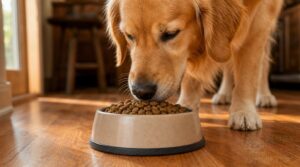
The simplest fix is often the most effective: switch to a heavy non-slip bowl.
A rubberized or silicone base grips tile, hardwood, and laminate floors — reducing bowl movement by up to 70 percent during active feeding. The wide footprint distributes weight evenly, so even an enthusiastic eater can’t nudge it sideways. That one change stops most bowl tipping immediately.
Try Puzzle Feeders
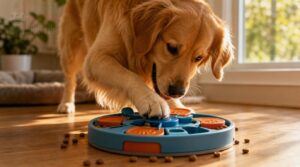
If your dog treats the bowl like a toy, redirect that energy into a puzzle feeder.
Devices like Nina Ottosson puzzles, Kong Wobblers, and Buster Cubes route kibble through compartments your dog must slide, lift, or spin open — turning mealtime into a mental workout. That cognitive engagement satisfies foraging instincts directly, so there’s no bowl left to flip.
Feed Smaller Portions
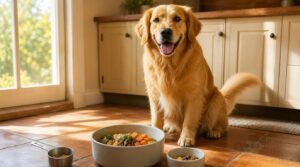
Sometimes the fix is simpler than you’d expect — portion size reduction alone stops the tipping for many dogs.
- Split one large meal into two or three smaller feedings daily
- Use a consistent feeding schedule with measured scoops
- Introduce a gradual portion increase if underfeeding occurs
- Remove uneaten food to discourage bowl play
- Track intake to spot food dissatisfaction early
Create Calm Feeding Spots
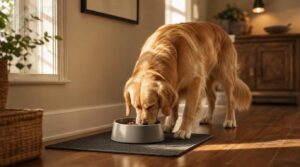
Where your dog eats matters as much as what he eats. A quiet feeding corner — away from appliances, TVs, and foot traffic — removes the triggers that cause stress‑driven tipping.
Keep it a consistent feeding spot every meal. Add a non‑slip mat under the bowl, choose a low‑traffic area, and avoid direct sunlight or bright reflections nearby.
Reward Calm Eating
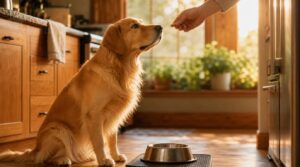
Calm behavior is something you can actually teach — one meal at a time. Reward your dog the moment he stands quietly at his bowl. That split-second reward timing matters more than most owners realize.
- Use a calm, consistent cue before placing the bowl down
- Deliver small treats only after a settled eating posture
- Offer non-food rewards like quiet praise in a low, steady tone
- Withhold the bowl briefly if pawing starts, then try again when he’s still
- Keep consistent feeding times so meals feel predictable, never exciting
Positive reinforcement works because it tells your dog exactly which behavior earns the next step.
Frequently Asked Questions (FAQs)
Can bowl tipping lead to food aggression over time?
Yes, it can. Bowl tipping reinforces resource control — if tipping keeps others away from food, your dog learns that. Over time, that pattern can escalate into full resource guarding or aggression.
Should I hand-feed my dog instead of using bowls?
Hand-feeding works well short-term for behavior modification or bonding, but it’s not a sustainable daily routine. A weighted non-slip bowl with a calm feeding routine solves most tipping without replacing structured mealtimes.
At what age do dogs usually outgrow this behavior?
Most dogs outgrow bowl-tipping between 1 and 2 years old, as impulse control improves. Larger breeds may take closer to 2 years. But if pain or learned attention-seeking drives it, age alone won’t fix it.
Is bowl tipping more common in rescue or shelter dogs?
Both environments see it — but for different reasons. Rescue dogs tip bowls during adjustment chaos; shelter dogs tip from reinforced habit. Either way, a behavioral assessment helps you untangle the root cause fast.
Conclusion
Most owners figure out why their dog tips over his food bowl the same week they fix something else entirely—swapping floors, rearranging furniture, or changing routines. The bowl stops flipping almost by accident.
That’s not luck; it’s cause and effect finally lining up.
Your dog isn’t making mealtimes difficult. He’s reacting to something real.
Find that thing—instinct, pain, stress, or a $4 rubber mat—and dinner stays where it belongs.
- https://www.dogster.com/dog-behavior/why-does-my-dog-flip-his-food-bowl
- https://www.boosie.co/en-us/blogs/journal/why-does-my-dog-flip-his-food-bowl
- https://www.pawaii.com/blogs/blog/why-do-dogs-flip-their-water-bowl
- https://wagwalking.com/behavior/why-do-dogs-kick-their-food-over
- https://pethelpful.com/dogs/Understanding-dog-Foraging-Behavior