This site is supported by our readers. We may earn a commission, at no cost to you, if you purchase through links.

Most dog trainers reach for the treat pouch out of habit, not necessity. Treats work—nobody disputes that—but they also create a dependency that can stall real-world performance the moment your pockets are empty. Dogs trained exclusively on food often perform brilliantly in the kitchen and fall apart at the park.
Clicker training without treats breaks that pattern by building a reward system around what your dog actually craves: a game of tug, a fetch sprint, or a burst of genuine praise. The steps ahead will show you exactly how to make the click meaningful without a single biscuit.
Table Of Contents
Key Takeaways
- Treats create dependence that breaks down outside controlled environments, so building your reward system around what your dog naturally craves—tug, fetch, praise—produces more durable real-world results.
- The clicker only works as a training tool once it’s properly conditioned: pair the click with a meaningful reward within one second, every single time, across 10–15 short repetitions until the association is rock-solid.
- Timing is the non-negotiable variable—click within half a second of the target behavior, or you’re reinforcing the wrong moment and teaching the wrong lesson.
- Variable reinforcement schedules outlast consistent food rewards because unpredictability keeps your dog working harder; fade treats gradually, rotate reward types every few minutes, and you’ll build behaviors that hold even when the treat pouch stays home.
Choose Rewards Your Dog Loves

Before a single click means anything to your dog, you need to know what actually motivates them. Not every dog goes wild for a squeaky toy — some live for a good belly rub, others just want to run.
Pay attention to what makes your dog’s eyes light up — whether it’s food, play, or praise — because matching rewards to your dog’s motivation level is what makes training actually stick.
Start by testing a few options across these key reward categories.
Test Toys, Play, Praise
Testing nonfood rewards before committing to one is non-negotiable. Run 3–5 short trials and track your dog’s actual response — not what you assume they prefer.
Measure these engagement metrics during each trial:
- Toy selection: ears perk, tail wags, body leans forward
- Play burst timing: 30–60 seconds of focused interactive play
- Praise tone variation: high-pitched, enthusiastic praise drives faster responses
- Signal consistency: same reward, same delivery, every repetition
Try Movement Rewards
Movement itself becomes a powerful nonfood reward. Energetic Direction Changes, Targeted Leg Lifts, and Body Position Shifts let your dog earn physical engagement as the payoff after each click.
Speed Enhancement Drills, Balance Beam Tasks, weaving patterns, and interactive fetch runs deliver the same motivational punch as a treat — channeling your dog’s drive into purposeful, clicker-driven action.
Record Interest Levels
Once you’ve run your preference trials, track what you actually see. Log Orientation Speed — how fast your dog turns back to you after the click — alongside Engagement Latency and Sniffing Frequency, which signal fading motivation. These metrics provide critical insights into your dog’s responsiveness and focus during training sessions.
Use a simple Motivation Scoring sheet across your short trials: rate body language, disengagement, and interest on a 1–5 scale. Structured observation prevents habituation from going unnoticed, ensuring you adapt training strategies to maintain enthusiasm and progress.
Rank Best Rewards
Now that your Motivation Scoring sheet is complete, convert those numbers into a clear Preference Index. Rank each non-food reward—social rewards, play, and alternative rewards—by Speed Ranking first, then Consistency Score, Size Impact, and Goal Fit. The reward your dog pursues fastest and most reliably across sessions wins the top spot. That’s your primary variable reward for initial clicker pairing.
Rotate Reward Options
Once your top reward is ranked, don’t let it stagnate — build a Fluid Reward Pool of three to five nonfood rewards and cycle through them every two to three minutes. Preference Renewal Sessions keep your dog’s drive sharp by preventing habituation.
Use Reward Cue Rotation and Variable Reinforcer Timing to mix toy reinforcement, praise, and alternative rewards. This approach maintains engagement through unpredictability.
Load The Clicker Without Treats
Loading the clicker without treats is simpler than it sounds, but the sequence matters. You’re basically teaching your dog that the click predicts something worth working for — no food required.
Here’s exactly how to build that association from scratch.
Click Then Reward Immediately

The click marks a precise moment — don’t waste it. Signal-Reward Pairing depends entirely on your Instant Reward Window: deliver the reward within 0.5–1 second of the click, every single time. Poor reward latency breaks the association. Keep your Click Reward Sync tight, and clicker timing builds a true conditioned reinforcer fast.
If you want to nail the technique from the start, this practical clicker training guide walks you through timing and reward delivery so the habit sticks fast.
Studies highlight that effective instant reward timing can accelerate learning.
Pair Click With “Yes”

Add "Yes" immediately after every click signal to build Verbal Cue Pairing that reinforces Cue Reliability. Marker Consistency is critical—say "Yes" only when reinforcement follows, never casually.
- Click Yes Timing: click first, then "Yes" within half a second
- Secondary Reinforcer Development: repeat 10–15 pairings until the dog orients toward you
- Clicker conditioning turns the click signal into a true conditioned reinforcer independently
This structured approach ensures clarity and reinforces the training objectives effectively.
Use Toy or Tug
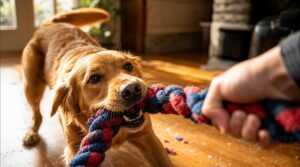
A tug toy transforms the click into a powerful, food-free event. Choose braided rope or reinforced fabric for Toy Durability, and match Size Matching to your dog’s breed. Grip Design keeps control during high-energy pulls, while Material Choice prevents ingestion risks.
Run a Safety Inspection before every session.
These non-food rewards make clicker training through tug-of-war a legitimate alternative reward system.
Repeat Short Pairing Sessions

Short trials are your blueprint for building a rock-solid click association. Structure each session around a Mini-Block Structure of 10–15 repetitions, then stop. A Consistent Reset Routine ensures your dog returns to a neutral start position before the next block.
To optimize training effectiveness:
- Apply Session Clock Management: cap each block at 5 minutes.
- Use Clear Cue Transitions between nonfood rewards to prevent confusion.
- Prioritize Fatigue Prevention by spacing blocks with brief rest intervals.
- Rotate variable rewards to sustain click timing integrity across positive reinforcement pairing.
Test Clicker Response

Now run a Clicker Sensitivity Test to confirm your work is paying off. Deliberately omit treats and observe your dog’s response speed—this Latency Assessment reveals whether the clicker functions as a true conditioned reinforcer.
Watch for Response Consistency across 3–5 repetitions. Strong Marking Accuracy and steady Behavioral Cue Verification confirm your marker training is solid.
Once these elements align, treat-free clicker training can begin.
Practice Precise Clicker Timing

Timing is everything in clicker training — get it wrong, and your dog learns the wrong lesson. The click has to land within half a second of the behavior, or the connection starts to blur.
Here’s exactly how to nail your timing every single session.
Click Within Half Second
The click window is exactly 0.5 seconds — miss it, and you’re training the wrong behavior. Master Click Window Calibration through Micro‑Timing Drills: practice clicking at a fixed Consistent Click Angle before adding cues.
Reaction Lag Management means slowing your cue timing so your click lands during the behavior, not after.
Fatigue‑Proof Timing keeps your clicker as a conditioned reinforcer sharp across every rep.
Reward Within One Second
Nailing the click is only half the equation. Once that sound fires, you have one second — no more — to deliver the reward. This is your Signal-Reward Link in action. Reinforcement Speed determines whether your dog locks onto the right behavior or drifts.
Latency Impact is real: delays kill Instant Feedback, weakening the clicker as a conditioned reinforcer. Position your toy, tug, or verbal praise before the rep begins — reward timing and consistency with nonfood reinforcement demand zero fumbling.
Attention Capture ends the moment your dog looks away.
Train 8–12 Repetitions
Structure each block around Repetition Criteria: 8–12 successful clicks per set, counting only correct responses toward your Performance Metrics. Session Pacing determines everything — push past 12 reps and attention collapses.
Build in Break Points between sets to reset focus.
Success Tracking across blocks reveals whether your nonfood reinforcement is holding. That data drives smarter reward fading decisions later.
Keep Sessions Short
Five-minute Micro Training Blocks outperform marathon sessions every time. Once you’ve hit 8–12 clean reps, stop — that’s your Success-Based Ending.
- Train in Low-Distraction Zones for sharper attention
- Use a Consistent Start Routine to signal work time
- Schedule Attention Reset Breaks between rounds
- Keep focused play sessions brief to sustain drive
Short clicker training sessions lock in positive reinforcement faster.
Avoid Late Clicking
Late clicks don’t just slow learning — they actively teach the wrong behavior. Define your Marker Moment Definition precisely: click the instant the paw touches the floor, not after.
Handler Positioning and Visual Cue Consistency keep your reaction sharp.
Apply Movement Speed Control during early repetitions so you’re not chasing fast transitions.
Use Feedback Correction immediately — your clicker as a conditioned reinforcer only builds cue reliability when the click always means a reward is coming for the right action.
Use Play, Affection, and Environment

Once your clicker has meaning, the real question is what comes after the click. Your dog doesn’t care whether the reward is food or a game of tug — what matters is that they feel worth working for.
Here are five non-food rewards that deliver exactly that.
Tug After The Click
Tug is one of the most powerful non-food rewards in clicker training — if you control it precisely. The moment you click, present the tug toy using a consistent Tug Start Cue, letting your dog grip and pull briefly.
Apply Drive Modulation by keeping sessions short, then end with a clear Release Cue Timing.
Use Safety Grip Technique to prevent overstimulation and maintain focus.
Fetch as a Reward
Fetch transforms distance into your greatest training asset. Unlike tug, the thrown object rewards your dog up to 30 feet away — making it ideal for Reward Distance Scaling in open environments.
- Establish a Target Retrieval Zone so your dog learns exactly where to deliver the object.
- Use a Consistent Throw Cue before each toss to sharpen Fetch Timing Window precision.
- Apply Arousal Management by limiting fetch reps, keeping the toy’s value high across your reward schedule.
Praise and Petting
Physical affection is one of the most underused tools in treat-free training. Deliver verbal praise — "Good sit" — within half a second after the click, using a calm, upbeat tone in a quiet environment.
| Action | Guideline |
|---|---|
| Consistent Praise | Use the same phrase every session |
| Petting Pressure | Light contact; adjust if dog leans away |
| Petting Timing | Immediate after behavior, not after stopping |
| Body Language | Stay low, move smoothly, avoid looming |
| Quiet Environment | Minimize noise to strengthen praise reinforcement |
Match petting location — chest or shoulders — to your dog’s preference.
Safe Sniffing Breaks
A sniffing break isn’t downtime — it’s a precision tool. Break Timing matters: release your dog to sniff only when focus starts slipping, never after full shutdown. Use free sniffing as a deliberate reward.
- Spot Safety — choose low-hazard, boundary-zoned areas free of debris or scavenging risks
- Arousal Monitoring — end breaks before excitement escalates
- Cue Consistency — use one identical release and return cue every session
- Controlled Freedom — keep the leash on in open areas
Short Walk Rewards
Every step forward is a training opportunity. During walk time, reward heeling progress or a calm shift with a brisk 5-minute loop — movement itself becomes one of the most effective alternative rewards. Use Pace Adjustment Rewards after smooth speed changes, Direction Change Bonuses when your dog pivots cleanly, and Distance Landmark Rewards at key checkpoints.
In clicker training, the environment as a reward is positive reinforcement in motion.
Fade Treats and Troubleshoot Motivation

Treats got you this far — now it’s time to loosen your grip on them without losing your dog’s drive. The fading process is where most trainers either succeed or fail.
This phase often causes motivation to quietly unravel if mishandled.
Here’s how to make the shift cleanly and address issues as they arise.
Start With Mixed Rewards
Don’t drop food rewards cold turkey — use an Incentive Blend instead. A smart Reward Combination Strategy starts at 100% treats, then introduces non-food rewards for dogs like tug, praise, and movement until you’re running a true Variable Reward Mix.
Your Mixed Reward Sequencing should follow this order:
- Treats paired with play
- Play paired with praise
- Praise standing alone
Shift to Variable Reinforcement
Once your mixed rewards feel natural, shift to a variable reinforcement schedule — the behavioral engine behind lasting results. Understanding Ratio vs. Interval matters here: variable-ratio schedules tie rewards to an unpredictable response count, producing a Response Rate Boost nearly double that of interval-based timing.
| Schedule Type | Trigger | Effect on Dog |
|---|---|---|
| Fixed-ratio | Every correct response | Fast learning, quick extinction |
| Variable-ratio | Unpredictable response count | Steady, persistent responding |
| Fixed-interval | Set time elapsed | Lower response rate |
| Variable-interval | Unpredictable time passed | Moderate persistence |
| Intermittent reinforcement | Mixed/random delivery | Strong Extinction Resistance |
Unpredictable Reward Timing keeps your dog engaged — they can’t calculate the next payoff, so they keep working. That’s the power of Partial Reinforcement Benefits: reinforcement fading through intermittent reinforcement and partial reinforcement builds behaviors that endure long-term, even during training without food.
Unpredictable rewards keep dogs working harder because they can never calculate when the next payoff arrives
Prevent Reward Habituation
Variable reinforcement keeps behavior strong, but even unpredictable rewards lose power when they’re the same toy, the same tug, the same praise — every session. That’s habituation at work.
Counter it with Novel stimulus infusion: rotate alternating reward modalities every 2–3 minutes, cap exposure time per reward type, and run micro sessions under 5 minutes.
Reinforcement fading only holds if the rewards stay fresh.
Fix Ignored Clicks
Habituation isn’t the only reason clicks get ignored — sometimes the problem is Marker Clarity or Timing Calibration slipping out of alignment.
Run an Attention Reset:
- Switch to a high-value toy and rebuild Signal Consistency with 10 click-then-reward pairings.
- Apply Distraction Management — move to a quieter space to sharpen clicker marker response.
- Tighten your reinforcement schedule back to 100%, preventing behavioral extinction before you fade out again.
Maintain Learned Behaviors
Sustaining behavior maintenance means staying proactive, not reactive. Use Consistent Cue Structure and Variable Ratio Schedules so your dog can’t predict exactly when reinforcement arrives—that unpredictability keeps responding strong.
Practice Cross-Location Generalization by running short sessions in new environments.
Run a Motivation Reassessment before each block, and master Session End Timing by stopping while performance is still sharp.
Frequently Asked Questions (FAQs)
Can clicker training work for aggressive dogs?
Clicker training works for aggressive dogs when applying Threshold Management, Counter‑Conditioning, and Safety Protocols. These techniques form the foundation of the training approach.
Stress Monitoring and Owner Body Language ensure sessions remain safe, addressing potential risks proactively.
Positive reinforcement and nonfood rewards drive genuine behavior modification, fostering lasting changes in the dog’s responses.
At what age should puppies start clicker training?
Start clicker training at 8 weeks old — right when your puppy’s socialization window opens and sensory readiness peaks. That critical period shapes behavior faster than any later training schedule can replicate.
How do you clicker train multiple dogs simultaneously?
Assign one handler per dog, use separate clicker assignments, and build individual marker schedules.
Dedicated hand signals and parallel cue chains keep stimulus control intact.
Trainer role rotation prevents each dog from cueing off another’s reinforcement.
Does clicker training differ for rescue or traumatized dogs?
Clicker training absolutely differs for rescue or traumatized dogs. Building trust comes first — gradual exposure, trigger management, and emotional regulation shape every session.
Use low-stress, nonfood rewards and keep positive reinforcement simple until confidence builds.
How long until a dog fully understands the clicker?
Most dogs grasp the clicker’s meaning within 5–10 pairings. Full acquisition timeframe varies by breed differences and consistency impact.
Reliable mastery indicators usually appear across just a few short, focused sessions.
Conclusion
The treat pouch isn’t a training tool—it’s a crutch, and you’ve just learned to walk without it. Clicker training without treats reframes the entire reward system around drives your dog already has: the chase, the tug, the connection.
Load the clicker precisely, rotate your rewards strategically, and apply variable reinforcement to lock behaviors in place. This approach leverages innate motivations rather than relying on external incentives.
Your dog doesn’t need a biscuit to perform—it needs a reason. And now you know exactly how to deliver one.
- https://www.thedrakecenter.com/services/dogs/blog/rewarding-your-dog-without-treats
- https://servicedogtraininginstitute.ca/8-blog/302-can-i-use-rewards-other-than-food-with-the-clicker
- https://www.everydogaustin.org/handouts/clicker-training-101
- https://bestfriends.org/pet-care-resources/guide-clicker-training-pets
- https://sitmeanssit.com/how-to-clicker-train-a-dog-the-professional-guide-to-precision-and-attention/