
This site is supported by our readers. We may earn a commission, at no cost to you, if you purchase through links.

A single click—that tiny sound—can teach your dog more in ten minutes than an hour of repeated commands. That’s not an exaggeration; it’s the science of operant conditioning at work. The clicker gives your dog something no verbal cue can match: a precise, consistent signal that marks the exact moment they got it right. Dogs learn fast when the feedback is clear, and confusion disappears when the timing is sharp.
Mastering the best clicker training techniques comes down to understanding a few principles and applying them with consistency—starting with how you charge that little device in your hand.
Table Of Contents
- Key Takeaways
- What is Clicker Training?
- Choose The Right Clicker
- Charge The Clicker First
- Use Core Clicker Techniques
- Plan Short Training Sessions
- Avoid Common Clicker Mistakes
- Frequently Asked Questions (FAQs)
- How to properly do clicker training?
- What is the 10-10-10 rule for dogs?
- What are common mistakes in clicker training?
- How do you transition to a variable reward schedule?
- Can clicker training help with multi-dog households?
- What behaviors are impossible to shape with clickers?
- How does clicker training differ across dog breeds?
- When should you stop using the clicker entirely?
- Conclusion
Key Takeaways
- The clicker works because it marks the exact moment your dog gets something right—precise timing is something your voice simply can’t replicate.
- Charging the clicker first isn’t optional; your dog needs to learn what the click means before you can teach them anything.
- Short sessions of five to ten minutes, repeated a few times daily, build faster and more lasting results than one long training grind.
- Skipping proofing is where most progress quietly falls apart—your dog needs to practice behaviors across different places, distractions, and distances to truly learn them.
What is Clicker Training?

Clicker training is one of the most effective ways to communicate with your dog — it is built on science, and it actually works. Essentially, it uses a small clicking sound to tell your dog the exact moment it does something right, followed by a reward.
If you’re starting with a newly adopted dog, this approach pairs especially well with the patience and consistency outlined in this German Shepherd rescue guide for first-time adopters.
Here is what you need to understand before you pick up that clicker.
Clicker as a Marker
Think of the clicker as a promise — the moment you press it, your dog hears: "Yes, that exact behavior earns a reward." This bridge stimulus connects behavior to reinforcement with timing precision a spoken word simply cannot match.
The clicker is a promise: the instant you press it, your dog knows that exact behavior earned a reward
Signal consistency matters here: one click, one treat, every time. That single-click rule keeps marker decoding clear, so your dog always knows exactly what they did right.
Studies have shown faster acquisition with clickers.
Positive Reinforcement Basics
That promise only works because of what comes right after: a reward your dog actually wants. Positive reinforcement is straightforward — mark the desired behavior, deliver an immediate reward, and your dog starts connecting the dots fast.
Reinforcer value matters, so mix it up. Reinforcer variety keeps motivation high.
Consistent delivery and clear target behavior definition are what separate real progress from guesswork.
Why Timing Matters
Consistent delivery sets the stage — but timing is key to making it all click. Dogs associate the reward with whatever behavior happened right before it, so even a one-second delay in reinforcement latency changes what your dog thinks it earned. That razor-thin behavioral window demands precision.
Shaping accuracy depends on split-second accuracy: click then treat, every time, with precise consistent timing to drive real error prevention.
Click Versus Verbal Cues
That precision carries over into how you choose your marker. A clicker sound wins on marker consistency — it’s the same sharp tone every single time, which makes auditory discrimination easy for your dog. A verbal "yes" shifts in pitch and speed depending on your mood. That variation quietly undermines cue recognition.
When distractions rise, distraction resilience depends on a standardized signal, not your voice having a good day.
Choose The Right Clicker
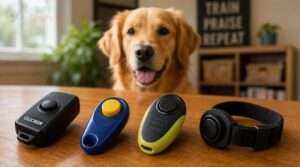
Not all clickers are built the same, and picking the right one can make a real difference in how smoothly your training goes. Your dog’s temperament, your hand size, and how fast your sessions move all play a role in which style works best.
Here are the main types to explore.
Standard Box Clickers
The standard box clicker is your most reliable starting point. Its Durable Plastic Housing survives daily drops, while the Compact Dimensional Design — just 38mm long — sits perfectly in your palm.
The Ergonomic Thumb Grip keeps consistent clicks smooth, even mid-session.
With Audible Range Performance reaching up to 10 feet and Maintenance-Free Construction, this clicker device does exactly what a clicker as a marker should: show up every single time.
Low-volume Clickers
If your dog flinches at soft scary-click sounds, a low-volume clicker changes everything. Using a Piezoelectric Click mechanism, these devices produce a crisp Quiet Mode sound around 40–50 dB — perfect for quiet spaces and low-distraction environments.
The Splash‑Resistant Housing ensures durability during outdoor training sessions. Adjustable Tone settings allow customization, while a built-in Indicator Light enhances precision.
Together, these features create a precise and stress-free clicker-training experience for dogs.
Finger-mounted Clickers
Want faster, hands-free marking during clicker training for dogs? A finger-mounted clicker delivers Rapid Marking right at your fingertip. Its Adjustable Loop ensures an Ergonomic Fit for any hand size, while Water Resistance keeps it reliable outdoors.
Trainers prefer this clicker for active sessions because of its thoughtful design. Key benefits include:
- Weighs under 8 grams
- Recessed button prevents accidental clicks
- Consistent clicker sound with every press
- Replacement parts extend its lifespan
Noise-sensitive Dogs
Some dogs flinch at the clicker itself. If yours startle at soft, scary click sounds, use a low-volume clicker to prevent click fatigue before training starts. Pair it with a low-distraction environment and short training sessions.
Gradual Desensitization and Sound Counterconditioning help your dog build confidence.
Add Safe Retreat Zones, Calming Music, and medication integration when fear runs deep during clicker training for dogs.
Consistent Click Sound
Your clicker is only as reliable as the sound it makes. Volume uniformity matters — press with the same grip, from the same consistent hand placement, every time.
Device wear impact is real: a worn clicker drifts in tone, weakening your precise consistent signal.
Follow a simple clicker maintenance routine, adapt for ambient noise outdoors, and honor the single click rule to keep that clicker sound association sharp.
Charge The Clicker First

Before your dog can learn anything from the clicker, you need to teach them what it actually means. Think of it as a short one-time setup that turns a simple click into a powerful signal your dog will trust.
Here’s how to charge it the right way.
Click Then Treat
Order matters here: click first, then treat — every single time. Keep your treat hand behind your back until after the click lands.
This prevents your dog from watching your hand instead of focusing on the behavior. That split-second accuracy in reward timing defines marker clarity.
Consistent click-and-treat sequencing, with strict treat hand concealment, teaches your dog that the click itself is the real signal.
Use High-value Rewards
Not every treat is created equal — and your dog knows it. Reward Value Matching means picking what your dog genuinely goes crazy for, not just what’s convenient. Keep those high-value treats rare; Reward Rarity Management preserves their power.
- Rotate options with Reward Variety Rotation: chicken, cheese, liver
- Use bite-sized treats for Fast Reward Delivery with zero reward latency
- Reserve top primary reinforcers for the hardest moments
Keep Sessions Distraction-free
Those high-value treats work best when your dog’s mind is fully on you — not the cat across the room. Pick a Quiet Training Room with minimal foot traffic, non-slip flooring, and no competing noise.
Minimize visual clutter by removing toys and food bowls.
Schedule sessions during consistent environment windows when your dog is naturally calm, building a reliable low-distraction environment before you increase distractions gradually.
Watch for Expectation
Once your dog’s environment is quiet, watch for that moment when your dog hears the click and immediately looks at you — that’s expectant eye contact, confirming the clicker is charged. Body cue monitoring further validates this: observe posture shifts, ears forward, and attention locked on you. This demonstrates your criterion setting working effectively.
Avoid late marking by clicking the instant the behavior occurs, not after. This precision ensures clear communication and reinforces the desired action accurately.
Recharge When Needed
Even a well-charged clicker loses its edge if your dog gets tired or confused. That’s your cue to recharge — not tomorrow, but right now. Try these quick recovery moves:
- Pause Breaks — Stop before frustration builds.
- Short Reset Intervals — Return to an easy, already-known behavior.
- Easy Win Switches — Lower difficulty to rebuild confidence.
- Reward Rate Boost — Click and treat more frequently to restore momentum.
Marker Recovery Drills reconnect your dog with clicker conditioning fast.
Use Core Clicker Techniques
Once your dog understands what the click means, it’s time to put that marker to work.
There are a few core techniques every clicker trainer relies on — and each one fits a different moment in your dog’s learning journey. Here’s how each one works.
Capturing Natural Behaviors

Your dog is already doing exactly what you want — you just haven’t clicked it yet. Capturing natural good behaviors means using contextual spotting to mark the desired behavior the instant it happens, no prompting needed. This approach leverages spontaneous reinforcement in action.
Through real-life captures and everyday proofing, operant conditioning does the work. By reinforcing behaviors as they occur naturally, you build reliability without artificial cues.
Variability tracking helps you notice when your dog offers the same behavior across different situations. This consistency is key to mastering cues in diverse contexts, ensuring the behavior generalizes beyond training sessions.
Luring Simple Commands

Luring simple commands starts with a clear lure path design: hold a soft treat close to your dog’s nose and guide it smoothly toward the target position. Body starter alignment matters—keep your dog facing you before each repetition.
Move the lure to sit height, click the instant your dog hits position, and use immediate reward delivery.
Consistent prompting and steady lure fade steps build reliable responses fast.
Shaping Small Steps

Building a reliable behavior starts with shaping small steps — not waiting for the ideal. Begin with a Baseline Assessment of what your dog already does, then create a Step Analysis to map incremental training checkpoints.
Apply Gradual Criterion shifts, clicking closer approximations each session. Use Pace Adjustment and a Backtracking Strategy if progress stalls.
Behavior shaping through stepwise training turns small wins into lasting skills.
Targeting With Nose Touches

Nose targeting is one of the most multipurpose tools in clicker training for dogs. Begin by holding your palm close—this serves as your initial Target Surface Selection. When your dog’s nose makes contact, click instantly and treat.
To progress, use these techniques:
- Start with Proximity Progression: Present the target (e.g., a stick or your hand) inches from their nose.
- Employ Transfer Techniques to shift the touch behavior onto novel surfaces like a yogurt lid or Post-it.
- Apply Scent Augmentation if hesitation occurs with new surfaces.
Cue Consistency bridges Shaping and Targeting through incremental behavior shaping, ensuring clarity as your dog learns.
Fading Food Lures

Food lures act as training wheels—useful initially but temporary. Begin with a Full Lure, holding treats visibly above the nose. Progress to Motion Reduction by gradually shrinking hand gestures. Introduce the Empty Hand Surprise: guide with no food visible, clicking and rewarding correct responses immediately. This Visibility Progression naturally leads to Cue Integration.
The structured stages are outlined below:
| Fading Stage | What You Do |
|---|---|
| Full Lure | Hold treat visibly above nose |
| Motion Reduction | Shrink hand movements gradually |
| Empty Hand Surprise | Guide with no food showing |
| Reward Schedule Transition | Reward randomly, not every rep |
| Cue Integration | Dog follows gesture alone |
As training advances, transition to a variable reward schedule, reinforcing behavior unpredictably. Ultimately, your dog will respond reliably to gestures alone, achieving seamless Cue Integration.
Plan Short Training Sessions

Dogs don’t have long attention spans, and honestly, that works in your favor. Short, focused sessions are where real learning happens — and how you structure them makes all the difference.
Here’s what to keep in mind when planning your training time.
Five to Ten Minutes
Keep each session to five to ten minutes — your dog’s attention span isn’t built for marathons. Short practice sessions are the sweet spot for fatigue prevention and distraction control.
Set a micro goal for each block: one behavior, practiced until it clicks. Monitor your dog’s energy; the moment focus drifts, stop.
A positive finish routine keeps clicker training dogs both consistent and rewarding.
Multiple Daily Sessions
Short practice sessions work best when you stack several across the day. Think of it like brain consolidation in action — your dog processes each round, resets attention, and comes back sharper. Inter-session breaks prevent reward fatigue and keep motivation high.
Weaving training into your daily routine builds real training consistency without overwhelming either of you.
Three sessions beat one long grind every time.
One Skill at Once
Pick one behavior per session and stick with it. Behavior isolation sharpens your dog’s understanding fast—there’s no confusion about what earned the click.
Use micro-step progression, targeted reinforcement, and cue consistency to build simple commands cleanly. Shaping and targeting thrive in short sessions where reward timing stays precise.
Be consistent and patient, and environmental generalization follows naturally.
End on Success
Always end a session on a win. Your final trial criteria should be something your dog can nail — not a stretch goal. Lower the bar slightly, get that last successful cue, and click it clean.
- Use reward timing to lock in the behavior
- Apply a positive finish routine before you stop
- End-session proofing confirms what your dog actually learned
- Be consistent and patient — positive reinforcement dog training compounds over time
Practice in Daily Routines
Once your dog ends on a win, don’t let that momentum sit idle. Morning cue integration—like asking for a sit before the food bowl drops—turns breakfast into a short session. Midday refresher clicks and evening review reinforcement keep behaviors sharp without a formal schedule. On-the-go training builds real generalization.
| Time of Day | Activity | Training Opportunity |
|---|---|---|
| Morning | Feeding routine | Morning cue integration |
| Midday | Walk or play | Refresher clicks + targeting |
| Evening | Wind-down time | Review reinforcement + shaping |
| Weekend | Outings or errands | Practice consistency + proofing |
Avoid Common Clicker Mistakes
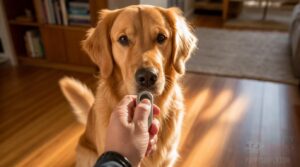
Even the best trainers slip up with a clicker — and small mistakes can quietly undo your progress.
Most problems come down to timing, repetition, or moving too fast before your dog is ready. Watch out for these five common clicker mistakes and how to fix them.
Clicking Too Late
Late clicks are one of the most common — and sneaky — training mistakes. That split-second accuracy matters more than most people realize. Marker drift happens when your marking signal lands even a beat late, teaching incomplete reps instead of the full behavior. Over time, this causes a behavior chain shift your dog can’t explain and you can’t see coming.
Try these timing reset strategies:
- Lower difficulty so the correct moment is obvious and easy to mark immediately.
- Pause mid-session if late click penalties keep stacking — reset before continuing.
- Practice clicking to non-dog cues, like a bouncing ball, to sharpen your reflex.
Inconsistent rewards follow inconsistent timing. Fix the click, and the learning follows.
Clicking Multiple Times
Each extra click breaks the reinforcement chain. The one-click rule keeps your clicker as a marker crystal clear — one behavior, one click, one treat. Click stacking risks confusing your dog about which exact moment earned the reward, blurring repetition boundary clarity.
To avoid double-click avoidance failures, pause briefly after each click. Keep your finger deliberate, not trigger-happy.
Rewarding Too Slowly
Even a two-second gap between the click and the treat can unravel your reinforcement schedule. Your dog doesn’t wait—it moves, sniffs, and shifts posture. That gap accidentally rewards whatever happens right before the treat lands.
Treat Placement and Immediate Hand Reach matter here: keep rewards within easy reach before each session. Reward Timing Drills sharpen your split-second accuracy and strengthen positive reinforcement dog training results.
Raising Criteria Too Fast
Jumping to criteria too fast is one of the most common ways trainers accidentally stall progress. This leads to a collapse in the dog’s reward pattern, cue confusion, and errorless learning going out the window. To maintain steady training progression, follow these incremental steps:
- Raise only one variable — duration, distance scaling, or distraction — at a time.
- Watch your error budget; more than two misses mean step back.
- Use shaping and targeting to rebuild before advancing in higher-level clicker training or generalization training.
Skipping Proofing Practice
Proofing behavior is the step most people skip — and it’s where generalization failure quietly takes root. Without generalization training, your dog isn’t learning a rule; they’re learning a room.
Contextual confusion sets in, discrimination loss follows, and behavioral variability becomes your new normal.
Weak learning extinction happens fast under real-world distractions.
Proof the clicker training method across locations, distances, and distractions consistently.
Frequently Asked Questions (FAQs)
How to properly do clicker training?
Clicker training works by pairing a click with a treat through positive reinforcement.
Charge the clicker first, then mark behaviors precisely using operant conditioning.
Shape responses through shaping and distraction escalation techniques.
What is the 10-10-10 rule for dogs?
The 10-10-10 rule splits your dog’s day into three focused micro-sessions, creating a predictable schedule built on balanced intervals and smart energy management.
These sessions include 10 minutes of training, 10 minutes of play, and 10 minutes of calm bonding — a structured approach to daily engagement.
What are common mistakes in clicker training?
Small mistakes can stall progress fast. Inconsistent clicking, unclear click standards, and clicking too late are the biggest culprits.
Avoid common mistakes by staying precise, keeping variable reward size minimal, and never overusing the clicker.
How do you transition to a variable reward schedule?
Once your dog performs reliably, shift to a variable reinforcement schedule by rewarding unpredictably — sometimes the 2nd rep, sometimes the 7th.
This gradual reinforcement fade keeps behavior strong without treats every time.
Can clicker training help with multi-dog households?
Individual markers keep multi-dog training clear, much like giving each musician their own sheet of music.
Separate setups, parallel training, and smart treat distribution transform household chaos into confident, rewarding teamwork.
What behaviors are impossible to shape with clickers?
Clickers can’t shape continuous actions, emotional state changes, or internal value judgments. Complex sequencing and judgmental decisions need broader approaches. For deep behavioral problems, pair clicker work with desensitization.
How does clicker training differ across dog breeds?
One size doesn’t fit all. Breed food drive, sound sensitivity levels, and learning pace differences all shape how you apply positive reinforcement training to get real results with your dog.
When should you stop using the clicker entirely?
Stop using the clicker when cue-only performance is solid—generalization milestones are met, stimulus control is strong, and your variable-ratio shift is complete. That’s your signal for marker fade-out.
Conclusion
The clicker doesn’t just train behavior—it builds a shared language between you and your dog. Every precise click tells them, "Yes, exactly that," without confusion or frustration.
The best clicker training techniques aren’t about repetition; they’re about clarity, timing, and trust built one small moment at a time. Stay consistent, keep sessions short, and let the rewards do the heavy lifting.
Your dog isn’t just learning commands—they’re learning to believe you mean what you say.
- https://equineclickertraining.wordpress.com/2015/11/18/capturing-behavior/
- https://clickertraining.com/foundation-behaviors-a-practical-perspective/
- https://sitmeanssit.com/how-to-clicker-train-a-dog-the-professional-guide-to-precision-and-attention/
- https://platopettreats.com/blogs/blog/clicker-training-101-treat-based-methods-explained-how-to-train-your-dog-with-clicks-treats?srsltid=AfmBOopkvXX3RsJcsyir_iIXmGpKvpL1bpJKTRzepLGFrhMAtmLqQrC5
- https://stalecheerios.com/training-concepts/clicker-timing-criteria/