
This site is supported by our readers. We may earn a commission, at no cost to you, if you purchase through links.

Most dog owners grab a training collar off a shelf, strap it on, and hope for the best. That’s roughly like handing someone a scalpel and wishing them luck.
These tools carry real science inside them—radio frequencies, adjustable electrical pulses, multi-modal stimulus sequences—and the difference between a well-trained dog and a fearful one often comes down to understanding what’s actually happening beneath that nylon strap. Knowing how dog training collars work gives you something more powerful than the collar itself: the judgment to use it right.
Table Of Contents
- Key Takeaways
- How Dog Training Collars Work
- Types of Training Collars
- How Tone and Vibration Help
- How Static Stimulation Works
- How Fit Affects Collar Performance
- How to Introduce a Collar
- How to Use One Safely
- Positive Reinforcement With Collars
- Choosing The Right Collar
- Risks, Limits, and Better Alternatives
- Frequently Asked Questions (FAQs)
- What is the 3-3-3 rule for dog training?
- Is a shock collar an effective way to train a dog?
- What is the hardest thing to train a dog to do?
- Can puppies use training collars safely?
- How long until training results become permanent?
- Do training collars work for aggressive dogs?
- What certifications should a collar trainer have?
- Can collars help with separation anxiety behaviors?
- Conclusion
Key Takeaways
- A training collar only works as well as the person using it — understanding the mechanics behind radio signals, pulse timing, and skin contact is what separates effective training from accidental harm.
- Fit is everything: two fingers under the strap, contact points at the laryngeal crest, and a daily skin check after sessions isn’t optional step — they’re what keep your dog safe and the collar functional.
- Tone and vibration should always come before static correction, and pairing any cue with an immediate reward is what actually teaches the behavior rather than just stopping it.
- Shock collars carry real risks — fear responses, skin irritation, and growing legal bans in many areas — so reward-based training isn’t a soft alternative; for puppies, sensitive dogs, and fear-reactive breeds, it’s simply the smarter choice.
How Dog Training Collars Work

Dog training collars aren’t just simple straps — they’re actually pretty clever little devices with real mechanics behind them. Understanding how they work makes it a lot easier to use one correctly and get results.
For smaller breeds especially, mechanics matter even more — the best dog training collars for small dogs are engineered to deliver precise feedback without putting strain on a tiny neck.
Here’s a look at the key things that make these collars tick.
Receiver and Transmitter Basics
Think of the remote transmitter as the brain and the collar as the ears. When you press a button, the transmitter modulates a control signal, uses antenna matching to send it cleanly, and the receiver unit picks it up—all in milliseconds.
In many systems, frequency division multiple access helps allocate spectrum efficiently.
- Power supply stability keeps signals consistent
- Receiver sensitivity determines collar responsiveness
- Modulation techniques encode your commands
- Link budget defines reliable range
Stimulus Delivery Through Skin Contact
Once the receiver picks up your signal, it’s all about what happens at the skin. The contact points press directly against your dog’s neck, and that’s where contact point pressure, skin conductivity variance, and fur density really matters.
Thick fur or a loose fit can weaken the stimulus intensity considerably.
Even micro‑motion coupling during movement affects consistency — so electrode interface design and proper fit aren’t optional.
Tone, Vibration, and Static Cues
Most modern collars give you three cue types to work with — and knowing when to use each one is where cue timing precision really pays off.
- Tone mode — a short beep that grabs attention instantly
- Vibration collar — a gentle buzz, ideal for noise environment adaptation
- Static shock — brief, adjustable, last-resort behavior correction
- Multi-modal sequences — combine all three for sensitivity calibration and response consistency
Momentary Versus Continuous Correction
Once you’ve picked your cue type, you need to decide how long that cue lasts.
Momentary stimulation delivers one quick pulse — perfect for cue timing on fast, discrete behaviors like stopping at a boundary. Continuous stimulation holds the signal while the behavior persists, giving ongoing feedback for harder-to-break habits.
| Feature | Momentary Stimulation | Continuous Stimulation |
|---|---|---|
| Stimulus Duration | Single brief pulse | Held until behavior stops |
| Best For | Discrete behavior correction | Persistent or ongoing behaviors |
| Dog Stress Signals Risk | Lower | Higher if misused |
| Training Consistency Need | High | Critical |
Watch your dog’s body language closely — correction escalation without reading stress signals breaks trust fast.
Range and Signal Limits
Range matters more than most people realize. Your remote training device might be rated for 1,000 feet — but that’s in a wide-open field with zero obstructions.
Real-world conditions cut that fast:
- Obstruction impact: Walls, fences, and dense vegetation reduce training distance by 20–50%
- Signal interference: Nearby electronics and metal structures disrupt signal intensity control
- Battery degradation: Weak batteries shrink your remote control transmitter’s reliable range noticeably
- Antenna positioning: Holding the transmitter flat against your body kills antenna performance — keep it raised
Environmental factors like humidity and urban landscaping quietly chip away at range too.
Types of Training Collars

Not all training collars are built the same, and that’s actually a good thing.
The right collar depends on your dog’s size, temperament, and what you’re trying to teach. Here’s a look at the main types and what each one brings to the table.
Flat Collars for Leash and Tags
Think of a flat collar as your dog’s everyday ID card holder — simple, reliable, and always on duty. These flat dog training collars are built from nylon or soft leather, offering solid durability features without the bulk. Material choices matter: nylon resists moisture, leather softens over time.
| Feature | Detail | Why It Matters |
|---|---|---|
| Adjustable Buckle Designs | Side-release or traditional buckle | Quick on/off during daily walks |
| Tag Attachment Systems | Dedicated D-ring or Quick Ring | Reduces jangling, keeps tags secure |
| Reflective Visibility | Stitched reflective trim | Keeps your dog seen at night |
| collar fitting guidelines | Two-finger rule under strap | Prevents chafing and restriction |
| Width Options | ½ inch to 1 inch | Matches breed size comfortably |
They won’t correct leash pulling, but for leash attachment, tag storage, and everyday dog behavior management, nothing beats their straightforward design.
Martingale Collars for Escape Prevention
If your dog’s a regular escape artist, martingale dog training collars are built for exactly that problem. The loop design mechanics work simply: the smaller control loop tightens just enough to prevent slipping without choking.
Breed suitability is a real factor here — Greyhounds and Whippets especially benefit.
Three reasons trainers love them:
- Pressure distribution stays even across the neck
- Material durability holds up through daily use
- Adjustment techniques keep the fit snug but safe
Prong Collars for Stronger Leash Control
For large, powerful dogs that treat leash time like a marathon sprint, prong dog training collars offer real leash pull leverage. Each metal prong material link distributes neck pressure distribution evenly — no single pressure point. That’s what separates them from a choke chain.
| Feature | Benefit | Consideration |
|---|---|---|
| Even pressure | Reduces strain | Trainer skill requirement |
| Metal prong material | Long-lasting | Professional fitting needed |
| Leash pull leverage | Better control | Switch to headgear when ready |
Safety guidelines for using training collars matter here. Choosing the right collar for your dog means pairing prong collars with consistent cues — not force alone.
Vibration Collars for Low-stress Cues
Vibration dog training collars are a quiet innovation, especially for deaf dog training or noise-sensitive pups. They send a gentle buzz — no static, no stress.
Since vibration collars attach to your dog’s neck just like any other collar, it’s worth understanding how a dog harness and collar differ so you can choose the safest, most comfortable fit for your pup.
Multi-modal cue integration lets you pair vibration with audible beeps, reinforcing training commands through positive reinforcement.
safety guidelines for using training collars: start at the lowest level of stimulation, check water resistance features, and monitor battery life optimization.
Electronic Collars for Remote Correction
Electronic remote training collars are the most flexible option in your toolkit. A handheld transmitter sends a radio signal to the receiver on your dog’s collar — delivering tone, vibration, or static correction from up to a mile away.
Premium models offer Multi‑Dog Synchronization, Weatherproofing Design, and Firmware Updates.
Smart Battery Management extends sessions, though Signal Interference from buildings can shorten range.
Always follow safety guidelines for remote training collars and pair corrections with positive reinforcement techniques.
How Tone and Vibration Help

Not every correction has to feel like a correction. Tone and vibration give you quieter, gentler ways to get your dog’s attention before reaching for anything stronger.
each cue works and when to use it.
Audible Beeps as Attention Cues
Think of a beep like a gentle tap on the shoulder — it says, ‘Hey, pay attention.’ Proper beep frequency selection and volume calibration make tone mode cut through noisy environment training without startling your dog. consistent cue timing, much like clicker training, builds a reliable signal.
Pair it with positive reinforcement, and your training collar becomes a communication tool, not just a correction device.
Vibration as a Non-aversive Signal
Where a beep taps the shoulder, a vibration collar gives a gentle nudge. It’s a buzz, not a shock — and that distinction matters.
Signal Timing Precision keeps the cue clean; sloppy timing confuses dogs fast. Intensity Calibration Methods let you match the buzz to your dog’s sensitivity.
Use Habituation Prevention Strategies — vary timing slightly — so your dog doesn’t tune it out.
Using Cues Before Stronger Correction
Once your dog knows the buzz, use it as a warning shot — not the final word. That’s cue timing in action.
- Issue trigger-specific cues before escalating.
- Follow escalation rules: cue first, correction only if ignored.
- Use consistent pre-cues every single time.
- Apply reward-after-cue with dog training treats or clicker training.
Behavioral cues only stick with training consistency.
Building a Cue-to-action Response
Consistent cues only work when your dog connects the signal to the action. That’s association strength, fundamentally. With cue timing precision, deliver your beep or buzz the instant the behavior begins — not after.
Pair it immediately with a treat or clicker to lock in the feedback loop optimization.
Repeat this in short sessions, and behavioral conditioning builds naturally through cue consistency training.
Best Uses for Sensitive Dogs
Sensitive dogs do best when you lean into a gentle cue hierarchy — tone first, vibration second, static only if truly needed. Vibration dog training collars are a great fit here.
Start at the lowest setting, watch for a calm head-turn, and build from there. Gradual desensitization paired with positive reinforcement keeps behavioral stress low and your dog’s confidence growing.
How Static Stimulation Works
Static stimulation is one of those features that sounds scarier than it actually is.
The collar delivers a brief, controlled pulse — barely a tingle at low settings — that gets your dog’s attention without causing harm.
Here’s a closer look at exactly how it works.
Adjustable Intensity Levels

Think of adjustable intensity like a volume dial — not a switch. Most e-collars offer up to 100 levels, with the lowest setting delivering barely a whisper of static.
Custom Intensity Profiles let you save ideal ranges per dog, while the Battery Voltage Safeguard keeps stimulus intensity control consistent. Variable Level Adjustment and an Intensity Feedback Loop mean you’re always training smarter, not harder.
Brief Pulse Timing

Here’s what makes brief pulse timing so effective — it’s less about strength and more about precision. Your remote electronic training collar delivers a quick burst, not a sustained jolt. The Pulse Train Cadence creates a rhythmic tap-tap pattern that your dog can actually process.
- Pulse Width Settings control exactly how long each burst lasts
- Duty Cycle Impact keeps stimulation brief, preventing prolonged output
- Timing Dose Control means the shock collar cues stop the moment compliance happens
That split-second delivery is everything.
Skin Contact and Nerve Response

Your dog’s skin has two key nerve types at play: fast-signaling A-delta fibers and slower C-fiber pain pathways.
When the contact points press the neck, mechanoreceptor activation sends signals straight to the brain.
That’s why collar fit adjustment and stimulus intensity adjustment matter so much — sensitivity variability is real.
Poor fit risks skin irritation, and electronic stimulus triggering neuroimmune interaction can compound discomfort quickly.
Progressive Correction Sequences
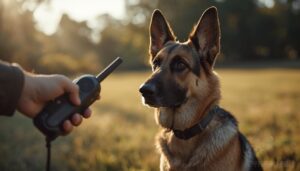
Most remote controlled collars don’t just zap and stop — they follow a smart escalation sequence that adjusts based on your dog’s response.
- Escalation Timing starts low, moving up only if behavior continues
- Pulse Interval keeps corrections brief with built-in cooldown gaps
- Intensity Step Size advances one level at a time via adjustable intensity settings
- Reset Mechanism restarts at the lowest step after your dog responds correctly
Handler Input Logic keeps you in control throughout — this behavior correction technique only continues while you’re actively transmitting.
Common Trainer Usage Patterns

Seasoned trainers follow rhythm, not just rules. Here’s how structure their sessions:
| Pattern | What It Looks Like |
|---|---|
| Signal Strength Monitoring | Adjust for terrain and distance before starting |
| Training Session Frequency | Short bursts, 10–15 minutes, once or twice daily |
| Environmental Adjustments | Reduce distractions early; increase gradually |
| Positive Reinforcement Techniques | Reward immediately after every correct response |
Your professional trainer will blend Remote Control Techniques with training commands, using Safety Guidelines and Data Logging to track progress.
How Fit Affects Collar Performance

A collar that doesn’t fit right won’t work right — it’s really that simple. Poor fit means inconsistent contact, missed cues, and possible skin irritation that makes your dog miserable.
Here’s what to check to make sure the collar is doing its job properly.
Two-finger Fit Rule
One simple rule covers most collar fitting situations: slide two fingers under the collar strap against your dog’s neck. Snug but not tight is the sweet spot.
Breed-specific adjustments matter here — fur thickness considerations change everything for a fluffy Samoyed versus a short-coated Boxer.
Recheck after activity rechecks, growth monitoring periods, or baths. Padding solutions help when the adjustable strap still irritates, keeping dog safety front and center.
Contact Point Placement
Fit doesn’t stop at the collar strap — contact point placement matters just as much. Get this wrong, and your dog feels nothing or feels too much in the wrong spot.
For proper Understanding Collar Fit and Comfort, position points with these cues:
- Alignment Height: level with the laryngeal crest, never near vocal cord avoidance zones
- Angle Orientation: slightly angled inward toward the neck’s center for consistent skin contact
- Pad Size: 6–8mm flat, hypoallergenic Material Choice reduces irritation on the dog’s neck
Avoiding Rubbing and Chafing
Even perfect contact point placement won’t save your dog’s neck if the collar material is working against you. Chafing usually sneaks up slowly — a little redness here, some hair loss there.
| Chafing Cause | Quick Fix |
|---|---|
| Heavy, stiff fabric | Switch to Breathable Materials |
| Sharp collar edges | Use Soft Edge Design |
| Moisture buildup | Apply Anti-Chafing Lubricants |
| Dirty collar strap | Prioritize Routine Collar Cleaning |
| Same collar daily | Try Rotating Collar Types |
Checking Strap Tightness
Tightness is easy to overlook — until your dog starts scratching mid-session. The two-finger test keeps you honest: slide two fingers under the strap against your dog’s neck. Snug resistance means good fit.
Rerun that Finger Test Consistency check after activity, since movement causes Strap Slip Detection issues quickly. Watch for Skin Redness Monitoring clues and adjust collar size as needed.
Comfort During Daily Wear
Wearing a collar all day shouldn’t feel like a burden for your dog. The right design makes a real difference — especially during long training sessions.
- Breathable materials and moisture-wicking linings keep your dog’s neck dry
- Padding edge design prevents chafing along sensitive skin
- Temperature regulation reduces heat buildup in warm weather
- Odor control fabrics stay fresher between washes
- Adjustable settings provide a safe, comfortable fit for every dog’s size
How to Introduce a Collar

Rushing straight into training with a new collar is one of the most common mistakes owners make. Your dog needs a little time to get comfortable with it before anything else happens.
Here’s how to make that first introduction go smoothly.
Letting The Dog Wear It Unpowered
Before you ever press a button, let your dog simply wear the collar. This unpowered wear time builds physical presence conditioning — your dog gets used to the weight and feel without any stimulus attached.
Do a quick buckle comfort check and routine collar inspection daily. Non-stimulus familiarity is the foundation every solid training collar introduction needs.
Short Acclimation Sessions
Once your dog is comfortable wearing the collar, keep your first active sessions short — think 5 minutes, not 50.
Here’s a simple structure that works:
- Start on the lowest setting and watch for a calm ear-twitch response.
- Build in Quiet Intervals and Calm Breaks between signals.
- Use Timer Controls to stay consistent across sessions.
Stress Monitoring matters — end immediately if tension rises.
Pairing The Collar With Treats
Think of treat pairing as building a simple promise: collar cue means something good is coming.
Start every pairing round with Short Pairing Bursts — just a few repetitions in a calm spot.
Environment Control matters here; distractions break focus fast.
| What to Do | Why It Works |
|---|---|
| Match Treat Flavor Preference | Keeps motivation high |
| Practice Cue Trigger Alignment | Dog predicts the reward |
| Apply Treat Quantity Management | Prevents full-belly refusals |
| Use positive reinforcement every rep | Locks in the collar–treat link |
Integrating Treats and Clicker Training sharpens timing beautifully — click, then treat, right after the cue.
Starting With Low Stimulation
Start at the lowest level of stimulation — always. Initial Intensity Testing means watching for a small ear-twitch or head-turn, not a dramatic reaction. That’s your signal that the cue landed.
Use Low-Intensity Cue Pairing and Brief Session Timing together, keeping rounds short and calm. Stress Signal Monitoring tells you when to back off. Gradual Level Increment only happens if your dog genuinely isn’t responding.
How to Use One Safely

Using a training collar the right way makes all the difference — for your dog and for your results. A few simple habits protect your dog’s skin, keep the gear working properly, and help you know when to call it a day.
Here’s what to keep in mind every time you train.
Limiting Session Length
Keep sessions short — 10 to 15 minutes, tops. Your dog’s attention span monitoring matters more than finishing a checklist.
Watch for fatigue indicators like yawning, lip licking, or tuning out. Those are your cues to stop.
Break scheduling and smart session timing strategies help you avoid overcorrection and keep cue frequency limits in check. Short sessions protect both learning and training safety.
Inspecting Skin After Use
After a session, take 60 seconds to check your dog’s neck. Look for skin irritation signs — redness, swelling, or warmth right where the contact points sat. Safety guidelines for remote training collars always stress this step.
- Check temperature changes by comparing the contact area to nearby skin
- Press gently to feel for tenderness or flinching
- Monitor moisture levels under the strap for trapped sweat
- Run strap mark analysis along the collar’s full path
- Know your veterinary referral triggers: pus, open sores, or spreading redness
Preventing Overheating or Battery Issues
Once you’ve checked the skin, give the device itself a quick look. Battery-powered collars can overheat if the ventilation design is blocked by thick fur or a snug fit.
Follow a consistent charging schedule — don’t leave it plugged in overnight.
Run battery swelling checks monthly, and keep the collar away from sunlight exposure.
Safety guidelines for remote training collars recommend temperature alerts as a non-negotiable feature worth paying for.
Removing The Collar Between Sessions
Once the battery check is done, take the collar off. This simple step — part of any solid Trainer Reset Routine — gives your dog a real Dog Recovery Break between short sessions.
- Resting Contact Points prevent skin pressure buildup
- Post-Session Collar Care includes wiping contact points clean
- Equipment Cleanliness Checklist: inspect strap, receiver, and buckle
Dog anxiety drops when training stays predictable and collar‑free time feels normal.
When to Stop Training
Now that the collar is off, ask yourself: should you even put it back on tomorrow?
Stop training when you see Improved Behavior Consistency across multiple days — that’s your green light to shift toward reward-based training.
Watch for Visible Stress Signals, Training Fatigue Indicators, or Neck Discomfort Signs.
Dog anxiety that lingers past the session means it’s time to pause and reassess.
Positive Reinforcement With Collars

The collar is just one piece of the puzzle — what you do right after the cue is what actually teaches your dog. Pairing corrections with rewards is what turns a signal into a lesson your dog remembers.
Here’s how to make positive reinforcement work alongside your collar training.
Rewarding The Desired Behavior
Rewarding the right behavior at the right moment — that’s the whole game. Think of it as your dog connecting the dots.
Here’s what makes it stick:
- Run a quick Treat Preference Assessment to find what truly motivates your dog
- Focus on Reward Magnitude — higher-value rewards build stronger behavior faster
- Apply Cue-Reward Pairing immediately after the desired behavior occurs
Reward Consistency and a smart Variable Ratio Schedule are the backbone of lasting positive reinforcement.
Using Clickers With Collar Cues
Clicker Collar Sync is simpler than it sounds. Your clicker marks the exact behavior — that sharp click is your dog’s "yes, that’s it" signal.
The collar tone works differently: it’s a remote cue, not a reward marker.
Keep Signal Hierarchy Design clear by never swapping their roles.
Remote Marking Strategies let you click at distance, but Timing Consistency Techniques matter most — mark within seconds, every time.
Reinforcing Recall and Calm Behavior
When your dog turns toward you mid‑distraction, that’s your window — reward it immediately.
Calm Recall Timing means catching that moment before arousal builds.
Use Reward Type Selection wisely: food for precision, a toy for drive.
Body Language Signals matter too — stay still, angle your shoulders.
Environmental Management keeps distractions low while your dog builds reliable off‑leash recall through positive reinforcement and consistent Attention Cue Training.
Reducing Reliance on Corrections
The goal was never to keep correcting forever — it’s to make make corrections unnecessary. That’s where Cue Fading Strategies come in.
Track your Error Tracking Metrics each session and watch the pattern shift.
- Use a Progressive Cue Ladder: tone first, vibration next, static last
- Apply Reward Timing Optimization — reward within one second of correct behavior
- Lean on Environmental Management to reduce triggers before they demand correction
Positive reinforcement training does the heavy lifting over time.
Timing Rewards Correctly
Timing is everything — miss the Reward Timing Window by even two seconds and your dog may connect the treat to whatever they just did, not what you wanted.
Immediate Marking locks in the right behavior fast. Think of it like a snapshot: click or cue the moment the action completes, then deliver the treat.
Consistent Cue-Reward sequencing and sharp Treat Delivery Speed turn your training collar into a precision tool.
Choosing The Right Collar

Picking the right collar isn’t one-size-fits-all — your dog’s personality, size, and training goals all play a role. A few key factors will point you in the right direction.
Here’s what to think through before you buy.
Matching The Collar to Temperament
Your dog’s personality is the real starting point for collar selection. Think of it like buying shoes — one size never fits all.
- Calm dog collars work best with soft tone or gentle vibration cues.
- Energetic dog cues should be rapid and clear to cut through distraction.
- Wary dog materials matter — lightweight, soft fabrics reduce anxiety.
- Sensitive dog comfort depends on non-aversive signals and steady routines.
Selecting for Breed and Size
Breed and size shape collar choice more than most people realize. A Greyhound’s narrow head, for example, makes martingales the smart pick — breed size standards exist for good reason.
Large breeds often carry health risk considerations like joint stress, so collar safety guidelines matter extra.
Match collar weight and stimulation settings to your dog’s size for real results.
Picking The Right Training Goal
Once you’ve matched the collar to size and breed, the next step is setting specific measurable objectives. Start with a baseline behavior assessment — where’s your dog right now? Then build up using progressive difficulty scaling, like moving from a quiet hallway to a busy park. Always define your stress threshold limits and cue-response timing before your first session.
- Name one clear, observable behavior
- Set a measurable success target (e.g., 5/5 recalls)
- Scale difficulty gradually across sessions
- Define a stop rule for stress signals
Comparing Cost and Features
Price Range Comparison matters more than most people expect.
A flat collar runs $5–$20, while a quality e-collar with GPS Tracking Extras, solid Waterproof Rating Impact, and real Battery Life Value sits closer to $150–$250.
Weigh Warranty and Support too — cheaply made collars cost more long-term.
Spend where it counts.
Considering Trainer Guidance
A good collar means nothing without the right hands guiding it. A professional trainer brings Trainer Assessment, Individualized Protocol, and Intensity Calibration to the table — things no product description can replace.
- They match Behavioral Cue Pairing to your dog’s actual triggers
- They use Progress Documentation to track real improvement
- They follow Safety Guidelines for Using Training Collars
- They apply Ethical Considerations of Shock Collars from day one
- Trainer Involvement keeps corrections purposeful, not punishing
Risks, Limits, and Better Alternatives

Training collars can be genuinely useful tools, but they’re not without drawbacks.
Like anything in dog training, knowing the limits helps you make smarter choices.
Here’s what you need to watch out for before strapping one on.
Skin Irritation and Stress Risks
Even a well-fitted collar can cause trouble over time. Friction and heat buildup trap moisture against the skin, triggering contact dermatitis and kicking off an itch-scratch cycle that’s hard to break.
Stress makes it worse — elevated cortisol skin effects lower your dog’s irritation threshold, so mild rubbing feels sharper.
Follow collar safety guidelines: inspect daily, limit wear to two hours, and rotate to a vibration collar when needed.
Overcorrection and Fear Responses
Too much correction too fast is where things break down. Without timing precision, your dog can’t connect the shock collar stimulus to the actual behavior — and cue generalization kicks in, turning routine settings into fear triggers.
Without precise timing, overcorrection teaches fear instead of behavior
Watch for these overcorrection warning signs:
- Cowering near training areas
- Refusing commands they already know
- Increased dog anxiety management challenges
- Shutdown instead of engagement
Fear extinction requires safety signals, not escalation thresholds.
Legal Restrictions in Some Areas
Before you buy, know your local rules — because bans on shock collars are real and growing. Several countries have outright prohibited them, and many U.S. municipalities have municipal leash ordinances that complicate e‑collar use outdoors. HOA training restrictions can also limit your options on private property.
| Location Type | Common Restriction | Enforcement Penalties |
|---|---|---|
| National/Country | Illegal to use a shock collar | Fines, seizure |
| Municipal/City | Leash ordinances override collar use | Citations, impoundment |
| HOA/Private Property | Equipment bans on aversive tools | Access revocation |
| Parks/Wildlife Areas | No aversive training devices allowed | Removal, fines |
The shock collar controversy has pushed legislators toward stricter legal restrictions and legislation on shock collars, shaped heavily by veterinary perspectives on aversive training tools and ethical considerations of shock collars. Licensing & certification requirements for trainers using these devices are also expanding in several jurisdictions. Always check local laws first.
When Rewards-based Training is Better
Sometimes a collar isn’t the right tool — and that’s okay. Reward-based training consistently wins for puppies, sensitive dogs, and fear-reactive breeds.
Positive reinforcement techniques accelerate Learning Speed by giving dogs a clear success signal.
You’ll also notice stronger Bond Strengthening, Stress Reduction during sessions, and better Environment Generalization.
Long-term Retention improves too — dogs trained with positive training methods often obey reliably long after treats disappear.
Signs You Need a Professional Trainer
Knowing when to call in a professional dog trainer isn’t a failure — it’s smart handling.
Watch for chronic fear signs like trembling or hiding when the collar appears, escalating aggression that doesn’t settle, or unresponsive cue learning where behavior only improves with the collar on.
Persistent stress indicators and mixed signal confusion from inconsistent household rules are clear signals you need professional guidance before behavioral problems get harder to fix.
Frequently Asked Questions (FAQs)
What is the 3-3-3 rule for dog training?
The 3-3-3 rule maps three phases — Decompression Phase, Learning Phase, and Confidence Building — across 3 days, 3 weeks, and 3 months.
Each stage shifts your Expectation Management and training session duration as your dog settles in.
Is a shock collar an effective way to train a dog?
Shock collars can work, but the effectiveness of shock collars in training depends heavily on shock timing and consistency. Stress indicators often appear, raising serious training ethics concerns.
Reward-based methods usually achieve the same behavioral correction more reliably.
What is the hardest thing to train a dog to do?
Reliable recall under distractions tops the list. When a dog catches a scent or spots a squirrel, "come" means nothing.
Loose-leash walking, house training, crate calm, and leave it, follow closely behind.
Can puppies use training collars safely?
Most trainers advise waiting until a puppy is at least six months old.
Follow puppy age guidelines, complete veterinary health clearance, and always prioritize parental supervision and skin sensitivity checks before introducing any collar.
How long until training results become permanent?
Results rarely become permanent overnight.
With consistent Reinforcement Schedules and Consistency Proofing across environments, most dogs show lasting behavior modification within a few weeks — especially when positive reinforcement stays in the mix.
Do training collars work for aggressive dogs?
Training collars can help with aggression, but only when behavior modification and positive reinforcement lead the way. Fear-Based Corrections alone often backfire.
Always start with a Behavioral Assessment from a professional.
What certifications should a collar trainer have?
Look for a CPDT‑KA certification at minimum. The IAABC Behavior Credential, Cooperative Paws SDC, or a Veterinary Behavior Credential adds serious credibility — especially when collar training is involved.
Can collars help with separation anxiety behaviors?
Collars alone won’t cure separation anxiety — not even close.
A pheromone collar or calming collar option can ease mild stress, but the real fix is desensitization techniques paired with positive reinforcement techniques.
Conclusion
Funny how a tiny plastic box around your dog’s neck gets blamed for everything—bad behavior, broken trust, ruined relationships. The collar didn’t do that. You did, or didn’t.
Understanding how dog training collars work strips away the mythology and hands you something real: informed control.
Used with patience, proper fit, and well-timed reinforcement, the right collar becomes less of a correction tool and more of a conversation.
Your dog’s been waiting for that conversation.