
This site is supported by our readers. We may earn a commission, at no cost to you, if you purchase through links.
A bored dog doesn’t stay bored quietly. Chewed furniture, endless barking, anxious pacing—these aren’t personality flaws, they’re symptoms of an understimulated brain. Dogs evolved to hunt, forage, and solve problems, and most modern pets spend their days in environments that demand almost nothing from them cognitively.
That gap between what their brains need and what their days actually offer is where behavioral problems take root. Interactive dog toys close that gap by giving dogs meaningful mental work—the kind that builds focus, eases anxiety, and redirects restless energy toward something constructive. Understanding how they work helps you use them far more effectively.
Table Of Contents
- Key Takeaways
- How Interactive Dog Toys Boost Mental Stimulation
- Key Benefits of Interactive Dog Toys
- Top Interactive Dog Toys for Mental Stimulation
- Tips for Choosing and Introducing Interactive Toys
- Frequently Asked Questions (FAQs)
- Is playing with toys mentally stimulating for dogs?
- What are the benefits of interactive dog toys?
- How often should I replace my dogs toys?
- Can interactive toys replace daily walks for dogs?
- Are interactive toys safe for multiple dogs together?
- How long should a dog play per session?
- Do interactive toys work for all dog breeds?
- Conclusion
Key Takeaways
- Dogs aren’t being destructive out of spite—chewing, barking, and pacing are signs of a brain that isn’t getting enough to do, and interactive toys directly address that root cause.
- Puzzle feeders and treat dispensers work by tapping into natural problem-solving instincts, which builds focus and eases anxiety more effectively than passive entertainment.
- Matching a toy to your dog’s size, energy level, and chew strength isn’t optional—it’s the difference between a useful tool and a safety hazard sitting in the corner.
- Short sessions of 10 to 15 minutes, repeated two or three times a day, deliver more cognitive benefit than one long stretch and prevent the mental fatigue that kills engagement.
How Interactive Dog Toys Boost Mental Stimulation
Your dog’s brain needs a workout just as much as their body does. Interactive toys tap into natural instincts — sniffing, problem-solving, and searching — in ways that genuinely tire dogs out mentally. Here’s how they do it.
Think of it like a scavenger hunt for their nose — and mixed-breed dogs like the Beagador tend to thrive with this kind of mentally engaging play.
Problem-Solving and Cognitive Challenges
When your dog noses open a sliding compartment or paws at a puzzle to reveal a hidden treat, something more than play is happening — their brain is actively working through a problem. Puzzle toys and brain teasers push dogs to apply critical thinking and mental agility to earn a reward.
That repeated problem-solving builds cognitive development over time, making interactive dog toys one of the most practical tools for real mental stimulation.
Reducing Anxiety and Stress
Beyond sharpening cognition, interactive dog toys offer real anxiety relief for dogs that struggle with stress. A focused task — nudging, pawing, or licking for a treat — redirects their attention away from triggers naturally.
Effective calming techniques include:
- Puzzle toys for sustained mental stimulation
- Treat-dispensing toys for rhythmic stress relief
- Snuffle mats for relaxation methods through sniffing
- Predictable toy routines for emotional support
- Chew-based toys for steady stress management
Introducing dogs to healthy play routines with interactive toys can support long-term wellness and prevent boredom.
Preventing Destructive Behaviors
A bored dog doesn’t stay bored for long — they find ways to entertain themselves, and your furniture usually pays the price. That’s where mental stimulation through interactive dog toys makes a real difference.
Treat dispensers and puzzle feeders redirect that restless energy toward problem-solving instead of chewing. Consistent use helps with anxiety reduction and boredom prevention, giving destructive behavior far less room to take hold.
Encouraging Physical Activity
Mental engagement and physical movement often go hand in hand — the right interactive toy doesn’t just work your dog’s mind, it gets their body moving too. Whether it’s high-energy play with a tug toy that mimics natural tug instincts or automated play movement from an electronic ball, interactive dog toys turn mental stimulation into real physical activity for dogs — even indoors.
Here are some examples of how interactive toys benefit dogs:
- Tug toys build muscle and reinforce impulse control simultaneously.
- Electronic balls prompt sprinting, supporting dog exercise and fitness without a yard.
- Fetch-style dispensers combine physical exercise with reward-based problem-solving.
- Chase toys encourage bursts of movement that burn energy fast.
- Rotating toy types prevents physical and mental plateaus over time.
Key Benefits of Interactive Dog Toys

Interactive dog toys do more than just keep your dog busy — they shape how your dog thinks, eats, and learns over time. The benefits go well beyond basic entertainment, touching on focus, digestion, age-specific needs, and daily training habits.
Mixing up rewards with tough toys built for curious chewers keeps the mental challenge fresh and the motivation high.
Here’s a closer look at what these toys actually do for your dog.
Improving Focus and Critical Thinking
Think of your dog’s brain like a muscle — and interactive toys are exactly the kind of workout it needs to sharpen focus and build real problem-solving skills.
Puzzle toys and dog puzzle toys demand mental agility with every use, nudging your dog toward cognitive development through repeated trial and error.
That sustained effort builds critical thinking, strengthens focus enhancement, and deepens mental stimulation in ways a simple walk just can’t replicate.
Slowing Down Fast Eaters
Fast eating isn’t just messy — it’s a genuine health risk. Interactive feeders and dog puzzle toys slow your dog’s eating habits by turning each meal into a small challenge, which promotes digestive health and reduces bloating.
Three standout slow feeder benefits worth noting:
- Extended mealtimes improve nutrient absorption
- Reduced gulping lowers bloat and choking risk
- Mental stimulation at mealtime curbs post-meal restlessness
Mealtime strategies like snuffle mats and treat dispensing toys make slow feeders an easy, practical upgrade. For more details on how these products offer, check out the latest research.
Supporting Senior Dogs and Puppies
Age changes everything about how your dog plays. Senior dogs benefit from soft, stationary puzzle feeders that offer cognitive support without stressing worn joints, while puppies need durable, lightweight interactive dog toys scaled to small jaws.
Both life stages gain from gentle play ideas and age-friendly toys that deliver mental stimulation in short sessions, supporting puppy development and helping slow canine cognitive dysfunction in older dogs.
Enhancing Daily Routines and Training
Interactive toys don’t just entertain your dog—they quietly do the work of a training session when woven into the rhythms of your day. Slip them into predictable moments and you’ll notice real results:
- Feed breakfast through a puzzle to build canine focus before the day starts.
- Use a treat dispenser mid-afternoon for routine enrichment that eases restlessness.
- Offer a snuffle mat before crate time to support canine mental health through calm mental exercise.
- End evenings with a simple interactive dog toy to reinforce dog training tips through repetition.
Top Interactive Dog Toys for Mental Stimulation
Not all interactive toys are created equal, and the right one can make a real difference in how engaged and calm your dog feels throughout the day. The options below have solid track records for keeping dogs mentally occupied without requiring constant supervision from you.
Here are five worth considering.
1. Kong Interactive Dog Treat Dispenser Toy
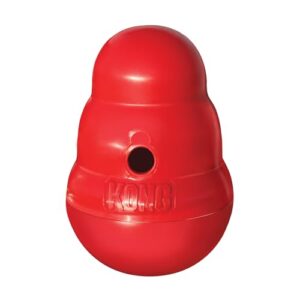
Few toys have earned their reputation as quietly and consistently as the KONG Interactive Dog Treat Dispenser Toy. Its hollow rubber cavity lets you stuff kibble, peanut butter, or canned food inside, then freeze it so your dog works 20 to 30 minutes or more to get every last bite.
That unpredictable bounce keeps fetch interesting, while the slow-release design turns mealtime into a focused mental workout.
It’s dishwasher safe, built from durable natural rubber, and sized from XS to XXL.
| Best For | Dog owners who want to keep their pup mentally engaged, slow down fast eaters, or just give them something to do besides chew the couch. |
|---|---|
| Material | Plastic |
| Mental Stimulation | Yes |
| Boredom Reduction | Yes |
| Size Suitability | All sizes |
| Supervision Needed | Yes |
| Easy to Clean | Dishwasher safe |
| Additional Features |
|
- Turns mealtime into a real challenge — great for keeping bored or anxious dogs occupied
- Easy to fill, and tossing it in the dishwasher makes cleanup a breeze
- Works for dogs of all ages and sizes, so it grows with your pet
- It can rattle pretty loudly, which might get annoying in a quiet house
- Smaller or younger dogs may find it a bit intimidating at first
- Some clever dogs crack the puzzle fast, so the challenge doesn’t always last long
2. Outward Hound Dog Brick Puzzle Toy
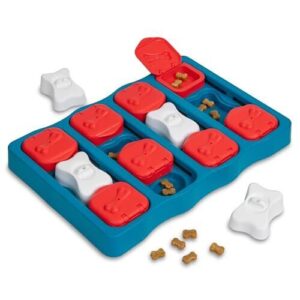
The Outward Hound Dog Brick Puzzle Toy gives your dog something the KONG doesn’t: a structured, multi-step challenge that works their brain like a real problem to solve. Your dog flips lids, slides red discs, and lifts out hollow bones to uncover hidden treats across three compartment types.
That layered sequence builds focus and tires them out mentally. It holds up to ¾ cup of kibble, so it doubles as a slow feeder.
Made from BPA-free plastic, it’s easy to hand wash and safe for daily use.
| Best For | Dogs that eat too fast or need more mental stimulation during mealtime. |
|---|---|
| Material | Plastic |
| Mental Stimulation | Yes |
| Boredom Reduction | Yes |
| Size Suitability | Small, medium, large |
| Supervision Needed | Yes |
| Easy to Clean | Rinse clean |
| Additional Features |
|
- Three difficulty levels mean your dog won’t outgrow it too quickly
- Works as a slow feeder, so meals take longer and digestion improves
- BPA-free plastic makes it safe for daily use and easy to clean
- Not great for unsupervised dogs—parts can get chewed off
- The sliding and flipping pieces can get noisy on hard floors
- It’s plastic, so a determined chewer will eventually wear it down
3. West Paw Interactive Dog Puzzle Toy
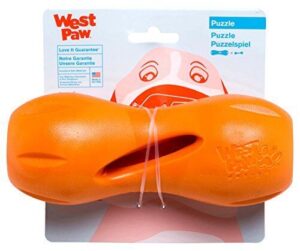
Where the Outward Hound works your dog’s brain through steps and sequences, the West Paw Toppl works it through persistence and licking — a different kind of focus entirely.
Pack it with kibble, yogurt, or peanut butter, freeze it overnight, and your dog can spend a solid stretch working every last bit out. The wobbling base and internal ridges slow that process down intentionally.
Made from non-toxic Zogoflex, it’s dishwasher safe, floats for water play, and backed by a manufacturer guarantee.
| Best For | Dogs that love to lick and chew their way through a challenge, especially strong chewers who need something durable and mentally engaging. |
|---|---|
| Material | Plastic |
| Mental Stimulation | Yes |
| Boredom Reduction | Yes |
| Size Suitability | All sizes |
| Supervision Needed | Yes |
| Easy to Clean | Dishwasher safe |
| Additional Features |
|
- Extends treat time significantly — pack it, freeze it, and your dog works at it for a good while
- Durable, dishwasher safe, floats in water, and backed by a manufacturer guarantee
- Works with tons of different treats — kibble, peanut butter, yogurt, dental sticks, you name it
- The end hole can be too wide for some treats, making it easy for dogs to pop them out too fast
- Not every dog is into puzzle toys — if yours isn’t food-motivated or patient, it may just ignore it
- Some people feel the price is a bit steep given how simple the design is
4. Cheerble Interactive Dog Ball Toy
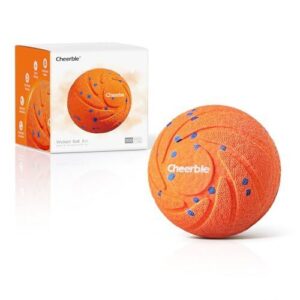
Some dogs don’t want to think their way to a treat — they want to chase something. That’s where the Cheerble Interactive Dog Ball fits in. It moves on its own, bouncing and reversing when it hits a wall, so your dog stays locked in without you having to throw anything.
Three modes — Gentle, Normal, and Passive — let you dial in the right energy level. It’s waterproof, easy to clean, and runs up to 3.5 hours per charge.
| Best For | High-energy adult dogs who love to chase and need entertainment when their owner’s hands are full. |
|---|---|
| Material | E-TPU |
| Mental Stimulation | Yes |
| Boredom Reduction | Yes |
| Size Suitability | Adult dogs |
| Supervision Needed | Yes |
| Easy to Clean | Rinse clean |
| Additional Features |
|
- Moves, bounces, and reverses on its own — no throwing required
- Three modes let you match the toy to your dog’s energy level
- IPX7 waterproof and easy to clean, so outdoor play isn’t a problem
- Not a good fit for aggressive chewers — they’ll likely destroy the shell
- 3.5 hours of battery life means you may be recharging it pretty often
- The price point turns some people off compared to a basic ball
5. Snuffle Mat For Dogs Interactive Toy
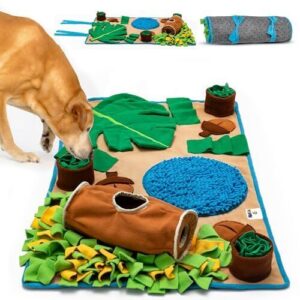
Not every dog needs movement to stay mentally sharp — some just need a reason to use their nose. The YOPSI Snuffle Mat hides kibble in dense polar fleece layers across a generous 39.4″ x 23.6″ surface, turning mealtime into a nose work session.
That slow, deliberate sniffing lowers arousal and helps anxious dogs settle, often more effectively than a short walk. It’s machine washable, has a non-slip bottom, and works for dogs of nearly any age or mobility level.
| Best For | Dogs that eat too fast, get anxious easily, or need mental stimulation without intense physical activity. |
|---|---|
| Material | Polar Fleece |
| Mental Stimulation | Yes |
| Boredom Reduction | Yes |
| Size Suitability | Various sizes |
| Supervision Needed | Yes |
| Easy to Clean | Machine washable |
| Additional Features |
|
- Turns mealtime into a brain workout — hiding kibble in the fleece keeps dogs focused and calm
- Large 39.4″ x 23.6″ surface works for big and small dogs alike
- Machine washable and non-slip, so cleanup and safety are both covered
- Not ideal for aggressive chewers — some dogs can tear through the fabric over time
- May need supervision, especially for dogs new to snuffle mats
- Doesn’t work for every dog — a few just aren’t interested in sniffing for their food
Tips for Choosing and Introducing Interactive Toys
Picking the right interactive toy isn’t just about what looks fun — it’s about what actually works for your dog. A few key factors can make the difference between a toy your dog ignores and one that genuinely challenges them.
Here’s what to keep in mind before you buy.
Matching Toys to Size and Play Style
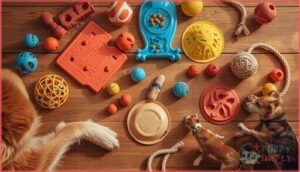
Not all toys are built equal, and picking the wrong size or style for your dog is a bit like handing a toddler a chess set—frustrating for everyone involved. Match interactive dog toys to your dog’s breed-specific traits, energy levels, and play style for real mental stimulation.
Matching an interactive dog toy to your dog’s size, energy, and play style is the difference between real mental stimulation and pure frustration
| Dog Type | Recommended Toy | Why It Works |
|---|---|---|
| High-energy breeds | Treat dispensing toys | Channels focus productively |
| Moderate-energy dogs | Puzzle toys | Matches pacing and curiosity |
| Gentle or senior dogs | Simple sliding puzzles | Low frustration, steady engagement |
| Small breeds | Size-appropriate feeders | Prevents choking hazards |
| Power chewers | Durable rubber dispensers | Withstands heavy use safely |
Prioritizing Safety and Durability

A toy that breaks apart mid-play isn’t just a ruined purchase—it’s a choking hazard waiting to happen. When reviewing interactive dog toys, check for chew resistance, durable designs, and non-toxic material certifications. Treat dispensing toys should have smooth, continuous joints with no small detachable parts.
These safety features directly support dog mental health by letting your dog engage without unnecessary pet hazards interrupting the experience.
Building Confidence With Simple Puzzles

Confidence, like most good things, usually builds slowly—and for dogs new to puzzle toys, starting easy isn’t taking shortcuts, it’s just smart training. A level-one puzzle introduction sets your dog up for early wins, which directly aids confidence building and canine engagement.
Simple challenges trigger real mental stimulation without frustration. That steady progress is how interactive dog toys nurture lasting mental growth and stronger canine mental health.
Using Rewards and Positive Reinforcement

Rewards do more than motivate your dog—they actually shape how your dog thinks about learning. When you pair interactive dog toys with positive reinforcement, like treat dispensing toys or clicker training, you’re building a reward system that drives real behavior modification.
Your dog starts connecting effort with outcome. That mental stimulation compounds over time, making each new puzzle faster and easier to crack.
Frequently Asked Questions (FAQs)
Is playing with toys mentally stimulating for dogs?
Yes, absolutely — even a few minutes with the right toy can feel like an entire workout for your dog’s brain.
Interactive dog toys tap directly into canine cognition, delivering real mental stimulation for dogs through play.
What are the benefits of interactive dog toys?
Interactive dog toys are essential tools for balanced canine engagement. They support mental wellness, reduce anxiety, and prevent destructive behavior.
These toys promote cognitive development and encourage playful learning, which in turn improve dog mental health and wellbeing.
How often should I replace my dogs toys?
Replace worn or damaged toys immediately.
For general toy rotation, swap them out every two to four weeks to keep things fresh.
Regular pet safety checks help you catch cracks, loose parts, or hygiene issues before they become hazards.
Can interactive toys replace daily walks for dogs?
No, they can’t. Dog Exercise Needs go beyond Mental Stimulation — physical activity, Canine Socialization, and real-world sensory input require actual Dog Exercise that Interactive Dog Toys simply weren’t designed to replace.
Are interactive toys safe for multiple dogs together?
Sure, just toss one toy into a room full of dogs and watch “pack dynamics” sort itself out — naturally.
In reality, canine conflict over toy sharing is common, so supervise multi-dog play closely with interactive dog toys.
How long should a dog play per session?
Most dogs do well with 10 to 15 minutes per session. Beyond that, mental fatigue sets in and engagement drops.
Two or three short playtime intervals spread across the day works better than one long stretch.
Do interactive toys work for all dog breeds?
Breed specificity matters, but toy adaptability makes interactive dog toys effective across canine temperaments.
Whether your dog is high-energy or laid-back, there’s an interactive design suited to support their unique cognitive development and enrichment needs.
Conclusion
A tired dog is a good dog—that old saying still holds, but the fatigue worth chasing is mental, not just physical. Understanding how interactive dog toys improve mental stimulation gives you a real tool for addressing the root cause of restless, anxious behavior.
Rotate toys regularly, match the challenge to your dog’s confidence level, and stay consistent. When their brain has meaningful work to do, everything else—the chewing, the barking, the pacing—usually quiets down.
- https://shopyomp.com/blogs/magazine/how-interactive-dog-toys-can-improve-your-dogs-behavior-and-mental-health
- https://digitalcommons.sacredheart.edu/cgi/viewcontent.cgi?article=2481&context=acadfest
- https://www.rover.com/blog/do-dog-snuffle-mats-work/
- https://hardypaw.com/collections/dog-lick-snuffle-mats
- https://doggielawn.com/blogs/blog/why-are-interactive-toys-important-for-dogs