This site is supported by our readers. We may earn a commission, at no cost to you, if you purchase through links.

Your dog races toward you at the park, then suddenly veers off to chase a squirrel. Sound familiar? That moment of hesitation—when recall fails—isn’t about disobedience. It’s about unclear communication.
Dog training clickers for recall training solve this problem by marking the exact instant your dog makes the right choice, creating a crystal-clear connection between behavior and reward. The click becomes a bridge, a split-second signal that says “yes, that’s it!” before the treat even reaches their mouth.
When you’re comparing clickers for recall work, you’re not just shopping for a plastic gadget. You’re choosing a precision tool that can transform your dog’s response time, boost their confidence, and give you reliable off-leash freedom in any environment.
Table Of Contents
- Key Takeaways
- How Clicker Training Improves Recall
- Key Features of Clickers for Recall Training
- Choosing The Right Clicker for Your Dog
- Top 10 Dog Training Clickers for Recall
- 1. HoAoOo Pet Training Clicker
- 2. PetSafe Dog Training Clicker Tool
- 3. Oyefly Dog Training Clicker
- 4. TreatPod Leash Treat Holder and Clicker
- 5. Crmada Dog Training Clicker
- 6. Brightkins Dog Training Clicker
- 7. Dog Training Clicker Kit
- 8. Diyife Dog Training Clicker
- 9. Left And Right Dog Training Kit
- 10. Szo Dog Training Treat Pouch
- Effective Recall Training Techniques With Clickers
- Tips for Consistent Success in Recall Training
- Frequently Asked Questions (FAQs)
- Conclusion
Key Takeaways
- Clickers create a precise communication bridge by marking the exact moment your dog makes the right choice, triggering reward pathways in the brain that build reliable recall through operant conditioning and immediate feedback.
- Choose a clicker based on your dog’s sensitivity and training environment—louder models or combo whistle-clickers work for outdoor recall, while softer clicks suit noise-sensitive dogs, and multi-pet households benefit from color-coded designs.
- Effective recall training requires starting in low-distraction settings with three-minute sessions, using high-value treats immediately after each click, then gradually increasing distance by 2-3 meters and adding distractions only after achieving 80% success.
- Phase out the clicker once your dog reaches 90% accuracy across three outdoor settings for two weeks, but avoid common mistakes like clicking without immediate rewards, using multiple cues simultaneously, or correcting after you’ve already clicked.
How Clicker Training Improves Recall
Clicker training transforms recall from a frustrating challenge into a reliable skill your dog actually enjoys performing. The secret lies in how the click creates a crystal-clear communication channel between you and your dog, marking the exact moment they make the right choice.
Clicker training turns recall into a reliable, enjoyable skill by giving your dog a clear signal for exactly when they succeed
Let’s explore the science, benefits, and proven principles that make clicker-based recall training so effective. Timing your rewards correctly is crucial, and understanding cluster training techniques can help you deliver reinforcement at the exact moment your dog responds.
Science Behind Clicker-Based Recall
Three key mechanisms make clicker training so effective for recall. The clicker acts as a secondary reinforcer, creating a neural bridge between your dog’s behavior and the reward. Here’s how behavioral science supports this approach:
- Immediate marking – The click pinpoints the exact moment your dog responds, strengthening memory traces through precise timing
- Dopaminergic activation – That distinctive sound triggers reward pathways in your dog’s brain, building positive associations with coming when called
- Clear signal-response mapping – Operant conditioning principles help your dog connect the cue to the action without confusion
- Long-term potentiation – Repeated click-reward pairings create lasting neural connections that support reliable canine recall training across different environments
Benefits for Recall Reliability
Once your dog grasps the science, you’ll see clicker precision translate into real recall consistency. That click marks the exact moment your pup gets it right—no guessing, no confusion.
Here’s what reliable recall training delivers:
| Benefit | How Clickers Help | Result |
|---|---|---|
| Reward Timing | Instant marking of correct response | Faster learning retention |
| Recall Consistency | Clear cue-behavior link | Reliable comebacks every time |
| Training Environment | Works in varied settings | Generalized dog recall |
| Clicker Precision | Fixed marker reduces ambiguity | Stronger association |
| Dog Motivation | Paired with high-value treats | Sustained focus and attention |
This reward system builds confidence through positive reinforcement, creating a dog who wants to come when called. The effectiveness of such training methods can be further understood through scientific study summaries that assess methodological rigor.
Positive Reinforcement Principles
That reliability hinges on positive reinforcement—the cornerstone of effective behavior modification. Every time your dog obeys the recall cue and hears that click followed by a reward, you’re applying reinforcement theory in action.
Smart reward schedules keep motivation techniques fresh:
- Immediate rewards after each successful recall build strong learning outcomes
- High-value treats maintain enthusiasm during challenging distractions
- Varied reinforcement prevents your dog from predicting every outcome
This approach transforms recall techniques into habit.
Key Features of Clickers for Recall Training
Not all clickers are created equal, and the right one can make or break your recall training. You need a tool that delivers a consistent sound, fits comfortably in your hand, and holds up session after session.
Let’s look at the essential features that separate a reliable training clicker from one that’ll end up in your junk drawer. A consistent click sound helps you nail the timing that makes positive reinforcement and clicker training so effective for shaping new behaviors.
Sound Clarity and Consistency
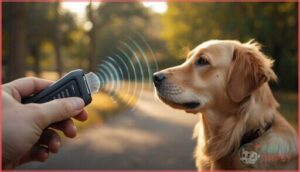
Your clicker’s tone should cut through everyday noise—think park chatter and passing cars—so your dog hears it every time. Look for a bright, high-frequency sound (1–4 kHz is ideal) that stays consistent across clicks, minimizing auditory thresholds and confusion. A clicker with sharp auditory feedback pairs perfectly with foundational sit-stay drills, where timing and clarity make all the difference.
Consistent frequency response and sound waveforms mean faster recall learning. Test with a decibel meter or calibration app to confirm your clicker delivers the same clear cue session after session. A clicker that produces reliable, consistent sound sits alongside other essential tools for building clear communication that help your dog understand exactly what behaviors earn rewards.
Ergonomics and Ease of Use

You need a training clicker that fits your hand and doesn’t fight back during rapid-fire clicks. Look for a palm-friendly grip and a button that responds instantly under your index finger—no fumbling, no strain. If you’re training outside where distractions run high, check out outdoor-ready dog training clickers that cut through wind and background noise.
Ambidextrous designs and textured surfaces help you maintain control in any weather, so you can mark the exact moment your dog nails that recall without missing a beat.
Durability and Portability
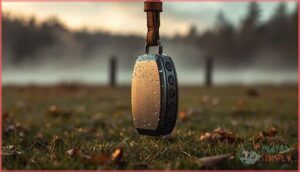
Training gear takes a beating in the real world, so you want a clicker that won’t quit halfway through recall training. Choose models that hold up under pressure and slip into your pocket without fuss.
- Metal housings withstand thousands of clicks and outdoor conditions without losing click consistency
- Compact designs (under 1.2 ounces) attach to lanyards for hands-free carry during training sessions
- Water-resistant seals protect internals from rain and dew, maintaining performance across environments
- Drop-tested frames survive falls from 1–2 meters, ensuring your clicker training stays on track
Quality construction means fewer interruptions and more successful recalls.
Clicker-Whistle Combos for Long-Distance Recall
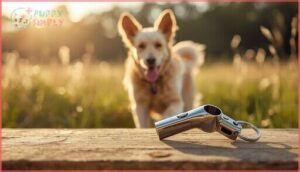
Distance changes everything when you’re calling your dog back across a field or park. Clicker-whistle combos deliver two distinct auditory cue training tools in one device, giving you flexibility for recall consistency in varied environmental factors.
| Feature | Training Advantage |
|---|---|
| Clicker for close work | Marks precise behavior at 5–15 meters |
| Whistle for long distance recall | Carries hundreds of meters outdoors |
| Dual signal methods | Builds cue discrimination under distraction |
| Compact design | Streamlines your recall training setup |
Whistles cut through wind and crowd noise better than clicks alone, while the clicker-whistle pairing reinforces your recall command at any range.
Choosing The Right Clicker for Your Dog
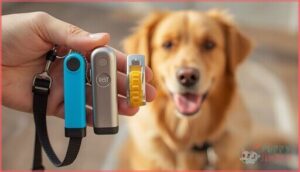
Not every clicker works for every dog, and picking the wrong one can slow your progress or even frustrate your pup. You need to match the clicker to your dog’s temperament, your training goals, and your household setup.
Let’s walk through the key factors that’ll help you choose the right tool for reliable recall.
Assessing Your Dog’s Sensitivity
Before you introduce any clicker training tool, pay attention to how your dog reacts to new sounds. Some pups startle easily, while others barely notice a click. You can gauge this with simple Sensitivity Tests and Reaction Monitoring:
- Observe ear position, tail tucking, or freezing right after a gentle click.
- Note whether your dog shows Canine Anxiety or avoidance behaviors.
- Test across different rooms to measure Auditory Threshold and context-specific responses.
- Document findings to tailor your positive reinforcement approach and recall training pace.
This Sensory Evaluation ensures your dog behavior stays calm and receptive throughout clicker training.
Match Clicker Type to Training Goals
Your recall training goals shape which clicker you need. If you’re working on long-distance recall, choose a louder clicker or combo whistle-clicker to cut through wind and noise. For noise-sensitive dogs, a softer clicker sound prevents stress while keeping training consistency strong.
Weather-resistant models with clicker durability outlast rain and dirt, and ergonomic grips help you nail precise timing during positive reinforcement sessions without hand fatigue.
Selecting Clickers for Multi-Pet Households
When you’re juggling two or more dogs, grab a separate clicker for each to keep their positive reinforcement histories crystal clear. Color-coded or distinct click sound models prevent cross-pet confusion during recall training.
Check pet hearing sensitivity first—some dogs need softer tones. Clicker durability matters in busy homes, and portable cases help you maintain training consistency when all your pups are learning together.
Top 10 Dog Training Clickers for Recall
You’ve narrowed down the features that matter most, so now it’s time to see which clickers deliver.
The tools below combine the clarity, durability, and design you need to build reliable recall with your dog.
Each option brings something different to the table, whether you’re training at home or working through distractions in the field.
1. HoAoOo Pet Training Clicker
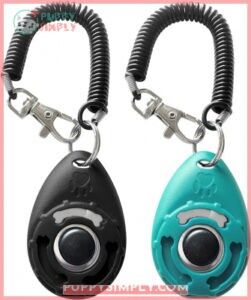
The HoAoOo Pet Training Clicker gives you a two-pack with wrist straps in black and blue, so you won’t fumble during critical recall moments. This clicker’s big button delivers a loud, sharp sound that cuts through distractions, and the metal mechanism won’t rust or break under daily use.
At just 41 grams and $4.99, it’s an accessible entry point for positive reinforcement training. You’ll find it works well for basic obedience and recall drills, though some dogs with noise sensitivity may need gentler training accessories.
| Best For | Dog owners looking for an affordable, durable clicker to teach basic commands and recall through positive reinforcement training. |
|---|---|
| Weight | 41 Grams |
| Material | Metal clicker |
| Wrist Strap | Yes |
| Color Options | Black and Blue |
| Pack Size | 2-pack |
| Training Use | Basic obedience and tricks |
| Additional Features |
|
- Two-pack with color-coded wrist straps makes it easy to keep one handy during training sessions
- Loud, consistent click sound cuts through outdoor distractions and marks behaviors clearly
- Rust-proof metal mechanism holds up to daily use at an unbeatable $4.99 price point
- May be too loud for noise-sensitive dogs or puppies just starting clicker training
- Some users report the build quality feels cheap despite the metal clicker component
- Limited effectiveness for stubborn dogs or complex behavioral issues beyond basic obedience
2. PetSafe Dog Training Clicker Tool
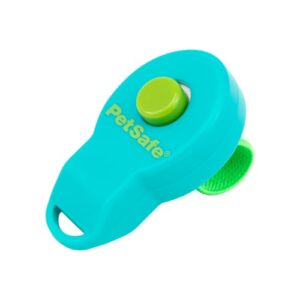
PetSafe’s Clik-R combines portability with consistent performance, measuring 3.94 by 1.5 inches and weighing just over an ounce. You’ll appreciate its teal ergonomic finger band that keeps the clicker secure during rapid-fire recall training sessions.
The clear, sharp click sound reinforces your dog’s behavior with immediate precision, making it ideal for marking the exact moment your pup turns toward you.
At this price point, you get reliable positive reinforcement without sacrificing quality, though some handlers with larger hands find the band slightly loose during intense outdoor drills.
| Best For | Pet owners who want a lightweight, portable clicker for positive reinforcement training with dogs, cats, or other animals at close to moderate distances. |
|---|---|
| Weight | 1.13 ounces |
| Material | Plastic |
| Wrist Strap | Finger band |
| Color Options | Teal |
| Pack Size | Single |
| Training Use | Positive reinforcement |
| Additional Features |
|
- Compact and lightweight design (just over an ounce) makes it easy to carry during training sessions or slip into your pocket
- Produces a consistent, sharp click sound that clearly marks desired behaviors for effective positive reinforcement
- Ergonomic finger band provides a secure grip for one-handed operation during rapid training sequences
- Some users report the click is too quiet for outdoor use or requires excessive pressing force
- The finger band may be too loose for people with larger hands, affecting control during active training
- Not ideal for pets with hearing sensitivities or for long-distance recall work where a louder cue is needed
3. Oyefly Dog Training Clicker

Oyefly’s four-pack clicker set gives you flexibility for multi-dog training at an unbeatable price point. Each clicker weighs just 68 grams and features a push-button design with a wrist band, so you won’t drop it mid-recall drill. The distinct clicking sound works across various pet compatibility scenarios—dogs, cats, even birds respond well.
User reviews highlight inconsistent click volume between units, and some trainers note the plastic construction wears faster than premium models.
Still, for budget-conscious handlers practicing basic recall strategies, Oyefly delivers reliable clicker training without breaking the bank.
| Best For | Budget-conscious trainers working with multiple dogs or pets who need an affordable, functional clicker set for basic recall and behavioral training. |
|---|---|
| Weight | 68 Grams |
| Material | Acrylonitrile Butadiene Styrene |
| Wrist Strap | Yes |
| Color Options | 4-color pack |
| Pack Size | 4-pack |
| Training Use | Behavioral training |
| Additional Features |
|
- Four-pack provides excellent value and allows you to keep clickers in multiple locations or train several pets simultaneously
- Lightweight design with wrist band keeps the clicker accessible and prevents drops during outdoor training sessions
- Versatile enough for various pets including dogs, cats, birds, and horses
- Click volume can be inconsistent between individual clickers in the pack
- Plastic construction may wear out faster than more expensive metal alternatives with frequent use
- Some users report quality control issues like receiving fewer clickers than ordered or units with overly loud clicks
4. TreatPod Leash Treat Holder and Clicker

If you’re juggling treats and a clicker during recall training, TreatPod’s all-in-one design solves that problem. This leash attachment combines airtight treat storage with a built-in clicker, so you can mark behavior and reward in seconds. The adjustable wrist strap keeps everything secure during outdoor sessions, and the waterproof container protects your high-value rewards from moisture.
Some users report the plastic feels flimsy and the clicker volume disappoints in noisy environments. However, for quick backyard drills where portable training gear matters, TreatPod streamlines your reward systems effectively.
| Best For | Dog owners who want hands-free training gear that keeps treats fresh and a clicker within reach during outdoor recall sessions. |
|---|---|
| Weight | 3.2 ounces |
| Material | Plastic |
| Wrist Strap | Yes |
| Color Options | Blue/Black |
| Pack Size | Bundle with treat holder |
| Training Use | On-the-go training |
| Additional Features |
|
- Combines airtight, waterproof treat storage with a built-in clicker so you don’t need to carry separate tools
- Adjustable wrist strap and leash attachment keep your hands free during training drills
- Comes with step-by-step instructions that help beginners get started with clicker training
- Plastic construction feels cheap and may not hold up to heavy use or active dogs
- Treat holder can be hard to unscrew quickly when you need to reward fast
- Clicker volume is too quiet for noisy outdoor environments or dogs that need louder cues
5. Crmada Dog Training Clicker
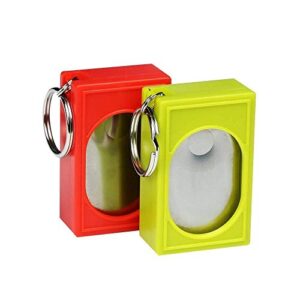
Crmada’s pocket-sized clicker delivers a crisp, consistent click that cuts through background noise during recall training. The lightweight ABS construction fits comfortably in your palm for repeated activations, and the metal mechanism produces reliable auditory feedback session after session.
You’ll appreciate the one-handed operation and wrist lanyard, which keeps your device accessible when practicing long-distance dog recall in the park.
Some users note the plastic housing shows wear over time, but for positive reinforcement training at an affordable price point, Crmada offers solid performance across dogs, cats, and other pets.
| Best For | Pet owners seeking an affordable, portable clicker for positive reinforcement training with dogs, cats, or other animals who respond well to auditory cues. |
|---|---|
| Weight | 0.52 ounces |
| Material | ABS |
| Wrist Strap | No |
| Color Options | Red and Lime Green |
| Pack Size | 2-pack |
| Training Use | Multiple pet types |
| Additional Features |
|
- Crisp, consistent click sound that’s audible at moderate distances without being harsh
- Lightweight and compact with one-handed operation and wrist lanyard for easy access during training sessions
- Budget-friendly two-pack option that works effectively for basic obedience, tricks, and recall training across multiple pet types
- Plastic housing and metal mechanism may show wear or feel flimsy with extended outdoor use
- Click volume receives mixed feedback—some find it too quiet while others find it adequate
- Durability concerns reported by some users, with quality varying between units
6. Brightkins Dog Training Clicker
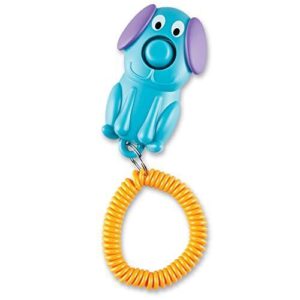
With its playful three-design lineup—blue Doggy, green Bone, and Hot Dog—Brightkins brings a splash of personality to your positive reinforcement training routine. The single-button clicker delivers sound consistency that marks each recall behavior with clarity, and the coil bracelet keeps the device within reach during training sessions at the park or in your backyard.
You’ll find the durable plastic construction holds up to daily use, though a few handlers report the button requires slightly firmer pressure than competing models, which may slow rapid-fire marking during dog training drills.
| Best For | Dog owners who want a fun, portable clicker for everyday positive reinforcement training with puppies or adult dogs. |
|---|---|
| Weight | 1.6 ounces |
| Material | Plastic |
| Wrist Strap | Coil bracelet |
| Color Options | Multi |
| Pack Size | Single |
| Training Use | Positive reinforcement |
| Additional Features |
|
- Three playful designs (blue Doggy, green Bone, Hot Dog) add personality to training sessions
- Coil bracelet attachment keeps the clicker handy during walks or park visits
- Durable plastic construction stands up to regular use in various training environments
- Button requires more pressure than some competing clickers, which may slow down rapid marking
- Click volume may not be loud enough for outdoor or noisy settings
- Some dogs may not respond to the clicker sound, limiting training effectiveness
7. Dog Training Clicker Kit
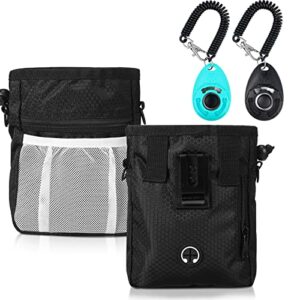
This all-in-one kit bundles two dog training clickers with wrist straps, a treat pouch measuring 9.29 × 4.25 × 2.28 inches, and a built-in poop bag dispenser so you can manage recall training sessions without juggling loose dog recall tools.
The hexagonal-patterned black pouch weighs just 6.4 ounces, and its integrated clip system keeps treats and pet training aids organized during walks or field drills.
You’ll appreciate the convenience, though handlers with thicker waists may find the closure snap reaches its limit, and the single-dog design won’t suit multi-pet households.
| Best For | Dog owners who want an organized, portable solution for positive reinforcement training sessions and walks with a single pet. |
|---|---|
| Weight | 6.4 ounces |
| Material | Plastic |
| Wrist Strap | Yes |
| Color Options | Black |
| Pack Size | Bundle with treat pouch |
| Training Use | Training sessions |
| Additional Features |
|
- Includes two clickers with wrist straps and a treat pouch in one lightweight package, so you don’t need to buy separate training gear.
- Built-in poop bag dispenser keeps essentials together, making walks and training sessions more convenient.
- Compact size (6.4 ounces) and durable construction make it easy to carry without adding bulk.
- Limited closure snap may not fit comfortably on people with thicker waists.
- Designed for single-dog training, so it won’t work well if you’re training multiple dogs at once.
- No adjustable strap means you can’t customize the fit to your preference.
8. Diyife Dog Training Clicker
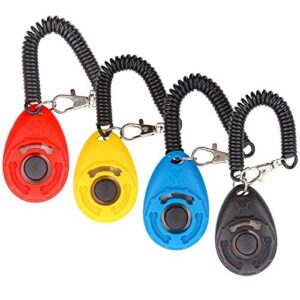
When you need loud, clear feedback for outdoor dog recall, Diyife’s four-pack of plastic clickers delivers a crisp sound that cuts through backyard distractions.
Each clicker features ABS construction with a stainless steel ring piece, an elastic wrist strap for quick access, and a matte, non-slip grip that stays comfortable during long training sessions.
You’ll get four colors—black, yellow, red, and blue—so you can designate one per family member or training goal, making clicker training more organized and consistent across your household.
| Best For | Dog owners who train outdoors and need a loud, durable clicker with wrist-strap convenience—especially helpful if multiple people are involved in training. |
|---|---|
| Weight | 100 Grams |
| Material | ABS plastic + stainless steel |
| Wrist Strap | Yes |
| Color Options | Black/Yellow/Red/Blue |
| Pack Size | 4-pack |
| Training Use | Basic obedience |
| Additional Features |
|
- Four clickers in different colors let you assign one per person or training task, keeping everyone consistent
- Loud, crisp sound works well in outdoor environments where softer clickers get lost
- Elastic wrist strap and matte grip make it easy to grab and use without fumbling
- Volume may be too intense for noise-sensitive dogs or quiet indoor spaces
- Button requires a firm press, which can be tough for kids or anyone with hand strength issues
- Some buyers report quality control problems, like clickers arriving broken or malfunctioning quickly
9. Left And Right Dog Training Kit

The Left And Right Dog Training Kit bundles a silicone treat pouch with dual training clickers, giving you everything you need for focused recall training sessions.
The food-grade pouch clips to your waist with a magnetic buckle and holds treats securely, while the clickers deliver a distinct sound for precise marking.
You can use the system to teach directional cues or basic obedience training, making it adaptable for dogs, cats, and other pets.
The dishwasher-safe design and lightweight build keep your dog training methods simple and hygienic.
| Best For | Dog owners who want a hands-free training setup with directional recall cues and quick treat access during outdoor practice sessions. |
|---|---|
| Weight | 100 Grams |
| Material | Silicone |
| Wrist Strap | No |
| Color Options | Black |
| Pack Size | Kit with treat pouch |
| Training Use | Basic obedience |
| Additional Features |
|
- Includes both a silicone treat pouch and clickers in one kit, so you don’t need to buy separate gear
- Food-grade silicone pouch is dishwasher safe and easy to clean after messy training sessions
- Magnetic buckle and waist clip let you keep treats and clickers accessible without using your hands
- Clickers can feel bulky and uncomfortable to hold during longer training sessions
- Pouch closure may pop open unexpectedly, especially when you bend over or move quickly
- Treats sometimes fall out when the magnetic seal doesn’t stay fully closed
10. Szo Dog Training Treat Pouch
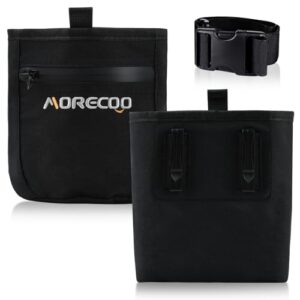
The Szo Dog Training Treat Pouch pairs a durable 600D nylon pouch with an included clicker, giving you the recall tool kits you need in one compact package. Dog training accessories like this keep treats secure with a magnetic closure, while the adjustable belt clip lets you deliver your reward the moment your dog responds.
The front zipper pocket stores keys and personal items, and the hands-free design facilitates positive reinforcement training during walks or recall training sessions when you need fast, consistent access to your dog training methods.
| Best For | Dog owners who want a hands-free training solution that keeps treats and personal items organized during recall sessions and walks. |
|---|---|
| Weight | 3.52 ounces |
| Material | 600D Nylon |
| Wrist Strap | No |
| Color Options | Black |
| Pack Size | Bundle with treat pouch |
| Training Use | Hands-free training |
| Additional Features |
|
- Magnetic closure provides quick, one-handed access to treats for immediate reward delivery during training
- Includes a pet training clicker and adjustable belt clip, giving you essential tools in one compact package
- Front zipper pocket securely stores keys, phone, and poop bags while keeping treats separate
- Waist strap may feel flimsy and less durable compared to higher-end training pouches
- Durability concerns with some users reporting wear after 8 months of regular use
- Stitching can weaken over time, requiring occasional inspection and maintenance
Effective Recall Training Techniques With Clickers
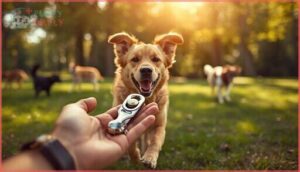
You’ve got your clicker in hand, now it’s time to build a rock-solid recall that actually works when it counts.
The techniques below will walk you through the exact process, from your first click to handling real-world distractions.
Let’s break down how to transform that come-when-called into second nature for your dog.
Step-by-Step Clicker Recall Process
Start with three-minute sessions in a quiet room where you and your dog can focus. Click the exact moment your dog looks at you or takes a step toward you, then immediately deliver the treat.
Gradually increase distance—first five feet, then ten—while keeping your clicker timing sharp.
Add mild distractions only after your dog shows recall consistency at shorter ranges.
Using High-Value Rewards
Your timing matters, but so does what comes after the click. High-value incentives—small pieces of chicken, cheese, or freeze-dried liver—drive faster learning and stronger motivation than kibble alone. Rotate treat variety to keep your dog enthusiastic and prevent boredom.
Reward scheduling starts dense during early clicker training, then thins as recall improves. Positive reinforcement thrives when your reward system matches your dog’s preferences, not your assumptions.
Gradually Increasing Distance and Distractions
Once your dog nails short-range recall training, push distance by 2–3 meters per session—but only after you hit 80% success across three trials.
Add distractions like foot traffic or family members in controlled blocks, keeping your clicker timing sharp and high-value treats ready.
Training environment matters: practice long distance recall in your yard before testing at the park, building recall consistency through positive reinforcement and smart distraction management.
Troubleshooting Common Recall Challenges
Even with exceptional timing, recall obstacles pop up. If your dog ignores the recall command past ten meters, drop back to shorter distance control and tighten reward schedules—immediate clicks build trust.
Environmental factors like squirrels or traffic can derail progress, so revisit positive reinforcement basics and layer in clicker training strategies that address real training mistakes before advancing again.
Tips for Consistent Success in Recall Training

You’ve learned the mechanics of clicker training, but consistent results come from knowing what works day after day. Small adjustments in how you practice can make the difference between a dog who sometimes comes and one who always responds.
Let’s cover the strategies that keep your recall training on track, from keeping sessions fresh to making it work in the real world.
Maintaining Motivation and Engagement
Your dog’s enthusiasm will wane if every session feels like yesterday’s rerun. Keep training fresh with high-frequency, short bursts that energize rather than drain. Rotate these engagement strategies to maintain motivation:
- Switch reward systems between treats, toys, and verbal praise
- Vary environments from quiet rooms to bustling parks
- Pair your clicker with highly valued reinforcements
- Track progress metrics to adjust difficulty intelligently
Positive reinforcement thrives on novelty and success.
Training Session Best Practices
Structure your training sessions around clear objectives and consistent timing. Keep each session brief—five to ten minutes—and reinforce within half a second of your dog’s correct response.
You’ll build stronger recall habits when you control distractions, use positive reinforcement consistently, and log each session’s distance, duration, and outcomes. Clicker training thrives on routine, so schedule your dog training at the same time daily.
Avoiding Common Clicker Mistakes
Consistently, trainers undermine their clicker training by clicking for attention rather than a completed behavior. You’ll sabotage recall training if you make these three errors:
- Clicking without an immediate reward—breaking the 0.5–1.5 second rule
- Using multiple cues simultaneously, confusing your dog’s response
- Punishing or correcting after you’ve clicked
Perfect your clicker timing, maintain reward consistency, and pace sessions to prevent fatigue for reliable positive reinforcement.
Reinforcing Recall in Real-World Scenarios
Real World Recall requires controlled escalation from your backyard to bustling sidewalks and dog parks. Start in low-distraction zones, then systematically introduce competing stimuli—joggers, squirrels, other dogs. Deliver your reward within two seconds of the click to cement Distance Control and Recall Consistency.
Track your progress with measurable benchmarks:
| Environment | Success Criteria |
|---|---|
| Quiet park | 90% recall at 30 feet |
| Urban Training street | 80% recall with pedestrians |
| Off-leash area | 75% recall near dogs |
Environmental Factors like weather and time of day affect performance, so practice during morning and evening cycles. Short, frequent drills using Clicker Training and Positive Reinforcement outperform marathon sessions—you’ll build durable Dog Recall that holds up when it matters most.
Frequently Asked Questions (FAQs)
Can clickers work for deaf dogs?
Where there’s a will, there’s a way. Deaf dogs thrive with vibration training devices, visual cues like hand signals, and tactile feedback.
Replace the auditory click with consistent silent recall markers, pairing rewards for reliable positive reinforcement success.
When should I stop using the clicker?
You can phase out the clicker once your dog hits 90% accuracy across three outdoor settings for two weeks. Keep rewards high, and reintroduce the marker if performance drops during shift.
What if my dog fears the sound?
If your dog shows fear response, switch to alternative markers like a verbal cue while you work on sound desensitization.
Pair the clicker with treats from a distance, gradually moving closer through counterconditioning to ease canine anxiety.
How do I introduce clicker to puppies?
Start gently—pair each click with an immediate treat in a quiet space. Keep sessions under three minutes, reward within two seconds, and let your puppy build a happy association before tackling recall training.
Can I use apps instead of clickers?
You can try training apps as clicker alternatives, but digital cues often lack the crisp timing and consistency that make traditional clickers so effective for recall training and positive reinforcement.
Conclusion
Imagine your dog sprinting back to you through a crowded park, ignoring every distraction. That’s not luck—it’s the result of consistent clicker work.
The dog training clickers for recall training you’ve explored here aren’t magic wands, but they’re close. With the right tool in hand and commitment to the process, you’ll build recall that’s fast, reliable, and joyful.
Your freedom—and your dog’s safety—starts with a single click.
- https://karenpryoracademy.com/teach-your-puppy-to-enjoy-collar-handling/
- https://www.akc.org/expert-advice/lifestyle/current-trends-pet-spending-2021-2022/
- https://www.humanesociety.org/resources/positive-reinforcement-training
- https://www.ncbi.nlm.nih.gov/books/NBK470326/
- https://academichelpexpress.blog/2024/08/please-use-the-bulleted-points-and-the-rubric-below-to-guide-your-work-your-pa/