This site is supported by our readers. We may earn a commission, at no cost to you, if you purchase through links.
The bag says “chicken,” but the first ingredient is corn. The label claims “complete nutrition,” yet your puppy’s coat looks dull and his energy lags. Understanding puppy food labels and ingredients isn’t about being picky—it’s about giving your growing dog what his developing body actually needs.
Pet food labels follow strict regulatory rules, but manufacturers know exactly how to work within those boundaries. The product name, ingredient order, and nutritional claims all tell different stories, and sometimes those stories don’t align. Learning to read between the lines protects your puppy from nutritional gaps that can affect bone development, immune function, and long-term health.
Table Of Contents
Key Takeaways
- You can’t trust product names alone—words like “chicken dinner” require only 25% of that ingredient, while “with chicken” needs just 3%, so always check the ingredient list where items appear by weight.
- The first five ingredients make up most of your puppy’s food, and named animal proteins like “chicken meal” should top that list rather than vague terms like “byproducts” or cheap fillers like corn.
- Large-breed and small-breed puppies need different nutrient ratios—large breeds require controlled calcium (1.0-1.5g per 1000 kcal) to prevent joint problems, while small breeds need higher calorie density for their faster growth rate.
- The AAFCO statement confirming “complete and balanced for growth” matters more than marketing claims like “premium” or “natural,” which aren’t regulated and often mean nothing for your puppy’s actual nutrition.
Key Elements of Puppy Food Labels
When you pick up a bag of puppy food, the label holds essential information about what’s inside and whether it’s right for your growing dog. Each section of the label fulfills a specific purpose and follows industry standards designed to help you make informed choices.
Here are the key elements you’ll find on every puppy food package and what they mean for your pup’s nutrition. Learning how to read a dog food ingredients list helps you spot quality proteins, fillers, and additives that impact your dog’s health.
Product Name and Species Identification

Label accuracy starts with the product name—it should clearly state the food is for puppies. Regulatory compliance demands species clarity, preventing confusion between puppy and adult formulas. Look for these consumer guidance markers:
- “For Puppies” or “Growth Formula” near the product name
- Bold or capitalized species-specific terms
- Front-panel placement for quick recognition
- Alignment with feeding directions
- Confirmation on the brand’s website
When pet food labeling matches puppy ingredients, you’re on track. Ensuring the accuracy of labels is essential, much like addressing methodological flaws in scientific research.
Quantity Statement and Net Weight
After you’ve confirmed the product is for puppies, check the net weight displayed on the packaging. This quantity statement tells you exactly how much food you’re buying, usually in pounds or kilograms. Label accuracy here matters for feeding guidelines and cost comparison. Many first-time puppy owners find it helpful to cross-reference the net weight with their vet’s portion recommendations to avoid overfeeding or running out unexpectedly.
Verify the weight matches your expectations—it’s a straightforward step in food labeling that aids portion planning. Think of it as your baseline for calculating daily servings before you move to the guaranteed analysis. A well-planned husky raw dog food diet naturally balances these mineral ratios when you include the right mix of bone and organ content.
Guaranteed Analysis Panel
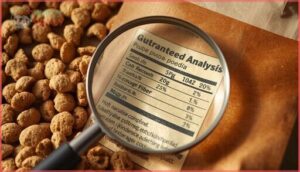
Once you know how much food is in the bag, look at the Guaranteed Analysis Panel. This label section lists minimum crude protein, crude fat, and maximum crude fiber and moisture content as percentages. Comparing these nutrient percentages helps you assess protein quality and moisture content across brands, though the panel doesn’t reveal nutrient bioavailability or ingredient quality without checking the full nutrition label and AAFCO statement for label compliance. Before diving deeper into nutrient percentages, it’s worth identifying ingredients that signal low-quality formulas so you know which brands to skip entirely.
- Crude protein and crude fat values show minimum amounts, but higher percentages don’t guarantee better protein quality or digestibility.
- Moisture content varies widely—canned puppy foods may be 75% moisture, affecting how you interpret nutrient concentrations.
- Guaranteed Analysis alone won’t confirm nutritional adequacy; you’ll still need the complete ingredients list and AAFCO guidance.
- Batch-to-batch differences can occur, so check the current label and feeding guidelines each time you buy.
Nutritional Adequacy Statement
After checking crude protein and moisture percentages, look for the nutritional adequacy statement. This wording confirms the food meets AAFCO guidelines for puppy nutrition and regulatory standards.
In the U.S., manufacturers must specify whether the formula accommodates growth, gestation/lactation, or all life stages. That statement tells you the product contains the proper nutrient requirements for healthy development, so pay close attention to its exact label claims.
Feeding Guidelines and Calorie Content
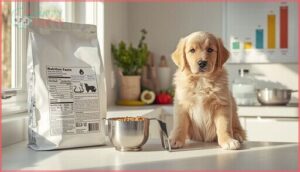
Your puppy’s label provides feeding directions that translate calorie content into daily feeding amounts scaled by weight and age. Many brands include feeding charts showing energy needs for growth phases, which guide calorie intake precisely. For owners preparing meals at home, homemade Saint Bernard dog food recipes offer portion guidance tailored to these large-breed puppies’ unique nutritional requirements.
Use the kcal per cup listed to budget portions accurately and support healthy puppy nutrition. Adjust servings based on your pup’s body condition to avoid overfeeding or underfeeding.
Decoding Ingredient Lists

The ingredient list is where you’ll find the real story behind your puppy’s food. Ingredients appear in order by weight, so the first few tell you what makes up most of the product.
Understanding what these ingredients actually mean helps you separate quality nutrition from clever marketing.
Ingredient Order and Weight Significance
The ingredient list reveals your puppy’s diet at a glance—every component appears in descending order by weight as formulated. Understanding this ranking enables you to decode what’s really fueling your pup’s growth.
- Moisture skews the picture: Fresh chicken weighs more than chicken meal, but meal packs concentrated protein once water evaporates.
- First five ingredients dominate: These make up the bulk of the formula, so scrutinize them closely during label reading.
- Weight doesn’t equal nutrition: A heavy ingredient isn’t always the most valuable for nutrient proportions or development.
Animal Protein Sources Vs. Byproducts
Protein quality hinges on transparency: named meat sources like “chicken meal” or “turkey” signal clear origins, while vague “byproduct” listings raise questions about digestibility and nutrient bioavailability.
Byproducts aren’t inherently bad—organs deliver essential amino acids—but their processing matters.
You’ll want dog food ingredients that list recognizable protein first on the label, ensuring your puppy’s nutritional requirements for growth are met efficiently.
Carbohydrates, Fats, and Fiber Sources
Energy sources on the label reveal whether your puppy’s carbohydrates, fats, and ingredients support sustainable growth. Nutritional requirements depend on balanced nutrient ratios and energy density:
- Carb sources like rice and oats offer digestibility with moderate fiber benefits
- Fat types (fish oil, poultry fat) fuel brain development and joint health
- Ingredient analysis should show whole grains before fillers
- Proper ratios prevent rapid weight gain
- Fiber benefits include stool quality and gut support
Artificial Additives and Preservatives
Preservatives are essential for keeping puppy food fresh, but not all additives are created equal. Synthetic preservatives like BHA and BHT carry potential toxicity risks, prompting many manufacturers to offer natural alternatives such as tocopherols and rosemary extract. Regulatory standards govern permissible levels, yet label transparency varies.
| Preservative Type | Purpose & Safety Notes |
|---|---|
| BHA, BHT, Ethoxyquin | Prevent rancidity; debated safety at high levels |
| Tocopherols (Vitamin E) | Natural antioxidant; shorter shelf life |
| Ascorbic Acid (Vitamin C) | Maintains freshness; generally recognized as safe |
| Rosemary Extract | Plant-based preservative; growing popularity |
Check the ingredients label carefully. Food safety depends on understanding which preservatives protect nutrients and which ones you’d rather avoid for long-term health.
Importance of The First Five Ingredients
Your puppy’s nutrition hinges on those first five ingredients. Named animal protein sources—like chicken or salmon—should appear at the top, signaling strong nutrient balance and ingredient quality.
If fillers or byproducts dominate the label, digestive health and growth may suffer. Check these ingredients carefully to minimize food allergens and confirm your puppy’s dog food nutrition backs healthy development from day one.
Understanding Labeling Rules and Claims
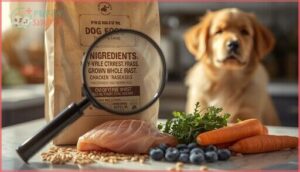
Puppy food labels follow strict naming conventions that can make or break your understanding of what’s actually in the bag. These rules determine how much of an ingredient must be present before a brand can spotlight it in the product name.
Let’s break down the most common labeling standards so you can see past the marketing and focus on what your puppy is really eating.
95% Rule, 25% Rule, and “With” Rule
Three labeling regulations govern how ingredients appear in product names, helping you see through misleading claims on any puppy food label. Understanding pet food labels requires knowing these naming conventions and ingredient thresholds:
- 95% Rule: The named ingredient must comprise 95% of the product weight, ensuring regulatory compliance
- 25% Rule: Often uses terms like “dinner” or “entrée” when the ingredient reaches only 25%
- “With” Rule: Requires just 3% of the highlighted ingredient—watch for this phrasing
- AAFCO standards: These rules align with guaranteed analysis requirements for transparency
- Marketing terms: Product names can mask lower ingredient amounts without violating regulations
“Complete and Balanced” Vs. “Supplemental”
Understanding pet food labels requires knowing the difference between complete and balanced formulas and supplemental foods. A complete and balanced label claims the diet meets nutrient profiles and regulatory standards for growth when fed alone. Supplemental foods lack full nutritional adequacy and must pair with another diet. Always check the statement for pet nutrition assurance.
| Label Type | Intended Use |
|---|---|
| Complete and Balanced | Sole diet for growth or maintenance |
| Supplemental | Must combine with primary food |
| Growth Formula | Meets puppy nutrient requirements |
| Maintenance Only | Not suitable for puppies |
| Indeterminate | Lacks clear life stage guidance |
Verify ingredients and feeding guidelines before choosing your puppy’s primary food.
Life Stage Designations (Puppy, All Life Stages)
Once you’ve confirmed a diet is complete and balanced, check the life stage claim. A “puppy” or “growth” designation signals the formula meets higher protein, energy, and nutrient needs for developing dogs.
“All life stages” means the food works for puppies and adults, though breed size matters—large-breed puppies need controlled calcium and phosphorus.
Always match the label to your puppy’s growth phase.
Grain-Free, Natural, and Organic Claims
Many bags boast “grain-free,” “natural,” or “organic” on the front, but these claims aren’t always what they seem. Grain-free benefits lack strong evidence—some formulas may even substitute grains with less digestible ingredients.
Natural ingredients mean minimal processing, yet standards vary. Organic certification requires verified compliance with USDA rules.
Always check for label verification and third-party seals to confirm nutritional adequacy and food labeling and safety.
Misleading Product Names and Marketing Terms
Eye-catching phrases like ‘premium,’ ‘gourmet,’ or ‘veterinarian approved’ often lack regulatory oversight, creating label deception. Marketing claims may exploit product name rules—’With Chicken’ requires only 3% chicken. False advertising thrives where descriptive terms aren’t tightly controlled.
Consumer protection depends on reading beyond the front panel. Check pet food labeling requirements, guaranteed analysis, and AAFCO statements to verify nutritional adequacy instead of trusting marketing alone.
Evaluating Nutritional Adequacy for Puppies
Reading a puppy food label isn’t just about checking boxes—it’s about making sure your growing dog gets the right fuel at the right time. Puppies need specific nutrients in precise amounts to build strong bones, healthy muscles, and a solid foundation for life.
Reading puppy food labels means ensuring your growing dog gets the precise nutrients needed to build strong bones, healthy muscles, and a foundation for life
Here’s what you need to verify to guarantee the food you choose truly assists your puppy’s development.
Essential Nutrients for Growth and Development
Your puppy’s body is building itself from the ground up, and every nutrient plays a role. Protein sources fuel lean muscle and organ maturation, while vitamins and minerals drive enzymatic processes and immune strength.
Growth factors like DHA support brain development, and nutritional balance ensures proper skeletal formation.
Nutritional adequacy means meeting developmental needs without excess—the foundation of puppy nutrition.
Protein, Fat, Calcium, and Phosphorus Requirements
Your puppy needs at least 22 percent crude protein on a dry matter basis to support lean muscle and organ growth. Fat Requirements sit between 8 and 20 percent, delivering energy and essential fatty acids for brain development.
Calcium Levels should range from 1.0 to 1.5 grams per 1000 kcal, balanced with Phosphorus Intake near a 1.2:1 ratio to guarantee proper skeletal formation without developmental risks.
Differences for Large Vs. Small Breed Puppies
Breed size matters because your large breed puppy gains weight more slowly—reaching 80 percent of adult size by six months—while small breeds mature faster. Growth rate differences demand distinct nutrient balance: large breeds need controlled calcium for joint health, whereas small breeds require higher caloric density.
Dog food labels reflect these dietary needs through pet food labeling, guiding your nutrition planning and feeding schedules with breed-specific ingredients.
Role of Added Vitamins and Minerals
Added vitamins and minerals act as essential co-factors in your puppy’s metabolism and bone formation. You’ll see vitamin A, D, E, and B-complex alongside calcium, phosphorus, and zinc listed on ingredients and labeling panels.
Bioavailability varies by form—chelated minerals absorb better than inorganic sources—and mineral balance matters for skeletal health. Excess dietary supplements risk nutrient toxicity, so follow feeding guidelines for safe nutrition planning.
Using AAFCO Statements for Nutritional Assurance
You can confirm your puppy food meets nutritional adequacy by checking the AAFCO statement on the label. Look for phrases like “complete and balanced for growth” backed by feeding trials or nutrient profiles that match regulatory standards.
AAFCO compliance doesn’t endorse brands but ensures the guaranteed analysis and ingredients align with established protocols for label accuracy and proper nutrition during development.
Safe Selection and Storage Practices

You’ve learned how to read labels and identify what’s in the bag. Now it’s time to turn that knowledge into action by choosing quality food and keeping it safe.
The following practices will help you select the right brand, store it properly, and recognize when something isn’t working for your puppy.
Choosing Reputable Puppy Food Brands
You want Dog Food from brands that show transparency in Ingredient Sourcing and earn Veterinary Endorsements. Check for AAFCO statements on labeling and seek Industry Certifications like GMP or ISO. Review Recall History to confirm safety, and ask for Veterinary Advice when unsure.
Brand Transparency matters—reputable companies disclose where ingredients originate and employ nutritionists to meet Pet Food Regulation standards.
Assessing Food Safety and Expiration Dates
After confirming a brand’s credibility, focus on Pet Food Safety and Quality through expiration dates and Food Safety Guidelines. Check “best by” dates—dry puppy foods usually last 12 to 18 months, while canned products expire sooner. Stay alert for Food Recall Alerts by reviewing lot codes. Watch for Spoilage Signs like off-odors or bulging cans. These Pet Food Handling steps protect your puppy from contamination risks.
- Prioritize the “best by” date for quality assurance
- Inspect cans for bulging or leaks before purchase
- Note lot codes to track potential recalls
- Discard food showing mold, odor, or discoloration
- Contact the manufacturer if safety concerns arise
Proper Storage to Preserve Freshness
Once you’ve checked expiration dates, protect that freshness through proper Dry Food Storage. Keep kibble in its original bag, then slide it into Airtight Containers to guard against Moisture Control issues and oxygen. Store in a cool, dry spot below 80°F—heat and humidity invite mold and rancidity.
Use opened dry food within four to six weeks for peak Shelf Life and Food Safety. Proper storage is key to preventing dog food spoilage.
Monitoring for Intolerance or Allergies
After storing food properly, watch for signs your puppy’s immune system isn’t tolerating the ingredients. Allergy symptoms and intolerance signs differ in reaction timing and severity, so sensitivity testing through food trials helps pinpoint triggers.
- Vomiting within two hours of eating new pet food labeling signals possible intolerance
- Diarrhea lasting over 24 hours after a dietary change requires evaluation
- Skin reactions—itching, hives, or swelling—suggest food allergies
- Appetite loss with gastrointestinal signs indicates sensitivity
When to Seek Veterinary Nutrition Advice
If your puppy shows persistent vomiting or diarrhea beyond 24 hours, seek veterinary nutrition guidance immediately. Veterinary care becomes essential when growth stalls, skeletal deformities appear, or suspected food allergies arise.
Dietary consultations help address chronic pet health issues like kidney or liver conditions that alter nutrient needs. Medical nutrition advice ensures your puppy’s diet fosters ideal development.
Frequently Asked Questions (FAQs)
Can I mix different puppy food brands together?
Yes, blending brands is acceptable when both dog food formulas meet AAFCO growth standards. Introduce the dietary shift gradually over one to two weeks, monitoring nutrient balance and puppy nutrition through stool quality and body condition.
How do I transition between puppy food formulas?
Introduce the new formula slowly over 7 to 14 days to support digestive health and maintain nutrient balance.
Replace 25% of your current dog food daily, monitoring for food sensitivity signs that affect puppy development and nutritional adequacy.
What are probiotics and does my puppy need them?
Probiotics are live microorganisms supporting gut health and microbiome balance in puppies.
Your veterinarian can guide when canine supplements are appropriate, especially during digestive upset or antibiotic use, ensuring nutritional adequacy for your puppy’s unique needs.
Should puppies eat wet food, dry food, or both?
Both wet and dry food offer distinct advantages for puppy nutrition. Mixed feeding strategies can balance moisture intake with dental benefits, but you’ll need to monitor total caloric intake carefully to prevent overfeeding.
How often should I change my puppys food?
You don’t need to change your puppy’s food frequently. Once you find a complete and balanced diet meeting nutritional adequacy standards, maintain it for one to two months, monitoring health and adjusting portions as your puppy grows.
Conclusion
The irony? Pet food companies count on you not understanding puppy food labels and ingredients. They’ve mastered the language of compliance while leaving gaps wide enough for nutritional shortcuts.
But now you recognize the difference between marketing and reality. You can spot protein splitting, decode percentage rules, and demand true nutritional adequacy.
Your puppy’s health doesn’t depend on trusting labels anymore—it depends on reading them correctly. That knowledge changes everything.
- https://www.fda.gov/animal-veterinary/animal-health-literacy/fdas-regulation-pet-food
- https://talkspetfood.aafco.org/readinglabels
- https://www.aafco.org/consumers/understanding-pet-food/reading-labels/
- https://www.sciencedirect.com/science/article/pii/S0749208123000268
- https://www.linkedin.com/posts/bohdanlukianets_tasks-study-research-activity-7373377539521667072-UTEi