
This site is supported by our readers. We may earn a commission, at no cost to you, if you purchase through links.

When Max von Stephanitz registered the first German Shepherd in 1899, he built the breed around one standard: a dog that could work. The spine ran level, the structure was balanced, and every physical trait served a purpose. That original dog looked nothing like the dramatically angled show lines many people picture today.
The straight back German Shepherd carries that founding blueprint forward. Level topline, correct pelvic angle, and even weight distribution across all four limbs—these aren’t just aesthetic preferences. They shape how the dog moves, how it ages, and what it can do across a working lifetime.
Table Of Contents
- Key Takeaways
- What is a Straight Back German Shepherd?
- Straight Back German Shepherd History
- Straight Back German Shepherd Appearance
- Straight Back German Shepherd Health
- Straight Back German Shepherd Ownership
- Frequently Asked Questions (FAQs)
- Should a German Shepherd have a straight back?
- Are straight back German Shepherds healthier?
- Why does my German Shepherd have a straight back?
- Are straight back German Shepherds better?
- What breeders have German Shepherds with straight backs?
- How much do straight back German Shepherds cost?
- Are straight back German Shepherds recognized by AKC?
- How long do straight back German Shepherds live?
- Can straight back German Shepherds compete in shows?
- What do straight back German Shepherds eat?
- Conclusion
Key Takeaways
- The straight back German Shepherd’s level spine isn’t just a look — it’s the original working design Max von Stephanitz built in 1899, and it’s still the blueprint that keeps these dogs moving well for life.
- A level topline spreads weight evenly across all four limbs, which means less joint stress, fewer spinal problems, and better mobility as your dog ages compared to sloped-back show lines.
- Back shape alone won’t protect your dog — you still need to ask breeders for OFA hip and elbow certifications, degenerative myelopathy DNA results, and documented health testing on both parents before you buy.
- These dogs thrive when their physical and mental needs are met daily, so plan for two exercise sessions, regular coat maintenance, and early socialization if you want a confident, well-balanced companion.
What is a Straight Back German Shepherd?
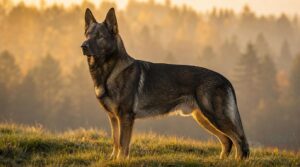
The straight back German Shepherd embodies the breed’s original vision—level spine, strong frame, built to move all day without breaking down. This type remains true to its functional roots, designed for endurance and resilience.
That enduring build makes the straight back German Shepherd one of the top picks among best farm dog breeds that need to pull double duty across long working days.
Its appearance is often misunderstood, particularly as show lines have drifted further from the original blueprint. Here’s what actually defines a straight back GSD: a structure prioritizing utility over exaggerated features, aligning with the breed’s historical purpose.
Definition of a Straight Back German Shepherd
A straight back German Shepherd is defined by a level skeletal profile — the topline runs roughly flat from the withers to the croup when the dog stands naturally. Within breed lexicon, ‘straight back’ is an appearance-based visual reference point, not a medical label. It marks structural efficiency rooted in the AKC German Shepherd breed standard’s original intent: a dog built to work, not just look impressive.
Straight‑back GSDs generally suffer fewer spinal problems compared with sloped‑back lines.
How The Level Topline Differs From Sloped-back German Shepherds
The biggest difference comes down to pelvic slope impact. A straight back German Shepherd maintains a level topline with correct angulation, keeping spinal stress distribution even across all four limbs. A sloped-back line shows a visible drop from withers to croup, driven by genetic topline variation and exaggerated hindquarter angles.
This topline angle standard directly shapes movement fluidity—and long-term joint health.
Old-fashioned Straight-backed German Shepherd Meaning
When people say "old-fashioned German Shepherd," they mean a dog with a traditional skeletal outline — level back, balanced frame, wolf-like silhouette. It’s community terminology, not an official classification.
Owners use this term to describe a backline preference rooted in functional type perception: a Straight Back German Shepherd that looks built to work, not just stand in a show ring.
Working-line Versus Show-line Appearance
Working lines and show lines look noticeably different side by side.
Straight Back German Shepherd from working lines carries a level Silhouette Profile, balanced Leg Length Ratio, and compact Body Compactness built for endurance.
Show lines feature a sloped topline, greater Hindquarter Angle, and richer Coat Feathering — visually striking, but the Health implications of back conformation in German Shepherds favor functional conformation versus show exaggeration every time.
Why The Term “straight Back” Became Popular
The term caught fire because it just works. Buyers needed a simple search-friendly labeling shorthand, and "Straight Back German Shepherd" delivered.
Social media buzz amplified it fast — breeders leaned into breeder branding, while show-ring jargon felt too technical for everyday conversations. The phrase became convenient debate shorthand around breed standards and controversy over sloped-back dogs.
Simple language wins every time.
Straight Back German Shepherd History

The straight back German Shepherd didn’t just appear out of nowhere — it has roots that go back over a century. Understanding where this dog came from helps you see why its build matters so much.
Here’s how the breed’s history unfolded.
Max Von Stephanitz and The Original Breed Purpose
Max von Stephanitz founded the SV club in 1899 with one clear goal: a dog built to work. His fitness-for-work ethos drove every decision. He chose Horand von Grafrath as the foundation sire, which anchored the historical development of the German Shepherd breed around real ability.
The straight back German Shepherd’s breed standard and working dog traits—from herding to rescue—all trace back to that early breeding philosophy and diverse working roles.
Early German Shepherd Breed Standards
From the very beginning, the SV standard language was precise about what a working dog should look like.
Early breed selection prioritized a level topline, a controlled croup angle near 23 degrees, and a length ratio where body length ran 10–17% longer than height.
These historical conformation priorities weren’t arbitrary — they locked in the original straight back that Max von Stephanitz intended:
- Level spine from withers to croup
- Compact loin for efficient weight transfer
- Balanced proportions supporting sustained trot
Functional Back Structure for Endurance and Trotting
A straight back isn’t just about looks — it’s an engineering choice. That level topline keeps spinal alignment consistent stride after stride, so the dog doesn’t bleed energy through unnecessary flexion.
A straight back is not aesthetics — it is engineering, keeping every stride efficient and every joint protected
| Structural Feature | Endurance Benefit |
|---|---|
| Lumbosacral Support | Stabilizes pelvis through repeated strides |
| Core Stability | Resists twisting during diagonal trot |
| Forequarter Load | Front end absorbs impact without back collapse |
| Hindquarter Transfer | Drives power forward cleanly and efficiently |
That’s functional conformation doing exactly what it was built for.
How Show-line Breeding Changed The Topline
Show-line breeders began selecting for a sculpted spinal silhouette — one where withers’ emphasis, lumbar curve, and croup balance created a polished "picture" in the ring. The goal shifted from function to form, prioritizing aesthetic appeal over practical utility.
This topline rest carriage looked striking to judges, but it pulled the German Shepherd conformation straight back from its working roots, widening the gap between working versus show lines. The emphasis on visual refinement diverged sharply from the breed’s original purpose-driven structure.
The Straight Back German Shepherd Controversy
The controversy around the Straight Back German Shepherd is louder than ever — fueled by marketing hype, social media debate, and real buyer bias.
Here’s what actually drives the divide:
- Judging criteria vary, making standard interpretation inconsistent across shows
- Differences between straight and sloped-back German Shepherds get oversimplified online
- Health implications of back conformation in German Shepherds are real but complex
- Myths about straight back German Shepherds spread fast without evidence
- Breed standards and controversy over sloped-back dogs continue pushing buyers toward labels over health testing
Straight Back German Shepherd Appearance
The straight back German Shepherd has a look that sets it apart the moment you see it — sturdy, balanced, and built like it means business. From how tall it stands to the texture of its coat, every detail tells you this is a dog shaped for real work.
Here’s what you can expect regarding appearance.
Male and Female Size Expectations
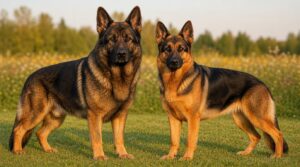
Most adult male Straight Back German Shepherds stand 24 to 26 inches tall and weigh 65 to 90 pounds — solid numbers for a large breed dog. Females are slightly smaller, typically measuring 22 to 24 inches and weighing 50 to 70 pounds.
These breed standard ranges serve as guidelines rather than rigid rules. Body condition scoring matters more than weight alone, as muscle tone and overall build provide a more accurate health assessment.
Rectangular Body Shape and Level Spine
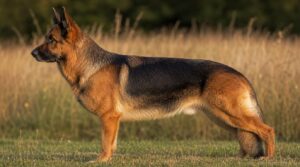
One look at a Straight back German Shepherd tells you everything about its build. The torso length ratio is longer than the dog is tall, creating that signature rectangular silhouette. This isn’t just about looks — it’s function. Proper pelvic alignment and spinal load distribution ensure strong midsection support and controlled backline flexibility.
- Level spine from withers to croup
- Torso visibly longer than height
- Minimal curvature through the back segment
Chest Depth, Shoulder Angle, and Movement
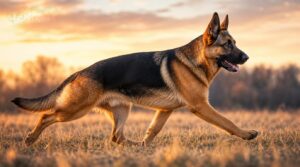
Chest depth impact matters more than most people realize. On a Straight-Back German Shepherd, the ribcage sits deep enough — about 45–48% of the dog’s height — to support real lung capacity and free elbow movement.
Pair that with correct angulation and a proper shoulder reach angle, and the foreleg path opens up naturally, producing a smooth, balanced trot with genuine biomechanics of German Shepherd movement behind every step.
Tail Shape and Overall Balance
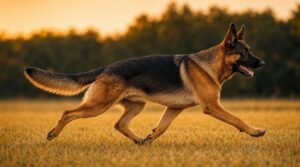
The tail tells the full story of a Straight Back German Shepherd’s structural balance in working dogs.
- Tail set aligns naturally with the level spine
- Tail carriage rises with alertness, lowers with calm
- Tail taper flows gradually toward the tip
- Tail flexibility aids the smooth counterbalance role during movement
Correct angulation and balanced proportions make every step look seamless.
Common Coat Colors and Coat Texture

Coat colors on a Straight Back German Shepherd range from classic black saddle contrast to rich sable, solid black, and warm tan. The sable pattern depth can shift from silvery-gray to reddish-brown depending on light. Their distinctive texture arises from double-coat layers: a soft undercoat beneath coarser guard hairs, which defines the breed’s standard texture.
Grooming frequency is critical. Regular brushing helps control seasonal shedding and maintains healthy coat texture variations year-round. This practice ensures the coat’s integrity and adapts to seasonal changes.
Differences Between Straight and Sloped Backs
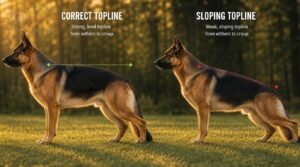
When you observe a straight back German Shepherd from the side, the difference is immediate. The spine remains level, creating a clean visual topline contrast against the sloped back’s downward curve toward the hips.
This variation in hindquarter angulation fundamentally alters stride fluidity, spine alignment stress, and long-term canine spinal health. The structural mechanics directly influence movement efficiency and skeletal strain.
Understanding these health implications of back shape empowers informed decisions when selecting a dog, prioritizing both performance and welfare.
Straight Back German Shepherd Health

Health is one of the biggest reasons people choose straight-back German Shepherds in the first place. Their build affects everything, from how they move to how their joints hold up over the years.
What you should know before bringing one home is essential to ensure their long-term well-being and your preparedness as an owner.
Are Straight Back German Shepherds Healthier?
The short answer is yes — and the science backs it up. Straight Back German Shepherds tend to show fewer signs of movement asymmetry and lumbosacral stenosis, two serious concerns tied directly to backline genetics.
A level spine distributes load more evenly across all four limbs, which shows up in longevity indicators like sustained mobility and working capacity well into later years.
Hip and Elbow Dysplasia Risks
Straight-backed dogs still carry genetic risk for hip and elbow dysplasia — no conformation eliminates that.
What helps is joint congruence from level limb alignment, plus smart growth management during puppyhood. Avoid hard-surface impact early on.
Always ask breeders for hip dysplasia testing, elbow dysplasia testing, and genetic screening through the Orthopedic Foundation for Animals.
Thorough hip and elbow health testing is your first real line of defense.
Spine, Joint, and Mobility Considerations
A level spine isn’t just about looks — it’s about how your dog’s body holds up over years of activity. For straight-backed German Shepherds, spinal ligament flexibility, intervertebral disc cushioning, and facet joint loading all work together to support healthy movement.
Watch for these mobility red flags:
- Stiffness after exercise
- Reluctance to climb stairs
- Shortened stride
- Rigid mid-back posture
Gait, Weight Distribution, and Biomechanics
Watch how a straight-back German Shepherd moves — it’s canine biomechanics at its best. Their skeletal balance enables true limb load symmetry, meaning ground reaction forces distribute evenly across all four legs.
That efficient locomotion comes from a level spine keeping the center of mass stable through every gait phase.
Pelvic stabilization stays consistent, reducing wear on joints over time.
Degenerative Myelopathy Screening
Genetic health testing is crucial in breeding, particularly for screening the SOD1 mutation linked to degenerative myelopathy. This process employs a DNA collection kit to identify genetic risks. Testing labs classify results into clear test result categories—clear, carrier, or affected—to guide breeding decisions.
A smart carrier breeding strategy involves pairing carriers exclusively with clear dogs to minimize disease transmission. Health certifications must document these practices to maintain transparency and accountability.
Importantly, degenerative myelopathy requires a clinical exclusion diagnosis; DNA testing alone cannot confirm the disease. This distinction ensures accurate health assessments and responsible breeding practices.
Bloat Risk in German Shepherds
German Shepherds have a deep chest, and that body shape makes bloat a real risk.
A good feeding schedule helps — split meals into smaller portions, slow rapid eating down with a puzzle feeder, watch water intake after meals, and keep exercise timing away from feeding.
Average Lifespan and Long-term Mobility
Straight-back German Shepherds generally live 9–13 years, and many remain active well into their senior years, especially when joint disease prevention begins early. Weight management and adapting activities for seniors significantly enhance their quality of life.
Key areas to monitor include:
- Arthritis management needs
- Mobility aid options as hind-end strength fades
- Signs of degenerative myelopathy
Good genetics, orthopedic screening, and a level back structure all support longer, healthier movement.
Straight Back German Shepherd Ownership

Owning a straight back German Shepherd is deeply rewarding, but it does come with real responsibilities you’ll want to understand upfront.
These dogs thrive when their needs are met consistently — from daily exercise to proper training and care.
Here’s what you should know before bringing one home.
Temperament and Family Suitability
This dog is built for family life — loyal, confident, and deeply bonded to the people it lives with. As a Family-Oriented Companion Dog, it thrives on a daily interaction schedule that mixes calm companionship with structured activity.
Child supervision tips matter most with toddlers. Consistent commands and a clear visitor greeting protocol keep behavior steady across every situation.
| Family Fit Factor | What It Looks Like | Why It Matters |
|---|---|---|
| Playtime Boundaries | Calm, structured play sessions | Prevents overexcitement or accidental knocks |
| Consistent Commands | Same cues from every household member | Builds reliable, predictable behavior |
| Visitor Greeting Protocol | Leashed, calm introductions with guests | Reinforces companion dog temperament and loyalty |
Low-drive Versus High-drive Straight Back Lines
Not all Straight Back German Shepherds are wired the same way. Low drive canine lines — your calm, steady companions — show gentler motivation patterns, settle easily around distractions, and suit Low Energy German Shepherds for Family Life roles perfectly.
High drive dogs require stronger arousal control, deliberate training pacing, and structured jobs. Understanding where your dog falls shapes everything about working vs companion dogs and daily distraction response.
Exercise and Mental Stimulation Needs
Your Straight Back German Shepherd needs daily exercise split into two sessions—morning and evening works well. Mix walks with scent enrichment games, where your dog hunts hidden treats using their nose.
Rotate puzzle toys to keep things fresh. Build skill progression gradually, adding distance or new environments.
Always follow active sessions with rest and recovery time so your dog stays calm and focused.
Training and Early Socialization
Start training early — your straight-back GSD is ready to learn from day one. Gentle handling of paws, ears, and mouth builds trust fast.
Progressive socialization in a home environment, loose-leash walking practice, calm dog introductions, and basic obedience cues like sit and name response lay the foundation.
Short sessions keep your family-oriented companion engaged without stress.
Grooming and Shedding Care
Your straight-back GSD’s double coat is a shedding machine — and managing it well makes life easier for everyone.
Build your routine around these four essentials:
- Brushing Frequency — Weekly, normally, daily during seasonal coat blows
- Deshedding Tools — Undercoat rake plus slicker brush, finished with a comb
- Bathing Routine — Every 6–8 weeks using dog-specific shampoo and conditioner
- Coat Drying — Brush while drying to pull loose undercoat out immediately
Skin allergy management also matters — flea prevention and diet stability protect coat health long-term.
Choosing a Responsible Straight Back Breeder
A good breeder is worth their weight in gold — and the right one leaves no question unanswered. Look for pedigree verification, documented hip dysplasia certification for puppies, and a straight back German Shepherd breeding program built on extensive hip and elbow health testing.
Responsible breeder criteria include limited litters, transparent breeding ethics, observable parent temperament, and genuine post-sale support that doesn’t end at pickup.
Health Testing to Ask About Before Buying a Puppy
Before you put down a deposit, ask the breeder for paperwork — not promises. A reputable straight back German Shepherd breeder should provide documented results for every parent, including:
- Hip Score and Elbow X-ray results through OFA certification or PennHip screening
- Eye Clearance, Heart Echo, and Myelopathy DNA confirming DM Tested status
- Full thorough hip and elbow health testing and degenerative myelopathy testing records
Frequently Asked Questions (FAQs)
Should a German Shepherd have a straight back?
A German Shepherd should have a straight back. Breed guidelines and veterinary perspective both support it — a level topline distributes weight evenly, reduces back issues, and keeps your dog moving comfortably for years.
Are straight back German Shepherds healthier?
In general, they tend to have better joint longevity and more even forelimb load — but back shape alone isn’t the whole story.
Orthopedic screening still matters far more than topline appearance.
Why does my German Shepherd have a straight back?
Your German Shepherd’s straight back comes down to genetic lineage and breeding objectives. If your dog descends from working lines, that level topline is exactly what those breeders selected for.
Are straight back German Shepherds better?
Depends on what you need. For endurance, joint health, and working roles, straight-back lines often edge ahead — but genetics, health screening, and the individual dog matter just as much as back structure.
What breeders have German Shepherds with straight backs?
Finding a reputable straight-back breeder takes research.
Southern Legacy German Shepherds, Southernwind Kennels, and breeders preserving Czech line or DDR lineage are solid starting points focused on AKC straight-back bloodline preservation.
How much do straight back German Shepherds cost?
Prices usually range from 1,200 to 2,500 euros, depending on breeder pricing tiers, bloodline, and location. Geographic price differences, import fees, and puppy age pricing all affect what you’ll pay.
Are straight back German Shepherds recognized by AKC?
The AKC doesn’t recognize "straight back" as a separate classification — it’s all one breed.
Your dog’s pedigree labeling, show eligibility, and AKC-registered status follow the German Shepherd breed standard’s topline language, not informal type names.
How long do straight back German Shepherds live?
Most straight back German Shepherds live 9 to 13 years.
Genetic screening, weight control, activity levels, nutritional balance, and preventive veterinary care all shape that number — especially when hip dysplasia or degenerative myelopathy enters the picture.
Can straight back German Shepherds compete in shows?
A straight back German Shepherd can compete in shows when it meets conformation standards for topline, angulation, and gait evaluation. Eligibility rules focus on movement and soundness, not marketing labels.
What do straight back German Shepherds eat?
Feed your dog a balanced diet built around quality protein — think named meats like chicken, beef, or salmon.
Pair this with healthy fats, fiber, and joint nutrition to support long-term mobility and steady energy levels.
Conclusion
Think of the straight back German Shepherd as a living echo of what von Stephanitz first put on paper—a dog built to last; not just to impress. The level topline isn’t a trend or a preference. It’s the reason these dogs move freely, age well, and keep working long after others slow down.
Choose a breeder who health tests; ask the hard questions, and you’ll bring home a dog that earns your trust every single day.
- https://www.pedigreegermanshepherds.com/resources/german-shephard-history/
- https://www.germanshepherds.com/threads/straight-back-vs-sloped-back.540042/
- https://pmc.ncbi.nlm.nih.gov/articles/PMC7567065/
- https://articles.hepper.com/straight-vs-sloped-back-german-shepherd/
- https://www.tasteofthewildpetfood.com/articles/behind-the-breed/german-shepherd/