This site is supported by our readers. We may earn a commission, at no cost to you, if you purchase through links.

Training a puppy in an apartment is a different game than working with one in a house with a backyard. You can’t just open a back door and wait—every potty break is a planned event, every session happens in tight quarters, and the wrong treat can leave your whole place smelling like a pet store.
What you reward your puppy with matters more than most owners realize. The right puppy training treats for indoor apartment training are small, low-odor, and irresistible enough to make your pup forget the neighbor’s dog barking through the wall. These ten options deliver exactly that.
Table Of Contents
- Key Takeaways
- 10 Best Puppy Training Treats for Indoor Apartment Training
- 1. The Honest Kitchen Beef Salmon Dog Treats
- 2. Open Farm Soft Beef Training Treats
- 3. Cloud Star Tricky Trainers Dog Treats
- 4. Full Moon Natural Beef Dog Treats
- 5. Onward Hound Soft Bison Training Treats
- 6. Polkadog Salmon Training Treats
- 7. Stella Chewy Freeze Dried Raw Beef Treats
- 8. Zukes Mini Naturals Chicken Training Treats
- 9. Pet Botanics Bacon Training Treats
- 10. Badlands Ranch Freeze Dried Beef Liver Treats
- Why Treat Choice Matters for Apartment Puppies
- Key Features of The Best Puppy Training Treats
- Best Ingredients for Sensitive Puppy Stomachs
- How Scent and Flavor Drive Training Motivation
- How to Use Treats Effectively During Potty Training
- How Many Treats Can a Puppy Have Daily
- How to Introduce New Treats Safely Indoors
- Apartment Puppy Training Tips Beyond The Treat
- Frequently Asked Questions (FAQs)
- Conclusion
Key Takeaways
- Soft, small treats under 3 calories each are your best bet for apartment training — they keep sessions moving fast without blowing your pup’s daily calorie budget.
- Scent control matters as much as treat quality indoors — low-odor options like chicken or turkey won’t take over your living space the way fish-based treats can.
- The reward has to land within 1–3 seconds of the right behavior, so keep treats in your pocket or a belt pouch — timing is everything in potty training.
- Single-ingredient or short-label treats are the safest pick for sensitive puppy stomachs — less on the label means fewer chances for a reaction mid-training.
10 Best Puppy Training Treats for Indoor Apartment Training
Not every treat cuts it when you’re training in a tiny apartment — you need something small, soft, and worth working for.
Soft, protein-rich options like freeze-dried liver work especially well — and if you have a powerful breed, check out these high-protein dog food picks for Pit Bulls to keep training fuel consistent all day.
These ten options check all the right boxes for indoor potty training sessions.
Here’s what made the list.
1. The Honest Kitchen Beef Salmon Dog Treats
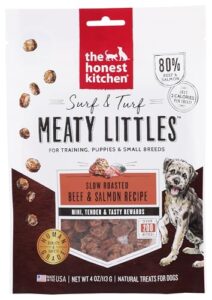
The solid first pick for apartment training — and for good reason. At just 2 calories per treat, you can reward your puppy dozens of times without blowing their daily calorie budget.
They’re soft, chewy, and sized just right for tiny mouths. Made with ranch-raised beef and wild-caught salmon in a human-grade facility, they’re free from artificial additives and meat meals. The DHA from salmon is a nice bonus for brain development too.
| Best For | Dog owners who do a lot of training sessions and want a low-calorie, clean-ingredient treat that works for dogs with sensitive stomachs or food allergies. |
|---|---|
| Calories Per Treat | 2 |
| Made in USA | Yes |
| Artificial Additives | None |
| Primary Protein | Beef & Salmon |
| Suitable Life Stage | All Life Stages |
| Training Suitable | Yes |
| Additional Features |
|
- Only 2 calories per treat, so you can reward generously without worrying about overfeeding
- Made with human-grade ingredients — no artificial additives, meat meals, or fillers
- DHA from salmon supports brain health, which is a great bonus for puppies still developing
- The salmon gives these a pretty strong fishy smell, which some people find hard to deal with
- They can arrive crumbly if the bag gets crushed in shipping
- A bit pricier than your average dog treat, so the cost adds up if you train frequently
2. Open Farm Soft Beef Training Treats
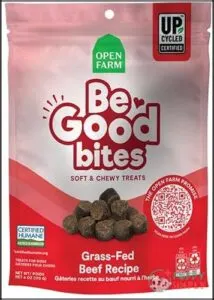
If you care about where your pup’s food comes from, Open Farm’s Soft Beef Training Treats are worth a look. The beef is grass-fed and fully traceable — from pasture to pouch.
At around 2.4 calories per treat, they fit neatly into a puppy’s daily calorie budget. The soft, chewy texture makes them easy to break into even smaller pieces for rapid reps. Plus, the real meat aroma is strong enough to keep your puppy motivated — but not so intense it takes over your apartment.
| Best For | Dog owners who care about ingredient transparency and want a low-calorie treat built for long training sessions. |
|---|---|
| Calories Per Treat | 2.5 |
| Made in USA | Not specified |
| Artificial Additives | None |
| Primary Protein | Beef |
| Suitable Life Stage | Adult |
| Training Suitable | Yes |
| Additional Features |
|
- Fully traceable, grass-fed beef — you know exactly where the ingredients come from
- Under 2.5 calories per treat, so you can reward often without blowing your dog’s daily budget
- Soft and chewy texture makes them easy to break into tiny pieces for quick, repetitive training
- At $14.85 for 6oz, you’re paying a premium — the pouch goes fast
- Not a fit for dogs with sensitivities to turkey, barley, or molasses
- Some pet parents may find the quantity a little light for the price
3. Cloud Star Tricky Trainers Dog Treats
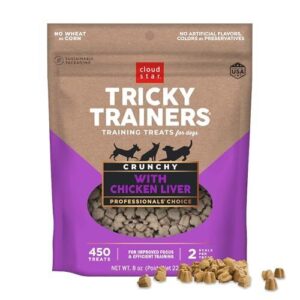
go-to for good reason Cloud Star Tricky Trainers are a go-to for good reason.
Each treat clocks in at just 2 calories — low enough for long indoor sessions without blowing your puppy’s daily limit.
They’re crunchy, bite-sized, and made with real chicken liver, which puppies find hard to ignore.
No wheat, corn, dairy, or soy either, so they’re a solid pick if your pup has a sensitive stomach.
An 8-ounce bag holds around 450 treats — that’s a lot of "good dog" moments.
| Best For | Puppies and dogs of all sizes who need a low-calorie, high-reward treat for training sessions — especially pups with sensitive stomachs. |
|---|---|
| Calories Per Treat | 2 |
| Made in USA | Not specified |
| Artificial Additives | None |
| Primary Protein | Chicken Liver |
| Suitable Life Stage | All Life Stages |
| Training Suitable | Yes |
| Additional Features |
|
- Only 2 calories per treat, so you can reward freely without overfeeding
- Made with real chicken liver — most dogs go absolutely nuts for it
- 450 treats per bag means you’re set for a long stretch of training
- Some owners have had shipping headaches, including surprise signature requirements
- The small, crunchy size might not work for every dog’s taste or chewing style
- Not ideal for dogs with chicken allergies or other specific sensitivities
4. Full Moon Natural Beef Dog Treats
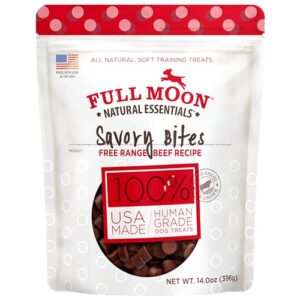
If you want something a little heartier, Full Moon Natural Beef Dog Treats are worth a serious look. Made from USDA-approved free-range beef with zero grains, corn, wheat, or soy — these are clean, simple bites your pup can actually digest. No artificial preservatives or flavors either.
Each piece runs about 2 to 3 calories, which keeps things manageable during apartment sessions. They’re slow-cooked in small batches, so the beef smell is real and strong — exactly what grabs a puppy’s attention fast.
| Best For | Dog owners of all experience levels who want a clean, high-quality treat for training, rewards, or everyday snacking — especially for pups with grain or soy sensitivities. |
|---|---|
| Calories Per Treat | Not specified |
| Made in USA | Yes |
| Artificial Additives | None |
| Primary Protein | Beef |
| Suitable Life Stage | All Life Stages |
| Training Suitable | Yes |
| Additional Features |
|
- Made with real USDA-approved free-range beef and zero artificial additives, so you know exactly what your dog is eating.
- Works for all life stages and sizes, making it a solid go-to whether you have a tiny puppy or a full-grown dog.
- No grains, corn, wheat, or soy means it’s a great pick for dogs with common food sensitivities.
- Pricier than a lot of other treat options on the market, which can add up fast if your dog goes through them quickly.
- Overfeeding can cause digestive upset or changes in stool color, so you do need to keep an eye on portions.
- The bag needs to be sealed tight after each use — leave it open and the treats can dry out pretty quickly.
5. Onward Hound Soft Bison Training Treats
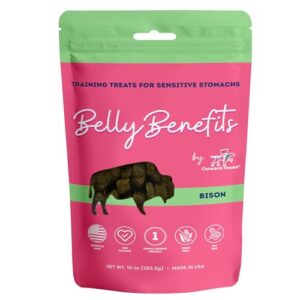
Switching things up with bison might be the smartest move you make. Onward Hound’s Soft Bison Training Treats use a single-source protein — great news if your pup has a sensitive stomach.
At just 3.5 calories per treat, you can reward freely without stressing over the scale. They’re corn-free, soy-free, and made in the USA.
The soft, moist texture means quick chewing — no choking, no mess, no delay.
Perfect for fast-paced apartment sessions where timing is everything.
| Best For | Dogs with food sensitivities, puppies, seniors, and small breeds who need a low-calorie, hypoallergenic treat for training. |
|---|---|
| Calories Per Treat | 3.5 |
| Made in USA | Yes |
| Artificial Additives | None |
| Primary Protein | Bison |
| Suitable Life Stage | All Life Stages |
| Training Suitable | Yes |
| Additional Features |
|
- Only 3.5 calories per treat, so you can reward often during training without worrying about weight gain
- Single-source bison protein is easy on sensitive stomachs and great for dogs with allergies
- Soft texture makes them quick to eat — no interruptions mid-session
- Dogs with molasses sensitivities might not tolerate them well
- Pricier than a lot of other training treats on the market
- Can’t return them once opened, so you’re taking a chance if your dog is picky
6. Polkadog Salmon Training Treats
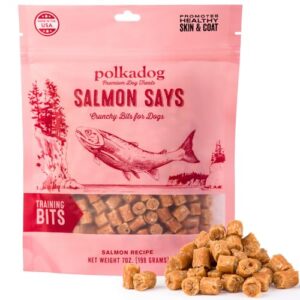
Salmon lovers, meet your new go-to. Polkadog’s Salmon Training Treats keep things beautifully simple — salmon, brown rice, and potato flour. That’s it.
For pups with sensitive stomachs or allergy concerns, that short ingredient list is a real win.
Each bite-sized piece runs about 19 calories, so you’ll want to track your count carefully.
They’re handcrafted in the USA, preservative-free, and built for quick one-hand rewards.
The salmon scent is strong enough to grab attention — but not strong enough to take over your whole apartment.
It pairs well with a quiet dog water fountain designed for apartments — hydration sorted without adding noise to the mix.
| Best For | Dogs with allergies or sensitive stomachs who need a simple, clean treat for training. |
|---|---|
| Calories Per Treat | Not specified |
| Made in USA | Yes |
| Artificial Additives | None |
| Primary Protein | Salmon |
| Suitable Life Stage | All Life Stages |
| Training Suitable | Yes |
| Additional Features |
|
- Only three ingredients — salmon, brown rice, and potato flour — making it a solid pick for allergy-prone pups
- Bite-sized and low-calorie, so they’re easy to use through long training sessions without overdoing it
- Handcrafted in the USA with no preservatives, so you know exactly what your dog is getting
- Pricier than a lot of other training treats on the market
- Only comes in smaller package sizes, which adds up fast if you train often
- The strong salmon scent might be a dealbreaker for some owners
7. Stella Chewy Freeze Dried Raw Beef Treats
Raw-food fans, this one’s worth a look.
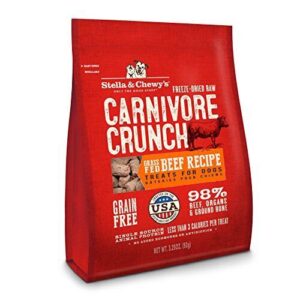
Stella & Chewy’s Freeze Dried Beef Treats are made from 98% grass-fed beef — organs, bone, and all — with barely anything else on the label.
Pumpkin seed and tocopherols round it out.
That’s a short, clean list you can actually trust.
The freeze-drying locks in real meat aroma, which means serious motivation for your pup.
Soft enough to break into smaller pieces, low-mess indoors, and grain-free.
At $14.99 for 3.25 oz, it’s a premium pick — but the ingredient quality shows.
| Best For | Dog owners who want a clean, high-protein treat for training, picky eaters, or senior dogs with sensitive teeth. |
|---|---|
| Calories Per Treat | Not specified |
| Made in USA | Not specified |
| Artificial Additives | None |
| Primary Protein | Beef |
| Suitable Life Stage | All Life Stages |
| Training Suitable | Yes |
| Additional Features |
|
- 98% grass-fed beef with organs and bone — a short, honest ingredient list you can actually read
- Soft texture breaks apart easily, great for smaller dogs or pups with dental issues
- No grains, fillers, or artificial anything — just real food with serious smell-appeal to motivate even stubborn dogs
- At $14.99 for 3.25 oz, it adds up fast if your dog goes through treats quickly
- Tends to crumble, which can get messy and makes them trickier to use on walks
- A few dogs just aren’t that into them — not every pup is a freeze-dried convert
8. Zukes Mini Naturals Chicken Training Treats
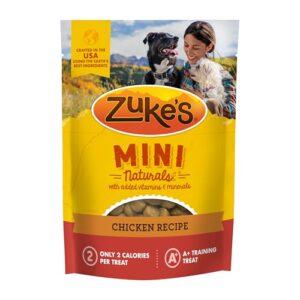
Zuke’s Mini Naturals are practically a reference point for apartment training — and for good reason. Each chicken treat clocks in at just 2 calories, made with real chicken, rice, and oats, and free from corn, wheat, and soy.
The soft, bite-sized pieces are easy for young puppies to swallow quickly — no lingering chew time mid-session. The mild chicken aroma won’t take over your apartment air, either.
Consistent, clean, and widely available — these are a reliable daily workhorse for indoor potty training.
| Best For | Small breeds, puppies, and apartment dwellers who need a low-calorie, no-fuss treat for quick training sessions. |
|---|---|
| Calories Per Treat | 2 |
| Made in USA | Yes |
| Artificial Additives | None |
| Primary Protein | Chicken |
| Suitable Life Stage | All Life Stages |
| Training Suitable | Yes |
| Additional Features |
|
- Only 2 calories per treat, so you can reward often without guilt
- Free from corn, wheat, and soy — great for dogs with common sensitivities
- Soft and small enough for puppies to eat fast and stay focused
- Can dry out quickly if the bag isn’t sealed tight after each use
- Some pet parents would rather see human-grade meat on the label
- Delivery can lag — a few users have waited up to three weeks
9. Pet Botanics Bacon Training Treats
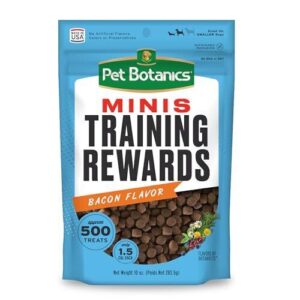
Pet Botanics Bacon Training Treats punch well above their weight for apartment training.
Real pork liver is the first ingredient — and dogs notice.
The bacon scent is strong enough to grab attention fast, but won’t linger in your living room all day.
At just 1.5 calories per treat, you can reward frequently without blowing your pup’s daily limit.
Soft, chewy, and easy to break apart — these work beautifully in rapid reward cycles during short indoor potty sessions.
| Best For | Small dog owners who train indoors and want a low-calorie, high-reward treat that actually gets their pup’s attention. |
|---|---|
| Calories Per Treat | 1.5 |
| Made in USA | Yes |
| Artificial Additives | None |
| Primary Protein | Pork Liver |
| Suitable Life Stage | All Life Stages |
| Training Suitable | Yes |
| Additional Features |
|
- Real pork liver as the first ingredient — dogs go crazy for it
- Only 1.5 calories per treat, so you can reward generously without overdoing it
- Soft and easy to break apart, great for tiny mouths or quick training sessions
- The smell is strong — not everyone’s favorite thing in a small space
- Not ideal for dogs with pork or protein sensitivities
- Very small dogs or puppies may still need the treats broken down further
10. Badlands Ranch Freeze Dried Beef Liver Treats
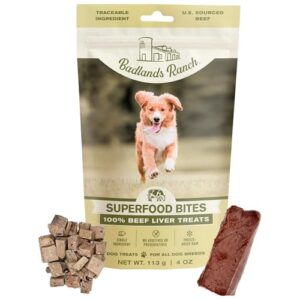
Freeze Dried Beef Liver Treats are as simple as it gets — one ingredient, zero fillers, nothing else. Just 100% freeze-dried beef liver.
That single-meat formula makes these a solid pick for puppies with sensitive stomachs or food sensitivities.
The bold scent — real liver aroma — so use fewer pieces per session if you’re in a small apartment.
Each bite is soft, chewy, and protein-packed at around 58% crude protein.
High-value, high-motivation, and surprisingly easy to portion out.
| Best For | Dogs with sensitive stomachs or food allergies who need a clean, single-ingredient treat for training or daily rewards. |
|---|---|
| Calories Per Treat | Not specified |
| Made in USA | Yes |
| Artificial Additives | None |
| Primary Protein | Beef Liver |
| Suitable Life Stage | All Life Stages |
| Training Suitable | Yes |
| Additional Features |
|
- Pure beef liver, nothing else — no fillers, no preservatives, just one real ingredient
- High protein and nutrient-rich, great for energy, coat health, and overall vitality
- Works for all ages and sizes, from tiny puppies to big senior dogs
- At $15.99 for under 4 oz, it’s pricey — especially if your dog goes through treats fast
- Some customers say the bag arrives only a quarter full, which stings at that price
- A few dogs need the treats soaked in water first to digest them comfortably
Why Treat Choice Matters for Apartment Puppies
Training a puppy in an apartment isn’t quite the same as having a backyard to work with — the tight space changes everything, including the treats you reach for.
The wrong choice can slow down housebreaking, stink up your living room, or upset a sensitive stomach. Here’s what actually matters when you’re picking training treats for small-space life.
How Small Spaces Change Your Training Approach
Training in a studio apartment isn’t the same as a backyard — and that’s actually good news. Tight quarters make micro‑session timing easier to manage, since your pup can’t wander far. Use furniture tethering strategies to keep focus sharp, and lean on positive reinforcement with the best dog training treats right after housebreaking wins. Compact toy integration and vertical space utilization help reward‑based training click faster indoors.
Researching a suitable breed for apartments(https://www.howtotrainadreamdog.com/puppy-training-in-an-apartment/) can simplify the training process.
Why Scent Control Matters in Enclosed Living Areas
Tight spaces don’t just change how you train — they change how everything smells. In an apartment, odors build fast. Poor Airflow Management lets smells linger, and high humidity makes them stronger. That affects your puppy’s Odor Perception during housebreaking.
Keep your space fresh with:
- Open windows for natural air exchange
- Humidity Regulation to stop moisture buildup
- Carbon Filtration near your pup’s potty spot
- Hard floors over carpet for easier cleanup (Material Choice matters)
- A purifier running during puppy training treat sessions
Urine salts cause persistent odors
The Link Between Treat Quality and Faster Housebreaking Results
Scent control is just one piece of the puzzle. Treat potency matters just as much.
Higher-quality puppy training treats — ones with real protein purity, strong aroma intensity, and calorie precision — get faster housebreaking results.
Soft textures with texture consistency mean rewards land within that 2-second window.
Better ingredients equal sharper focus. That’s the core of effective reward-based training and positive reinforcement.
Key Features of The Best Puppy Training Treats
Not every treat is worth reaching for — especially when you’re trying to train a puppy in a tight space.
The right treat checks a few specific boxes that make a real difference during those quick indoor sessions.
Here’s what to look for.
Ideal Size and Texture for Quick Indoor Rewards
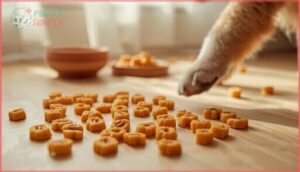
Size and texture aren’t afterthoughts — they’re the whole game for indoor reward-based training.
Aim for micro bite dimensions: roughly 0.25 to 0.5 inches across.
That pliable moisture level keeps quick chewability high, so your pup swallows fast and stays focused.
Consistent density means no awkward size differences between pieces, and easy breakability lets you adjust on the fly.
Puppy training treats that nail these details make positive reinforcement feel easy.
Calorie Range to Look for Per Treat Piece
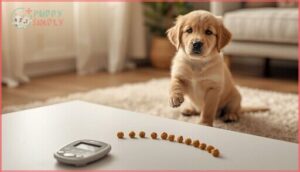
Every calorie counts when you’re training a puppy in a small apartment. Stick to a low calorie threshold — ideally 1 to 3 calories per piece — to keep calorie density manageable across multiple sessions.
- Best treat size: pea-sized, 0.25–0.5 inches
- Weight-based portion: 1 calorie per piece for puppies under 7 pounds
- Calorie tracking: stay under 10% of daily intake
- Best dog training treats: 2 calories per piece, like Zuke’s Mini Naturals
- Puppy training treats calorie range: 2–5 calories max
Why Soft and Moist Treats Outperform Crunchy Options

Soft and moist puppy training treats are built for speed.
They deliver Faster Reward Delivery because your pup swallows quickly — no crunching pause. Enhanced Aroma Release kicks in immediately, pulling attention your way.
They leave Minimal Mess in tight spaces and cause Reduced Jaw Fatigue during repeated positive reinforcement cycles.
For reward-based training, Consistent Bite Size and palatability make soft treats the smarter pick.
Importance of Uniform Bite Weight and Texture Consistency
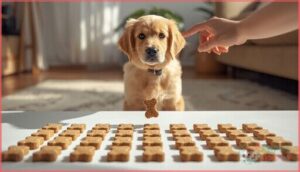
Consistency is your secret weapon in reward‑based training. When your puppy training treats have uniform texture feel, and predictable bite weight, every reward lands the same way — same chew, same swallow, same satisfaction. That precision matters more than you’d think.
Here’s what standardized piece size actually does for you:
- Equal calorie delivery keeps sessions within the 10% daily limit — no guesswork.
- Consistent chewing resistance means one or two chews, then focus snaps back to you.
- Uniform texture feel prevents treat rejection mid‑session.
- Predictable bite weight lets you split one treat into 10+ pieces without losing positive reinforcement value.
Best Ingredients for Sensitive Puppy Stomachs

A puppy’s stomach is still figuring things out — and the wrong treat can turn a good training session into a messy afternoon. What goes into that tiny treat matters a lot more than most people realize.
Here’s what to look for when you’re reading that ingredient label.
Single-ingredient Protein Sources Like Chicken and Turkey
For sensitive stomachs, less is more. Chicken and turkey are the benchmark for puppy training treats — lean, vet approved, and built around Protein Purity and Ingredient Transparency.
Single‑ingredient options deliver Allergen‑Free, high protein rewards with Calorie Precision around 2–3 calories per piece and impressive Shelf Stability.
| Protein | Key Benefit |
|---|---|
| Chicken breast | Lean, natural ingredients, familiar flavor |
| Turkey breast | Mild scent, low-fat, apartment-friendly |
| Freeze-dried chicken | Shelf Stability, easy to portion |
| Dehydrated turkey | Compact, high protein, mess‑free |
| Single-ingredient both | Allergen‑Free, simple dog training treats |
Digestible Fiber From Pumpkin and Oats
Pumpkin and oats are quiet heroes in puppy training treats.
Pumpkin Fiber Benefits come from its Soluble Insoluble Balance — soluble fiber firms loose stools, insoluble fiber keeps things moving. Oat Beta-Glucan adds Gentle Digestion Support with slow‑burning energy, not sugar spikes.
Both natural ingredients boost digestibility and allergy‑friendliness. For Fiber Portion Guidance, small amounts matter — a little goes a long way with the best dog training treats.
Natural Fruit Additives Such as Blueberries
Blueberries punch above their weight as natural ingredients in puppy training treats. Their antioxidant benefits — thanks to anthocyanins — support long‑term health while keeping things light at just 57 calories per 100 grams. That fiber content aids digestion without overloading a sensitive stomach.
For texture integration, mash them into soft treats or use freeze‑dried pieces for cleaner positive reinforcement. Just mind portion safety — a little goes far.
Benefits of Omega-3 Fats From Salmon Oil
Salmon oil does a lot of heavy lifting in healthy treats. It’s packed with DHA and EPA — the omega-3s that directly support Brain Development, Skin Health, Joint Mobility, and Heart Function in growing pups.
Dogs can’t efficiently convert plant-based omega-3s, so marine sources matter. For safe dosing, stay under 280 mg of EPA plus DHA per 100 kcal — and always choose reputable natural ingredients.
Ingredients and Additives to Avoid Entirely
Flip the label over before you buy.
Xylitol Toxicity is no joke — even a tiny amount can trigger seizures within 20 minutes.
Chocolate Hazards, Grape Kidney Risk, and Allium Blood Damage from onion or garlic are equally serious.
For preservative safety concerns, skip BHA, BHT, and ethoxyquin.
Healthy treats with real, recognizable ingredients protect allergy-friendliness — and keep your puppy training treats actually safe.
How Scent and Flavor Drive Training Motivation

puppy’s nose is doing most of the work before a treat even hits their tongue.
right scent and flavor can mean the difference between a focused training session and a distracted pup who’s already moved on.
Here’s what to know before you pick up that next bag.
Why Real Meat Aromas Work Best for Puppies
Your puppy’s nose knows — and science backs it up. Real meat aromas trigger dopamine boost mechanism responses that lock in learning faster than any artificial flavor can.
Here’s why meat scent evolution makes dog treats the best reward‑based training tool:
- Puppies have 200 million olfactory receptors — meat volatiles hit hard.
- Umami neural activation from beef and chicken outperforms plant proteins 10×.
- Natural aroma persistence keeps puppy treats effective across 30‑minute sessions.
- Olfactory reward timing aligns perfectly with the critical 1–3 second window.
- Real meat ingredients trigger dopamine, cementing potty habits faster.
Choosing Mild-scented Treats for Apartment Freshness
Real meat works — but in a small apartment, strong smells linger. That’s where low‑odor ingredients make a real difference.
Treats like sweet potato chews, Charlee Bear’s peanut butter bites, or plant‑based options from Soopa keep positive reinforcement effective without overwhelming your space. Store them in airtight containers to lock in freshness. Allergy‑free formulations with mild aromas still trigger aroma memory cues — without the funk.
Using Flavor Variety to Sustain Longer Training Sessions
Switching flavors mid-session isn’t a trick — it’s a strategy. Rotating high-value puppy training treats between chicken, beef, and liver creates novelty reward signals that keep your pup locked in.
This flavor pairing strategy works because repeated identical rewards lose their pull fast. Multi-flavor scheduling and aroma-based motivation together make reward-based training and positive reinforcement more effective — turning healthy puppy treats into real training rewards.
Treats to Avoid for Daily Indoor Training Sessions
Some dog treats are simply the wrong tool for apartment life.
High-calorie treats pack too many calories per piece — your pup hits their daily limit fast, with no room left for real meals. Oversized treats break your reward timing completely.
Strong-odor treats like fish-based options linger all day in tight spaces.
Crumbly messes grind into carpets. Artificial additives trigger reactions.
How to Use Treats Effectively During Potty Training

Choosing the right treat is only half the battle — knowing exactly when and how to use it makes all the difference.
Puppies learn fast, but only if the reward hits at the right moment and feels worth it to them.
Here’s what you need to get right.
Mastering The 1 to 3 Second Reward Window
Timing is everything in reward‑based training — miss the window, and your puppy has no idea what earned the treat. That 1 to 3 second reward window is your golden rule for positive reinforcement.
Miss the reward window by even a second, and your puppy learns nothing
- Exact Timing locks in the right behavior instantly
- Rapid Delivery keeps puppy training treats meaningful
- Pocket Accessibility ensures marker synchronization never misses a beat
Keep treats within arm’s reach. Always.
Pairing Verbal Cues With Treat Rewards
signal light — green means “yes, that’s it.” Say your verbal cue first, mark the exact moment with “yes” or “good,” then follow immediately with one of your puppy training treats. That cue‑reward sequence is everything.
Cue‑word consistency and marker timing lock in the learning. Keep your tone pitch calm and steady — puppies read energy fast.
Building a Consistent Indoor Potty Training Routine
Routine is the backbone of housebreaking.
Use Timer Alerts every 45 to 90 minutes for puppies under 16 weeks — then grab your puppy treats and head straight to the same spot every time.
Leash Guidance keeps focus, Spot Consistency builds the mental map, and Supervised Breaks prevent accidents before they happen.
Pair Cue Consistency with your reward-based training, and that training schedule clicks into place fast.
Adjusting Treats Based on Your Puppy’s Preferences
Not every puppy goes crazy for the same treat — and that’s okay. Run a quick Puppy Taste Tests session to find their MVP flavor.
- Try an Aroma Rotation Strategy — switch between chicken and beef dog training treats weekly.
- Do a Texture Sensitivity Check — soft beats crunchy for most pups.
- Explore Allergen-Free Options and Seasonal Flavor Swaps when interest dips.
Reward-based training only works when the treat actually excites them.
How Many Treats Can a Puppy Have Daily

Treats are a powerful training tool — but too many can throw off your puppy’s whole diet.
There’s a simple rule that keeps things balanced, and it starts with understanding your puppy’s daily calorie needs.
Here’s what you need to know before reaching into that treat bag again.
The 10 Percent Daily Calorie Rule Explained
Here’s a simple rule to bookmark: treats should never exceed 10% of your puppy’s daily calories. That’s your calorie budget calculation right there.
If your pup eats 500 calories a day, 50 calories max go toward puppy training treats. Daily calorie tracking keeps nutrient balance monitoring on point — because too many dog treats and chews quietly crowd out the complete nutrition your puppy actually needs.
Calorie Counts by Puppy Age and Weight
That 10% rule hits different once you see actual numbers. Age-based calorie needs and weight-adjusted energy targets vary more than most owners expect — and getting them right shapes smart daily treat calorie limits.
Here’s a quick snapshot for healthy puppy treats planning:
- 1–5 lbs: ~125–392 calories/day
- 10 lbs: ~649 calories/day
- 20 lbs: ~1,100 calories/day
- Under 4 months: Growth-stage multipliers reach 3× RER
- 4–12 months: Breed-size calorie needs drop to 2× RER
Those numbers shift your puppy training treats budget fast.
Balancing Treats With AAFCO-approved Puppy Food
Once you know puppy’s calorie budget, the next step is protecting it. Think of AAFCO‑approved puppy food as the foundation — dog training treats are just the seasoning.
Label comparison helps here: check both bags, then reserve 90% of daily calories for the main meal. Smart calorie budgeting and portion control keep the nutrient ratio balanced, so healthy puppy treats never crowd out proper puppy nutrition.
When to Consult Your Veterinarian About Treat Intake
Even with the best vet-approved dog treats, your puppy’s body will tell you when something’s off. Don’t second-guess these signs — call your vet:
- Vomiting signs that repeat or follow a rich, fatty treat
- Stool changes like blood, grease, or lasting diarrhea
- Allergy reactions — itching, redness, or skin flare-ups
- Calorie overload causing weight gain or skipped meals
- Choking hazards — gagging, drooling, or breathing trouble
How to Introduce New Treats Safely Indoors

Switching to a new treat isn’t something you want to rush — puppies have sensitive stomachs, and a bad reaction indoors is no fun for anyone. A little patience up front saves you a lot of cleanup later.
Here’s what to keep in mind when introducing something new.
Starting Slow With Homemade Versus Store-bought Treats
Homemade or store-bought — both work, but starting slow is non‑negotiable. With homemade puppy training treats, you get full ingredient control, calorie precision, and texture uniformity right from your kitchen. Store‑bought options offer convenience and consistent fresh aroma.
Either way, introduce one treat at a time. Your puppy’s gut needs time to adjust — and your training momentum depends on it.
Watching for Digestive Sensitivity or Allergic Reactions
Once you introduce new puppy training treats, watch your pup closely for the first 24 to 48 hours. Vomiting indicators, diarrhea triggers, and skin itchiness signs are your earliest red flags. Facial swelling alerts demand an immediate vet call.
Smart allergen log tracking — treat name, ingredients, symptoms — keeps your healthy puppy treat routine safe and promotes steady puppy development.
- Note loose stools or vomiting after any new treat
- Check paws, ears, and muzzle for redness or swelling
- Log each treat with date and ingredients for allergy‑friendliness tracking
Storing Treats Properly in a Small Apartment Space
Small apartments don’t have much room for error — or clutter. Keep puppy treats fresh and organized with smart storage from day one.
| Storage Solution | Best For |
|---|---|
| Airtight Stackable Containers | Maximizing cabinet height |
| Vertical Shelf Risers | Creating multi-layer treat zones |
| Magnetic Wall Tins | Freeing shelf space for small bites |
| Portable Treat Cart | Moving dog treats room to room |
A treat pouch clipped to your waist keeps pet parenting smooth during sessions. Humidity control solutions prevent texture loss — critical for soft puppy treats.
Apartment Puppy Training Tips Beyond The Treat

Treats are a powerful tool — but they’re only part of the picture.
Apartment training comes with its own set of challenges, from tight spaces to thin walls, and your setup matters just as much as your snacks.
Here’s what else you can do to set your puppy up for success indoors.
Setting Up a Dedicated Indoor Potty Spot
Pick a low‑traffic corner on nonporous flooring — tile or linoleum — and make it your puppy’s one consistent potty spot. Keep the path clear, use vertical pad holders for male dogs, and tuck odor‑absorbing materials nearby.
An easy‑access gate keeps the area reachable without giving a full run of the apartment. Solid housebreaking here is the backbone of solid housebreaking and reward‑based training success.
Crate Training Basics for Apartment Dwellers
Crate training in an apartment is less complicated than it sounds. Choose a quiet zone placement — away from loud appliances, but close enough to family activity so your puppy doesn’t feel isolated.
Ventilation considerations matter too; metal crates offer airflow without trapping heat.
For noise reduction strategies, a plastic crate’s den-like walls can muffle sounds.
Soft-sided portable crate options work if your pup isn’t a chewer.
Build crate entry training slowly — pair each session with puppy training treats and calm praise. That’s reward-based training doing its job.
Keeping a Consistent Schedule in Limited Square Footage
Consistency is your secret weapon in a small apartment. A tight training schedule actually works with limited space — not against it. Post a Shared Calendar Sync on the fridge so everyone stays aligned.
- Lock in a Morning Feed Routine with Fixed Potty Windows right after meals
- Use Timer‑Driven Sessions in your Compact Training Zone to keep housebreaking on track
- Keep puppy treats ready so dog treats hit that reward window fast
Managing Noise and Distractions During Indoor Sessions
A steady schedule helps — but apartment noise is a whole other battle.
Try sound masking with a white noise machine near your training spot to soften door slams and hallway chaos. Pair that with trigger desensitization, starting with short 5‑to‑10‑minute calm sessions.
Quiet cue training works best when your puppy’s training treats and positive reinforcement techniques arrive the moment silence happens.
Frequently Asked Questions (FAQs)
Can treats help reduce puppy barking indoors?
Yes — absolutely.
The right Puppy Training Treats combined with Calm Redirection, Quiet Cue Pairing, and Timing Rewards make Bark Counterconditioning surprisingly simple.
Positive Reinforcement Training rewires Dog Behavior fast — quieter than you’d ever expect.
Should treats differ for nighttime potty training?
Nighttime calls for a different approach. Stick to small portions, mild flavor, and sleep-friendly texture — nothing too rich.
Low calorie timing keeps tummies settled, and reward frequency stays minimal, so your puppy drifts back to sleep easily.
How do treats work with clicker training methods?
The click marks the exact moment your puppy nails it — then the treat seals the deal.
That Timing-Reward Pairing is everything in clicker training.
Small, soft treats with Rapid Swallowability keep the rhythm tight.
Are freeze-dried treats safe for very young puppies?
Freeze-dried treats can be safe — but only with the right Chewing Size, strict Ingredient Transparency, and Veterinary Guidance.
Puppies’ immune systems are still developing, so Pathogen Risk and Calorie Density make careful selection essential.
Do training treats affect a puppys dental health?
Training treats can affect plaque buildup, but the real danger is skipping brushing.
Soft healthy puppy treats dissolve fast, reducing residue — but no dog treats or rewards replace daily dental care.
Conclusion
It’s no coincidence that the puppies who learn fastest in apartments are also the ones whose owners obsess over the smallest details—like which treat fits in a pocket without leaving a grease stain.
The right puppy training treats for indoor apartment training don’t just reward good behavior—they shape it, rep by rep, in a space where every choice echoes. Pick well, stay consistent, and your pup won’t just adapt to apartment life. They’ll thrive in it.
- https://www.akc.org/expert-advice/nutrition/best-dog-treats/
- https://www.purina.com/articles/dog/health/nutrition/are-dogs-omnivores-or-carnivores
- https://booking.splootvets.com/
- https://petcorner.pangovet.com/pet-nutrition/dogs/how-to-make-bone-broth-for-dogs/
- https://badlandsranch.com/superfood-bites-beef/