This site is supported by our readers. We may earn a commission, at no cost to you, if you purchase through links.
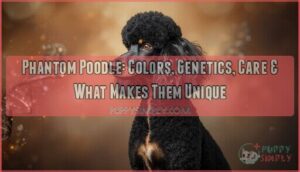
Most dog lovers can spot a Golden Retriever or a Dalmatian from a block away, but a phantom poodle? That’s a different story. These striking dogs wear what looks like a built-in tuxedo—a rich base color accented by tan or cream markings above their eyes, on their muzzle, chest, and legs, creating a pattern that turns heads at every dog park.
Despite their dramatic appearance, phantom poodles aren’t a designer crossbreed or rare mutation. They’re purebred poodles sporting a specific coat pattern controlled by the same genetics that give Dobermans and Rottweilers their signature looks.
Understanding what makes these dogs unique—from the science behind their markings to their grooming needs and personality traits—helps you decide if this eye-catching variation is right for your home.
Table Of Contents
- Key Takeaways
- What is a Phantom Poodle?
- Phantom Poodle History and Origins
- Distinctive Phantom Poodle Appearance
- Phantom Poodle Color Variations
- Phantom Poodle Types by Size
- Phantom Poodle Genetics and Breeding
- Phantom Poodle Temperament and Training
- Care, Health, and Grooming Needs
- Frequently Asked Questions (FAQs)
- Are Phantom Poodles hypoallergenic?
- Is it difficult to find a Phantom Poodle breeder?
- Are Phantom Poodles good for families with children?
- Is the price of a Phantom Poodle worth it?
- What kind of diet should a Phantom Poodle have?
- Are Phantom Poodles recognized by major kennel clubs?
- How much does a Phantom Poodle puppy cost?
- Do Phantom Poodles get along with children?
- Can Phantom markings fade or change over time?
- Whats the average lifespan of a Phantom Poodle?
- Conclusion
Key Takeaways
- Phantom poodles are purebred poodles with a two-toned coat pattern controlled by polygenic genetics—the same genes that create Doberman and Rottweiler markings—not a separate breed or designer crossbreed.
- These dogs require the same intensive grooming commitment as solid-colored poodles, including brushing 2-3 times weekly and professional grooming every 6-8 weeks, so their striking appearance comes with no maintenance shortcuts.
- Phantom markings appear in predictable locations (above eyes, muzzle, chest, legs, and tail) and come in various color combinations like black-tan, chocolate-cream, and rarer tri-color variations, though finding reputable breeders can be challenging due to limited availability.
- Their temperament combines exceptional intelligence with high energy and strong family bonds, making them highly trainable companions that need 30-60 minutes of daily exercise plus consistent early socialization to prevent behavioral issues.
What is a Phantom Poodle?

A Phantom Poodle isn’t some ghostly canine wandering around your backyard—it’s a regular Poodle with a striking two-toned coat pattern that turns heads everywhere. You might think they’re a different breed entirely, but they’re just standard Poodles wearing nature’s most eye-catching color scheme.
Let’s break down what makes these beautifully marked dogs so distinctive and why they’ve captured the hearts of Poodle enthusiasts everywhere.
Phantom Pattern Vs. Solid Colors
Think of phantom Poodle colors as nature’s custom paint job, not just one solid shade. Unlike solid-colored Poodles showing uniform coat color genetics across their bodies, phantom pattern expression creates distinct markings with lighter highlights above each eye, on the muzzle, chest, legs, and tail tip. This canine coat color variation comes from specific pigment distribution genes—and that marking intensity can range from subtle to striking, affecting tint stability over time. Understanding the genetics behind phantom Poodle colors requires exploring language related concepts to better comprehend the breed’s characteristics.
- Phantom patterns follow predictable Poodle color variations, not random splotches
- Solid Poodles lack the contrasting facial and body markings
- Coat variations between phantom and solid don’t change texture or grooming needs
- Breeders use genetic testing to predict phantom versus solid outcomes
Phantom Markings Explained
Phantom markings appear in precise locations, revealing how phantom genetics orchestrate canine coat patterns and colors. These marking patterns follow breed standards tied to color theory and coat color genetics, making authentic phantom Poodle coat variations identifiable at a glance. Understanding black Goldendoodle genetics helps breeders predict which puppies will display phantom markings based on parent coat combinations.
You’ll spot the secondary shade above each eye, along the muzzle sides, across the chest, down all four legs, and beneath the tail—never random splashes. The study of genetic patterns can be enhanced by using scientific study methods to analyze the data.
Not a Separate Breed
Despite their striking appearance, Phantom Poodles aren’t a separate breed—they’re standard Poodles with a unique color pattern. Kennel clubs classify them within the Poodle breed (Toy, Miniature, or Standard), and pedigree analysis traces their lineage through conventional Poodle ancestry. Like their phantom counterparts, blue Poodles are purebred but carry rare recessive genes that produce their distinctive silvery-gray coats.
Genetic testing confirms these Poodle colors result from specific canine genetics and breeding, not distinct breed characteristics. Breed registries reinforce this: Phantom is a coat variation, not a standalone breed classification. Similarly, red Poodles showcase another striking color variation driven by the same genetic principles rather than representing a different breed entirely.
Phantom Poodle History and Origins

Phantom Poodles didn’t just appear out of nowhere with their striking coat patterns. These dogs have a fascinating backstory that stretches back centuries, long before anyone cared about fancy markings.
Let’s look at where these beautiful, brainy dogs got their start and what they were originally bred to do.
Early Development in Europe
You might be surprised to learn that phantom poodles emerged from 19th-century European crossbreeding experiments. Continental kennels deliberately mixed standard poodles with sporting breeds to create eye-catching coat variations. These designer dogs, now known as Pugapoos or Pug-Poodle mixes, became especially popular among families seeking affectionate, intelligent companions with minimal shedding.
Here’s what shaped their development:
- Breeder selection focused on diverse phantom genetics alongside traditional solid colors
- Early 1900s German Poodle Club documents confirmed phantom markings as recessive traits
- Coat pattern evolution gained momentum with formal breed standard publications
- Poodle breed information linked phantom visibility to hunting advantages
- European breed history prioritized performance over pattern alone
This wasn’t accidental—it was calculated innovation.
Role in Waterfowl Retrieval
Water retrieval wasn’t a phantom-specific advantage—training and drive mattered most. Your poodle’s coat pattern won’t boost scenting ability or swimming performance. Field training demands retrieving to hand, steadiness under pressure, and cold-water safety protocols. Dog safety always trumps color preferences. Hunting ethics require evaluating individual temperament, not assuming phantom markings equal field readiness.
Poodle characteristics like trainability and poodle temperament determine retrieval success. Poodle breed standards prioritize health over pattern. Dog sports and activities test real-world poodle training outcomes. Retrieval strategies evolve with consistent positive reinforcement, not phantom genetics alone.
| Training Focus | Practical Application |
|---|---|
| Retrieve to hand | Controlled delivery mechanics |
| Water confidence | Early pond socialization |
| Steadiness drills | Calm around waterfowl |
| Safety protocols | Cold-water protective gear |
Distinctive Phantom Poodle Appearance
You’ve already learned where Phantom Poodles come from, but now let’s talk about what makes them stand out in a crowd. These dogs have a specific look that’s hard to miss once you know what you’re looking at.
From the exact spots where their markings appear to their athletic build and that famous curly coat, here’s what defines the Phantom Poodle’s distinctive appearance.
Marking Locations and Patterns
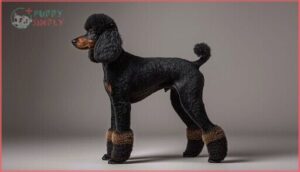
Think of Phantom Patterns like a carefully placed tattoo—they’re not random splashes. Symmetry Importance matters here: balanced Dobie markings on both sides define true Phantom Poodles.
You’ll spot the secondary color above each eye, along the muzzle, across the chest, down the legs, and under the tail. Breed Standards demand this specific placement, distinguishing phantoms from random parti or merle coat patterns in Poodle colors.
Coat Texture and Maintenance
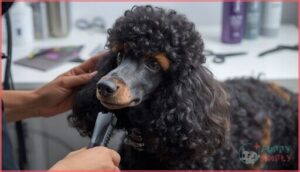
Your Phantom Poodle’s dense, cotton-like coat demands consistent attention—neglect isn’t an option. Shedding control and mat prevention require dedication, but the payoff is worth it:
- Coat Brushing: Daily or every-other-day sessions keep tangles at bay and maintain that signature curl.
- Professional Grooming Tips: Schedule visits every 6-8 weeks for trimming and curl maintenance.
- Bathing: Every 4-6 weeks with dog-specific shampoo preserves natural oils without overdrying.
Poodle grooming isn’t just vanity—it’s essential Poodle care and health wrapped into one routine.
Size and Build Overview
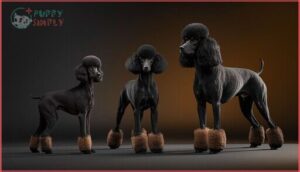
Your Phantom Poodle’s frame tells a story—whether you’re eyeing a compact toy or a muscular standard. Body proportions stay balanced across all sizes, maintaining that athletic Poodle breed silhouette. Here’s what skeletal growth delivers:
| Size Categories | Weight Range | Height at Shoulder |
|---|---|---|
| Toy | 4–6 lbs | 9–11 inches |
| Miniature | 10–15 lbs | 11–15 inches |
| Standard | 40–70 lbs | 18–24 inches |
Muscle structure matures differently—toys finish by 12 months, standards need 18. Build variations reflect Poodle breed characteristics, blending elegance with power.
Phantom Poodle Color Variations
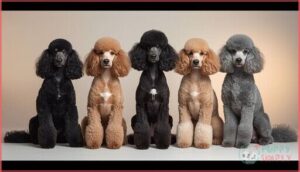
Phantom Poodles don’t just come in one flavor—they actually show up in a surprising range of color combinations, each with its own unique charm. The base color sets the stage, while the phantom markings add that signature contrast that makes these dogs stand out.
Let’s break down the most popular color variations you’ll encounter, from classic blacks to the rarer combinations that really turn heads.
Black Phantom Poodles
Black phantom poodles rock a dramatic jet-black base with lighter tan or cream markings that pop on their chest, legs, eyebrows, and muzzle. These coat patterns aren’t just pretty—they’re the result of phantom genetics working behind the scenes.
When you’re considering this poodle breed, here’s what matters:
- Regular brushing prevents matting in those dense curls
- Professional grooming every 6–8 weeks keeps markings sharp
- Balanced dog nutrition promotes vibrant coat health and overall poodle health
Chocolate Phantom Poodles
Rich brown tones meet lighter cream or apricot phantom markings in chocolate phantom poodles, creating a warm contrast that’s all about canine genetics at work. The breed standards recognize this striking variation, though chocolate genetics make it less common than black variants.
| Care Element | Frequency | Purpose |
|---|---|---|
| Coat maintenance | Every 2–3 days | Prevent matting, preserve phantom markings |
| Professional dog grooming | 6–8 weeks | Maintain texture, definition |
| Poodle nutrition check | Daily | Support poodle health, coat vibrancy |
Your chocolate phantom poodle needs consistent brushing to keep those curls manageable and those phantom markings crisp.
Red and Silver Phantom Poodles
You’ll notice red and silver phantom poodles bring dramatic contrast to canine genetics, with reddish or steel-toned phantom markings that pop against darker base coats.
Silver markings need sun protection and gentle shampoos for color preservation, while red toning benefits from topical phantom care to maintain vibrancy.
Phantom genetics can skip generations, so pedigrees matter when you’re pursuing these striking phantom poodle variations.
Tri Color and Rarer Variations
Beyond red and silver, tri color phantom poodles showcase three distinct hues—often black, white, and tan—creating even more dramatic coat patterns. These rare markings pop up when multiple color genetics loci interact during development, producing unusual face masks or chest patches that breeders verify through genetic testing and pedigree records.
You’ll find:
- Atypical eyebrow patterns
- Irregular patch shapes
- Dilute silver tones
- Unique facial masks
Expect longer waiting lists for these uncommon phantom patterns.
Phantom Poodle Types by Size
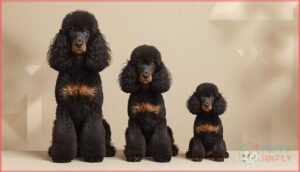
Phantom Poodles aren’t just one-size-fits-all dogs—they come in three distinct sizes, each with its own personality quirks and care needs. Whether you’re living in a cozy apartment or a sprawling house with a yard, there’s a phantom version that’ll fit your lifestyle.
Let’s break down the toy, miniature, and standard options so you can figure out which size suits you best.
Toy Phantom Poodles
The tiniest Phantom Poodles pack a lot of personality into frames under 11 inches tall, weighing just 4–7 pounds. These Companion Dogs showcase the same striking facial and leg markings as their larger cousins, but Toy Care demands extra attention—dental checkups, patellar screenings, and Poodle Nutrition customized for Small Breed metabolism keep your pocket-sized pup thriving.
| Feature | Specification | Care Notes |
|---|---|---|
| Height | Under 11 inches | Ideal for apartments |
| Weight | 4–7 pounds | Monitor for obesity |
| Grooming | Every 6–8 weeks | Daily brushing essential |
| Exercise | 20+ minutes daily | Mental stimulation key |
Miniature Phantom Poodles
Miniature Phantom Poodles stand 11–15 inches tall, offering a sweet spot between lap dog and adventure buddy. These curly companions show off the same eye-catching markings—tan splashes on black, chocolate accents on cream—while fitting comfortably in apartments or houses.
You’ll need to brush several times weekly and book professional Dog Socialization early, because smart Miniature Poodles thrive when their brains stay busy. Poodle Nutrition customized for Small Breed metabolism keeps them lean and lively.
Standard Phantom Poodles
Standard Phantom Poodles tower at 15–24 inches, blending athletic grace with striking Phantom Genetics—chocolate eyebrows over silver, black coats kissed with cream. These gentle giants adapt beautifully to active families who appreciate Breed Standards and Poodle history and origins.
Your Standard Poodle needs:
- Professional grooming every 6–8 weeks to showcase Phantom Poodle breed characteristics
- Daily walks plus mental games for Canine Behavior balance
- Early Dog Socialization to polish confidence
- Quality Poodle Nutrition matched to their 40–70 pound frame
Poodle care and grooming prevents matting while celebrating their elegant silhouette.
Phantom Poodle Genetics and Breeding

The phantom pattern isn’t just a happy accident—it’s written into your Poodle’s DNA. Understanding the genetics behind these striking markings can help you appreciate what makes them so special, and why responsible breeding matters so much.
Let’s break down the science, the ethics, and what you need to know if you’re hoping to bring a phantom Poodle into your life.
Genes Responsible for Phantom Pattern
The Phantom Poodle’s signature coat pattern isn’t controlled by a single gene—it’s a polygenic trait, meaning multiple genetic factors work together to create those distinctive markings.
The extension and agouti gene categories influence color expression, while melanocyte activity determines where pigment appears on your dog’s body. This polygenic inheritance explains why phantom markings can vary in intensity, even among puppies from the same litter.
Responsible Breeding Practices
When searching for a Phantom Poodle, prioritize breeders who conduct genetic testing for hip dysplasia, progressive retinal atrophy, and von Willebrand disease before mating. Responsible dog breeding practices demand health certifications, transparent pedigrees, and breeder accountability for puppy welfare.
Ethical breeding ethics include proper socialization, documented health guarantees, and follow-up support—ensuring genetic factors in dog breeding align with Poodle conformation and standards while protecting your future companion’s wellbeing.
Rarity and Availability
You’ll find Phantom Poodles harder to track down than solid-colored relatives, primarily due to breeding challenges tied to color genetics and the polygenic inheritance pattern.
Regional demand fluctuates with breed standards and show seasons, while market trends reveal that toy and miniature sizes face tighter supply chains.
Ethical breeders prioritize health testing over rapid production, so expect waitlists—especially in rural areas where Poodle history and genetic factors in dog breeding limit availability.
Phantom Poodle Temperament and Training

If you’re picturing a Phantom Poodle, you’re probably imagining those striking markings—but the real magic happens when you get to know their personality.
These dogs bring serious brainpower, boundless energy, and a confident swagger that makes them both delightful and, let’s be honest, a little demanding.
Here’s what you need to know about their temperament, social needs, and how to train one without losing your mind.
Personality Traits
You’ll find that Phantom Poodles rank among the smartest breeds around, making them incredibly trainable thanks to high intelligence levels and a genuine eagerness to please. Their canine behavior shows strong emotional bonds with family, often shadowing you from room to room.
Phantom Poodles rank among the smartest breeds, forming deep emotional bonds and shadowing their families with eager-to-please devotion
They’re socially adaptable, responding beautifully to positive reinforcement during dog training, and their behavioral quirks—like playful antics and alert watchfulness—reveal classic Poodle characteristics that make them both entertaining and deeply loyal companions.
Socialization Needs
Your Phantom Poodle’s behavioral issues often stem from inadequate puppy socialization, making early canine development vital for dog behavior and psychology. Poodle training and socialization during those critical first 16 weeks cuts fear responses by half, shaping social learning patterns that last a lifetime.
Focus your dog training and behavior efforts on:
- Early exposure to diverse people and environments
- Positive encounters with various dog sizes and temperaments
- Structured sessions 2–3 times weekly during months 1–4
- Gentle handling of paws, ears, and mouth for future grooming cooperation
Training Tips for Phantom Poodles
Once your Phantom Poodle understands social boundaries, you’ll want to use consistent positive reinforcement to build reliable obedience commands. Short 5–10 minute sessions work best, given their quick attention shifts. Mix crate training with high-value treats to ease separation anxiety, and add agility exercises weekly to channel that famous poodle intelligence productively.
| Training Focus | Frequency | Key Technique |
|---|---|---|
| Obedience commands | Daily, 5–10 min | Positive reinforcement with treats |
| Crate training | Consistent schedule | Gradual time increases, comfort items |
| Socialization techniques | 2–3x weekly | Varied environments, people, sounds |
| Recall practice | Daily in safe areas | High-value rewards, enthusiastic praise |
| Agility exercises | Weekly sessions | Structured play, impulse control drills |
Care, Health, and Grooming Needs
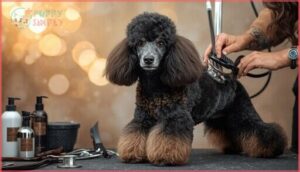
Phantom Poodles aren’t just about those stunning two-tone coats—keeping them healthy and looking sharp takes real commitment. From genetic health issues that pop up in the breed to the daily brushing sessions that prevent their curls from turning into felt, there’s plenty you need to know.
Let’s break down the health concerns, activity needs, and grooming routines that’ll keep your Phantom Poodle thriving.
Common Health Concerns
Vigilance pays off when caring for your Phantom Poodle, since dog health challenges like chronic ear infections, hip dysplasia, and early dental issues crop up more often than you’d think.
Allergic reactions can cause itching and hair loss, while bloat risks demand quick veterinary care if your pup shows abdominal distress.
Regular check-ups keep canine health and wellness on track.
Exercise and Nutrition Requirements
Beyond catching health problems early, your Phantom Poodle thrives on 30–60 minutes of daily exercise—brisk walks, fetch sessions, or enrichment games that keep both body and mind sharp.
Balanced diets with quality protein fuel their energy, while portion control prevents weight gain. Monitor caloric intake based on activity level, adjust feeding schedules as needed, and always keep fresh water available for peak canine health and wellness.
Grooming Routines for Phantom Coats
Grooming your Phantom Poodle’s coat pattern demands consistency, not heroics. Brush 2–3 times weekly with a pin brush to prevent matting, especially along the chest, legs, and tail where debris loves to hide. Bathe every 4–6 weeks using pH-balanced shampoo, then condition to reduce static in those stunning dark markings.
- Detangle from ends upward to protect delicate phantom coat zones
- Professional grooming every 6–8 weeks maintains sharp color boundaries
- Focus brushing techniques on pattern edges for maximum contrast
Reward-based practice keeps sessions stress-free and your pup looking sharp.
Frequently Asked Questions (FAQs)
Are Phantom Poodles hypoallergenic?
Poodles produce pet allergens, yet deliver dander reduction through their low-shedding coats. Hypoallergenic dogs aren’t allergy-free, but phantom poodles offer allergy prevention advantages for sensitive owners.
Regular grooming enhances their hypoallergenic reputation within breeding standards.
Is it difficult to find a Phantom Poodle breeder?
Yes, finding reputable sources can be challenging. Phantom Poodle breeders are scarcer than standard ones, with longer waiting lists, higher puppy costs, and limited breeder networks requiring genetic testing verification.
Are Phantom Poodles good for families with children?
They fit like a glove in family dynamics when you prioritize child safety through early pet socialization and consistent dog training.
Household management requires dedication, but their gentle temperament fosters rewarding family lifestyle adjustments.
Is the price of a Phantom Poodle worth it?
That depends on your lifestyle and budget. Lifetime investment in any dog ownership extends far beyond the initial price tag, encompassing grooming, veterinary care, training, and daily enrichment—factors that truly define breed value.
What kind of diet should a Phantom Poodle have?
Your canine companion thrives on high-quality animal nutrition and diet featuring 25-35% protein, 15-20% healthy fats, and digestible carbs.
Nutrient balance, consistent feeding schedules, and portion control support digestive health while preventing food allergies.
Are Phantom Poodles recognized by major kennel clubs?
Major kennel clubs like the American Kennel Club and United Kennel Club don’t offer phantom poodles a separate spotlight—they’re registered as standard poodles, since phantom describes coat pattern, not breed standards or distinct registration requirements.
How much does a Phantom Poodle puppy cost?
Puppy pricing from reputable breeders generally ranges from $1,500 to $3,500, though champion bloodlines can reach $8, Adoption costs run lower, and purchase contracts should include health guarantees covering ownership expenses.
Do Phantom Poodles get along with children?
Yes, Phantom Poodles usually bond well with kids when socialized early. Their affectionate nature and intelligence make them excellent family companions, though supervision ensures safe play and teaches children proper pet care habits.
Can Phantom markings fade or change over time?
Phantom Poodle markings can fade or shift slightly as dogs age due to coat fading, sun exposure, and natural color evolution. However, the core pattern remains stable since genetic inheritance determines marking placement from birth.
Whats the average lifespan of a Phantom Poodle?
You’re looking at a breed that can practically outlive your mortgage—most Phantom Poodles live 12 to 15 years, with smaller varieties often reaching 16 years when you prioritize health screening, genetic testing, and smart longevity tips for canine health.
Conclusion
A phantom poodle’s rarest feature isn’t its striking coat—it’s finding one that needs less grooming than any other poodle. Spoiler: that won’t happen.
These dogs demand the same brushing schedules, professional trims, and attentive care as their solid-colored cousins. What you gain in head-turning looks, you’ll invest in consistent maintenance.
But for owners who relish the grooming ritual and crave a companion with both brains and beauty, phantom poodles deliver an unbeatable package worth every minute spent with clippers in hand.