
This site is supported by our readers. We may earn a commission, at no cost to you, if you purchase through links.

Walk a muscular, short-coated dog through any neighborhood, and someone will probably call it a pit bull—whether it’s one or not. That mislabeling happens constantly, and it trips up everyone from shelter staff to landlords reviewing pet policies.
The American Bully and the American Pit Bull Terrier share enough surface-level similarities to fool a quick glance, but under that smooth coat, they’re genuinely different dogs with separate breed histories, distinct body structures, and different day-to-day needs.
Knowing which is which isn’t just trivia—it shapes how you train, exercise, and care for the dog living in your home.
Table Of Contents
- Key Takeaways
- Is an American Bully a Pitbull?
- What Does “Pitbull” Mean?
- How These Breeds Developed
- How Their Bodies Differ
- How Their Heads and Faces Differ
- Do Their Temperaments Differ?
- Which Dog Needs More Exercise?
- Which Breed is Easier to Train?
- What Health Issues Matter Most?
- Which Breed Fits Your Lifestyle?
- Frequently Asked Questions (FAQs)
- Are Pitbulls the same as American Bullies?
- What is an American Bully & a pit bull terrier?
- Are American Bully & pit bull aggressive dogs?
- What is the average size of an American Bully?
- Are American Bullies hypoallergenic?
- What type of exercise do American Bullies need?
- Is it expensive to own an American Bully?
- Is the American Bully recognized by the AKC?
- Do American Bullies get along with other dogs?
- How much does an American Bully puppy cost?
- Conclusion
Key Takeaways
- Despite looking alike, the American Bully and the American Pit Bull Terrier are two separate breeds with different histories, body structures, and temperaments — calling them the same dog is a common but real mistake.
- Your choice between these breeds should match your lifestyle: Pit Bulls need 60–90 minutes of daily exercise and thrive with active owners, while American Bullies do well with 30–60 minutes and prefer calm, companion-focused homes.
- Neither breed is naturally aggressive — how your dog behaves comes down to early socialization, consistent training, and responsible ownership far more than breed alone.
- Health and lifespan differ in meaningful ways: Pit Bulls typically live 12–16 years, while American Bullies average 8–13 years, with the shorter gap often tied to weight management and breed-specific conditions like skin fold infections and joint problems.
Is an American Bully a Pitbull?
If you’ve ever called an American Bully a "pitbull," you’re definitely not alone — most people do. The confusion makes sense, but these are actually two separate breeds with different histories, builds, and personalities.
There are actually several distinct Pitbull breeds with their own traits and histories, which makes getting the labels right more important than most people realize.
Here’s what you need to know.
Short Answer: No, They Are Different Breeds
Short answer? No — these are two distinct breeds, separated by breed registry differences, genetic marker studies, and decades of deliberate breeding. Here’s what sets them apart at a glance:
- Different registries recognize them under separate standards.
- Their physical appearance and structural comparison reveal clear distinctions.
- Temperament and personality traits of each breed differ noticeably.
Owner responsibility starts with knowing which dog you actually have.
Why People Often Use “pitbull” Loosely
The word “pitbull” has become convenient shorthand — and that’s where breed comparison gets messy. Media sensationalism, social media trends, and legal ambiguity all push people toward one catch‑all label for any blocky‑headed, muscular dog.
Research highlights that visual breed identification errors are common in shelters.
| Reason for Loose Use | Real Impact |
|---|---|
| Media sensationalism | Fuels breed stigma unfairly |
| Social media trends | Spreads misidentification fast |
| Legal ambiguity | Complicates bully breed ownership |
| Convenient shorthand | Blurs American Bully distinctions |
When an American Bully May Look Pitbull-like
Even knowing the facts, perspective distortion, lighting influence, and angle similarity can make breed label perception unreliable in real life. An American Bully’s blocky head and broad chest look strikingly familiar when you spot one on a leash.
Here’s what fuels the confusion visually:
- Shared short, smooth coats blur appearance differences between American Bully and Pitbull
- Size class confusion happens most with Pocket and Standard varieties
- A wide chest reads as "Pitbull-like" from the front
- Low-angle photos enhance the blocky head silhouette
- Identifying American Bully versus Pitbull visually gets harder with overlapping color patterns
What Does “Pitbull” Mean?

The word "pitbull" gets thrown around a lot, but it’s not actually one specific breed. It works more like a catch-all label covering several related dogs — and that’s where most of the confusion starts.
Here’s what that really breaks down to.
Pitbull as an Umbrella Term
Think of "pitbull" less as a breed and more as a catch-all label. It groups the American Pit Bull Terrier, American Staffordshire Terrier, and American Bully under one roof — even mixed breeds that look the part.
This matters because media portrayal, legal classification, shelter intake decisions, and insurance policies all hinge on that single word. Genetic testing often tells a very different story.
American Pit Bull Terrier Vs. Other Bully Breeds
The American Pit Bull Terrier has a clear genetic lineage analysis rooted in working-dog history — lean, driven, and built for endurance.
Other bully breeds, including the American Bully, were shaped by different breed standard variations, prioritizing a stockier frame and calmer temperament differences.
They share ancestry, but that’s where the overlap ends. Same family tree, very different branches.
Why Breed Labels Get Confused
Labels get messy fast when visual similarity does most of the talking. Shelters rely on appearance guesses, not DNA testing. Media shorthand turns bully breed into “pit bull” overnight. Legal terminology then locks that label into housing policies and insurance forms — even when it’s wrong.
Here’s what actually drives the confusion:
- Shelter labeling practices often skip breed registration or kennel club recognition entirely
- Breed misconceptions spread through headlines, not breed standards or breed origins and historical development
- American Bully and Pit Bull get lost when one catch-all word fits every form
How These Breeds Developed

To really understand the difference between these two breeds, it helps to know where each one came from. Their histories took very different paths, and that shaped everything from their size to their personality.
Knowing each breed’s roots also helps you choose the right toys for pit bulls, since their history as working dogs means boredom and pent-up energy hit them harder than most.
Here’s how each breed developed into what you see today.
Pit Bull Ancestry and Working Origins
The pit bull’s story starts in 19th-century England, where breeders crossed Old English Bulldogs with terriers — blending jaw strength with speed.
These dogs were built for Bull Baiting Roots and Blood Sport Legacy, and then shifted into Catch Dog Roles on farms. Their Terrier Crossbreeding shaped Early Working Tasks like herding and guarding, proving breed origins and historical development always prioritized function over appearance.
American Bully Creation in The 1990s
The 1990s brought a deliberate shift. Razor’s Edge Origin kennels led the charge, crossing American Pit Bull Terriers with bulldog-type breeds — a Bulldog Cross Influence designed to produce a calmer, stockier companion. Kennel Network Collaboration helped spread preferred bloodlines nationwide, while Early Breed Clubs standardized that blocky look.
Hip Hop Culture gave the breed visibility, turning the American Bully into a symbol of loyalty.
Why The American Bully Split Off
So why create a whole new breed? Breeders wanted a dog built for family life — one with a companion temperament and a lower prey drive than traditional pit bulls.
Establishing a separate registry gave clubs a way to standardize that blocky look and shift safety perception. It wasn’t just brand differentiation.
It was a fresh identity, rooted in purpose.
How Their Bodies Differ
Once you see the two breeds side by side, the physical differences are hard to miss. Their builds tell very different stories about what each dog was bred to do.
Here’s how their bodies actually compare.
Lean, Athletic Pit Bull Build

Think of the pit bull as a natural athlete — lean, quick, and built to move. Their body structure is a study in function over flash.
- Shoulder Power drives forward momentum and jumping ability
- Quadriceps Strength aids fast acceleration and direction changes
- Hindquarter Engine delivers explosive bursts during active play
- Lung Capacity allows agility stamina over sustained activity
This muscular appearance stays sleek, never bulky.
Stocky, Blocky American Bully Build

Where the pit bull runs lean, the American Bully is built like a tank — compact, heavy-boned, and unmistakably solid. Every feature reinforces that impression.
| Trait | Description | Why It Matters |
|---|---|---|
| Blocky Head Proportions | Broad, massive skull | Signature visual identifier |
| Rib Cage Depth | Deep, wide barrel chest | Provides muscular appearance |
| Muscular Leg Angulation | Thick, powerful legs | Carries the shorter compact frame |
Spine Alignment stays level, tail carriage style is low and natural, and that wide chest makes every step look purposeful.
Size Classes in American Bullies
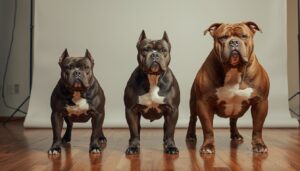
That solid frame comes in more than one size. American Bully size classifications are based on Height Standards at the withers — not Weight Ranges. The Breed Registry recognizes five classes using this Size Terminology:
- Pocket – males under 17 inches
- Standard – males between 17–20 inches
- XL – males between 20–23 inches
Class Boundaries keep Micro and Classic separate by build type.
How Their Heads and Faces Differ

Once you get past the body, the face tells the rest of the story. These two breeds don’t just look different from a distance — up close, the differences are even more obvious.
Here’s what to look for when comparing their heads and features.
Head Shape and Muzzle Length
One of the clearest ways to tell these two dogs apart is by looking at their heads. The American Bully has a blocky, wide skull — what’s called a low cephalic index — with a short muzzle under 2.5 inches. A Pitbull’s head is more balanced, with a medium muzzle length range and moderate facial proportion types.
| Feature | American Bully | Pitbull |
|---|---|---|
| Head Shape | Broad, blocky skull | Proportionate, balanced |
| Muzzle Length | Short (under 2.5 in.) | Medium (2.5–3.5 in.) |
| Brow Ridge Shape | Pronounced stop | Moderate stop |
Skull width variation and brow ridge shape reflect each breed’s standards clearly.
Chest Width and Bone Structure
Beyond the head, the chest tells its own story.
American Bullies carry thick bone and wider rib cage geometry — their sternum width variation and thoracic inlet shape create that signature broad-chested look.
Rib curvature impact is real: bone structure limits how wide a chest can actually be, independent of muscle development in dogs.
Pit Bulls stay leaner and narrower by comparison.
Here’s what shapes that chest difference:
- Broader sternum width in Bullies anchors a naturally wider front chest
- Greater rib curvature projects the chest wall outward further
- Thoracic inlet shape determines upper chest width near the shoulders
- Bone structure limits mean size classifications within the American Bully breed reflect genuine skeletal differences
- Breed standards require Bullies to show thick bone throughout, not just added muscle
Coat Type and Common Appearance Clues
Both breeds share a short, smooth coat that lies flat and sheds lightly year-round. That said, coat appearance can still hint at breed differences.
| Feature | Pit Bull | American Bully |
|---|---|---|
| Coat Texture Variations | Sleek, close-lying | Dense, smooth |
| Shedding Frequency | Light, steady | Light, steady |
| Grooming Needs | Weekly brush | Weekly brush |
Color Pattern Indicators and Undercoat Thickness vary little, but the Bully’s muscular build and body structure differences make even identical coats look different on each dog.
Do Their Temperaments Differ?

Their looks aren’t the only thing that sets these two breeds apart — their personalities tell a pretty different story too. From energy levels to how they bond with people, Pit Bulls and American Bullies each bring something unique to the table.
Here’s a closer look at what makes each one tick.
Pit Bulls and High Energy Drive
Pit bulls run hot — in the best way. Their high energy levels mean they need around 60 minutes of daily exercise, and skipping that invites zoomies management problems fast.
Puzzle toy rotation and scent work games help satisfy their mental drive too.
Watch for energy burnout signs like restlessness or destructive chewing — your pit bull’s telling you something.
American Bullies and Companion-focused Traits
Where a pit bull wants to run, an American Bully wants to cuddle.
Their companion-focused temperament makes owner bonding feel almost easy — they follow you from room to room, thrive on interactive play, and show calm alertness without constant barking.
That loyalty display and routine adaptability are exactly why they’ve earned their reputation as the premier companion dog and family pet.
How Socialization Shapes Behavior in Both Breeds
Think of socialization as the foundation that shapes everything else. Both breeds benefit deeply from early socialization — meeting diverse people, visiting new environments, and joining supervised playgroups.
Human interaction training and environment desensitization help puppies build calm confidence.
Without consistent diverse stimuli exposure, even the friendliest Bully or Pit Bull can develop reactive habits.
Start early, and you’ll raise a steady, well-adjusted dog.
Which Dog Needs More Exercise?

Exercise needs are one of the biggest practical differences between these two breeds. How much daily movement each dog needs can shape your whole routine.
Here’s a closer look at what each breed actually requires.
Daily Activity Needs for Pit Bulls
Adult pit bulls run on high-octane fuel. Their exercise needs are real — most require 60 to 90 minutes of daily activity, normally split between a morning walk length of 30 minutes and an evening play duration of equal time.
Age-adjusted sessions matter too: puppies need shorter, gentler bursts. Indoor activity options like puzzle toys help manage energy levels on slower days.
Exercise Needs for American Bullies
American Bullies are lower-maintenance on the energy scale. Most need 30 to 60 minutes of daily exercise — split into shorter walks rather than one long push.
Low-impact cardio like brisk walking works well, especially with a simple warm-up routine before you head out.
Age-adjusted exercise matters too: seniors need gentler sessions.
Weight management activities keep joints healthy, since extra pounds hit this breed hard.
Mental Stimulation and Play Recommendations
Both breeds need more than just physical activity — mental stimulation fills the gap. Puzzle feeders, scent games, and trick chains keep their minds busy without extra miles.
Rule-based retrieval teaches impulse control through structured play. Rotating toys prevent boredom from setting in.
Short sessions work best, and mixing behavioral enrichment for dogs into your daily routine promotes calmer, more balanced behavior overall.
Which Breed is Easier to Train?

Both breeds are smart and genuinely want to please, which makes training more manageable than you might expect. That said, each one learns a little differently, so your approach matters.
Here’s what works best for each.
Positive Reinforcement for Both Breeds
Both breeds respond well to positive reinforcement training, and the foundation is the same for each. Marker timing matters — the moment your dog does something right, mark it immediately with a word like "Yes" or a clicker, then reward.
Rotate treats to keep motivation high, and mix in play rewards and social praise. Consistent sessions, even just 5–10 minutes, build real results.
Training Style for a Pit Bull
Pit Bulls thrive with structure and variety. Short Training Sessions — just 5 to 10 minutes, repeated a few times daily — keep their sharp minds engaged without burnout.
- Use Impulse Control exercises like "wait" and "leave it" before meals and doorways
- Practice Leash Positioning with rewards for staying close, not yanking
- Build a reliable Emergency Recall with high-value treats in quiet areas first
- Add Puzzle Enrichment between sessions to satisfy their working drive
- Rotate tasks — sit-stay, "look," basic tricks — to prevent restlessness
Training Style for an American Bully
Bullies are a bit more "what’s in it for me?" compared to Pit Bulls.
That’s why reward timing matters — treat or praise lands immediately after the correct behavior. Use consistent cues, the same word and gesture every time. short sessions, clicker shaping, and crate place training build reliable habits.
For problem behavior management, skip harsh corrections — patience and positive reinforcement always win.
What Health Issues Matter Most?

both breeds are generally hardy, but they do come with some health baggage worth knowing about. The differences between a Pit Bull and an American Bully go beyond looks and personality — they show up in the vet’s office too.
Here’s what you should keep on your radar for each breed.
Common Health Concerns in Pit Bulls
Health concerns that American Pit Bull Terrier owners should know include skin allergies, ear infections, and joint problems like hip dysplasia.
Skin allergies often trigger itchy, inflamed skin — and repeated scratching can lead to secondary infections. Ear infections frequently follow.
Heart disease and dental issues also show up in the breed.
Catching these early makes a real difference.
Common Health Concerns in American Bullies
American Bullies carry a unique set of health concerns worth knowing.
Skin Fold Dermatitis is common — trapped moisture in skin folds invites bacterial or yeast infections. Cardiomyopathy risks are real, with some dogs showing fatigue or breathing trouble. Hypothyroidism symptoms like weight gain and dull coat can appear too.
Allergic itch management, joint arthritis pain, and hip dysplasia all demand attention, especially in muscular dogs.
Lifespan and Weight Management Differences
Lifespan tells a real story here. Pit bulls usually live 12–16 years, while Bullies average 8–13. That gap often comes down to weight management and daily care.
Pit bulls live up to 16 years; American Bullies average just 8–13, a gap shaped by daily care
Body Condition Scoring beats the scale for tracking health in muscular dogs. Calorie Adjustment based on activity prevents Joint Health Impact from creeping in.
Age-Related Metabolism slows with time, so nutrition needs for large breeds shift — and Breed Longevity Variance reminds you that good habits matter more than breed labels.
Which Breed Fits Your Lifestyle?

Picking the right dog isn’t just about looks or personality — it’s about honestly matching a breed to how you actually live.
Both the Pit Bull and the American Bully can thrive with the right owner, but they don’t thrive in the same situations.
Here’s what to think about before you decide.
Best Match for Active Owners
If you love daily movement, the Pit Bull’s energy levels match your pace well. These dogs thrive on leash walking tips put into practice, high intensity play, and outdoor enrichment ideas like scent trails or fetch routines.
Owner fitness integration feels natural here.
Their exercise requirements for dogs run high, so your owner lifestyle matching with the dog energy level truly matters when choosing this breed.
Best Match for Families and Companions
If calm home life and steady companionship matter most to you, the American Bully is a natural fit. Their companion-focused temperament and low prey drive make family pet suitability almost simple.
- Affectionate bonding happens daily through cuddles and closeness
- Supervised play stays gentle and predictable with kids
- Routine predictability keeps their calm energy steady
- Dog socialization builds trust with visitors and pets
- Owner lifestyle match works well for relaxed households
Legal, Housing, and Ownership Considerations
Before you bring either breed home, check your lease. Many German rental agreements require written landlord approval for dogs, and breed-specific legislation can affect both Pit Bull-type dogs and American Bullies.
Condo breed restrictions, liability insurance requirements, and pet insurance restrictions vary widely.
Keep ownership transfer docs and know your hardship eviction rights.
Responsible ownership starts before you sign anything.
Frequently Asked Questions (FAQs)
Are Pitbulls the same as American Bullies?
No, they’re not the same.
Despite public perception and media representation blurring the lines, the American Bully and the American Pit Bull Terrier are two distinct breeds with different origins, builds, and registration standards.
What is an American Bully & a pit bull terrier?
Think of them as cousins, not twins.
The American Pit Bull Terrier is an athletic working dog rooted in 1800s England, while the American Bully is a stocky, companion-focused breed developed in 1990s America.
Are American Bully & pit bull aggressive dogs?
Neither breed is naturally aggressive. Socialization impact, owner responsibility, and training shape behavior far more than breed alone.
Media perception fuels aggressive stereotypes, but dog temperament traits vary widely by individual.
What is the average size of an American Bully?
American Bully size depends on its category. A Standard adult stands 17–20 inches and weighs 50–85 pounds. Pocket types run smaller, while XL dogs can exceed 85 pounds and reach 23 inches.
Are American Bullies hypoallergenic?
No, American Bullies aren’t hypoallergenic. Their short coat still sheds dander and allergen sources like saliva. Individual sensitivity varies, so grooming impact helps but won’t eliminate allergies entirely.
What type of exercise do American Bullies need?
Your Bully’s exercise needs are straightforward: 30–60 minutes of daily walks, Fetch Sessions, and Agility Drills keep energy levels balanced. Add Puzzle Feeders and Low‑Impact Swimming for joint-friendly Strength Conditioning.
Is it expensive to own an American Bully?
Owning one isn’t cheap. Between puppy prices, food costs, veterinary expenses, gear supplies, and insurance premiums, costs add up fast. Smart budgeting makes it manageable.
Is the American Bully recognized by the AKC?
No, the American Bully doesn’t hold AKC registry status.
The AKC hasn’t granted it breed recognition or breed standards requirement eligibility, so it relies on alternative registries like the UKC instead.
Do American Bullies get along with other dogs?
Yes, they can — with the right start. Early socialization, neutral meeting areas, and leash introductions make a real difference in how well your American Bully shares space with other dogs.
How much does an American Bully puppy cost?
Prices vary widely. Pet-level puppies generally run $1,500–$3,500, while show quality or championship lineage can push past $7, Pocket and micro sizes often cost more due to demand.
Conclusion
Some might argue label doesn’t matter—a dog’s a dog. But when you’re choosing training methods, negotiating housing rules, or simply understanding what your pet actually needs, knowing whether an American Bully is a pitbull makes a real difference.
These aren’t interchangeable dogs wearing the same coat. One thrives on athletic challenge; the other lives for your couch and company.
Know your dog’s breed, and you’ll know exactly how to help it flourish.