This site is supported by our readers. We may earn a commission, at no cost to you, if you purchase through links.
Your Golden Retriever puppy just devoured her breakfast in 30 seconds flat, and now you’re staring at the measuring cup wondering if you gave her enough—or too much. This isn’t a trivial concern: overfeeding a large breed puppy can accelerate bone growth faster than joints can handle, setting the stage for hip dysplasia and lifelong pain, while underfeeding robs them of the nutrients they need during the most critical developmental window of their lives.
The challenge is that Golden Retriever puppies don’t grow at a steady, predictable rate—their nutritional needs shift dramatically between 8 weeks and 12 months, and what works for one puppy might leave another hungry or overweight. Getting the portions right means understanding not just how much food goes in the bowl, but when to feed, which nutrients matter most, and how to adjust as your puppy transforms from a fuzzy 10-pound ball of chaos into a 65-pound adolescent.
Table Of Contents
- Key Takeaways
- Golden Retriever Puppy Feeding Basics
- How Much to Feed a Golden Retriever Puppy
- Golden Retriever Puppy Feeding Chart
- Essential Nutrients for Golden Retriever Puppies
- Factors Affecting Puppy Food Intake
- Top Puppy Foods for Golden Retrievers
- Tips for Healthy Golden Retriever Puppy Feeding
- Frequently Asked Questions (FAQs)
- How much food should you feed a Golden Retriever puppy?
- Can you overfeed a Golden Retriever puppy?
- How much to feed a puppy chart?
- How to transition to adult dog food?
- What supplements are beneficial for puppies?
- How to address food allergies in puppies?
- Is home-cooked food suitable for puppies?
- Are raw diets safe for Golden Retriever puppies?
- How do I transition between puppy food brands?
- Should puppies take vitamins or nutritional supplements?
- Conclusion
Key Takeaways
- Golden Retriever puppies need 1 to 4 cups of food daily, split across multiple meals, with amounts adjusted every 2 to 4 weeks based on age, weight, and body condition, rather than a fixed feeding chart alone.
- Overfeeding accelerates bone growth faster than joints can handle and raises the lifelong hip dysplasia risk, while underfeeding during critical development windows stunts growth and weakens immunity.
- Large breed puppy formulas should contain 22-30% protein, controlled calcium at 1.1-1.25%, and omega-3 fatty acids like DHA to support brain development without stressing growing bones.
- Consistent meal timing at the same hours daily improves digestive health, simplifies house training, and prevents blood sugar swings better than free-feeding or irregular schedules.
Golden Retriever Puppy Feeding Basics
Getting your Golden Retriever puppy’s nutrition right from the start sets the foundation for a healthy, energetic life.
Choosing the right puppy food for your Goldendoodle follows many of the same nutritional principles, since both breeds thrive on high-quality ingredients that support their rapid growth and active lifestyles.
You’ll need to understand how much to feed, when to feed, and what happens when those amounts are off. Let’s cover the essential feeding basics that every Golden Retriever puppy owner needs to know.
Importance of a Balanced Diet
Your golden retriever puppy’s nutrition sets the foundation for lifelong health. A balanced diet fosters steady growth without overwhelming developing joints, strengthens immune defenses, and prevents obesity-related problems down the road.
Here’s what ideal nutrition delivers:
- Controlled bone development – Balanced calcium and phosphorus protect hips and elbows from growth disorders.
- Strong immunity – Vitamins A, C, E, plus zinc and iron help your puppy fight infections.
- Healthy weight – Proper calorie balance fuels play and growth without excess that strains joints. For more guidance on, consult expert resources customized to Golden Retrievers.
Role of Feeding Schedules
Beyond the nutrients in your puppy food, meal timing shapes digestive health and daily life. Feeding rhythms help you predict potty schedules, calm begging, and measure portions accurately. A golden retriever puppy fed at set times develops smoother digestion, learns faster house training, and settles into family routines more easily than one left to free-feed.
| Benefit | How It Helps |
|---|---|
| Digestive Health | Steady meal timing reduces upset and promotes nutrient absorption |
| Potty Schedules | Predictable elimination follows each feeding by a consistent window |
| Energy Levels | Regular feeding chart entries prevent blood sugar highs and crashes |
| Portion Control | Scheduled meals make it simple to track intake for feeding golden retriever puppies |
Establishing a routine for your puppy’s digestion, behavior, and overall well-being.
Risks of Overfeeding and Underfeeding
Meal schedules keep portions in check, but getting amounts wrong brings real trouble. Too much puppy food loads extra pounds that stress growing hips and elbows, raising the risk of arthritis before your golden retriever hits adulthood. Too little starves muscle and bone, stunting puppy growth and leaving coats dull.
Getting puppy portions wrong—whether too much or too little—damages joints, stunts growth, and undermines long-term health
Overfeeding dangers:
- Puppy obesity shortens life expectancy and strains the heart.
- Joint issues appear earlier when rapid weight gain outpaces proper cartilage development.
- Digestive problems like bloating and diarrhea overwhelm an immature gut.
Underfeeding consequences:
- Nutrient deficiencies weaken immunity and slow healing.
- Growth stunting leaves puppies smaller and frailer than healthy peers.
- Visible ribs and low energy signal your feeding chart needs adjustment.
Balanced nutrition keeps your puppy’s development on track without tipping into either extreme.
How Much to Feed a Golden Retriever Puppy
Getting the portions right isn’t guesswork—it’s about matching your puppy’s age, weight, and energy levels to their actual nutritional needs. Most golden retriever puppies eat between one and a half to four cups of food daily, depending on how old they’re and how fast they’re growing.
Here’s how to break down those amounts so you’re feeding enough to fuel healthy development without overdoing it.
Recommended Portion Sizes by Age
Your Golden Retriever puppy’s portion sizes shift as rapidly as their growth spurts, so age-based feeding charts offer practical starting points. At 8 weeks, most puppies eat 1 to 1.5 cups of high-quality puppy food daily, split into multiple meals.
By 3 months, expect about 2 cups per day. At 6 months, males often need 3.5 to 4 cups, while females usually eat closer to 3 cups.
As your puppy grows beyond 6 months, large breed puppy nutrition requirements shift to support healthy bone development without overfeeding.
Feeding Frequency for Puppies
Usually, puppies younger than 3 months do best on 4 small meals per day to maintain steady blood sugar and support rapid growth stages.
From 3 to 6 months, you can shift to 3 meals, spacing them morning, midday, and evening.
By 6 to 12 months, most switch to twice-daily feeding schedules while staying on puppy food for balanced nutrient delivery and digestive health.
Adjusting Amounts Based on Growth
Growth monitoring drives smart feeding adjustments throughout puppy development. You’ll need to check your Golden Retriever’s body condition every 2 to 4 weeks, adjusting portions by 10 to 15 percent based on what you see and feel.
Puppies need around 55 to 60 calories per pound daily, so as weight increases, total food rises while maintaining nutrient balance and healthy weight management.
Golden Retriever Puppy Feeding Chart
A feeding chart takes the guesswork out of portioning meals for your growing puppy. The right amounts depend on your Golden’s age, current weight, and how active they’re throughout the day.
Here’s a breakdown of what to feed at different stages, along with general guidelines to keep your puppy healthy and on track.
Feeding Chart by Age (8 Weeks to 12 Months)

Your puppy’s calorie intake shifts month to month as development stages accelerate or slow down.
Below is a feeding chart that tracks portion sizes and feeding schedules from weaning through their first birthday.
| Age Range | Daily Food Amount | Meals Per Day |
|---|---|---|
| 8-12 weeks | 1.5-2 cups | 3-4 |
| 3-6 months | 2-3 cups | 3 |
| 6-12 months | 2.5-3.5 cups | 2 |
Adjust portions as your Golden Retriever puppy hits growth spurts or plateaus.
Feeding Chart by Weight and Activity Level

Body weight shapes daily portions, but activity level fine-tunes the final amount you measure out. A moderately active puppy needs less food per pound than a high-energy companion who sprints and plays several hours each day.
Below is a feeding chart that pairs weight with activity to help you dial in the right calorie intake for your Golden Retriever.
| Puppy Weight | Moderate Activity | High Activity |
|---|---|---|
| 15 lbs | 1-1.5 cups | 1.5-2 cups |
| 25 lbs | 2-2.5 cups | 2.5-3 cups |
| 35 lbs | 2.5-3 cups | 3-3.5 cups |
| 45 lbs | 3-3.5 cups | 3.5-4 cups |
| 60 lbs | 3.5-4 cups | 4-4.5 cups |
Watch your puppy’s waistline every week, and adjust portions up or down by ten percent if ribs become hard to feel or too prominent.
General Guidelines for Meal Portions

Set portions with an eight-ounce measuring cup or kitchen scale to keep each meal consistent, because eyeballing kibble often leads to unintentional overfeeding. The table below shows meal frequency and general portion control by age, helping you balance nutrient intake with growth monitoring.
| Age Range | Meals Per Day | Daily Total |
|---|---|---|
| 8-16 weeks | 3-4 | 1-2 cups |
| 4-6 months | 3 | 2-2.5 cups |
| 6-12 months | 2 | 2.5-3 cups |
Adjust every two weeks based on your golden retriever’s body condition, not the feeding chart alone.
Essential Nutrients for Golden Retriever Puppies

Your puppy’s body is building muscle, bone, and organ systems at a rapid pace, which means every meal needs to deliver specific nutrients in the right amounts.
Protein, calcium, carbohydrates, fiber, and healthy fats each play a distinct role in supporting your Golden Retriever’s growth and long-term health. Here’s what you need to know about each essential nutrient and why it matters.
Protein Requirements
A golden retriever puppy’s diet should provide about 22 to 30 percent protein on a dry matter basis, supplying essential amino acids that support muscle development and immune function.
Animal-based protein sources like chicken, turkey, and fish offer complete amino acid profiles with better digestibility than plant proteins. Balancing protein percentages with appropriate calories and nutrient balance ensures your puppy grows steadily without excess metabolic stress.
Importance of Calcium and Bone Health
Calcium promotes bone growth in your golden retriever puppy, with large breed puppy food usually supplying 3 to 4.5 grams per 1,000 kilocalories to maintain skeletal health.
This mineral balance prevents brittle bones from excess intake and calcium deficiency from inadequate amounts. Proper nutrition ensures strong bones without oversupplementing, as most complete puppy foods already meet canine nutrition standards for safe development.
Role of Carbohydrates and Fiber
Carbohydrates give your puppy quick glucose for play and growth, with most large breed puppy food formulas containing 35 to 45 percent carbohydrate to power daily activity.
Fiber—a complex carb—promotes gut health by fermenting slowly in the large intestine, producing short-chain fatty acids that nourish intestinal cells and keep stools firm without causing excess gas or bulk.
Fats and Omega Fatty Acids
Dietary fat needs for golden retriever puppies usually land around 12 to 18 percent on a dry matter basis, fueling growth while keeping joints healthy.
Fat soluble vitamins like A, D, E, and K depend on these fats for absorption, and omega 3 sources such as fish oil boost brain development through DHA. Balancing fatty acid roles—omega 3 for learning, omega 6 for coat shine—ensures complete puppy nutrition.
Factors Affecting Puppy Food Intake

Your puppy’s food requirements aren’t set in stone, and what works for one golden retriever mightn’t work for another. Several factors influence how much your puppy should eat each day, from obvious considerations like age to less visible elements like metabolism.
Understanding these variables helps you adjust portions to match your individual puppy’s needs rather than relying solely on generic feeding guidelines.
Age and Growth Stage
Your puppy’s nutritional needs shift dramatically across development stages, so feeding schedules and puppy food portions must adjust as your Golden Retriever grows.
From 8 to 12 weeks, rapid puppy growth and development demands frequent meals—three to four times daily—because small stomachs can’t handle large amounts at once.
Following a feeding chart helps you match nutrient needs to each phase of puppy development, supporting healthy growth patterns without overfeeding.
Weight and Activity Level
Two major factors drive how much puppy food your Golden Retriever needs: body weight and daily exercise. Activity multipliers help calculate daily caloric needs—inactive puppies around 1.6 times resting energy, active ones up to 3.0—so feeding adjustments match energy burn.
- Check your puppy’s body condition score every two weeks to fine-tune portions
- Use your feeding chart as a starting point, then adjust based on ribs you can feel but not see
- Highly active puppies may need an extra cup daily compared to calmer littermates
Weight management begins now, shaping your Golden Retriever’s long-term health and preventing joint strain during rapid growth.
Monitoring Individual Caloric Needs
Daily caloric intake shifts as your puppy grows, so tracking weight every two to four weeks reveals whether portions need fine-tuning. Golden Retriever puppies commonly require 55 to 70 calories per pound of body weight, with feeding adjustments based on body condition score rather than the scale alone.
| Monitoring Method | Action Frequency |
|---|---|
| Weigh puppy | Every 2–4 weeks |
| Check body condition | Weekly |
| Adjust caloric intake | As growth tracking shows |
This nutrient balance protects joints during rapid development.
Top Puppy Foods for Golden Retrievers
Choosing the right puppy food sets your Golden Retriever up for healthy growth, strong bones, and plenty of energy.
Large breed formulas provide the balanced nutrition your pup needs without overloading calcium or protein, which can stress developing joints.
Here are three top-quality options that meet the specific needs of Golden Retriever puppies.
1. Purina Pro Plan Large Breed Puppy Food

Purina Pro Plan stands out as a formula designed specifically for puppies expected to reach over 50 pounds at maturity, fitting most golden retrievers.
The chicken and rice recipe delivers 28 to 30 percent protein with glucosamine at 500 ppm to support developing joints, while DHA from fish oil aids brain and vision development. You’ll find calcium controlled at about 1.1 percent and phosphorus around 0.8 to 0.9 percent, giving the balanced mineral levels large breed puppies need for steady, healthy growth.
| Best For | Large breed puppy owners who want a protein-rich formula with joint support and brain development nutrients for dogs expected to weigh over 50 pounds at maturity. |
|---|---|
| Brand | Purina Pro Plan |
| Flavor | Chicken & Rice |
| Form | Dry |
| Weight | 34 lb |
| Age Range | Puppy – Large Breed |
| Primary Protein | Real Chicken |
| Additional Features |
|
- High protein content (28-30%) with real chicken as the first ingredient supports muscle development
- Contains glucosamine for joint health and DHA for brain and vision development
- Balanced calcium (1.1%) and phosphorus (0.8-0.9%) levels promote controlled, healthy growth in large breeds
- Higher price point compared to many other puppy food options
- Not suitable for small breed puppies or dogs with specific food allergies
- May require gradual transition to avoid digestive issues
2. Royal Canin Golden Retriever Puppy Food
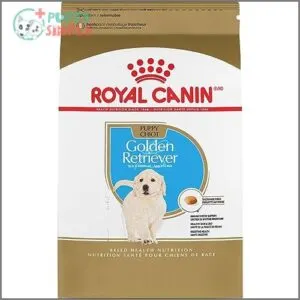
Royal Canin offers a breed-specific formula designed exactly for golden retriever puppies from 8 weeks to 15 months, addressing their unique muzzle shape with custom kibble that encourages chewing rather than gulping. You’ll get 27 percent protein and 14 percent fat to fuel rapid growth, plus EPA at 0.17 percent minimum and DHA at 0.07 percent to support brain and vision development.
The recipe includes 420 IU per kilogram of vitamin E to strengthen the immune system, while prebiotics and highly digestible L.I.P. proteins promote firm stools and efficient nutrient absorption.
| Best For | Golden retriever puppy owners who want a breed-specific formula tailored to their dog’s unique nutritional needs and jaw shape during critical growth stages. |
|---|---|
| Brand | Royal Canin |
| Flavor | Chicken |
| Form | Dry |
| Weight | 30 lb |
| Age Range | Puppy (8 weeks to 15 months) |
| Primary Protein | Chicken By-Product Meal |
| Additional Features |
|
- Custom kibble shape designed specifically for golden retriever puppies’ muzzles, encouraging proper chewing and reducing gulping
- Strong nutritional profile with 27% protein, 14% fat, and added EPA/DHA to support brain development, vision, and healthy skin and coat
- Includes prebiotics and highly digestible proteins for better nutrient absorption and digestive health
- Significantly more expensive than general puppy food brands, especially for a 30-pound bag
- Contains chicken by-product meal, corn, and wheat gluten, which may trigger allergies or sensitivities in some puppies
- Some owners report their puppies lost interest in the taste over time or experienced digestive issues
3. Eukanuba Large Breed Puppy Food
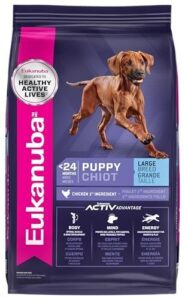
Eukanuba Large Breed Puppy Food gives your golden retriever 26 percent protein and controlled calcium levels, about 1.15 to 1.25 percent, to support steady bone development without stressing growing joints. You’ll feed based on adult target weight, with a 30-kilogram puppy receiving roughly 2⅞ cups daily at two months, increasing to 4⅝ cups at six months, then gradually tapering as growth slows.
The formula includes clinically proven DHA for brain development, plus prebiotics and beet pulp to support firm stools and easy digestion throughout the growth window.
| Best For | Owners of large breed puppies (like golden retrievers) who want controlled calcium and protein levels to support healthy bone growth without overtaxing developing joints. |
|---|---|
| Brand | Eukanuba |
| Flavor | Chicken |
| Form | Pellet |
| Weight | 30 lb |
| Age Range | Puppy (up to 15 months) |
| Primary Protein | Chicken |
| Additional Features |
|
- 26% protein with controlled calcium (1.15-1.25%) designed specifically for large breeds to prevent joint stress during growth
- Clinically proven DHA supports brain development and trainability during critical puppy months
- Prebiotics and beet pulp promote healthy digestion and firm stools throughout the growth period
- Higher price point can add up quickly when feeding large or multiple puppies
- Some puppies may get bored with the taste over time and lose interest
- Contains fillers like corn and wheat, which aren’t human-grade ingredients and may not suit puppies with sensitivities
Tips for Healthy Golden Retriever Puppy Feeding

Feeding a golden retriever puppy the right amount is only part of the equation—how you feed matters just as much.
A few simple habits can set your puppy up for a lifetime of healthy eating and steady growth.
Here are some practical tips to help you avoid common pitfalls and keep your puppy thriving.
Creating a Consistent Feeding Schedule
A steady feeding schedule shapes your puppy’s digestive health and makes house training much easier. Golden retrievers thrive when meal timing stays predictable, so pick times that fit your day and stick with them.
- Morning meals work best between 7–8 a.m. to jumpstart energy and set the rhythm for the day
- Midday feeding around 12–1 p.m. keeps younger puppies fueled without long gaps
- Evening portions should land 2–3 hours before bedtime to support overnight bladder control
- Consistent feeding environments help puppies focus and reduce mealtime distractions
- Regular puppy schedules align nutritional needs with predictable bathroom breaks
Measuring and Adjusting Portions
Accurate portion control starts with a digital kitchen scale rather than cups alone, since scoops can misjudge amounts by up to 80 percent. Weigh your puppy’s daily food in grams, then split it into meals according to your feeding schedule.
As growth slows near 12 months, trim caloric intake by about 10 percent to match changing nutritional needs and prevent excess weight gain.
Signs of Proper Nutrition and Growth
Once you’ve dialed in portions, watch your golden retriever puppy for signs everything is clicking. Steady puppy growth shows up as consistent weekly weight gain on a feeding chart, a shiny coat without dull patches, playful energy that doesn’t drop off between meals, and firm stools that hold their shape.
These markers tell you that nutritional needs are being met and puppy growth and development are on track, so a healthy body condition follows naturally.
Common Feeding Mistakes to Avoid
Even with a solid feeding chart, mistakes slip in. Avoid these traps that derail golden retriever nutrition:
- Overfeeding risks and free feeding turn portion control into guesswork, letting your puppy graze all day and pack on unhealthy weight.
- Sudden changes between puppy food brands skip the five-to-seven-day gradual switch and trigger loose stools or vomiting.
- Inconsistent schedules confuse your pup’s digestion and house-training routine, while toxic foods like chocolate or grapes create immediate danger.
Stick to measured meals at set times.
Frequently Asked Questions (FAQs)
How much food should you feed a Golden Retriever puppy?
Most Golden Retriever puppies need one to four cups of puppy food daily, split across multiple meals.
The exact amount depends on your puppy’s age, weight, activity level, and individual growth rate.
Can you overfeed a Golden Retriever puppy?
Yes, you can overfeed a Golden Retriever puppy, because their strong appetite often outlasts actual nutritional needs, making weight gain and joint stress real risks without careful portion control and growth monitoring.
How much to feed a puppy chart?
Most puppy feeding charts group golden retrievers by age—8 weeks, 3 months, 6 months—and weight, listing daily cup amounts alongside meal frequency to match your pup’s current developmental stage.
How to transition to adult dog food?
Most large breed puppies switch between 12 and 18 months, with many vets recommending closer to 15 months to support complete bone development.
Mix increasing portions of adult food gradually over seven to ten days.
What supplements are beneficial for puppies?
Healthy puppies eating complete food don’t need extra supplements because their diet already meets nutrient requirements.
Your vet may recommend targeted omega-3, probiotics, or joint support only when specific deficiencies or medical conditions require them.
How to address food allergies in puppies?
When your pup struggles with constant itching, ear infections, or digestive upset, an elimination diet using novel protein sources often pinpoints allergy symptoms, restoring skin health and meeting nutritional needs without standard puppy food triggers.
Is home-cooked food suitable for puppies?
Home-cooked meals can work if you follow veterinary nutritionist recipes that meet AAFCO growth standards, ensuring nutrient balance for golden retriever puppy nutrition.
Most homemade diets lack essential vitamins, minerals, and proper calcium levels critical for healthy development.
Are raw diets safe for Golden Retriever puppies?
Raw diets for Golden Retriever puppies carry serious pathogen risks, nutrient balance concerns, and bone safety hazards that outweigh benefits, so veterinary guidance strongly recommends complete, AAFCO-approved puppy food instead for ideal canine health and wellness.
How do I transition between puppy food brands?
Switching brands overnight can wreck your puppy’s digestive health, so blend old and new food over seven to ten days, starting with 25 percent new, watching stool closely, and matching calorie density.
Should puppies take vitamins or nutritional supplements?
Most puppies don’t need vitamins because complete puppy foods already provide balanced nutrition for normal growth.
Extra supplements can actually disrupt nutrient balance and create health risks, especially excess calcium in large breeds.
Conclusion
Feeding your Golden Retriever puppy is less like following a recipe and more like steering a ship—you set the course, but you adjust for the currents. Understanding how much to feed a golden retriever puppy means measuring portions with precision, watching your puppy’s body condition, and recalibrating as growth demands shift.
The bowl you fill today protects joints, builds muscle, and shapes the healthy adult your puppy will become tomorrow.
- https://www.morewagginlessbarkin.com/2025/07/11/how-much-should-a-golden-retriever-eat-a-complete-2025-guide/
- https://secretlifepets.com/golden-retriever-puppies/
- https://www.mygoldenretrieverpuppies.com/blog/how-much-to-feed-a-golden-retriever-puppy
- https://www.purina.com/articles/dog/puppy/feeding/how-much-to-feed-a-puppy-chart
- https://www.spotandtango.com/blog/dog-food-for-golden-retrievers?srsltid=AfmBOopqp3l2_0YItROfFF12WqxfQ5MtFSYeME6emfcNZTppX0CXC--c