This site is supported by our readers. We may earn a commission, at no cost to you, if you purchase through links.
The click that marks perfect behavior means nothing to a deaf dog. Traditional clickers, the cornerstone of positive reinforcement training, rely entirely on sound—a sensory channel that’s completely inaccessible for dogs with hearing loss. This creates a fundamental communication gap, one that’s frustrated countless owners who’ve watched their deaf dogs miss cues, ignore timing, and struggle with consistency.
But deaf dogs aren’t untrainable; they simply process the world through different channels. Visual markers like LED lights and tactile cues from vibrating collars tap into the heightened sensory awareness these dogs naturally develop, transforming training from an exercise in frustration into a precise, effective dialogue. The right dog training clickers for deaf dogs work with their strengths, not against their limitations.
Table Of Contents
- Key Takeaways
- Why Traditional Clickers Don’t Work for Deaf Dogs
- Visual Clicker Alternatives for Deaf Dog Training
- Vibration-Based Clickers and Remote Training Tools
- Implementing Marker Training With Your Deaf Dog
- Product Reviews: Best Training Clickers for Deaf Dogs
- Frequently Asked Questions (FAQs)
- Conclusion
Key Takeaways
- Deaf dogs need visual or tactile markers, like hand signals, LED lights, or vibrating collars, instead of sound-based clickers for effective training.
- Consistent marker timing—delivered within half a second of the desired behavior—builds strong reward associations and accelerates learning.
- Marker choice should match your dog’s sensory strengths and training environment, with high-contrast visual cues or reliable tactile signals for different situations.
- Safety and comfort matter when using vibration devices; start with low intensity and monitor your dog’s reactions to avoid startling or stress.
Why Traditional Clickers Don’t Work for Deaf Dogs
You can’t train a dog with a tool they can’t perceive, and that’s exactly the problem with standard clickers for deaf dogs. The sharp click that hearing dogs respond to is completely lost on a dog who experiences the world through sight, vibration, and scent instead of sound.
Let’s break down why traditional clickers fall short and what your deaf dog actually needs to succeed in training. While standard dog training clickers for small dogs rely on sound, deaf dogs respond best to visual signals like hand flashes or gentle vibration-based markers instead.
Understanding How Deaf Dogs Perceive The World
Your deaf dog isn’t broken—they’ve just rebuilt their entire navigation system from the ground up. Without sound, they’ve sharpened other senses into precision tools, transforming how they read the world around them:
Deaf dogs aren’t broken—they’ve honed their other senses into precision tools, creating a new way to navigate the world
- Visual processing becomes their primary radar, detecting even subtle movement shifts
- Sensory compensation heightens awareness of vibrations and air currents
- Environmental awareness develops through mental mapping of familiar spaces
- Social cues from body language replace auditory signals
- Tactile sensitivity increases, making touch-based markers remarkably effective
This sensory recalibration makes deaf dog training with assistive technology—like vibrating collars or visual markers—not just possible, but powerful. Clicker training adapts beautifully once you understand deaf dog perception works differently, not deficiently. The use of methodological rigor in training methods can also improve the effectiveness of these approaches.
The Limitations of Sound-Based Training Tools
Traditional clicker training collapses the moment sound can’t reach your dog’s ears. Auditory barriers like environmental noise mask cues, while hearing loss renders sound-based markers completely ineffective. Even dogs with intact hearing sometimes prioritize visual alternatives over clicks. That’s why teaching dogs to respond to visual and tactile cues creates a more reliable foundation than relying on sound alone.
That’s why deaf dog training demands assistive technology for pets—vibrating collars and tactile markers become your lifeline for silent communication.
| Sound Limitations | Impact on Training | Alternative Solution |
|---|---|---|
| Hearing loss blocks auditory cues | Zero communication pathway | Visual alternatives (hand signals, lights) |
| Environmental noise interference | Inconsistent marker timing | Tactile markers (vibration devices) |
| Competing sounds mask clicks | Delayed or missed responses | Vibrating collar with clear signals |
| Dogs ignore auditory markers | Weak behavior reinforcement | Silent communication through touch/sight |
Clicker training isn’t obsolete—it just needs translation into languages deaf dogs actually speak.
Why Deaf Dogs Need Alternative Markers
Sound-based cues vanish into silence when your dog can’t hear them. That’s why alternative markers transform training—they align with your dog’s sensory strengths, delivering instant feedback through sight or touch. Vibrating collars and visual markers don’t just replace clickers; they rebuild marker timing for deaf communication, boosting training accuracy while keeping reward systems tied to behaviors your dog actually perceives.
- Your dog’s world operates on vision and touch, not phantom sounds
- Marker timing becomes pinpoint-accurate when you leverage sensory strengths
- Training accuracy skyrockets with visual markers your dog won’t miss
- Vibrating collars create a language you both understand instantly
- Positive reinforcement finally clicks when your reward systems match your dog’s reality
Visual Clicker Alternatives for Deaf Dog Training
You can’t rely on sound to mark good behavior with a deaf dog, but visual cues work just as well once you find the right tool. The key is choosing a marker that’s quick, clear, and consistent enough for your dog to recognize instantly. A penlight or vibration collar can serve as your marker, and you can reinforce that timing with basic obedience training techniques for puppies that emphasize consistency.
Let’s look at the most effective visual alternatives and how to pick one that fits your training style.
Hand Signal Markers and Best Practices

Your hands become the clicker when training deaf dogs—a simple thumbs-up or palm flash can mark correct behavior instantly. The same foundation of lure-and-reward training applies—just swap the clicker sound for a bright visual cue they can actually see.
Signal consistency matters most: choose distinct hand signs for each command, pair them with immediate positive reinforcement, and practice marker timing so your visual cue arrives the moment your dog responds. A vibration collar for training can complement your hand signals by providing an additional sensory cue that doesn’t startle your dog during the learning process.
Clear visual cueing beats fancy gadgets every time.
Flashlight Training Tools and Techniques

A simple keychain flashlight becomes your portable marker when distance separates you from your dog. Use brief 0.2–0.5 second white LED flashes to signal correct behavior, then immediately follow with treats to strengthen the connection.
Flashlight safety matters—calibrate brightness to avoid startling your dog, and practice consistent reward timing across different lighting conditions. Visual cueing beats inconsistency every time.
LED Light Markers for Consistent Communication

Dedicated LED training markers deliver power where flashlights falter—programmable flash patterns, distance visibility up to 20 meters, and color-coded signals (red for cues, green for rewards) that your deaf dog recognizes instantly.
Visual consistency breeds confidence in deaf dogs.
- Consistent marker timing through programmable flashes eliminates human error in clicker training
- Multiple display modes (steady, slow flash, quick flash) adapt to different positive reinforcement protocols
- Battery life spans 4–12 hours of continuous use, outlasting typical training sessions
- Distance visibility maintains nonverbal cues and signals across yards and parks
- Color differentiation helps dogs distinguish between attention requests and reward markers
Choosing The Right Visual Marker for Your Dog

Match your visual marker to your dog’s world—not your wishlist. Training distance, marker visibility, and color contrast determine whether your deaf dog catches every cue or misses critical nonverbal cues during positive reinforcement sessions.
| Factor | Close-Range Training | Distance Work |
|---|---|---|
| Marker Visibility | Hand signals work well | LED devices outperform flashlights |
| Color Contrast | Yellow/red stand out indoors | High-contrast required outdoors |
| Device Portability | Minimal gear needed | Compact LEDs win |
| Training Distance | Under 3 meters | 10–20 meters |
| Marker Consistency | Gesture precision matters | Programmable flash patterns excel |
Clicker training adaptation requires matching equipment to the environment—bright backyards demand different tools than dim living rooms.
Vibration-Based Clickers and Remote Training Tools
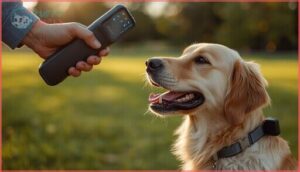
Vibration-based training tools offer a tactile way to communicate with your deaf dog, delivering a physical marker they can feel no matter where they’re looking. These devices work by sending a gentle pulse through a collar or handheld unit, creating a consistent signal that bridges the gap between correct behavior and reward.
Understanding how to choose and use vibration markers safely will help you build a training system that works for both you and your dog.
How Vibrating Collars Work as Training Markers
Think of a vibrating collar as a silent tap on your dog’s shoulder—it delivers a distinct tactile cue the instant your deaf dog nails a behavior.
These devices use programmable vibration patterns paired with positive reinforcement to mark correct responses, just like clicker training for hearing dogs.
The marker timing creates clear communication, helping you shape training outcomes without relying on sound or visual markers alone.
Adjustable Intensity Settings and Safety Considerations
Most vibrating collars offer adjustable intensity controls, so you can start at the lowest effective setting and fine-tune as your deaf dog responds. Marker calibration matters—excessive intensity triggers discomfort or startle responses that derail positive reinforcement.
Monitor your dog’s stress cues like lip licking or turning away during training feedback sessions. Device monitoring and clear safety protocols prevent overstimulation, keeping clicker training humane and effective.
Distinguishing Between Attention and Reward Vibrations
You’ll need distinct vibration patterns so your deaf dog doesn’t confuse “look at me” with “you did it.” Use a short, low-intensity pulse for attention signals, then reserve a longer, stronger pattern as your reward timing marker.
Marker consistency matters—pair your reward vibration with treats immediately after the behavior to lock in positive reinforcement. Training protocols work best when each cue feels unmistakably different to your dog.
Top-Rated Vibration Training Devices
Once you’ve nailed vibration patterns, look for devices with at least four training modes and waterproof collar designs built to last.
The best picks offer adjustable intensity safety features—your deaf dog communication depends on clear, distinct cues.
Models blending vibration clicker training with visual marker backups give you flexibility, making assistive training methods more reliable when standard tools fall short.
Implementing Marker Training With Your Deaf Dog

Now that you’ve chosen your visual or tactile marker, it’s time to put theory into practice and actually teach your dog what that signal means.
The process follows a clear path, starting with creating the marker association and building up to more complex behaviors that keep your deaf dog engaged and confident.
Here’s how to implement marker training step by step, from that first exciting milestone to avoiding common pitfalls that can set you back.
Establishing Your First Visual or Tactile Marker
You’re about to lay the foundation for every command your deaf dog will learn. Start in a calm, distraction-free training environment where visual consistency and marker timing matter most. Choose one marker—whether a thumbs-up hand signal, LED light, or gentle shoulder tap—and stick with it relentlessly. Your dog needs to see or feel the exact same cue every single time, within half a second of the correct behavior, to build that essential reward association through positive reinforcement techniques.
Here’s your action plan for establishing marker training with deaf dog communication:
- Select one marker type (visual marker like a hand flash or tactile cues like a consistent tap) and commit completely
- Practice your marker timing to deliver the signal within 0.2–0.5 seconds after your dog’s desired action
- Train in a quiet space initially, removing environmental distractions that compete for attention
- Keep your marker identical across every session—same hand shape, same light pattern, same touch location
- Document your dog’s responses to track progress and identify when adjustments are needed
Pairing Markers With Rewards for Positive Reinforcement
Once your deaf dog recognizes the marker, link it immediately to something they crave. You have a razor-thin window—under half a second—to pair that visual marker or tactile cue with a high-value treat. This marker consistency builds the outcome association that makes clicker training work. Vary your rewards to keep engagement sharp, but never compromise on training precision or reinforcement strategies.
| Marker Type | Ideal Reward Pairing |
|---|---|
| Hand flash | Small, soft treats delivered within 0.3 seconds |
| LED light | Favorite toy or cheese cube immediately after signal |
| Shoulder tap | High-value protein treat paired with enthusiastic praise gesture |
| Thumbs-up | Chicken bits or play session starting instantly |
| Vibration pulse | Jackpot reward (multiple treats) for clear positive reinforcement techniques |
Teaching Basic Commands Using Alternative Clickers
You’ve paired your marker with rewards—now put them to work. Start with “sit,” holding a treat near your dog’s nose, then sweeping your hand sign upward. The instant your deaf dog’s rear hits the ground, flash your visual marker and reward within that tight 0.3-second window.
Marker timing and training consistency make or break recall training and clicker ethics in real-world deaf dog socialization.
Building Check-in Behaviors and Eye Contact
Trust is the foundation—your deaf dog needs regular check-ins to stay connected. Position yourself within their line of sight, raise your hand or flash your visual marker, and wait for eye contact. When those eyes lock onto yours for 1–3 seconds, deliver your reward instantly.
Practice this every 15–30 seconds during training sessions. Marker consistency and clear reward systems transform clicker training into deaf dog socialization that sticks.
Avoiding Startle Responses During Training Sessions
Surprise disrupts learning faster than anything else. Keep your visual marker predictable—same hand flash, same timing, every session. Start in calm spaces without sudden shadows or movement that might spook your deaf dog.
Gradually introduce new cues one at a time, pairing each with high-value treats. Monitor body tension and slow your pace if your dog seems uneasy. Strong safety protocols protect special needs dogs during clicker training.
Product Reviews: Best Training Clickers for Deaf Dogs
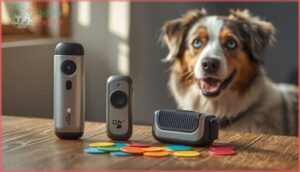
You’ve learned the methods, now it’s time to talk gear. Not every training tool works the same way, and choosing the right one can mean the difference between frustration and pivotal moments with your deaf dog.
Let’s break down what’s actually out there, what works, and what you should watch out for before you buy.
EOEDEPAZ Dog Training Clicker Whistle Analysis
You won’t find rigorous studies backing the EOEDEPAZ Dog Training Clicker Whistle for deaf dog marker training, though user experience reports vary widely on device reliability and training outcomes.
The audible whistle component offers limited marker effectiveness for deaf dogs unless you add a visual marker or tactile cue.
Safety features remain unclear, and clicker training success depends entirely on consistent, perceivable signals your dog can actually detect.
Comparing Visual Vs Tactile Training Devices
Choosing between Visual Marker and vibration tools boils down to how your deaf dog perceives cues and the training context you’re working in.
- Marker Effectiveness: hand sign and flashlight cues deliver instant visual feedback, while vibration tools function without line-of-sight
- Canine Perception: some dogs favor tactile input over visual signals, even in bright settings
- Training Outcomes: mixed-modal Clicker Training often accelerates mastery and real-world transfer
- Device Durability: LED systems need weather resistance; vibration collars require comfortable strap integration
- User Experience: visual markers demand clear sightlines; tactile devices offer consistent contact-based cueing
Budget-Friendly Options for Deaf Dog Training
You don’t need pricey gear to master Clicker Training with your deaf dog. DIY Markers—simple hand signals or repurposed flashlights—deliver Marker Consistency without draining your wallet.
Pair these with a basic Reward Systems approach: treat, praise, repeat. Training Logs track progress using paper and pen, proving that Dog Behavior and Psychology principles work regardless of cost.
Assistive Technology doesn’t have to break the bank to transform communication with deaf dogs.
Premium Features Worth Considering
Investing in premium markers means better Marker Reliability and faster Visual Latency—both essential for Clicker Training Methods with your deaf dog. Look for Ergonomic Design that won’t cramp your hand during long sessions, plus Water Resistance and strong Durability Tests to survive outdoor training.
These Assistive Technology upgrades simplify Training for Special Needs Dogs, making Dog Behavior and Psychology work easier to master.
What to Look for When Buying a Deaf Dog Clicker
Before you buy, check Marker Reliability—your deaf dog needs split-second timing every session. Device Ergonomics matter when you’re holding it for twenty minutes straight. Safety Features protect curious paws from batteries or sharp edges.
User Reviews reveal real Training Outcomes, not marketing hype. Clicker Training Methods for deaf dogs demand tools that won’t fail when dog behavior gets exciting, so choose wisely.
Frequently Asked Questions (FAQs)
Can deaf dogs learn advanced tricks and commands?
Your deaf dog’s silence doesn’t limit their brilliance—it sharpens their focus.
Through marker system effectiveness and reward strategies, deaf dogs master sophisticated trick training, from weaving to scent work, proving cognitive development thrives beyond sound.
How long does marker training typically take?
Most deaf dogs achieve marker reliability within two to six weeks of consistent practice.
Training duration depends on session frequency, your dog’s learning speed, and how well you track progress with positive reinforcement training techniques.
Should puppies and older dogs train differently?
A three-month-old deaf puppy learning sit might need three daily two-minute sessions, while your eight-year-old deaf dog could handle focused ten-minute blocks.
Age-based training adjusts session length, cognitive development stages, and learning curves—puppies require shorter bursts matching their attention spans.
What mistakes do new deaf dog owners make?
Many owners rely on sound-based cues that deaf dogs can’t perceive. They skip establishing clear visual markers, show impatience with slower communication, and create confusion through reward inconsistency—undermining trust entirely.
How do you train outdoors in bright sunlight?
Like trying to read a text message with the sun glaring off your screen, training your deaf dog outdoors demands high-contrast hand signs, shaded spots, and strategic timing during softer morning or evening light for ideal nonverbal cues and canine communication.
Conclusion
Silence isn’t a barrier—it’s just a different language. Your deaf dog’s world operates on visibility and touch, channels that make dog training clickers for deaf dogs not just possible, but remarkably effective.
Whether you choose LED precision, vibration feedback, or hand signal clarity, you’re speaking directly to your dog’s strengths. The markers may look different, but the bond you’re building through consistent communication? That’s universal, powerful, and entirely within your reach.
- http://www.diamondsintheruff.com/
- http://www.clickersolutions.com/
- http://www.shirleychong.com/
- https://www.facebook.com/SavvyDT/?__tn__=kCH-RH-R&eid=ARCXu0A3_FB7ilC-CSvy2okCii1ahZYY-VvnL1PtBD8r75PVVjVJK5-4o6bzguysj7jQSOtJ0OmHMdn8&hc_ref=ARTi4-PR1pA7wbAaL_CRN7ak6bpSNV7ADBJIh0MrqTxLjfBK2-C2re5LEkIr9psnPi8&__xts__[0]=68.ARDbDNZ8veUQVjMDmdMzjs7LyNQJXlbpkqqVaqpDk570t0trSuYUvTB0WZKXcbxXh8JK59JZMGEyolUBp7NGyl1el0vlInbW6d7KFqh41c8zZyZseMB93nEwGYG-7O_28skrGhl4CCrk-YgePvjbUzzWy014DZ4EGPBeEpEKuAZK6g2xUMgdfQLqfG4FNFmdQZb8PWDCCzUJ_kFPVSkGKfNxVXMoK5TZDUZu0OMbZ_M6XCTazD0BmypZtmcSS4gmRr63CZrA9SdcIQQ06XPiHWGklyU3Gn72X4salV9--5LD845Iapk8LLDwQfYKRYRBr9M7Dox_MVmv2fYqY9C2MQ
- http://mailto:savannahlefors2