This site is supported by our readers. We may earn a commission, at no cost to you, if you purchase through links.

Your dog bolts after a deer, vanishing into dense timber before you can shout their name. That heart-stopping moment happens faster than you’d think—and on remote trails, it can stretch from seconds into hours of desperate searching.
Standard cell service won’t help you three miles from the trailhead, and yelling only carries so far through canyon walls or thick underbrush. Dog GPS trackers for hiking solve this exact problem by broadcasting your dog’s location even when you’re miles from the nearest tower.
The right tracker transforms that worst-case scenario into a manageable inconvenience, letting you pinpoint your wandering explorer within minutes instead of mounting a full-scale search operation.
Table Of Contents
Key Takeaways
- GPS trackers prevent lost-dog emergencies on trails by delivering real-time location updates every 1-5 seconds, even miles from cell towers, transforming hours of searching into minutes of recovery.
- Dedicated GPS collars with handheld receivers provide true off-grid tracking up to 9 miles without monthly fees, while cellular trackers offer smartphone convenience but fail beyond 3-20 miles from towers.
- Critical features for backcountry reliability include IP67/IP68 waterproofing, multi-day battery life, sub-10-meter accuracy using multi-constellation satellites, and geofence alerts that notify you instantly when your dog crosses boundaries.
- Match your tracker to terrain and hiking style—day hikes need waterproof builds and 12-hour battery, while backcountry trips demand offline maps, satellite connectivity, and ruggedized housings that survive submersion and impact.
Why Use Dog GPS Trackers for Hiking
Trails can turn from peaceful to panicked in seconds when your dog disappears over a ridge or bolts after wildlife.
A training treat pouch built for hiking keeps rewards instantly accessible so you can reinforce recall the moment your dog checks back in.
Trails turn from peaceful to panicked in seconds when your dog vanishes over a ridge or bolts after wildlife
GPS trackers give you real-time answers instead of hours of worry—you’ll know exactly where your dog is, even miles from the nearest cell tower.
Here’s why serious hikers consider them essential gear, not optional extras.
Preventing Lost Dogs on Trails
A moment of distraction on the trail can turn an off-leash adventure into a desperate search. GPS dog collars prevent that panic by providing real-time location updates every one to two minutes.
Long-range tracking works even in dense forests where cell service fails. If your dog bolts after wildlife, you’ll know exactly where to recover them—no guesswork, no lost dog protocols, just immediate wilderness navigation.
Owners can further increase peace of mind by learning about essential dog identification and tracking strategies.
Enhancing Outdoor Safety and Security
Real-time GPS tracking transforms outdoor risks into manageable challenges. Trail safety improves when your device sends instant alerts if your dog nears cliff edges or water hazards.
Emergency response gets faster—SOS buttons and location sharing mean help can find you in the wilderness. Weather warnings and terrain sensors on sophisticated GPS dog collars help you avoid environmental hazards before they become problems during outdoor adventures.
Managing Off-Leash Adventures
GPS dog collars with long-range tracking let you give your dog off-leash adventures without the anxiety. When your dog explores beyond sight lines, live updates show exactly where they’re roaming.
Build confidence on the trail with these essentials:
- Test recall training before releasing your dog in open terrain
- Practice trail etiquette by keeping voice commands consistent
- Study hazard awareness around water and wildlife zones
- Pack gear essentials including extra batteries for extended hikes
Proper training is critical for safe off-leash experiences, as explained in this guide to off leash activities.
Navigating Challenging Terrains
Once you’re past training and etiquette, tackle the terrain itself. Steep ridges, dense forest, and loose scree all threaten visibility. A GPS dog collar with long-range tracking keeps tabs when switchbacks separate you or thick underbrush hides your dog. Terrain mapping plus trail safety features help you respond fast if your companion wanders into a rockfall zone or crosses into unmarked wilderness survival situations requiring off-grid navigation or even mountain rescue.
| Terrain Type | GPS Tracking Benefit |
|---|---|
| Steep rocky sections | Pinpoint location when sight lines break |
| Dense forest canopy | Continuous updates despite visual barriers |
| Loose gravel descents | Track movement if dog slips ahead |
| Snow and ice patches | Monitor safety zones and boundary crossings |
| Technical scrambles | Enable quick response for off-leash adventures |
Key Features to Look for in Hiking GPS Trackers

Not every GPS tracker is built for the backcountry. When you’re miles from cell towers with your dog running ahead through streams and underbrush, the device on their collar needs to deliver on a few non-negotiables.
Here’s what separates trail-ready trackers from the ones that’ll leave you stranded.
Real-Time Location Accuracy
When your dog bolts after a squirrel, location precision determines whether you find them in minutes or hours. Modern GPS dog collars deliver updates every 1–5 seconds, pinpointing your pup within 5–10 meters in open terrain—accuracy that shrinks to under 3 meters with multi-constellation support (GPS, GLONASS, Galileo).
However, signal strength matters:
- Dense forest canopy can degrade precision to 10–30 meters temporarily
- Tracking algorithms use sensor fusion to smooth gaps during brief outages
- GPS interference from canyons or metal structures occasionally skews coordinates beyond 50 meters
Update frequency and real-time dog location depend on battery trade-offs, but longrange tracking systems balance power with consistent positioning for reliable off-leash adventures.
Waterproof and Rugged Design
Trail conditions won’t wait for a delicate tracker. Look for IP67 or IP68 ratings—that means your GPS dog collar survives submersion up to 1 meter for 30 minutes.
Reinforced polymers and aluminum housings deliver impact resistance when your pup crashes through brush. O-ring gaskets seal out mud and rain, while ribbed chassis designs absorb drops on rocky terrain, keeping waterproof pet collars functioning when adventure gets rough.
Battery Life for Extended Hikes
Most backcountry outings demand at least two days of continuous GPS dog collar runtime. Activate low power modes and extend tracking intervals to 5–15 minutes—this GPS optimization delivers extended runtime without losing critical pet tracking updates.
Before investing in GPS collars for extended trips, review timing considerations like when to neuter your dog based on breed and growth to ensure they’re physically ready for demanding backcountry adventures.
Battery tests show cold weather halves lithium capacity, so warm your device before dawn starts. Power saving strategies keep dog GPS trackers alive when cellular dog GPS tracking matters most.
Range and Off-Grid Capabilities
Radio Range determines where offleash adventures stay safe. Dedicated GPS dog collars push 9 miles line-of-sight, yet dense forest cuts that to a few hundred meters—Terrain Effects matter.
Cellular GPS Tracking needs network coverage; Satellite Tracking works anywhere but costs more. Off Grid Limits appear fast in ravines where Signal Strength drops. Match your remote monitoring needs to real trail conditions, not marketing hype.
Alerts and Emergency Functions
When your dog bolts beyond sight, Emergency Alerts become your fastest rescue tool. GPS dog collars send instant SOS Signals via text, email, and push—some even trigger voice calls.
Geo Fencing notifies you the moment your dog crosses trail boundaries, while Low Battery warnings prevent tracker failure mid-hike.
Alert Customization lets you tailor Emergency Functions to match real conditions, keeping Pet Safety and Dog Tracking reliability under your control.
Types of GPS Trackers for Outdoor Adventures

Not all GPS trackers work the same way in the backcountry. Some talk directly to satellites, others rely on cell towers, and a few combine tracking with health monitoring or training features.
Here’s how the main categories stack up for trail use.
Dedicated GPS Collars With Handheld Receivers
When cellular coverage isn’t an option, dedicated GPS dog collars paired with handheld receivers deliver true long range tracking up to 9 miles without monthly fees. These systems use radio frequency or satellite connectivity for off grid navigation, giving you real time updates every 1 to 2 seconds on a dedicated handheld display.
- Works completely independent of cell towers in remote wilderness
- Tracks multiple dogs simultaneously on separate channels
- Stores trail history for later review and route analysis
Cellular-Connected GPS Trackers
Most hikers prefer cellular trackers that beam GPS coordinates through LTE or 5G networks straight to your phone. These pet tracking devices rely on cell towers, so you’ll lose real-time updates once you wander beyond coverage—usually 3 to 20 miles into the backcountry.
Battery life runs 1 to 5 days with active tracking, and GPS accuracy holds steady at 5 to 10 meters under open sky.
Hybrid GPS and Activity Monitors
Some pet GPS trackers bundle satellite positioning with onboard sensors that log steps, distance, and calories—turning your dog tracking device into a health monitor.
These hybrids pull double duty: GPS accuracy hits 3 to 10 meters on open trails, while sensor technology captures movement data.
Power management stretches battery life to 2–7 days, and data visualization in the companion app shows routes alongside activity metrics in one dashboard.
Subscription-Free and Satellite-Based Options
If you want GPS trackers that work beyond cell towers, satellite tracking systems bypass monthly fees and deliver off-grid navigation where cellular trackers fail. Emergency alerts trigger via satellite, while offline maps cache your routes. Battery optimization becomes critical—configure update intervals to balance signal strength and endurance across multi-day hikes.
- Position fixes arrive every few seconds to minutes
- No subscription fees for core satellite tracking
- Real-time boundary alerts without cellular networks
- Rechargeable batteries last 2–7 days of continuous use
- IP68-rated housings survive mud and stream crossings
Top Dog GPS Trackers for Hiking
You’ve narrowed down your tracker type—now it’s time to see the standouts.
The devices below represent the most reliable GPS options for hiking, each tested in real-world conditions across varied terrain.
Here’s what works when the trail gets steep and the cell signal gets sketchy.
1. Fi Smart Dog GPS Tracker Collar
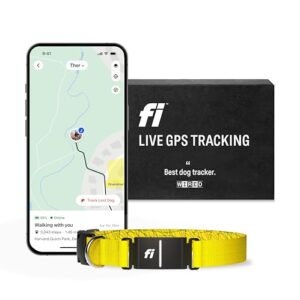
You need live tracking with no surprises. The Fi Smart Dog GPS Tracker Collar Series 3 combines GPS satellites and LTE-M networks to deliver location updates every few minutes while your dog moves.
Its stainless steel chassis withstands rough play and trail debris, and the waterproof build accommodates rain and puddles. Battery lasts multiple days per charge, adjusting update frequency when your dog rests.
The Fi app shows real-time maps, geofence alerts, and activity data—steps, sleep, movement patterns—so you monitor fitness alongside location during backcountry adventures.
| Best For | Dog owners who want reliable GPS tracking and activity monitoring for active pets, especially those who frequently explore outdoor areas with good cellular coverage. |
|---|---|
| GPS Tracking | Real-time nationwide |
| Waterproof | Yes |
| Battery Life | 3 months |
| Activity Monitoring | Yes |
| Subscription Required | Yes |
| Safe Zone Alerts | Yes |
| Additional Features |
|
- Real-time GPS tracking with geofence alerts keeps you updated on your dog’s location and sends notifications if they wander off
- Durable waterproof design with stainless steel construction handles rough play, weather, and outdoor adventures
- Monitors activity, sleep, and movement patterns to help you track your dog’s fitness and health trends
- GPS accuracy suffers in rural areas or regions with poor cellular coverage, limiting reliability in remote locations
- Geofence range is small (under a third of an acre) and alerts can be delayed up to 45 minutes
- Battery life falls short of the claimed 3 months, and the device only works in the United States
2. Invoxia Dog Health Gps Tracker
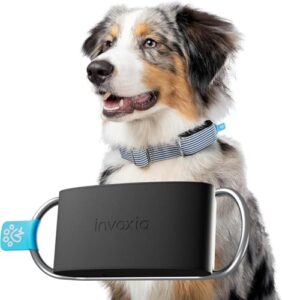
Beyond location tracking, the Invoxia Dog Health GPS Tracker captures heart rates and respiratory rates with onboard radar sensors. Real-time biometric data syncs to the app, triggering alerts when patterns shift—ideal for monitoring chronic conditions on long hikes.
The lightweight 37-gram device clips onto your dog’s collar with IP-rated waterproofing for rain and creek crossings. Battery runs multiple days before needing a USB recharge. You’ll pay a subscription fee for the integrated SIM card that keeps GPS and health data flowing.
| Best For | Dog owners who want to monitor their pet’s location and health metrics in one device, especially those with dogs that have existing heart conditions or who enjoy off-leash adventures. |
|---|---|
| GPS Tracking | Real-time GPS |
| Waterproof | No |
| Battery Life | Not specified |
| Activity Monitoring | Yes |
| Subscription Required | Yes |
| Safe Zone Alerts | No |
| Additional Features |
|
- Tracks both GPS location and biometric data like heart rate and breathing patterns through built-in radar sensors
- Lightweight at just 37 grams and waterproof, so it won’t weigh down your dog or get damaged in wet conditions
- Sends automatic alerts when health patterns change, giving you early warning signs of potential issues
- Requires an ongoing subscription fee for the SIM card to access GPS and health tracking features
- GPS accuracy can be unreliable in some areas, with users reporting inconsistent location performance
- Health metrics may not be as accurate or real-time as advertised, with some data captured randomly rather than continuously
3. Tractive Smart Dog GPS Tracker
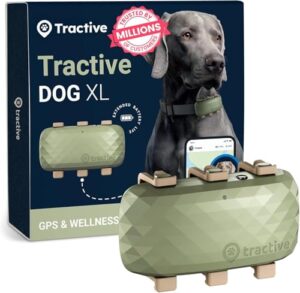
Tractive’s XL variant brings multi-satellite GNSS—GPS, GLONASS, Galileo, Beidou—to track dogs 50 pounds and up.
Live mode pushes updates every two to three seconds, plotting position on your phone with a blue dot.
You’ll set virtual fences and receive escape alerts the moment your dog crosses that boundary.
The water-resistant shell withstands rain and creek splashes; battery endures day-long hikes when you toggle out of Live mode.
Coverage spans worldwide LTE networks, though subscription fees apply for unlimited data and cellular connectivity.
| Best For | Owners of large, adventurous dogs who need worldwide tracking with real-time updates and health monitoring. |
|---|---|
| GPS Tracking | Real-time unlimited range |
| Waterproof | Yes |
| Battery Life | Up to 1 month |
| Activity Monitoring | Yes |
| Subscription Required | Yes |
| Safe Zone Alerts | Yes |
| Additional Features |
|
- Multi-satellite GNSS provides accurate positioning with 2-3 second updates in Live mode
- Virtual fences and escape alerts keep you informed the moment your dog wanders off
- Month-long battery life and waterproof design handle extended outdoor adventures
- Requires ongoing subscription fees for cellular data and connectivity
- Struggles with tracking in areas with poor cell reception or heavy tree cover
- Won’t work underground and may fail in extreme cold below -10°F
4. Garmin Dog Tracking Collar
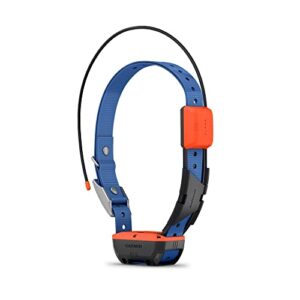
Garmin’s Alpha T 20 pairs with dedicated handheld units to deliver satellite GPS tracking up to nine miles across ridges and valleys. You’ll see your dog’s position refresh every 2.5 seconds on a topographic map, and geofence alerts notify you when she crosses your defined boundary.
The 9.3-ounce collar survives mud and rain, runs 68 hours on standard power, and features multicolor LEDs for night identification. No monthly fees—just a one-time purchase and automatic Wi-Fi updates.
| Best For | Hunters and trainers who need reliable, long-range GPS tracking for working dogs in remote terrain without recurring subscription costs. |
|---|---|
| GPS Tracking | Up to 9 miles |
| Waterproof | No |
| Battery Life | Up to 68-136 hours |
| Activity Monitoring | No |
| Subscription Required | No |
| Safe Zone Alerts | No |
| Additional Features |
|
- Tracks dogs up to 9 miles away with rapid 2.5-second position updates, giving you precise real-time location data even in challenging backcountry
- Impressive 68-hour battery life (or 136 hours with the expanded pack) means you can run multi-day trips without recharging
- Multicolor LED beacon makes it easy to spot your dog at night, and the rugged build handles mud, rain, and rough conditions
- Requires a separate Garmin handheld device to actually use the collar, which adds significant upfront cost
- Limited to one color option (Alpha T 20), so you can’t choose different styles or shades
- Initial setup and configuration can be involved, especially if you’re new to GPS tracking systems
5. SpotOn GPS Wireless Dog Fence Collar
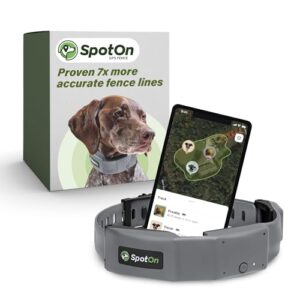
SpotOn draws your virtual boundary anywhere—three-foot accuracy in open sky, ten feet under canopy—using TrueLocation GPS that locks onto 128 satellites. You’ll sketch unlimited keep-out zones across 100,000 acres or set a quick perimeter for weekend camp, all without cell coverage for the fence itself.
Forest Mode punches through heavy tree cover on remote trails. The collar triggers audible warnings before correction, recharges fast between hikes, and sends real-time breach alerts when your dog crosses. Subscription optional; boundary enforcement runs off-grid.
| Best For | Pet owners with large properties or remote land who need flexible, portable GPS fencing that works without physical barriers and can handle multiple zones across acres of terrain. |
|---|---|
| GPS Tracking | Verizon cellular network |
| Waterproof | Water-resistant |
| Battery Life | ~1 day |
| Activity Monitoring | Yes |
| Subscription Required | Optional |
| Safe Zone Alerts | Yes |
| Additional Features |
|
- TrueLocation GPS with 128-satellite tracking offers impressive three-foot accuracy in open areas and maintains Forest Mode for wooded trails where coverage typically drops
- Unlimited customizable boundaries let you create any fence shape or size—from temporary camping setups to permanent 100,000-acre ranch perimeters—all without installing wires or posts
- Works off-grid for fence enforcement and sends real-time breach alerts so you know immediately if your dog crosses, plus audible warnings give correction before shock activation
- Battery drains quickly with roughly one-day runtime between charges, which can be frustrating for multi-day trips or owners who forget to recharge nightly
- Struggles in small yards under one acre where the GPS accuracy window becomes a larger percentage of your total space, making boundaries less precise
- Requires separate accounts per dog and some users report inconsistent shock delivery or GPS drift that triggers false corrections
6. Cube GPS Vehicle Tracker Device

Cube GPS wasn’t designed for dogs, yet its 4G LTE real-time updates and magnetic mount make it a creative off-label solution for tracking your pack on the trail. You’ll clip the compact IP67 case to a collar D-ring, set geo-fence boundaries, and watch live locations through the mobile app using GPS, WiFi, and cell tower data.
Battery lasts several days to weeks depending on ping frequency. You’ll pay a monthly or annual data subscription, and signal jumps can occur in patchy coverage—but for multi-asset tracking across vehicles and hiking gear, it’s adaptable.
| Best For | Hikers or outdoor enthusiasts who need a rugged, multi-purpose tracker for pets, gear, and vehicles with real-time 4G LTE updates and long battery life. |
|---|---|
| GPS Tracking | Worldwide tracking |
| Waterproof | IP67 rated |
| Battery Life | Up to 60 days |
| Activity Monitoring | No |
| Subscription Required | Yes |
| Safe Zone Alerts | Yes |
| Additional Features |
|
- Real-time location tracking via 4G LTE, GPS, WiFi, and cell towers with customizable geo-fence alerts
- Durable IP67 waterproof design with magnetic mount and rechargeable battery lasting days to weeks
- Versatile for tracking multiple assets like pets, vehicles, or hiking gear with shareable location access
- Requires ongoing monthly or annual data subscription, which can add up over time
- Not originally designed for dogs, so collar attachment may be less secure than dedicated pet trackers
- Signal can jump or drop in areas with weak cell coverage or heavy terrain
7. Link GPS Dog Tracker Device

Link combines GPS technology, cellular, WiFi, and Bluetooth into one 10.5-ounce collar mount that delivers real-time location data through dedicated iPhone and Android apps. You’ll track breadcrumb trails, set geofence alerts, and monitor activity goals customized to your dog’s breed and size.
The waterproof design withstands trail splashes, and training tones add positive reinforcement on the move. Battery life spans multiple days depending on update frequency. You’ll pay $189 plus a monthly or yearly GPS service plan—connectivity can falter in remote canyons with weak signal.
| Best For | Dog owners who want comprehensive location tracking and activity monitoring in one device, especially those training their pets or managing active breeds that need exercise goals. |
|---|---|
| GPS Tracking | GPS/Bluetooth/WiFi/Cellular |
| Waterproof | Yes |
| Battery Life | Not specified |
| Activity Monitoring | Yes with goals |
| Subscription Required | Yes |
| Safe Zone Alerts | Yes |
| Additional Features |
|
- Combines GPS, cellular, WiFi, and Bluetooth for real-time tracking with geofence alerts and breadcrumb trails
- Monitors daily activity with customized exercise goals based on your dog’s breed, age, and size
- Waterproof and lightweight design includes training tones for positive reinforcement during walks
- Requires ongoing monthly or yearly GPS service plan on top of the $189 device cost
- Connectivity struggles in remote areas with weak cellular signal and some urban centers
- Training features and tracking reliability can be inconsistent at longer ranges
8. FitBark GPS Dog Tracker

FitBark GPS weighs just 16 grams and measures 1.85 × 1.18 × 0.59 inches—light enough that your dog won’t notice it clipped to the collar. You’ll track location via 4G LTE across Verizon, AT&T, and T-Mobile networks, set safe zones with instant alerts, and review breadcrumb history in the app.
The waterproof enclosure withstands rain and stream crossings. Battery lasts multiple days between charges. Expect a monthly subscription fee; tracking precision drops in backcountry zones where cellular towers thin out.
| Best For | Dog owners who want reliable GPS tracking with safe-zone alerts and don’t mind paying a monthly subscription for cellular coverage across major US carriers. |
|---|---|
| GPS Tracking | 4G LTE multi-carrier |
| Waterproof | Yes |
| Battery Life | Not specified |
| Activity Monitoring | Yes |
| Subscription Required | Yes |
| Safe Zone Alerts | Yes |
| Additional Features |
|
- Lightweight 16-gram design won’t bother your dog on walks or outdoor adventures
- Works across Verizon, AT&T, and T-Mobile networks for solid coverage in populated areas
- Waterproof build handles rain, puddles, and stream crossings without issue
- Monthly subscription required on top of the device purchase price
- Tracking accuracy drops significantly in rural or backcountry areas with weak cell signals
- Some users report frustrating issues with charging reliability and canceling subscriptions
Comparing Performance on Hiking Trails
Not all GPS trackers perform the same when you’re miles from the nearest cell tower or pushing through a rainstorm.
The difference between a tracker that updates every five seconds versus every two minutes can mean finding your dog quickly or searching for an hour. Here’s how the top devices stack up where it matters most—on real trails, in real conditions.
Location Update Speed and Accuracy
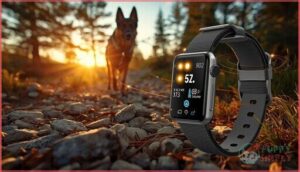
Update latency separates trail-ready GPS dog collars from unreliable options. High-end GPS trackers deliver location updates every 1 to 2 seconds during active movement, while energy-saving modes stretch that to 5 to 10 seconds. Signal strength matters—open sky yields horizontal GPS precision within 3 to 5 meters, but dense forest or rock faces can worsen location accuracy by 2 to 6 meters temporarily.
| Update Speed | Typical GPS Precision |
|---|---|
| 1–2 seconds (active mode) | 3–5 meters (open sky) |
| 5–10 seconds (energy-saving) | 5–15 meters (vertical) |
| 30-second default interval | Sub-meter (differential GPS) |
| Real-time alerts enabled | Degrades 2–6 m (multipath) |
Multi-frequency receivers improve tracking reliability by reducing horizontal error about 20 percent compared with single-frequency units. You’ll want at least four satellites visible simultaneously for peak performance. GPS technology now enables differential augmentations that deliver sub-meter accuracy under favorable conditions, giving you confidence when your dog ranges ahead on narrow switchbacks.
Durability in Harsh Weather
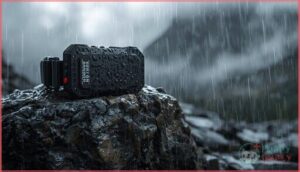
Rugged materials like high-grade polycarbonate and IP67-rated seals guarantee GPS dog collars survive rain, snow, and river crossings without losing signal.
Weather testing confirms these waterproof GPS collars operate from -20°C to 60°C—critical when you’re crossing alpine passes or desert flats. Moisture control features like conformal coating protect circuit boards from salt spray and condensation.
IPX9K waterproof ratings mean your outdoor dog safety solutions withstand 1-meter immersion for 30 minutes, keeping GPS technology functional when your dog plunges into streams.
User Interface and App Functionality

A tracker survives the elements, but you still need clear interface design to act fast. Your smartphone app should display live position with a velocity indicator and preloaded map navigation for offline stretches.
Push alert systems notify you when your dog breaches a geofence, while data visualization—speed graphs, elevation profiles, battery charts—helps you assess conditions instantly.
User guidance tools like onboarding tutorials and context-sensitive tips let you master pet GPS trackers without fumbling through menus on windy ridges.
Multi-Dog Tracking Capabilities

When you manage multiple dogs on remote trails, dog group tracking separates chaos from control. Multi collar systems report each position on a single map, preventing scattered searches across switchbacks or dense timber.
- Simultaneous tracking monitors up to eight dog GPS collars under one account
- Color-coded icons distinguish individual dogs on shared terrain maps
- Shared geofences trigger alerts when any pet tracking devices breach boundaries
- Battery dashboards display remaining power for each GPS dog tracker
- Quick-switch views let you focus on one dog or see your entire pack
Choosing The Best GPS Tracker for Your Dog

You won’t find a one-size-fits-all GPS tracker that works for every dog and every hike. The right device depends on where you’re headed, how much you’re willing to spend, and whether your dog will actually tolerate wearing it all day.
Here’s what to weigh before you commit to a tracker.
Matching Tracker Features to Hiking Needs
Your hiking style drives your tracker choice. Day hikes under 12 hours need solid battery life with continuous location tracking and waterproof ratings of at least IP67 for rain protection.
Backcountry adventures demand GPS accuracy within 5 meters in dense terrain, offline maps that load in under 2 seconds, and geofence alerts to keep your dog within safe trail boundaries.
Budget and Subscription Considerations
Your wallet faces two costs: the upfront device and ongoing service. Budget options like Tractive XL start around $56, while premium GPS dog collars reach $300. Most dog GPS trackers require subscription plans running $5 to $15 monthly—though annual prepay cuts costs by 10 to 25 percent.
Here’s what affects your bottom line:
- Monthly fees fund cellular updates and live maps
- Activation charges add $0 to $20 at signup
- Multi-dog bundles slash per-device costs
- Subscription-free pet trackers eliminate recurring fees but sacrifice real-time updates
Some brands lock you into 6- to 12-month minimums. Check cancellation policies before you commit.
Sizing and Comfort for Your Dog
Your dog’s neck isn’t a one-size-fits-all affair. Position the GPS tracker two finger widths above the shoulder blades—this secure yet breathable fit prevents chafing on long hikes.
Allow two to three fingers’ slack under the collar materials to avoid pressure points. For pet wearables under 10 percent of body weight, measure neck circumference at its thickest point while your dog stands, ensuring the GPS dog collars won’t shift or restrict movement.
Customer Reviews and User Experiences
Real hikers share where product reliability meets trail reality. User feedback reveals that GPS dog tracking systems deliver location updates within 20 to 60 seconds, cutting search time in half versus traditional methods.
- Tracker accuracy holds up in rain, mud, and brush thanks to rugged IP67/IP68 casings
- Customer support responds quickly when app syncing issues arise mid-hike
- User satisfaction peaks with geofence alerts and emergency contact sharing features
- Dog GPS trackers with offline maps prevent tracking gaps in remote terrain
Frequently Asked Questions (FAQs)
What is the most accurate GPS tracker for dogs?
When signal strength and satellite reception align, Fi Smart Dog GPS Tracker delivers five-meter accuracy using GNSS fusion.
Garmin achieves sub-ten-meter precision on woodland trails through sophisticated location algorithms and multi-constellation tracking.
Can GPS trackers help locate dogs at night?
Yes. Most GPS trackers maintain satellite signals after dark, delivering location updates within 5 to 20 meters.
LED beacons, emergency alerts, and night vision modes help you spot your dog quickly in low light.
Do GPS collars interfere with regular leash use?
A wider profile can snag your leash on narrow trails.
Proper collar fit—two fingers of space—and strap adjustments minimize tethering issues, keeping walking dynamics smooth while your GPS tracker stays secure and comfortable.
How accurate are GPS trackers under dense tree cover?
Dense canopy blocks satellites, causing GPS trackers to drift 5 to 15 meters on average. Multi-constellation receivers help, but expect delayed updates and occasional gaps until your dog reaches open sky again.
Can multiple people track the same dog simultaneously?
Most GPS tracking platforms let friends or family monitor the same dog through multi user shared tracking, delivering live updates and realtime alerts to all authorized accounts for effortless group monitoring during hikes.
Conclusion
A collar with GPS costs less than a single emergency rescue. Dog GPS trackers for hiking turn potential disasters into minor detours—you’ll spend less time scanning ridgelines and more time enjoying the trail.
Match your tracker’s range to your terrain, prioritize battery life over flashy features, and test it before your first real adventure. Your dog gets freedom. You get peace of mind. That’s the entire point of bringing them along.
- https://click.linksynergy.com/deeplink?id=/BxsnbLejGQ&mid=45904&u1=gjbgpetsdoggps&murl=https%3A%2F%2Ftractive.com%2Fen%2Fpd%2Fgps-tracker-dog
- https://tractive.com/en/pd/gps-tracker-dog-xl?_gl=1*pfcotn*_up*MQ..&gclid=Cj0KCQjwztOwBhD7ARIsAPDKnkAoQUzo4soUJEotib0i6EP-zDCHRXtZnG3hQsoLk5Z_Ltku0lK9xpoaAqZJEALw_wcB
- https://youtube.com/playlist?list=PLUyv9o51tJHUxidaZoqONz0AQcyOk9Xop&si=U1dyvOwzhw7Iu9JW
- https://wehunt.app/wehunt-x/
- https://petgent.com/products/c2-mini