This site is supported by our readers. We may earn a commission, at no cost to you, if you purchase through links.
Your dog can sniff out a single treat buried under three feet of snow, yet somehow gets bored with a $2 tennis ball in ten minutes flat. That’s not a contradiction, it’s biology: dogs are wired to work for their food, not have it handed to them in a bowl. Skip that mental workout, and you’ll likely meet its cousin, destructive chewing, at 6 PM on a Tuesday.
That’s exactly where the best puzzle toys for dogs earn their keep. From treat-dispensing wobblers to snuffle mats that turn dinner into a nose-powered scavenger hunt, the right toy connects with instincts your dog’s been carrying since its wolf days.
Ahead, you’ll find ten standout picks, sorted by difficulty and durability, so you can match the challenge to your dog’s smarts and chew-strength alike.
Table Of Contents
- Key Takeaways
- 10 Best Puzzle Toys for Dogs
- 1. Barkwhiz multi level dog puzzle toy
- 2. Nina Ottosson Tower of Treats Puzzle
- 3. Trixie Flip Board Dog Activity Puzzle Toy
- 4. Trixie Windmill Beginner Dog Puzzle
- 5. Difflife dog snuffle nosework mat
- 6. PetSafe Busy Buddy Tug-A-Jug Toy
- 7. Nina Ottosson Dog Brick Puzzle
- 8. Outward Hound Fun Feeder Slow Dog Bowl
- 9. West Paw Zogoflex Toppl Treat Dispensing Toy
- 10. Outward Hound Hide A Squirrel Plush Puzzle Toy
- Why Dogs Need Puzzle Toys
- Best Puzzle Toy Types
- Choosing The Right Difficulty
- Safety and Durability Features
- Feeding and Weight Control
- Cleaning and Care Tips
- Frequently Asked Questions (FAQs)
- Conclusion
Key Takeaways
- Puzzle toys satisfy dogs’ innate drive to work for food, reducing boredom and preventing destructive behaviors like chewing.
- Matching toy difficulty to your dog’s skill level (beginner, intermediate, advanced) keeps them engaged without causing frustration.
- Safety features like non-toxic materials, appropriately sized pieces, and constant supervision are essential when using puzzle toys.
- Slow feeder puzzles help control weight and prevent bloat by extending mealtime and slowing down fast eaters.
10 Best Puzzle Toys for Dogs
Ready to give your dog’s brain the workout it craves? From beginner-friendly boards to multi-level brainteasers built for the sharpest sniffers, this lineup covers every skill level and budget. Here are ten puzzle toys worth adding to your dog’s toy box.
If your pup’s a quick learner who thrives on structure, pairing these puzzles with Akita-specific training and trick routines can really sharpen their focus and confidence.
1. Barkwhiz multi level dog puzzle toy
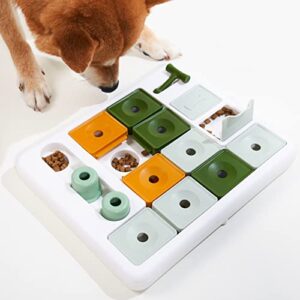
Four games in one box, how’s that for keeping your dog guessing? Barkwhiz layers a flip lid, sliding disc, and nine movable blocks across three difficulty tiers, forcing your pup to sequence steps before treats appear.
The 14-hole slow feeder design doubles as a gulping fix, while six silicone pads keep things steady mid-play. Just supervise sessions and hand wash it afterward, since this BPA-free feeder isn’t meant for solo destruction testing.
| Best For | Dog owners looking for a mentally stimulating, multi-level puzzle toy that slows down fast eaters and keeps curious, food-driven dogs of any breed entertained at home. |
|---|---|
| Difficulty Level | 3 levels |
| Material | Plastic |
| Supervision Required | Yes |
| BPA Free | Food-safe |
| Weight | 1.3 lbs |
| Cleaning Method | Hand wash only |
| Additional Features |
|
- Four distinct games across three difficulty levels keep dogs mentally engaged and less bored
- 14-hole slow feeder design helps prevent gulping and related digestive issues
- Six silicone anti-slip pads keep the toy steady during active play
- Requires adult supervision, so it’s not ideal for unsupervised alone time
- Hand wash only, which means a bit more cleanup effort than dishwasher-safe toys
- Plastic construction may not hold up long-term against very determined chewers
2. Nina Ottosson Tower of Treats Puzzle
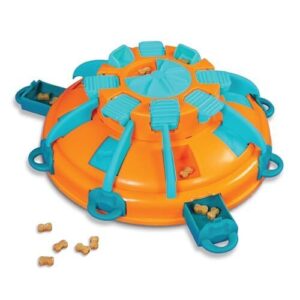
Ready to graduate your dog to the big leagues? The Tower of Treats stacks multiple layers of levers, wheels, and sliding drawers, and your dog has to work through them in sequence to reach hidden compartments below.
It’s rated Level 4 expert, but you can start with everything unlocked and lock layers gradually as your pup catches on. Built from BPA, PVC, and lead-free plastic, it’s dishwasher safe, though you’ll still want to supervise every round closely.
| Best For | Dogs who have mastered easier puzzle toys and are ready for an advanced mental challenge that keeps them engaged and out of trouble. |
|---|---|
| Difficulty Level | Level 4 expert |
| Material | Plastic |
| Supervision Required | Yes |
| BPA Free | Yes |
| Weight | 2.8 lbs |
| Cleaning Method | N/A |
| Additional Features |
|
- Multi-layered design with levers, wheels, and drawers keeps dogs mentally stimulated for the equivalent of 30 minutes of exercise
- Adjustable difficulty lets you unlock all layers at once for beginners or lock them gradually as your dog improves
- Made from food-safe, BPA, PVC, and lead-free plastic, and it’s dishwasher safe for easy cleanup
- Requires close supervision at all times and isn’t meant to be left with an unattended dog
- Not built for aggressive chewers, since dogs who chew on the pieces could damage the toy or hurt themselves
- Its Level 4 expert difficulty may be too advanced or frustrating for dogs new to puzzle toys
3. Trixie Flip Board Dog Activity Puzzle Toy
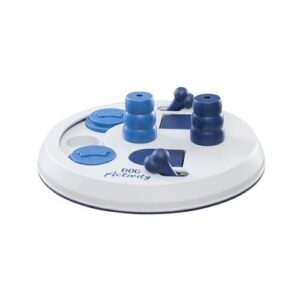
Not every dog is ready for a four-layer tower, and that’s where the Flip Board earns its keep. This Level 2 intermediate puzzle packs nine compartments under lifting cones, flipping lids, and sliding panels, so your dog learns several skills at once without getting overwhelmed.
The non-slip rubber base keeps things steady mid-play, and BPA, phthalate, and lead-free construction means treat time stays worry-free. It’s dishwasher safe too, making cleanup a breeze.
| Best For | Dogs who’ve already mastered basic puzzles and are ready for a more challenging mix of flipping, lifting, and sliding mechanisms to keep their minds engaged. |
|---|---|
| Difficulty Level | Level 2 intermediate |
| Material | Plastic and Rubber |
| Supervision Required | Yes |
| BPA Free | Yes |
| Weight | 1 lb |
| Cleaning Method | Dishwasher safe |
| Additional Features |
|
- Combines multiple play mechanisms (flaps, sliders, and cones) to keep dogs mentally engaged and prevent boredom
- Non-slip rubber base keeps the toy steady, and dishwasher-safe, BPA/phthalate/lead-free materials make cleanup and safety easy
- Doubles as a slow feeder, helping pets eat at a healthier pace while also strengthening the bond between pet and owner
- Not built for aggressive chewers, so heavy-duty destroyers may damage it over time
- Requires supervision during play to keep pets safe around the moving parts
- Hard base can let treats scatter across the floor, and the toy isn’t ideal for very large dogs who might tip or break it
4. Trixie Windmill Beginner Dog Puzzle
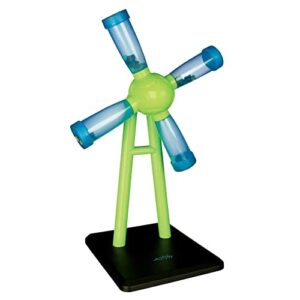
Now flip the script and start simple. The Windmill puzzle is a true Level 1 beginner toy, built around four treat tubes that spin like blades to reveal rewards. Two sets of interchangeable lids let you adjust difficulty as your dog catches on.
Non-slip rubber feet keep it steady, and the BPA, phthalate, and lead-free plastic makes cleanup easy with warm soapy water. It’s a gentle, confidence-building intro to puzzle play, but skip unsupervised sessions.
| Best For | Dogs or cats new to puzzle toys who need a gentle, confidence-building way to start learning foraging and problem-solving skills. |
|---|---|
| Difficulty Level | Level 1 beginner |
| Material | Plastic |
| Supervision Required | Yes |
| BPA Free | Yes |
| Weight | 2 lbs |
| Cleaning Method | Warm water and soap |
| Additional Features |
|
- Level 1 design with adjustable lids makes it easy to increase difficulty as your pet improves
- Non-slip rubber feet and easy-clean, BPA/phthalate/lead-free plastic add convenience and safety
- Encourages natural foraging instincts while reducing boredom and unwanted behaviors
- Not indestructible, so it needs to be used under constant supervision
- Not suitable for unsupervised play, limiting its use as a standalone distraction
- New pets may need a slow, guided introduction before they fully engage with it
5. Difflife dog snuffle nosework mat
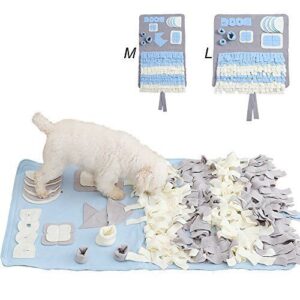
Sniffing is a dog’s superpower, and this mat puts it to work. The Difflife nosework mat hides kibble in dense fleece pockets, roughly 20 to 24 by 30 to 40 inches, with a non-slip backing that stays put during excited searches.
It’s machine washable on gentle cycle, folds flat for storage, and doubles as legit nose work training. Start shallow, hide deeper as confidence grows, and you’ve got calm, scent-driven enrichment perfect for small apartments or rainy days indoors.
| Best For | dog owners who want an easy way to slow down mealtime, ease boredom, and give their pup some low-key mental exercise indoors. |
|---|---|
| Difficulty Level | N/A |
| Material | Upcycled fabric |
| Supervision Required | No |
| BPA Free | N/A |
| Weight | N/A |
| Cleaning Method | Machine washable |
| Additional Features |
|
- Made from upcycled materials, so it’s a more sustainable choice
- Machine washable, making cleanup simple after messy sniff sessions
- Built-in handles make it easy to carry, store, or hang up
- Meant for indoor use only, so it’s not ideal for outdoor play
- Dimensions listed are inconsistent across sources, which may cause sizing confusion
- Buyers should watch for third-party sellers to ensure they’re getting an authentic product
6. PetSafe Busy Buddy Tug-A-Jug Toy
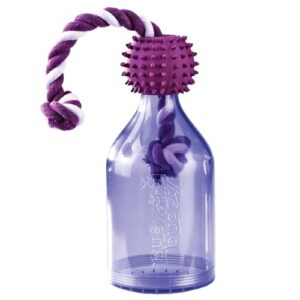
Tug meets tease with this one, since the Tug-A-Jug rewards your dog’s inner wolf for pulling, tipping, and rolling. The braided rope handle doubles as a chew-satisfying tug toy while randomizing treat release through a patented internal mechanism.
For senior dogs who prefer quiet, low-impact fun, this gentle puzzle pairs beautifully with other dog chew toys for apartment living that keep noise and mess to a minimum.
Trim the plastic prongs to slow down speedy eaters, load up to 3.5 cups of kibble, and let physical play meet mental work. Built for medium-to-large dogs (over 40 pounds), it’s tough, but always supervise chewing sessions.
| Best For | Medium-to-large dogs who eat too fast or need extra mental and physical stimulation during playtime. |
|---|---|
| Difficulty Level | N/A |
| Material | Plastic |
| Supervision Required | No |
| BPA Free | N/A |
| Weight | 16 oz |
| Cleaning Method | N/A |
| Additional Features |
|
- Randomized treat dispensing keeps dogs mentally engaged
- Braided rope handle doubles as a satisfying tug toy for combined play styles
- Adjustable prongs let owners customize dispensing speed for different eating habits
- Only sized for medium to large dogs, so it won’t work for smaller breeds
- Prongs must be trimmed manually, which takes some initial setup
- Durable plastic still requires supervision with strong chewers
7. Nina Ottosson Dog Brick Puzzle
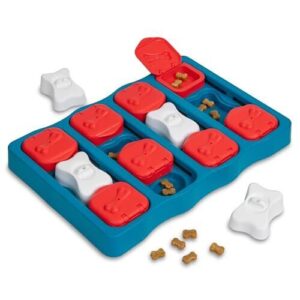
Three hiding methods live in one plastic base here, mixing flip lids, sliding panels, and removable bone pieces your dog must maneuver in sequence. That layered setup makes this a true Level 2 puzzle, ideal once your pup’s graduated past one-step games.
Measuring roughly 12.75 by 8.75 inches, it’s built for medium-to-large dogs and holds up to 3/4 cup of treats. Hand wash only, since dishwashers can warp the compartments, and always supervise play, as pieces can separate with rough handling.
| Best For | Medium-to-large dogs who’ve mastered simple puzzle toys and are ready for a multi-step mental challenge. |
|---|---|
| Difficulty Level | Level 2 intermediate |
| Material | Plastic |
| Supervision Required | Yes |
| BPA Free | Yes |
| Weight | 250 g |
| Cleaning Method | N/A |
| Additional Features |
|
- Combines three hiding methods (flip lids, sliders, and bone covers) in one puzzle for varied, layered play
- Made from food-safe plastic free of BPA, PVC, lead, and phthalates
- Slows down fast eaters while providing mental stimulation equal to about 30 minutes of exercise
- Requires constant supervision, as pieces can separate during rough play
- Not indestructible and needs regular inspection for wear or damage
- Holds only 3/4 cup of kibble or treats, which may be limiting for larger meals
8. Outward Hound Fun Feeder Slow Dog Bowl
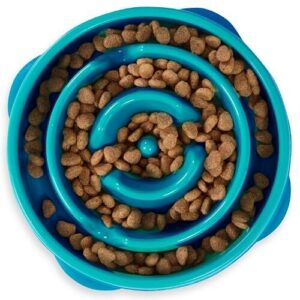
Ever watch your dog inhale dinner in ten seconds flat? The Outward Hound Fun Feeder Bowl fixes that with raised maze ridges that slow eating up to 10 times, cutting bloat and digestion risks for gulpers.
Its non-slip base stops sliding mid-meal, and the BPA, PVC, and lead-free plastic holds 2 cups, working for dry, wet, or raw food alike. Top-rack dishwasher safe, though deep grooves need extra scrubbing with wet food residue.
| Best For | small to medium dogs and cats who eat too fast, especially owners looking to ease bloat, obesity risk, or digestion issues at mealtime. |
|---|---|
| Difficulty Level | Slowest level maze |
| Material | Durable plastic |
| Supervision Required | No |
| BPA Free | Yes |
| Weight | 8.82 oz |
| Cleaning Method | Dishwasher safe |
| Additional Features |
|
- Slow maze design extends mealtime up to 10x, easing bloat and digestion concerns
- Non-slip base keeps the bowl steady and mess-free during meals
- BPA, PVC, lead, and phthalate-free plastic that’s top-rack dishwasher safe
- Deep grooves can be tricky to clean thoroughly when used with wet food
- 2-cup capacity may run small for pets that eat larger kibble portions
- Hard plastic construction may not hold up well against aggressive chewers
9. West Paw Zogoflex Toppl Treat Dispensing Toy
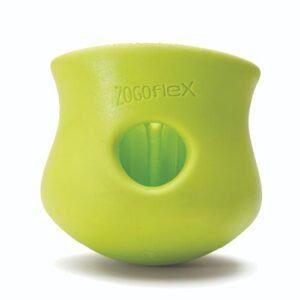
Two Topples can nest together, turning a simple treat cup into a stacked, two-level puzzle your dog has to work to crack.
Made from Zogoflex, it’s BPA-free, dishwasher-safe, and floats, so poolside play won’t end in a lost toy. Internal ridges trap kibble or frozen wet food, rewarding nudges and licks with slow, steady release.
At 3.5" x 3.5" x 4" and 290 grams, the Granny Smith Green color is easy to spot in tall grass, too.
| Best For | Dog owners looking for a mentally stimulating, slow-feeding puzzle toy to keep their pet entertained, calm, and cool during downtime or hot weather. |
|---|---|
| Difficulty Level | N/A |
| Material | Zogoflex plastic |
| Supervision Required | Yes |
| BPA Free | Yes |
| Weight | 290 g |
| Cleaning Method | Dishwasher safe |
| Additional Features |
|
- Durable, non-toxic Zogoflex material that’s dishwasher safe and easy to clean
- Open-ended puzzle design offers mental stimulation while slowing down fast eaters
- Bright, high-visibility color makes it easy to spot outdoors
- Not built for aggressive or heavy-duty chewers
- Higher price point compared to standard treat toys
- Larger size may not suit small breeds or active fetch play
10. Outward Hound Hide A Squirrel Plush Puzzle Toy
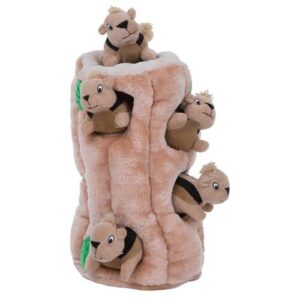
Squirrel hunting, minus the backyard mess—that’s the appeal here. This plush tree trunk hides six squeaky squirrels, and your dog has to sniff, paw, and dig them out one by one, satisfying that natural foraging instinct without any digging holes in your yard.
At 12.25"L x 7"W x 7"H, it’s soft enough for gentle carrying but not built for heavy chewers. Keep supervision handy, since tails and ears can tear with rough play.
| Best For | dogs who love sniffing out treats and toys, especially puppies and moderately active chewers who need mental stimulation rather than a tough chew toy. |
|---|---|
| Difficulty Level | N/A |
| Material | Polyester |
| Supervision Required | Yes |
| BPA Free | N/A |
| Weight | 4.8 oz |
| Cleaning Method | N/A |
| Additional Features |
|
- Taps into natural foraging and hunting instincts with a fun hide-and-seek design
- Six squeaky squirrels keep playtime varied and engaging
- Lightweight and soft enough for easy carrying between play sessions
- Not durable enough for heavy chewers
- Tails and ears on the squirrels can tear with rough play
- Requires constant supervision to prevent your dog from swallowing small parts
Why Dogs Need Puzzle Toys
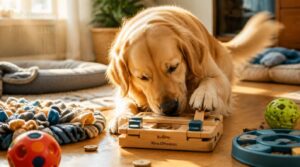
Ever notice how a bored dog can turn into a furniture-destroying tornado in about ten minutes flat? That’s not stubbornness or spite, it’s a brain begging for a job to do. Here’s why puzzle toys matter so much, and what they actually do for your dog’s mind.
A bored dog isn’t stubborn, it’s a brain begging for a job to do
Mental Stimulation Benefits
Curiosity keeps a dog’s mind sharp, and dog puzzle toys turn that instinct into real brain work. Sniffing, searching, and solving fires up neural pathway stimulation, sharpens improved attention span, and builds cognitive reserve for later years. Engaging in these activities can enhance brain plasticity through constant neural adaptation.
Three quick wins from regular brain games:
- Sharper focus during training
- Better memory retention
- Stronger sensory processing skills
Boredom and Anxiety Relief
A bored, anxious dog isn’t just restless, it’s stuck with nowhere to put that nervous energy.
Dog puzzle toys fix that by triggering endorphin release and lowering cortisol levels, calming nerves once the initial excitement fades. They’re especially handy for managing separation anxiety, redirecting fear responses into focused tasks, and building predictable routines that steady your dog’s mood between play sessions.
Destructive Behavior Prevention
Chewed shoes and shredded couch cushions usually mean pent-up energy with nowhere to go. Dog puzzle toys channel that drive into constructive activity, working alongside boundary setting and routine consistency to prevent destructive behavior.
Pair toys with:
- Positive reinforcement for calm choices
- Environmental management during high-risk hours
- Structured activity daily
- Consistent enrichment for dogs to curb pet boredom prevention long-term
Confidence Through Problem-solving
Redirecting energy is only half the story—dog puzzle toys also build self-efficacy reinforcement through repeated wins. Each solved puzzle strengthens neural pathway strengthening tied to planning, while mistakes teach strategic approach habits instead of frustration.
| Puzzle Outcome | Confidence Effect |
|---|---|
| Success | Reinforces mastery |
| Near-miss | Builds mental toughness |
| Repetition | Sharpens problem-solving skills |
Senior Dog Enrichment
Slowing down doesn’t mean your gray-muzzled buddy stops needing a workout upstairs. Low-impact mobility puzzles let arthritic joints rest while scent-based foraging and cognitive memory games keep neurons firing.
Strategy-based challenges matter most once running and jumping fade, giving seniors purpose without strain. Pair puzzles with sensory comfort techniques and gentle social interaction, and you’re supporting whole-dog cognitive health—not just tiring out the body.
Best Puzzle Toy Types
Not every dog gets excited by the same kind of challenge, and that’s exactly why puzzle toys come in so many different flavors.
Some pups are food-driven diggers, others are nose-first sniffers, and a few just want to lick their way to calm.
Here’s a rundown of the main toy types worth knowing before you pick one out.
Treat-dispensing Toys
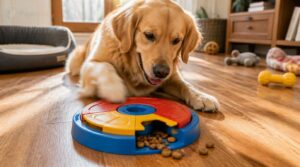
What makes a dog work harder for its dinner than a puzzle that fights back? These toys use mechanical release methods—rolling, pawing, wobbling—to trigger unpredictable treat drops.
- Rotating discs exposing hidden openings
- Adjustable internal dividers for skill level
- Skill-based reward systems that build patience
That mix of mental stimulation and motion-triggered rewards turns snack time into real food puzzles.
Snuffle Mats
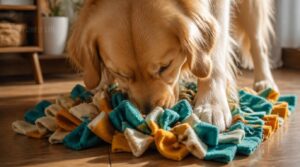
Sniffing beats sitting, hands down—snuffle mats tap straight into a dog’s natural foraging behavior by hiding kibble inside layered fleece pockets. Sizes like 30×30 cm fit most breeds, and soft fabric keeps nose contact gentle.
This olfactory stimulation extends mealtime, sharpens nosework skills, and delivers real mental stimulation. Best part? They fold flat for easy storage between sessions.
Slow Feeder Bowls
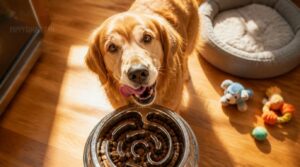
Ever watch your dog inhale dinner in ten seconds flat? A slow feeder dog bowl fixes that fast. Molded ridges create tiny obstacles, slowing intake 2-4x by encouraging licking over gulping.
Look for BPA-free plastic or stainless steel, 1-6 cup capacities, and dishwasher-safe designs. These ridge patterns also spark mild foraging behavior—bonus mental engagement with every meal.
Hide-and-seek Plush Toys
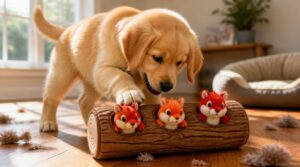
Something about burying a squeaky squirrel in a fabric log just clicks with a dog’s inner hunter. Hide-and-seek plush toys tap prey drive stimulation, using scent pockets and rattles for auditory cues that boost spatial awareness.
- Reinforced seams resist tugging
- Zippers protect hidden pockets
- Polyester plush meets durability standards
- Multiple hiding spots add variety
- Machine-washable fabric simplifies care
Lick-based Enrichment Toys

Lick your dog’s worries away? That’s the idea behind licking mats and lick-sticks, which trigger endorphin release for genuine stress reduction. Great for licking for anxiety, crate rest, or vet visits—many designs are muzzle-friendly too.
| Tool | Best For | Key Benefit |
|---|---|---|
| Licking mat | Mealtime calm | Sensory stimulation |
| Lick-stick | Training with lick-sticks | Targeted licking rewards |
| Muzzle mat | Grooming visits | Stress reduction |
Choosing The Right Difficulty
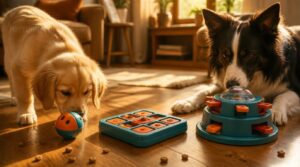
Not every dog is ready for a spinning, multi-layered brain teaser right out of the box, and that’s okay. Matching the challenge to your dog’s current skill level keeps them motivated instead of frustrated, so growth happens naturally over time. Here’s how to figure out where your pup should start, and where they can go from there.
Beginner Puzzle Toys
Beginner puzzle toys favor one accessible compartment, bright colors, and puppy-safe materials over complicated mechanisms. Look for simple sliding lids, textured tactile surfaces, and clear openings that offer visual scent cues so pups grasp the game fast.
Low cognitive load builds confidence without frustration. These interactive pet toys deliver real mental stimulation and enrichment games while keeping choking hazards minimal—perfect training wheels before tackling trickier puzzles.
Intermediate Problem-solving Games
Once your dog’s aced the easy stuff, it’s time to raise the stakes. Intermediate puzzles like the Trixie Flip Board demand real spatial reasoning—predicting multi-step moves, rotating parts, sliding covers in sequence.
Your pup starts recognizing patterns, testing logic, even managing which "tools" (paws, nose, teeth) work best. This is where genuine problem-solving skills kick in, turning snack time into a satisfying mental workout.
Advanced Enrichment Challenges
Ready for the canine equivalent of a Rubik’s Cube? The Nina Ottosson Dog Tornado puts multi-layer rotation and sequence planning tasks front and center, hiding treats behind spinning discs.
Your dog must remember which compartments held rewards before, since memory-based hiding and variable reward locations keep things fresh. Watch for cognitive frustration—step in if paws start pawing wildly instead of thinking.
Adjustable Difficulty Designs
Not every dog fits neatly into one skill level, which is why customizable challenge designs earn their spot on this list. Look for toys with adjustable sliders, interchangeable lids, or tiered reward paths that lead to tougher sub-tasks over time.
Sequential puzzle mechanics and randomized hiding spots keep your pup guessing, preventing memorized shortcuts while letting you manage time pressure to match their confidence and problem-solving pace.
Skill Progression Tips
How do you know when to level up? Set a measurable goal, like solving a puzzle 15% faster within two weeks, and track success rates in a notebook.
Move up after five clean wins, praise good problem-solving instantly, and rotate toys weekly.
Small, consistent steps build real mental stimulation without overwhelming your dog’s confidence.
Safety and Durability Features
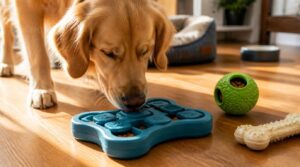
A fun puzzle only stays fun if it’s actually safe, and that’s where a lot of owners get tripped up. Before you hand your dog anything to chew, nudge, or fling across the kitchen floor, you’ll want to know what it’s made of and how well it holds up. Here’s what to check for before adding any of these picks to your dog’s toy box.
Non-toxic Materials
Would you really let your dog gnaw on something that leaches chemicals? Nontoxic materials matter as much as durability. Look for:
- BPA-free plastic
- Food-grade silicone
- Natural rubber (KONG-style)
- Lead/cadmium-free coatings
- Certified petsafe materials
Check for material certification standards (FDA, LFGB) to avoid chemical leaching risks and heavy metal prevention gaps. Stick to non-toxic cleaning methods—skip harsh solvents entirely.
Choking Hazard Prevention
Picture a toddler and a terrier both eyeing the same squeaky part—that’s your cue to check component size standards before buying. Pieces should measure over 1.25 inches, with no detachable part risks lurking.
Confirm opening diameter safety stays above 0.5 inches so treats don’t create choke points. Stick to nontoxic materials and durable rubber, then keep up inspecting toy wear with regular supervision.
Chewer-friendly Construction
Some dogs treat puzzle toys like a personal chew-testing job, so durable material blends matter more than looks. Look for durable rubber or thermoplastic rubber with smart bite pressure distribution, plus smoothly built designs that skip weak seams.
Non-toxic coatings and BPA-free plastic keep power chewers safe, while structural wear indicators tell you exactly when it’s time to retire the toy.
Breed-size Compatibility
Size matters here just as much as material. A Great Dane and a Chihuahua shouldn’t share the same puzzle toy, and honestly, they shouldn’t roughhouse together either.
Match toy dimensions to your dog’s actual size to prevent choking risks, joint stress, or overpowering play. This same logic applies to size-matched socialization: pairing similarly sized dogs keeps energy levels balanced and household space manageable for everyone involved.
Supervised Play Recommendations
Even the safest puzzle toy still needs a set of eyes on it. Stay within two to three playground lengths, model correct play, and pause if frustration builds.
- Watch for chewing or malfunctions
- Redirect frustration triggers early
- Jot quick progress notes
Monitoring safety protocols during dog brain games keeps mental stimulation fun, not fraught, for every dog puzzle toy session you run.
Feeding and Weight Control
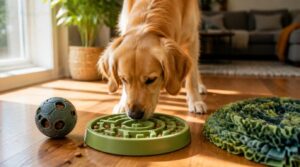
Puzzle toys aren’t just fun and games, they can also play a real role in keeping your dog at a healthy weight. If your pup inhales food like it’s a competitive sport, the right tools can slow things down and make every bite count.
Here’s how to turn mealtime into mindful eating, one clever design at a time.
Slower Mealtimes
Slowing down mealtime does more than curb gulping, it gives your dog’s brain roughly 20 minutes to catch up with their stomach, triggering fullness signals before overeating happens.
A slow feeder bowl also aids digestion, boosts saliva production, and softens glucose spikes. For dogs prone to bloat or scarfing kibble in seconds, a slow feeder solution transforms chow time into calmer, chew-focused engagement.
Portion Control Tips
Pair that slow feeder with real portion habits, and you’ve got a genuinely balanced feeding routine.
- Measure with your palm or fist for quick, accurate scoops
- Try a hunger scale check (1-10) before refilling the bowl
- Use preportioned snack bags to avoid guesswork
- Log meals with calorie tracking apps for pattern spotting
Cut mealtime distractions, offer water beforehand, and watch overeating shrink fast.
Treat Calorie Management
Here’s the part folks forget: those puzzle toy treats count toward your dog’s daily caloric targets, not extra credit. A treat-dispensing toy still delivers real calories, so swap kibble into it instead of piling on separate snacks—satiety through puzzles works best when it replaces meals, not adds to them.
| Treat Type | Calories (approx.) | Best Use |
|---|---|---|
| Small biscuit | 20-30 | Training reward |
| Kibble (per cup) | 300-400 | Puzzle filling |
| Peanut butter (1 tbsp) | 95 | Lick mat topper |
Kibble Compatibility
Not every kibble fits every puzzle, so check hole sizes before filling. Kibble diameter runs 6-20mm across brands, and a treat dispenser drilled for tiny pieces will jam with chunky pieces, while oversized holes let small kibble pour out too fast.
Round pieces roll smoothly through spinning puzzles; flat discs suit slower gravity-fed dispensers better, especially for small-mouthed breeds.
Fast Eater Solutions
Ever watched your dog inhale dinner in under 30 seconds? That’s a bloat risk waiting to happen, not just a funny party trick.
- Slow feeder dog bowls with raised ridges
- Puzzle balls for kibble
- Frozen Kong fillers
- Snuffle mats for foraging
- Multi-chamber treat-dispensing toys
These slow feeder solutions improve mealtime pacing, easing digestion while satisfying natural foraging instincts safely.
Cleaning and Care Tips
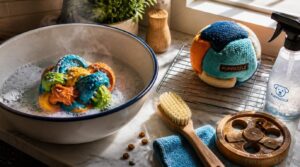
A puzzle toy only earns its keep if you can actually keep it clean, since slobber, kibble dust, and hidden treat residue build up fast in all those nooks and crannies.
Different materials call for different care routines, and using the wrong method can wear down a toy way before its time.
Here’s what you need to know to keep each type fresh, safe, and ready for the next round of play.
Dishwasher-safe Puzzle Toys
Dishwasher-safe puzzle toys are a busy owner’s best friend, especially when kibble crumbs hide in every groove. Look for BPA-free plastic or Zogoflex material with strong heat resistance and smooth seams for real sanitization efficiency. Top-rack washing cuts bacteria buildup fast, and detergent-safe coatings won’t fade.
For maintenance convenience, these interactive dog toy puzzles simply pop in, wash, and go.
Machine-washable Fabric Toys
Toss that snuffle mat in the wash and watch stubborn kibble dust disappear. Fabric durability hinges on tight stitching, so check seams before buying.
- Use detergent safety (fragrance-free, phosphate-free)
- Air dry, never tumble
- Check stitching quality regularly
- Watch for allergen prevention issues
- Confirm machine washable labeling
These interactive pet products deliver real mental stimulation through everyday enrichment activities, minus the funky odor.
Rubber Toy Maintenance
Rubber toys work hard, so give them love back. Wipe with warm soapy water after each use, scrub grooves with a soft brush, then rinse completely. A diluted hydrogen peroxide solution offers safe disinfection without bleach’s fading risk. Air dry fully before storage—preserving elasticity matters.
Regularly inspect for cracks or soft spots, and retire anything crumbling. Store away from sunlight and metal.
Wooden Puzzle Care
Wood is the diva of dog puzzle toys, gorgeous but fussy. Moisture prevention is non-negotiable: dry hands only, no soaking.
Dust with a soft brush, condition every few months with food-grade mineral oil for wood conditioning, and wipe off excess. Keep humidity control between 40-60%, away from radiators, to protect joint tolerances and preserve smooth problem solving skills for years.
When to Replace Toys
Every puzzle toy has an expiration date, even the sturdy ones. Make weekly inspection habits routine: run a thumbnail test for identifying cracks, check squeakers, and watch fraying edges.
Chewer type matters, power chewers cycle through toys in 1-2 months, light chewers stretch it to 6. Discard anything with loose parts. Smart managing toy rotation paired with preventative pet care keeps play safe and durable pet materials working longer.
Frequently Asked Questions (FAQs)
How long should a puzzle toy session last?
Aim for 15 to 30 minutes of active engagement, starting beginners at just 5 to 10 minutes. Watch for frustration or mental fatigue after 5 minutes, and always end sessions on a win to build lasting enrichment habits.
Can puzzle toys help with weight loss too?
Absolutely—dog puzzle toys slow down fast eaters, extend mealtime duration, and boost foraging energy expenditure.
That mental stimulation curbs stress eating and sedentary lounging, turning snack time into a calorie-burning workout while supporting pet wellness alongside your dog’s regular exercise routine.
Should I supervise my dog with every puzzle?
Think of first puzzle sessions like teaching a kid to ride a bike—stay close! Managing first-use safety matters most early on: watch for distress signs, assess choking risks, and evaluate toy integrity before letting your pup solve independently.
How many puzzle toys does my dog need?
Two to four toys, rotated weekly, keeps things fresh without overwhelming your pup.
Multi-dog homes need one per dog plus a shared option to avoid resource guarding.
Track solving time, then add new puzzles as novelty fades.
Are puzzle toys suitable for multi-dog households?
Like Noah’s ark, two by two works best: choose dual compartment designs with separate treat paths, preventing toy competition and resource guarding, while supporting cooperative play—just rotate toys fairly so every pup gets equal enrichment time.
Conclusion
Every dog has its day, but a bored dog has its evening, usually spent unraveling your couch cushions.
The best puzzle toys for dogs aren’t about spoiling your pup; they’re about honoring the working brain nature gave them. Start simple, watch confidence grow, then level up.
That wobbling, treat-spilling chaos on your floor? It’s not a mess. It’s a mind finally getting the workout it craves, one satisfied sniff at a time.