
This site is supported by our readers. We may earn a commission, at no cost to you, if you purchase through links.

Your dog bolts the second a campsite neighbor’s fireworks go off. No warning, no hesitation—just gone into the tree line at 11 PM. If you’ve traveled with a dog, you’ve either lived that moment or spent every trip quietly dreading it.
Dog GPS trackers for traveling families have gotten genuinely good in the last two years—lighter, faster, and reliable enough to hold a signal in rural Montana or coastal Maine. The difference between models isn’t just brand names; it’s update speed, battery endurance, and whether your tracker works in the country you’re actually visiting.
The ten options ahead cover every realistic travel scenario, from weekend road trips to international moves.
Table Of Contents
- Key Takeaways
- Top 10 GPS Trackers for Travel
- 1. Tractive Smart Cat GPS Tracker
- 2. Smart Pet Tracker for Android
- 3. GPS Smart Pet Tracker Collar for Cats
- 4. Tractive Smart Dog Tracker
- 5. Tracki 4G LTE GPS Dog Tracker
- 6. Petloc8 4G LTE GPS Cat Tracker
- 7. Halo GPS Dog Fence Collar
- 8. Fi Series 3 GPS Dog Collar
- 9. Dogtra Pathfinder 2 GPS Collar
- 10. SpotOn GPS Dog Fence Collar
- Best Features for Traveling Families
- Connectivity and Tracking Accuracy
- Battery Life and Durability
- Costs, Subscriptions, and Value
- Frequently Asked Questions (FAQs)
- Is there a GPS dog tracker without a monthly fee?
- How far can an AirTag track a dog?
- How can I track my dog if he runs away?
- Is AirTag or GPS better for dogs?
- How do I attach a tracker to my dogs collar?
- What happens if my dog loses the tracker device?
- Are GPS trackers safe for small or toy breeds?
- Can I track my dog without a smartphone?
- Conclusion
Key Takeaways
- Real-time GPS trackers updating every 2–5 seconds with LTE-M cellular or multi-constellation satellite support are the only reliable options when your dog bolts in unfamiliar terrain.
- Subscription costs run $5–$15 per dog monthly, but annual plans cut that by 10–25%, and no-fee RF trackers like the Aorkuler 2 eliminate recurring charges entirely for a one-time $249.99.
- Battery life swings wildly between models—from 5 days (Tractive Cat) to 3 months (Fi Series 3)—and live tracking mode can drain a battery up to 3x faster than periodic check-in mode.
- For families traveling internationally, coverage territory matters as much as specs: Tracki and Tractive cover 175–185+ countries, while SpotOn is U.S.
-only and Bluetooth-only trackers max out at roughly 10 meters of range.
Top 10 GPS Trackers for Travel
Not every tracker holds up when your family hits the road — coverage gaps, dead batteries, and clunky apps have a way of showing up at the worst possible moments.
These ten options were picked specifically for traveling families who need reliability across changing environments, multiple dogs, and long days away from home. Here’s what made the cut.
Whether you need heavy-duty crates for determined chewers or soft-sided carriers for lighter trips, these dog crate options for puppies and travel cover the full spectrum of what roaming families actually encounter on the road.
1. Tractive Smart Cat GPS Tracker

Designed with curious cats in mind, the Tractive Smart Cat GPS Tracker works just as well when your feline tags along for the trip. It weighs just 0.9 ounces and clips onto any standard collar — small enough that most cats forget it’s there.
Live tracking refreshes every 2–3 seconds, geofence alerts fire the moment your cat strays, and the 5-day battery keeps you covered across a long weekend. A subscription is required, but the peace of mind travels with you.
| Best For | Cat owners who let their pets roam freely and want real-time peace of mind whether they’re home or traveling. |
|---|---|
| GPS Type | Real-time GPS |
| Waterproofing | Waterproof |
| Battery Life | Up to 5 days |
| Subscription | Required |
| App Platform | iOS and Android |
| Alert System | Virtual fence push alerts |
| Additional Features |
|
- Live GPS updates every 2–3 seconds so you always know exactly where your cat is
- Lightweight at just 0.9 oz — small enough that cats barely notice it’s there
- Up to 5-day battery life, geofence alerts, and family sharing make it easy for the whole household to stay in the loop
- A monthly or yearly subscription is required on top of the device cost
- Battery life can drop significantly depending on your cat’s activity level and the weather
- GPS accuracy takes a hit in areas with weak signal, and Power Saving Mode can make location tracking less precise
2. Smart Pet Tracker for Android

If cats get the Tractive, Android users traveling with dogs or cats have their own solid option — the Smart Pet Tracker for Android.
At 0.63 ounces with an IP68 waterproof rating, it clips onto a collar or backpack without adding bulk. No monthly fees, either. The companion app delivers live location updates with configurable refresh intervals and works with multiple pets under one account.
The catch: Android only. iPhone families, keep scrolling.
| Best For | Android users who want a no-subscription pet tracker for dogs or cats during walks, hikes, or outdoor adventures. |
|---|---|
| GPS Type | Bluetooth network relay |
| Waterproofing | IP68 |
| Battery Life | Replaceable battery |
| Subscription | Not required |
| App Platform | Android only |
| Alert System | Audible tone locator |
| Additional Features |
|
- No monthly fees — pay once and you’re done
- IP68 waterproof rating handles rain, mud, and outdoor conditions
- Lightweight at 0.63 oz, so small pets won’t even notice it
- Android only — iPhone users are completely locked out
- Tracking range is Bluetooth-dependent, so it won’t work if your pet wanders far
- Signal and battery life can be inconsistent according to some users
3. GPS Smart Pet Tracker Collar for Cats

The cat collar GPS builds on what you’d expect — satellite positioning combined with cellular triangulation, updating location every 2 to 60 seconds depending on your chosen mode. It’s lightweight, breakaway-safe, and sealed against dust and water for daily outdoor wear.
A geofence escape alert fires the moment your cat strays past a custom boundary. No guessing. Charges via USB-C, with battery levels visible right in the app.
| Best For | Cat owners who want to monitor free-roaming outdoor pets and get instant alerts if they wander beyond a set boundary — without paying a monthly subscription. |
|---|---|
| GPS Type | Bluetooth relay network |
| Waterproofing | Waterproof |
| Battery Life | Rechargeable, unspecified |
| Subscription | Not required |
| App Platform | Android only |
| Alert System | Audible beep plus geofence |
| Additional Features |
|
- Geofence alerts notify you the moment your cat leaves a custom safe zone, so you’re never caught off guard
- No subscription fees make it a budget-friendly long-term option compared to GPS alternatives
- Waterproof and durable build holds up to everyday outdoor adventures
- Location accuracy depends on how many nearby Android devices are in range — sparse areas may see slower or less precise updates
- Direct Bluetooth range tops out around 10 meters, so it’s not useful for tracking at a distance on its own
- The audible beep for locating your pet can get drowned out in noisy environments
4. Tractive Smart Dog Tracker

If the cat collar keeps tabs on your feline, Tractive takes that same idea and scales it up for dogs built for adventure.
The Tractive Smart Dog Tracker delivers live GPS updates every 2–3 seconds — fast enough to track a sprinting dog in real time. It covers 175+ countries, weighs just 1.3 oz, and carries an IP67 water-resistant rating. Battery lasts up to 14 days. One subscription unlocks unlimited location history, family sharing, and virtual fence alerts.
| Best For | Dog owners who want real-time GPS tracking and health monitoring for active, adventurous, or frequently off-leash dogs. |
|---|---|
| GPS Type | Real-time GPS |
| Waterproofing | IP67 |
| Battery Life | Up to 14 days |
| Subscription | Required |
| App Platform | iOS and Android |
| Alert System | Fence breach plus bark alerts |
| Additional Features |
|
- Live GPS updates every 2–3 seconds with global coverage across 175 countries, so you always know where your dog is
- Built-in heart rate and respiratory monitoring helps catch early health issues, especially useful for senior or high-needs dogs
- Lightweight (1.3 oz), waterproof (IP67), and lasts up to 14 days on a single charge — tough enough for any adventure
- Full GPS functionality requires an ongoing subscription, and there’s no free trial to test it out first
- Geofence breach alerts can lag by several minutes, which matters most when speed counts
- Signal dropouts have been reported in dense cities and heavily wooded areas, limiting reliability in some environments
5. Tracki 4G LTE GPS Dog Tracker

Tracki packs a lot into a small frame — 4G LTE with a built-in international SIM covering 185+ countries, real-time updates every minute, and Wi-Fi fallback for indoor accuracy. It weighs roughly 1.3 oz and fits collar setups easily.
For households juggling multiple pets, pairing Tracki with an app built around multi-dog GPS tracking routines keeps feeding schedules, group walks, and shared space rotations running smoothly from one place.
Battery life runs a few days in live mode, weeks in save mode. The $9.95/month plan includes unlimited worldwide tracking, geo-fence alerts, and full path history — no contracts, no activation fees. Solid option for traveling families who want global reach without complexity.
| Best For | Pet owners with medium to large dogs who want reliable global GPS tracking, especially those who travel internationally or need peace of mind for outdoor adventures. |
|---|---|
| GPS Type | 4G LTE cellular GPS |
| Waterproofing | IP67 |
| Battery Life | Up to 7 days (30 days save mode) |
| Subscription | Required |
| App Platform | iOS and Android |
| Alert System | App, SMS, and email alerts |
| Additional Features |
|
- Massive 4G LTE coverage across 185 countries with a built-in SIM — no extra setup needed
- Flexible tracking modes let you choose between battery-saving 1-minute updates or quick 5-second manual pings
- IP67 waterproof rating plus an SOS button and audible beeper make it genuinely useful in real-world outdoor situations
- Requires a monthly subscription to function, adding an ongoing cost on top of the device price
- Can be too bulky for small dogs under 10 lbs, potentially throwing off collar balance
- Battery drains quickly in high-frequency mode, and some users have reported spotty notifications and slow customer support
6. Petloc8 4G LTE GPS Cat Tracker

Yes, the Petloc8 is built for cats — but don’t overlook it if your small dog travels with you. It runs on 4G LTE with an embedded SIM, covers you globally, and pushes location updates every 5 seconds in real-time mode. Geofence alerts fire the moment your pet slips the boundary.
At just 1.06 ounces with an IP67 rating, it faces rain and mud without fuss. Subscription required, and battery drains fast in live mode — but the coverage is hard to argue with.
| Best For | Outdoor cat owners (and small dog owners on the go) who want reliable real-time tracking with global coverage and instant boundary alerts. |
|---|---|
| GPS Type | 4G LTE cellular GPS |
| Waterproofing | IP67 |
| Battery Life | Varies by tracking mode |
| Subscription | Required |
| App Platform | iOS and Android |
| Alert System | Geo-fence departure alerts |
| Additional Features |
|
- Real-time location updates every 5 seconds with 4G LTE and a built-in global SIM — no extra setup needed
- Lightweight at 1.06 oz with an IP67 waterproof rating, so it handles rain, mud, and outdoor adventures without issue
- Geofence alerts trigger instantly when your pet leaves the designated area, giving you fast peace of mind
- Requires an ongoing subscription to function — the tracker is useless without it
- Battery drains quickly in live tracking mode, and battery saver mode can cause freezing or delayed updates
- Connectivity may be spotty in rural or remote areas with weak cellular coverage
7. Halo GPS Dog Fence Collar
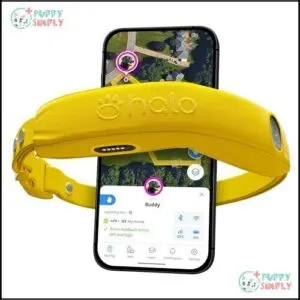
The Halo’s big trick is storing fence boundaries directly on the collar — so it enforces your virtual perimeter even without cell service. Dual-frequency GPS (L1 + L5) keeps accuracy within 0.6 meters, and the collar checks position up to 20 times per second. That’s real-time in the truest sense.
Battery runs up to 48 hours, recharges in 60 minutes. Waterproof build, fits dogs 10 lbs and up. Subscription starts at $9.99/month — required for tracking and fence features.
| Best For | Dog owners who want reliable off-leash freedom for their pets without installing a physical fence, especially those in areas with spotty cell coverage. |
|---|---|
| GPS Type | Dual-frequency L1/L5 |
| Waterproofing | Waterproof |
| Battery Life | 40+ hours |
| Subscription | Required ($9.99/mo min) |
| App Platform | iOS and Android |
| Alert System | Push notifications plus vibration |
| Additional Features |
|
- Dual-frequency GPS (L1 L5) delivers impressive location accuracy, and fence boundaries are stored on the collar itself so it keeps working even without cell service
- 40 hour battery life and a waterproof build mean it can keep up with active dogs in nearly any condition
- Multi-modal feedback (tone, vibration, and optional static correction) gives you flexible training options through the Halo app
- A mandatory monthly subscription starting at $9.99 adds an ongoing cost on top of the collar’s purchase price
- Some users have reported hardware issues like loose screws, and app lag can throw off training consistency
- The proprietary magnetic charger means you’re locked into buying replacements directly from the manufacturer
8. Fi Series 3 GPS Dog Collar
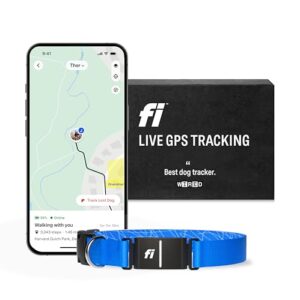
The Fi Series 3 runs on LTE-M cellular connectivity and updates location frequently enough that you won’t be staring at a stale dot on a map. Battery life stretches up to three months — real relief when you’re road-tripping and can’t remember the last time you charged anything.
It’s waterproof and built tough, fits small through large breeds, and the app lets the whole family track from their own phones. A subscription is required for live tracking.
| Best For | Dog owners who want real-time location tracking and activity monitoring for their pet, especially those with escape-prone dogs or active lifestyles. |
|---|---|
| GPS Type | Cellular GPS |
| Waterproofing | IP68 |
| Battery Life | Up to 3 months |
| Subscription | Required (free year 1) |
| App Platform | iOS and Android |
| Alert System | Escape zone app alerts |
| Additional Features |
|
- Built-in GPS with nationwide cellular coverage sends escape zone alerts so you know the moment your dog wanders out of bounds
- Up to 3 months of battery life means less charging and more peace of mind, even on long trips
- IP68 waterproof rating and an LED flash make it practical for any weather or low-light situation
- GPS accuracy can be off by several hundred feet, so you’ll get a general area rather than an exact location
- Escape alerts can be delayed by up to 45 minutes depending on signal, which isn’t ideal in a real emergency
- Live tracking and health insights require a paid subscription after the first complimentary year
9. Dogtra Pathfinder 2 GPS Collar
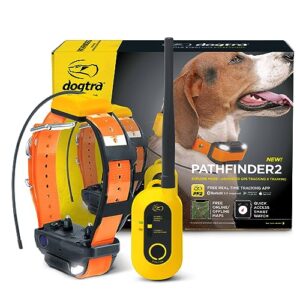
The Dogtra Pathfinder 2 is built for serious outdoor use — 9-mile range, 2-second location updates, and tracking up to 21 dogs simultaneously. At $365.49, it’s an investment, but hunters and off-leash trainers get e-collar commands, geofencing, and offline Mapbox maps baked right in.
No subscription required. The app runs on Apple Watch and Galaxy Watch, so you can check your dog’s position without digging for your phone. Waterproof, rugged, and genuinely trail-ready.
| Best For | Hunters, off-leash trainers, and serious outdoor enthusiasts who need reliable long-range dog tracking and remote correction without relying on cellular service. |
|---|---|
| GPS Type | Radio + GPS (9 mi) |
| Waterproofing | Waterproof |
| Battery Life | Several days moderate use |
| Subscription | Not required |
| App Platform | iOS and Android |
| Alert System | Push alerts plus auto-correction |
| Additional Features |
|
- Tracks up to 21 dogs with 2-second GPS updates across a 9-mile range — ideal for wide-open hunting terrain
- Smartwatch integration lets you check location and trigger e-collar commands hands-free
- Offline Mapbox maps (including satellite and terrain) keep you navigating even without cell service
- No physical stimulation dial means all e-collar adjustments go through the app, which can slow your response time
- Battery life with intensive use may require daily recharging in the field
- Geofencing has size and shape limitations, making it less practical for small or oddly shaped containment areas
10. SpotOn GPS Dog Fence Collar
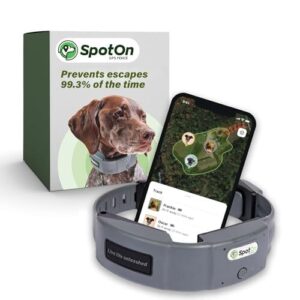
At $899, the SpotOn GPS Dog Fence Collar isn’t cheap — but it’s the only tracker here that doubles as a full virtual fence system. Draw boundaries in the app, scale from a backyard to 100,000 acres, and let your dog roam off-leash without burying a single wire.
True Location GPS pulls from 128 satellites, performs well under forest cover, and works off-grid. IP67-rated, 40-hour battery, and a free certified trainer session included.
| Best For | Dog owners with large or unfenced properties who want reliable off-leash freedom without the hassle of installing physical fencing. |
|---|---|
| GPS Type | Dual-feed satellite GPS |
| Waterproofing | IP67 |
| Battery Life | Up to 40 hours |
| Subscription | Optional |
| App Platform | iOS and Android |
| Alert System | Instant breach notifications |
| Additional Features |
|
- Massive boundary range (0.5 to 100,000 acres) with no wiring or base stations required — just draw your fence in the app
- Dual-feed GPS connecting to 128 satellites holds up well in wooded terrain and off-grid locations
- Comes with a free one-on-one certified trainer session, which helps offset the steep upfront cost
- At $899, it’s a significant investment, and full features like real-time tracking require an ongoing subscription on top of that
- Only works on U.S. cellular networks, so it’s useless for international travel or use in countries like the UK or Australia
- Some users have reported hardware and tracking issues after a few months, and repairs require sending the collar back
Best Features for Traveling Families

Traveling with your dog gets a whole lot easier when your tracker is actually built for it.
The best GPS collars for families on the move share a few key features that make all the difference — and knowing what to look for saves you from a panic-inducing moment at a rest stop. Here’s what separates a solid travel tracker from one that just looks good on paper.
Real-time Location Updates
When your dog bolts into unfamiliar territory, seconds matter. Most trackers refresh every 2–5 seconds in live mode — fast enough to watch movement unfold on your phone in near real time. This rapid data refresh is a key part of real-time location tracking for moving objects.
That speed comes at a cost, though: battery drain spikes noticeably. Many devices adapt automatically, slowing updates when your dog is still and accelerating the moment motion kicks in.
Family App Access
Speed only matters if the right people can act on it. Most trackers run through one app, multiuser access — meaning your partner, kids, or pet sitter all get real-time alert sync the moment your dog moves somewhere unexpected.
Location history access stretches back 30 days. Admins control shared permission roles, so guests see live location without touching geofence settings.
Multi-dog Tracking
That shared access gets even more useful when you’re traveling with more than one dog.
Multidog GPS trackers let you watch every animal on a single screen — no app-switching, no guessing.
Here’s what a good multi-pet dashboard delivers:
- Group location mapping — all dogs plotted simultaneously
- Cross-dog distance readings at a glance
- Realtime location updates every 2–3 seconds per dog
One app. Total picture.
Escape Alerts
Knowing where all your dogs are is one thing. Getting warned the moment one bolts is another.
Real-time entry alerts fire the instant a dog crosses a geofence boundary — by email, SMS, push notification, or even a Slack ping. You can also set time-based safety windows overnight, so any movement after midnight triggers an immediate flag. Anomaly detection catches unusual patterns before a full escape happens.
Safe Zone Setup
Think of a virtual fence as your dog’s invisible leash — one you draw yourself. Most apps let you build customizable safe zones around your campsite or rental yard in under two minutes.
Add a 15–30 meter geofence buffer beyond your actual boundary to catch drift before it becomes a problem. Calibrate with a quick walk around the perimeter, and your boundary breach notifications will fire accurately every time.
Connectivity and Tracking Accuracy
Not all trackers connect the same way — and when you’re traveling with your dog, that gap matters more than you’d think. The type of signal your tracker uses determines how accurate it is, how far it reaches, and whether it works at all in certain areas. Here’s what you need to know before choosing one.
LTE-M Cellular Coverage

LTE-M cellular coverage is the backbone of reliable real-time global tracking — it punches through building walls, basement parking, and rural dead zones that standard LTE can’t touch.
That’s because it trades raw speed for low power optimization and extended signal reach, covering urban connectivity stability and remote countryside alike. For GPS trackers for traveling dogs, that range isn’t a luxury. It’s everything.
GPS Satellite Support

Every position fix your dog’s tracker calculates depends on satellite triangulation — receivers measuring signals from at least four satellites simultaneously to pinpoint location in three dimensions, plus clock bias correction.
- Dual-satellite GPS + GLONASS taps two full constellations
- Atomic clock synchronization keeps timing errors under nanoseconds
- Multi-constellation systems access up to 128 satellites
- Navigation message integrity checks filter corrupted orbital data
- Accuracy usually lands within 1–10 feet
That precision doesn’t happen by accident.
Radio Frequency Tracking

RF trackers skip the satellite handshake entirely. Active tags broadcast signals on their own frequency — no towers, no subscription pings. That’s what makes them a quiet favorite for off-grid travel and road trips through dead zones.
| RF Feature | Travel Benefit |
|---|---|
| Active tag power | Broadcasts without cell networks |
| Signal triangulation | RSSI pinpoints location via multiple readers |
| Indoor localization | Tracks through walls and obstacles |
| Passive RFID benefits | No internal battery required |
| RF signal interference | Metal surfaces can reduce detection range |
Bluetooth Proximity Limits

Bluetooth sounds useful until your dog rounds a corner. Range tops out around 10 meters in open space — and drops fast indoors.
Walls, furniture, and your own body absorb the signal, throwing off RSSI readings enough to make your dog seem closer or farther than reality. It’s a short-leash tool, not a tracker. GPS or cellular takes care of the rest.
Rural Travel Reliability

Dead zones are the real test. Rural stretches mean cellular coverage thins fast — towers spread miles apart, live tracking hiccups, and your dog’s location can lag or freeze mid-update.
The best trackers handle this with satellite fallback, buffering position data offline until signal returns. Open farmland helps. Dense forest? Expect drift.
Battery Life and Durability

Battery life and build quality aren’t just specs on a box—they’re what stand between you and a panicked search at a trailhead with a dead tracker. Whether you’re charging up between national park stops or wading through a creek with your dog, these details matter. Here’s what to look for across five key areas.
Travel Charging Needs
Keeping your tracker charged on the road takes a little planning. A 10,000–20,000 mAh power bank covers multiple full charges for most GPS trackers — enough for a week of travel. Pair it with a USB-C PD charger for faster top-ups, and toss in a universal travel adapter if you’re crossing borders.
Vehicle charging hubs handle road trips without burning through your power bank.
Live Mode Battery Drain
Live mode is the power hog no one warns you about. Real-time GPS updates can raise current draw 1.5–3x compared to periodic check-ins — and poor cellular signal makes it worse, forcing the radio to work harder.
Use battery saver intervals when your dog’s stationary, and keep firmware updated. Smarter scheduling means longer battery life without losing your dog.
Waterproof Collar Ratings
Battery drain matters — so does what happens when your dog jumps into a lake before you can stop him.
IP67 vs IP68 is the key difference: IP67 can withstand 1-meter submersion for 30 minutes; IP68 goes deeper, longer. Both are waterproof and dustproof, but seals wear down. Check gaskets regularly — especially after saltwater exposure, which accelerates corrosion beyond what basic IP rating durability covers.
Lightweight Dog Comfort
GPS trackers are only as good as the collar carrying them. A heavy unit shifts constantly — irritating your dog’s neck over long travel days.
Look for slim integrated modules under 1.3 ounces, paired with breathable, hypoallergenic fabric that wicks moisture and prevents chafing. UV-resistant materials hold up in heat without degrading.
Comfortable gear stays on. That’s the whole point.
Rugged Outdoor Design
Your dog’s tracker takes the same beating your boots do — mud, rain, rocks, and unexpected dips in a creek.
The best units are built from reinforced polymer housings with IP68 waterproof ratings, surviving 1.5 meters of submersion for 30 minutes. Shock-absorbing bumpers handle drops up to 1.8 meters.
- Impact-resistant shells shrug off rocky trail collisions
- Dustproof seals block sand and debris from internal electronics
- Corrosion-resistant enclosures hold up in salt air near coastal campsites
- Temperature-tolerant materials stay functional from -20°C to 60°C
Ruggedized electronics aren’t optional on real adventures — they’re the whole game.
Costs, Subscriptions, and Value

The price tag on a GPS tracker doesn’t end at checkout — most cellular models charge $5 to $15 every month just to keep the signal alive. That ongoing cost adds up fast, especially when you’re tracking multiple dogs across a long trip.
Here’s a breakdown of what you’ll actually pay, how to stretch your budget, and which trackers give you the most for your money.
Monthly Plan Pricing
Most cellular trackers bill month to month — no annual lock-in, cancel at any paid cycle’s end. Base rates run $5–$15 per dog. Pawfit sweetens the deal with a 30-day free trial that auto-converts to standard billing unless you cancel. Taxes show separately at checkout and shift by region, so your final number may differ slightly.
| Tracker | Monthly Price | Trial Period |
|---|---|---|
| Whistle | From $6.95 | 7–30 days |
| Tractive Dog 6 | ~$8.99 | 30 days |
| Fi Series 3 | ~$9.99 | None listed |
Annual Subscription Savings
Paying yearly cuts costs fast. Most providers drop 10–25% off the monthly rate — that’s like getting 2–4 months free.
- Lock in pricing for 12 months, shielding you from mid-year increases
- Get promo codes unavailable on monthly plans
- Tiered discounts reduce per-device cost when adding multiple trackers
- Loyalty bonuses — free months or credits — kick in on renewal
Break-even hits around 6–9 months. After that, annual billing simply saves money.
No-fee Tracker Options
Subscriptions aren’t mandatory. No-fee models like the Aorkuler 2 use RF technology — a one-time purchase at $249.99, no monthly charges ever. Upfront costs run higher, but hardware longevity makes the math work over time.
You get geofencing, live location, even asset versatility across pets and luggage. Subscription-free tracking won’t suit every traveler, but for long-haul families, it’s worth serious consideration.
Multi-pet Cost Planning
Running trackers on two or three dogs adds up fast. Monthly subscriptions per dog, individual dog profiles, and separate app tiers can quietly double your tech budget.
Smart moves:
- Bulk purchasing savings on food and supplies
- Staggered veterinary visits to spread annual costs
- Multi-pet insurance discounts of 5–20%
- Emergency fund allocation covering all pets quarterly
One app, shared care budgeting — that’s the goal.
Best Value for Travel
Value isn’t just the lowest price tag — it’s what you get per dollar when your dog bolts at a rest stop.
Real value isn’t the lowest price — it’s what saves you when your dog bolts at a rest stop
| Tracker Type | Best Value Fit |
|---|---|
| Annual cellular plan | Budget travel families |
| No-subscription RF | Off-grid adventurers |
Annual plans save 10–25% over monthly billing. For pet travel GPS trackers covering multiple dogs, that gap compounds fast. Hidden costs — premium maps, realtime GPS updates, higher refresh tiers — quietly inflate totals. Know exactly what you’re buying before you pack.
Frequently Asked Questions (FAQs)
Is there a GPS dog tracker without a monthly fee?
Yes — subscription-free solutions exist. The Aorkuler 2 uses RF technology for a one-time $99 purchase. PitPat and Findster Duo+ skip monthly fees too, though private network tracking limits coverage versus cellular models.
How far can an AirTag track a dog?
Bluetooth range tops out at 100 meters—after that, location updates depend entirely on the Find My network. In rural areas, that could mean hours of silence. AirTag wasn’t built for real-time dog tracking.
How can I track my dog if he runs away?
When your dog pulls a Houdini, act fast. Open your GPS app, hit live tracking mode, and follow real-time updates. Instant escape alerts and your dog’s history trail guide you straight back.
Is AirTag or GPS better for dogs?
GPS trackers win for dogs. AirTag relies on Bluetooth and nearby iPhones — useless when your dog bolts into a field. GPS uses satellites and cellular to show real-time location anywhere.
How do I attach a tracker to my dogs collar?
Clean, align, secure — that’s the whole process. Thread the collar through the mounting loops, engage every clip or Velcro strap, then tug-test. Leave two fingers of space between the tracker and your dog’s neck to prevent chafing.
What happens if my dog loses the tracker device?
Lost tracker? Open your app immediately — it shows the last known location and timestamp. Check that spot first, alert neighbors, and contact local shelters with your dog’s details and last seen coordinates.
Are GPS trackers safe for small or toy breeds?
Yes, they’re safe — as long as you choose wisely. For toy breeds under 5 lbs, stay under 5 ounces (14g). Proper fit prevents neck strain, skin irritation, and discomfort during daily wear.
Can I track my dog without a smartphone?
Yes — with radio frequency receivers or handheld tracking units, you can locate your dog without a phone. Some models even trigger on-collar audible alerts to guide you in close range.
Conclusion
Picture a family huddled over one phone, watching a blue dot creep through dark woods while the campfire dies. That dot is everything.
The best dog GPS trackers for traveling families don’t just locate your dog—they buy back the trip you almost lost. Pick the tracker that matches your coverage zone, your dog’s size, and your honest battery habits.
Get it on the collar before you leave the driveway. Not after.