
This site is supported by our readers. We may earn a commission, at no cost to you, if you purchase through links.

Most dog owners spend more time picking a collar than a leash. The leash takes the real punishment—UV exposure, rain, mud, constant tension, and the occasional chew session when your dog decides it looks delicious.
Leash material directly affects how long it holds, how clean it stays, and whether it fails at the worst possible moment. A fraying nylon leash near a busy road isn’t a minor inconvenience. It’s a genuine safety risk.
Knowing what material is safest for dog leashes comes down to your dog’s size, habits, and where you walk. Each material has real strengths—and honest weaknesses worth knowing before you buy.
Table Of Contents
- Key Takeaways
- Why Leash Material Safety Matters
- TPU-Coated Polyester is Safest Overall
- Nylon Leashes: Affordable Everyday Choice
- Polyester Leashes: Best Outdoor Durability
- Hemp and Cotton Safety Compared
- Leather Leashes: Safe When Maintained
- Rope and Chain Leash Materials
- Safest Materials by Dog Type
- Hardware Makes Materials Safer
- Leash Materials to Avoid
- Frequently Asked Questions (FAQs)
- What material is best for dog leashes?
- What to avoid in a dog harness?
- What kind of leash do vets recommend?
- What’s the best thing to use as lead for a dog?
- How often should dog leashes be replaced?
- Are martingale leashes safer than standard leashes?
- Can leash materials cause skin irritation in dogs?
- Which leash materials work best in saltwater environments?
- Conclusion
Key Takeaways
- TPU-coated polyester (Biothane) is the safest all-around leash material — it’s waterproof, odor-resistant, easy to clean, and strong enough for most dogs when made phthalate-free.
- Leash material must match your dog’s size and strength, since heavy pullers need reinforced cores rated above 1,000 pounds, while puppies and small breeds do best with soft, lightweight cotton or thin nylon.
- Hardware matters as much as material — a stainless steel or brass clip with a locking gate, paired with box-stitched seams, is what actually prevents your dog from getting loose at the worst moment.
- Retire any leash that’s fraying, partially chewed, rusted, or showing loose stitching near the clip — these aren’t cosmetic problems, they’re safety failures waiting to happen mid-walk.
Why Leash Material Safety Matters
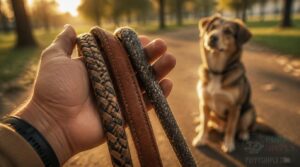
Most dog owners spend more time picking a collar than a leash — but the leash does most of the safety work. The material it’s made from affects your control, your comfort, and your dog’s wellbeing every single walk. Here’s what actually matters regarding leash material safety.
For a deeper look at how leash materials impact your daily walks, check out this guide comparing retractable and standard dog leashes.
A leash’s material matters more than most owners realize, shaping your control, comfort, and your dog’s safety on every walk
Control During Daily Walks
The leash in your hand is your main communication line with your dog. Grip and leash length both shape how well you steer, especially near traffic or other animals.
A mid-length leash lets you adjust quickly without overreaching. Pair it with simple hand signals, and you’ll manage most situations before tension ever builds.
Preventing Leash Failure
Good control starts with knowing your leash won’t give out mid-walk.
Partial chewing or fraying can cause sudden, silent failure — the leash separates without warning. Check for these three things regularly:
- Stitching integrity at the handle and clip ends
- Hardware wear — clips rated for 1,000 open-close cycles outlast cheap alternatives
- Material yield — standardized 50 kg force testing confirms real tensile strength
Always verify that your gear adheres to a safe working load to prevent unexpected hardware failure.
Comfort for Hands
Your hands matter as much as your dog’s safety on every walk.
A sudden lunge mid-stride doesn’t just startle you — it yanks your wrist, concentrates force across two or three fingers, and leaves your hand aching by the time you’re home. That’s why ergonomic grip shapes aren’t a luxury feature. They’re a practical safeguard. Contoured grips spread pressure evenly across your palm rather than pinching at one spot, which makes a real difference on longer walks.
| Handle Feature | What It Does | Best For |
|---|---|---|
| Foam or gel padding | Lowers peak pressure points | Long daily walks |
| Contoured shape | Distributes grip pressure evenly | Strong pullers |
| Moisture-wicking lining | Keeps your hand dry during activity | Hot weather or humid days |
| Temperature-neutral material | Stays comfortable in heat or cold | Year-round use |
| Rubberized texture | Reduces slip without tight gripping | Wet or sweaty conditions |
Leather leashes naturally conform to your hand over time, offering a grip that feels broken in rather than stiff. Cotton rope leashes are soft from day one, though they’re better suited to calm dogs than strong pullers.
Hand fatigue prevention comes down to one thing: how well the handle fits your grip without making you squeeze. A textured surface lets you hold firmly without clenching — your forearm muscles will thank you after mile two.
Matching Dog Strength
Your dog’s pulling force decides everything about leash choice.
A strong tensile center is non-negotiable for large, active breeds that lunge hard. Wider leashes — around 1.5 to 2 inches — distribute that force across more material instead of concentrating it on a single narrow strip. Small dogs and puppies need none of that. A lightweight, narrower leash keeps things comfortable without unnecessary bulk.
Reducing Chemical Exposure
What’s actually touching your dog every single walk? Roughly 45% of tested pet products contain detectable hazardous chemicals — including phthalates and lead in collars and coatings. PVC-coated leashes are a common culprit.
Natural fiber options like cotton dog leashes or hemp carry far fewer chemical risks. When you’re cleaning leashes, fragrance-free, plant-based cleaners keep harmful compounds out of your dog’s daily contact zone.
TPU-Coated Polyester is Safest Overall
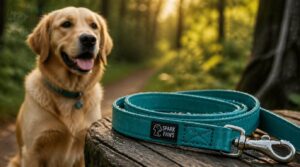
If you’re looking for one material that checks nearly every safety box, TPU-coated polyester — commonly sold as Biothane — comes closest to earning that title.
It holds up in real-world conditions better than most alternatives, and it does so without asking much from you in return. Here’s why it stands out across the qualities that matter most.
Waterproof and Odor-resistant
TPU-coated polyester seals out water at the structural level — not just on the surface. The TPU layer bonds directly to the polyester base, creating a waterproof barrier that holds up through rain, puddles, and muddy creek crossings.
What makes this pairing stand out for odor control is the layered defense:
- Hydrophobic coating repels moisture before bacteria can settle
- Silver ion treatments suppress odor-causing bacteria on contact
- Zeolite additives physically trap odor molecules inside the material
That last one is worth knowing. Zeolite works like a molecular sponge — it captures smell rather than just masking it. Antimicrobial finishes using silver ions add a second line of defense, inhibiting bacterial growth before it starts. Fabric leashes can’t offer that combination.
Laminated fabric construction also reinforces durability here. Binding a waterproof layer to the base thread prevents water from sneaking in at seams or worn edges. Your leash stays dry, light, and functional walk after walk.
Easy to Wipe Clean
Wiping down a TPU-coated leash takes about five seconds. The non-porous coating doesn’t absorb mud, grease, or grime — it just sits on top. A damp cloth cleans up most messes without scrubbing. That’s the real advantage of a hydrophobic surface: dirt can’t settle in because there’s nowhere for it to go.
Strong Polyester Core
The coating is what you see, but the polyester center is what holds. That center provides real tensile strength — resisting breakage when strong pullers lunge suddenly.
It also absorbs shock through controlled stretch, so the jolt doesn’t travel straight to your wrist. Core-wrapped construction keeps the leash stable under repeated stress, meaning better durability and shape retention over time.
Choose Phthalate-free Coatings
Not all TPU coatings are made the same. Some cheaper versions still use phthalate-based plasticizers — chemicals linked to liver and reproductive harm — to keep the coating flexible. That’s a real concern when your dog mouths the leash or you handle it daily.
Look for leashes that specifically state phthalate-free coating. Better formulations use bio-based rosin derivatives or similar alternative plasticizers that maintain flexibility and film integrity without the toxic trade-off. These low-emission finishes also tend to have less chemical odor straight out of the packaging.
The renewable coating content is a bonus — not the main reason to choose it, but worth knowing your gear isn’t entirely petroleum-derived.
Best for Most Dogs
Most dogs — from a nervous rescue to a boisterous Lab — handle TPU-coated polyester well. Balanced strength and weight make it a great fit across sizes and temperaments.
Here’s why it works for so many dogs:
- Smooth surface won’t irritate sensitive skin
- Lightweight daily comfort suits small and large breeds
- Waterproof coating experiences muddy trails or rainy streets
- Phthalate-free formulas reduce chemical exposure for everyone
Nylon Leashes: Affordable Everyday Choice
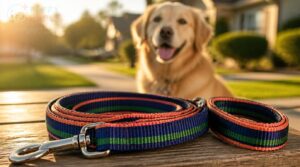
Nylon is one of the most popular leash materials out there, and it’s easy to see why. It hits a sweet spot between affordability, availability, and everyday practicality for most dog owners. Here’s what you should know before you grab one off the shelf.
Lightweight for Daily Walks
Daily walks add up fast — sometimes twice a day, every day. That repetitive load matters more than people expect.
Nylon leashes usually weigh 110–180 grams for a standard six-foot length, which keeps your hand relaxed over long distances. Pair that with lightweight stainless steel hardware, and your total walking gear stays easy to grip without the fatigue that heavier materials quietly build up over time.
Good for Most Breeds
Nylon’s real advantage isn’t just weight — it’s how well it scales across breed sizes and strengths. Leashes come in widths from 15 to 25 millimeters, so a Beagle and a German Shepherd can both be walked safely on nylon without switching materials entirely.
Ergonomic handle design on woven nylon grips also distributes tension evenly, which cuts down on handler fatigue during longer outings. That tension distribution matters most when your dog spots a squirrel and decides to investigate immediately.
For most dogs — small, medium, or large — standard nylon leashes rated for 250 pounds of tension handle daily dog walking safety without drama.
Can Fray With Wear
That 250-pound tension rating from the previous section sounds reassuring — but it only tells half the story. Tensile strength and fray resistance are two different things, and nylon can score well on one while quietly failing the other.
Here’s what fray actually looks like as it develops:
- Fuzzy edges appear along the leash sides where it drags on concrete
- Loose threads snag on grass, fences, or your dog’s collar hardware
- Stress points open near the clip, where pulling concentrates most
- Fiber thinning becomes visible at the handle’s base after repeated flexing
Wet conditions speed this up. Moisture causes fibers to swell and loosen, which increases movement at the seams and accelerates unraveling. A leash used daily on rough sidewalks can show real wear within six to twelve months.
Higher denier nylon holds up noticeably longer because denser fibers resist edge shedding better under load. That’s why leash construction matters as much as material — a tightly woven, high-denier nylon outlasts a loosely woven budget version by a wide margin.
Catch fray early and it’s manageable. Miss it, and a partially compromised leash can separate without warning mid-walk.
May Absorb Odors
Fray damage is a structural problem. Odor is a hygiene one. But both can make you quietly dread picking up that leash from the hook.
Nylon is hydrophilic by nature, meaning it pulls in moisture rather than pushing it away. That absorbed water carries sweat, urine, and outdoor grime straight into the fiber. Once those compounds settle in, they’re hard to fully remove.
| Material | Odor Retention | Ease of Cleaning |
|---|---|---|
| Nylon | High | Moderate |
| Polyester | Moderate | Easy |
| Cotton | High | Easy |
Warm water washing helps, but it doesn’t always clear embedded odor molecules completely. Storing a damp nylon leash in a closed bag or drawer speeds up bacterial growth and makes the smell worse faster. A breathable hook near the door beats a zipped pocket every time.
Cotton leashes share this problem — natural fibers absorb freely, which feels gentle but traps odors just as stubbornly. If odor is a real concern for you, polyester holds up better between washes simply because it repels moisture rather than soaking it in.
Inspect Stitching Regularly
Every few weeks, run your fingers slowly along the full length of the leash.
- Check the handle seams for loose or skipped stitches
- Look for fraying thread ends near the clip attachment
- Press on stress point reinforcement to feel for soft spots
- Watch for mismatched or darker stitching that signals a prior repair
Nylon hides wear quietly — until it doesn’t.
Polyester Leashes: Best Outdoor Durability
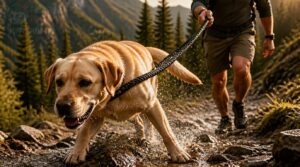
Polyester leashes quietly outperform nylon the moment the weather turns rough. They hold up where nylon starts to struggle — on sun-baked trails, in downpours, and on long active days with high-energy dogs. Here’s what makes polyester worth considering for outdoor use.
Strong UV Resistance
Sun does a lot of damage you can’t see coming. Polymer degradation from UV exposure isn’t just about fading — it breaks down molecular bonds, quietly reducing tensile strength until the leash fails without warning.
Polyester holds up where nylon struggles. After 12 months of continuous UV exposure, polyester retains over 90% of its original tensile strength, while untreated nylon grows brittle and loses load-bearing capacity noticeably faster. That’s a meaningful gap on a sunny hiking trail.
UV stabilizers — specifically hindered amine light stabilizers (HALS) and UV absorbers — are embedded during manufacturing to intercept UV energy before it snaps polymer chains. Good polyester leashes use both, since they work at different points in the degradation process and outperform either stabilizer used alone. Colorfastness testing under 1,000 hours of accelerated Xenon arc exposure confirms that stabilized polyester holds its color and flexibility far longer than untreated synthetics.
For dogs that spend real time outdoors, this isn’t a minor detail — sun-induced brittleness is a structural safety issue, not just a cosmetic one.
Dries Quickly After Rain
Wet leashes are a real annoyance on trail days, and polyester experiences rain better than most materials on the market. The fiber itself is naturally hydrophobic, meaning it repels water rather than soaking it in — absorbing only about 0.4% of its weight in moisture compared to nylon’s 2–5%. That difference shows up fast when you’re heading back to the car after a downpour.
On a warm, breezy day, surface evaporation rates climb quickly because moving air pulls moisture-laden vapor away from the leash before it has a chance to settle. Lower humidity and direct sunlight push that process even further — a concrete sidewalk can dry within 20–40 minutes under those conditions, and a polyester leash sitting on it won’t lag far behind.
Three conditions that accelerate drying after rain:
- Wind speed — faster airflow removes moisture vapor from the surface continuously
- Direct sunlight — heat increases evaporation rate across both the leash and the ground beneath it
- Low ambient humidity — drier air absorbs water vapor more readily, shortening dry time noticeably
Because polyester pushes water to its surface rather than locking it inside the fibers, weather resistance here is structural, not just a coating trick. The leash dries 10–30% faster than nylon under the same conditions, and it returns to its original weight quickly. That means no soggy grip, no lingering dampness, and no repeated wet-dry stress cycles weakening the weave over time.
Good Hiking Option
Polyester earns its place as a genuine trail leash — not just a fair-weather option. Its fiber structure resists UV degradation, maintaining color and tensile strength even after 200 hours of simulated sun exposure. That matters on exposed alpine ridgelines where a nylon leash quietly weakens with every sunny mile.
Trail abrasion resistance is where polyester holds its own, handling rocky surfaces without the rapid surface wear that sharp quartz gravel causes on nylon. The grip stays comfortable even on cold mountain mornings, which means your hand isn’t fighting the leash when your dog spots a squirrel on a steep switchback.
Wet conditions don’t slow it down either. Polyester absorbs almost no water, so the leash stays light and manageable through creek crossings and sudden showers — no soggy dead weight pulling at your wrist for the last two miles back.
Less Odor Retention
After a muddy trail, smell is the real test. Polyester’s tight fiber weave traps far fewer odor compounds than cotton or loose-woven nylon — both of which absorb moisture and hold bacteria close to the surface. That absorbed moisture feeds odor-causing bacteria fast.
Polyester’s low fabric absorption keeps the leash drier longer, cutting that bacterial window short.
Durable for Active Dogs
Active dogs put leashes through real punishment — scraping against rocks, absorbing sudden lunges, and dragging through wet brush for miles.
Polyester’s abrasion resistance holds up where softer materials start thinning out. Its tensile strength controls dogs that pull hard in short, sharp bursts without the fibers stretching or distorting. For large, active breeds, that structural consistency isn’t a bonus — it’s the baseline.
Hemp and Cotton Safety Compared
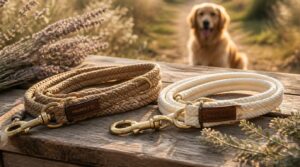
Hemp and cotton sit on the gentler end of the leash material spectrum, and they each come with their own set of trade-offs worth knowing. Neither one is a bad choice — they just work best in the right situations. Here’s what you should understand about both before deciding if one fits your dog.
Hemp Resists Mold Naturally
Hemp doesn’t just resist mold by accident — the protection is built into the fiber itself. The plant’s natural phenolic compounds and cannabinoids actively inhibit fungal growth on the fiber surface, which means mold can’t easily take hold even after repeated wetting. That’s a real advantage for a dog leash that spends time outdoors, in puddles, or clipped to a wet collar.
The crystalline cellulose structure in hemp also plays a role. Fungal enzymes have a harder time penetrating that tightly packed framework, so mold can’t break down the fiber the way it would with looser, less organized materials. Think of it like trying to cut through dense hardwood versus soft balsa — the structure itself slows the attack.
Hemp also wicks and evaporates moisture rapidly , which cuts off mold’s main fuel source. Mold needs prolonged dampness to grow. When a leash dries fast, that window closes quickly.
What makes this especially useful is that the protection is part of the fiber — it doesn’t wash off or wear away over time. You’re not relying on a chemical treatment that fades after a few months of use. The resistance stays because it lives inside the fiber, not on top of it. For an eco-friendly, sustainable leash option, hemp holds up surprisingly well where it counts.
Cotton Feels Soft
Cotton is different. Where hemp earns points for toughness, cotton wins on gentle texture. The natural cellulose fibers are fine and flexible, which creates a soft, cushioned feel in your hand — especially with cotton rope leashes.
- Smooth against sensitive skin
- Breathable in warm weather
- Lightweight and easy to hold
- Soft even after washing
- Kind to small, delicate necks
That softness, though, comes at a cost — cotton lacks durability for strong pullers.
Better for Gentle Dogs
That softness translates directly into suitability. Hemp and cotton leashes work best for calm, low-energy dogs — think small breeds, puppies, or seniors who aren’t yanking your arm off.
Lightweight fiber reduces shoulder strain on your end, while the hypoallergenic material prevents skin irritation on theirs. If your dog walks politely, these eco-friendly options genuinely deliver comfort without compromise.
Not Heavy-duty Options
Both materials have a real limit: neither can take heavy pulling. If your dog weighs over 40 pounds or tugs consistently, hemp and cotton leashes can fray at the tip faster than nylon or polyester dog leashes would.
- Budget vs durability tradeoff is real here
- Daily walk wear degrades fibers quickly
- Lightweight grip comfort doesn’t offset weak tensile strength
- Small breed suitability is where these shine
Save them for gentle, everyday use.
Eco-friendly Leash Materials
If sustainability matters to you, both hemp and cotton rope leashes deliver. Hemp’s antimicrobial properties reduce odor naturally, and it grows without heavy pesticide use. Recycled plastic webbing diverts waste from landfills while matching synthetic material durability. Cork mixes offer a natural grip texture with plant-based credentials.
| Material | Eco Benefit | Best Use |
|---|---|---|
| Hemp | Biodegradable, low-pesticide | Small calm dogs |
| Recycled plastic | Diverts landfill waste | Wet environments |
| Cork mix | Renewable, antimicrobial | Warm-weather walks |
Leather Leashes: Safe When Maintained
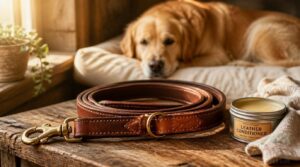
Leather leashes have been around for centuries, and there’s a reason they’ve stuck around. They feel great in your hand, hold up well under pressure, and age beautifully — but only if you take care of them. Here’s what you need to know before choosing leather.
Comfortable Natural Grip
Leather has a feel that’s hard to fake. The surface warms to your hand quickly, contouring naturally to your palm without pressure points.
Its slight texture gives you tactile grip even when things get sweaty or wet — no white-knuckling required. That natural give also dampens sudden pulls, protecting your wrist from the snap of an excited dog.
Strong Premium Material
Premium leather isn’t just about looks — it earns its price through tensile strength consistency and rigorous quality controls that cheaper synthetics often skip.
Here’s what sets quality leather apart:
- Abrasion wear testing ensures it holds up through years of daily use
- Thick hides (12–14 oz) resist tearing under sudden, heavy pulls
- Non-toxic additives in proper tanning reduce skin irritation risks
- UV degradation resistance keeps fibers from drying out prematurely
- Heavy-duty pet products built to this standard simply last longer
Needs Regular Conditioning
Think of leather like a joint — it stays strong only with regular care. Without it, fibers dry out, lose flexibility, and snap under pressure. Apply a leather conditioner every few months to maintain grip strength and suppleness.
| Conditioning Step | Frequency |
|---|---|
| Wipe with a damp cloth | After each walk |
| Apply leather conditioner | Every 2–3 months |
| Check for dryness or cracks | Monthly |
| Deep clean with leather soap | Every 6 months |
| Full structural inspection | Annually |
This routine is your leash’s recovery day — skip it, and durability fades fast.
Can Crack When Neglected
Neglect turns a tough material brittle. Small hairline cracks form first in high-flex zones — near the clasp, along fold points — and widen quietly under daily stress.
Moisture sneaks in, freezes, and pulls fibers apart from the inside. By the time a crack looks serious, structural failure may already be close. Skip the conditioning schedule, and you’re walking a countdown.
Avoid Poorly Treated Leather
Poor tanning leaves leather dry and stiff from the start. Harsh saddle soaps strip the natural oils that keep fibers flexible, accelerating brittleness before wear even begins.
Mold grows fast on leather stored damp or in low airflow. Once it sets in, the smell doesn’t leave. Check for soft spots, surface flaking, or loosening stitching — those are your early warnings.
Rope and Chain Leash Materials

Rope and chain leashes sit at opposite ends of the spectrum, but both have real strengths worth knowing. Your dog’s size, temperament, and habits will determine which one actually makes sense for you. Here’s what you need to keep in mind before choosing either.
Climbing Rope Absorbs Pulling
Mountain climbing rope leashes have a built-in safety advantage most people don’t think about — stretchiness. Unlike a stiff nylon or chain leash, climbing rope is engineered to absorb energy by stretching under load. When your dog lunges suddenly, that stretch spreads the force out over a longer moment instead of snapping it straight to your wrist.
That’s the same principle that protects rock climbers during falls. Nylon inner fibers in active rope can elongate anywhere from 28 to 40 percent before returning to shape, which means a sharp pull becomes a managed tug rather than a jarring jolt. Your shoulders and wrists take far less impact as a result.
The energy absorption mechanics here are worth understanding simply. The rope’s center does the stretching work, while the outer sheath controls how that stretch moves and protects the fibers from damage. Together, they reduce the peak force your body feels — the same way a soft catch works in climbing.
Cotton rope leashes exist too, but they don’t offer this active give. Cotton is soft and gentle on hands, yet it lacks the tensile strength and elasticity that make climbing rope genuinely protective for strong pullers. For sudden-pull protection specifically, climbing rope outperforms cotton every time.
Rope Suits Strong Dogs
Rope is genuinely one of the best fits for strong pullers — and the construction explains why.
Braided inner strength is the real workhorse here. Quality rope leashes use tightly braided nylon or polyester cores wrapped in a durable outer sheath, and very strong pullers should look for a pull rating of 1,000+ pounds for real peace of mind. Cotton rope leashes don’t come close to that standard — soft on hands, yes, but they lack the tensile strength and durability that strong dogs demand.
Three features that make rope leashes stand out for powerful breeds:
- Tangle-resistant braids keep the leash from twisting mid-walk, so you stay in control during sudden movements
- Padded grips prevent handle burn when your dog lunges — a real injury risk that sends thousands of owners to urgent care each year
- 8–12 mm diameter balances a comfortable grip with enough material strength to handle high load without snapping
The load capacity ratings on rope leashes aren’t just marketing. Polypropylene rope leashes, for instance, are rated for dogs up to 250 pounds. That safety margin matters when a dog hits the end of the leash at full sprint.
One practical note on material strength testing: check the stitching at attachment points, not just the rope itself. Double-stitched seams at stress points dramatically cut the risk of seam failure under tension. That’s where most leashes actually give out — not the rope, but the join.
Chains Resist Chewing
If rope controls the pulling problem well, metal chain leashes solve a completely different one — avid chewers.
Fabric leashes don’t stand a chance against a determined chewer. Nylon frays, rope shreds, and leather eventually gives in. Steel link durability is the real advantage here: dogs simply can’t gnaw through metal the way they can through softer materials.
Welding quality matters more than most owners realize. Properly welded links spread biting pressure across the full link, so no single point absorbs the full force of a bite. Thicker links — around 8 mm — distribute that load even further, making it harder for a dog to pry anything apart.
A chrome or stainless steel alloy adds corrosion resistance on top of raw strength, which keeps the chain safe and structurally sound even after wet walks. Some chains also carry a thin coating over steel links — vinyl or polymer — that deters chewing further while protecting your hands from abrasion.
That said, a chain leash isn’t a permanent fix for chewing behavior. Most dogs stop because metal simply doesn’t feel good on their teeth, but some persistent chewers push through anyway. Pairing a chain leash with training is always the smarter long-term move.
Chains Feel Heavy
Solving the chewing problem with a chain leash does come with a trade-off — weight on your hand.
Stainless steel links are denser than aluminum or rope, and that mass adds up fast. On longer walks, chain mass inertia can fatigue your grip, especially if you have smaller hands. Heavier link patterns like Cuban-style designs feel noticeably more substantial than thinner alternatives.
Watch for Rust
Rust is the silent enemy of any chain leash. Even stainless steel hardware can corrode if the coating gets scratched. Salt air and road salt speed things up dramatically.
Check your metal links and clips regularly for reddish-brown spots or pitting. Those small cavities weaken the metal fast. A rusted clip can fail open mid-walk — and then your dog is gone.
Safest Materials by Dog Type
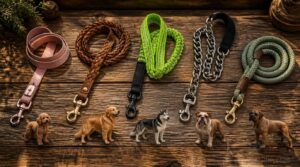
No single leash material works for every dog. Your dog’s size, temperament, and pulling habits all point toward different needs. Here’s what works best for each type.
Small Dogs Need Lightweight Leashes
Think about what happens when you clip a chunky, heavy leash onto a six-pound Chihuahua. The hardware alone can pull the collar sideways and throw the dog off balance mid-step.
Leashes under 4 ounces are the sweet spot for small breeds and puppies. Nylon is usually the lightest option, often landing between 1.5 and 2.5 ounces. Narrow webbing of 0.5 to 0.75 inches keeps bulk down and reduces hand fatigue on daily strolls — no white-knuckle gripping required.
A 4 to 6 foot length gives you enough control without yanking a small dog sideways every time you shift your weight. That range also folds into a jacket pocket easily, which makes compact travel storage a real benefit for trips and hikes.
For puppies learning leash manners, lighter gear helps them stay calm and focused. A heavy leash can distract or unsettle a young dog before the walk even starts.
Pullers Need Reinforced Materials
If your dog hits the end of the leash like a freight train, standard webbing won’t cut it. Strong pullers generate forces several times their own body weight during sudden lunges, and a leash built for casual strolls simply isn’t designed for that load.
- Reinforced inner fibers — multi-strand braided cores distribute pull across fibers, so no single point snaps under stress
- High-tenacity webbing — rated for heavy loads, resisting elongation even during aggressive tugging
- Abrasion-resistant sheath — protects internal fibers from rough ground and repeated friction
- Reinforced stitching at hardware — double or cross-stitched connection points prevent seam failure where stress concentrates most
For serious pullers, look for leashes rated above 1,000 pounds of tensile strength. That buffer matters because sudden pull force — a dog launching forward — far exceeds static weight. Polypropylene rope and Biothane both handle this well, with Biothane’s polyester center delivering 500 to 1,000-plus pounds of break strength depending on width. Wide 1-inch heavy-duty webbing gives you better load distribution and grip control than narrow straps during those sudden bursts.
Chewers Need Chew-resistant Options
A dog that chews its own leash isn’t just being difficult — it’s creating a real safety hazard. Partial chewing is especially dangerous because the leash looks intact but can snap without warning mid-walk.
For avid chewers, Kevlar-reinforced fibers and UHMWPE cores are your two strongest options. UHMWPE measures roughly 15 times stronger than steel, making it extremely hard for even powerful jaws to compromise. Kevlar adds cut resistance where teeth repeatedly target the same spot.
Ceramic-like surface coatings deter gnawing by creating a smooth, hard finish that’s frustrating for teeth to grip. Pair that with a tightly woven outer sheath, and you’ve got a leash that resists unraveling from repeated biting. Large breeds need materials rated above 350 Newtons bite force resistance to prevent catastrophic failure.
Standard nylon won’t hold up here — skip it.
Puppies Need Gentle Materials
Puppies aren’t just small dogs — their necks, skin, and tracheas are still developing, which makes leash material choice genuinely matter more at this stage than any other.
- Soft woven cotton or hemp reduces friction against tender skin and avoids the hot spots that rougher synthetics can cause
- Non-toxic, colorfast dyes prevent chemical transfer when puppies mouth or chew the leash
- Hypoallergenic fabrics like organic cotton minimize skin irritation in puppies with early sensitivities
- Lightweight construction keeps strain off a developing neck during those first leash lessons
Skip anything heavy or stiff. A thick nylon or chain leash puts unnecessary pressure on a puppy’s throat, especially if they lunge or startle. Smooth, gentle fibers distribute that force more evenly.
Check that dyes pass color safety standards — puppies chew everything, and leash dye ends up in their mouths regularly. Fragrance-free materials also lower the risk of respiratory irritation in young dogs still building immune tolerance.
Large Breeds Need Wider Leashes
A Great Dane pulling on a thin leash is asking for trouble.
Wide leashes — at least 1 inch — spread pulling force across more surface area, easing hand fatigue and reducing snap risk.
| Feature | Narrow Leash | Wide Leash |
|---|---|---|
| Pull Distribution | Concentrated | Spread evenly |
| Hand Fatigue | Higher | Lower |
| Snap Risk | Greater | Reduced |
| Twist Resistance | Poor | Strong |
| Giant Breed Fit | No | Yes |
Reinforced stitching and locking hardware matter just as much as width.
Pair a wide leash with a 6 to 10 foot length for open space and better control.
Hardware Makes Materials Safer
Even the best leash material can let you down if the hardware holding it together isn’t up to the job. A weak clip or worn stitching is often what causes a leash to fail — not the material itself. Here’s what to look for when you’re checking the hardware on your dog’s leash.
Stainless Steel Clips
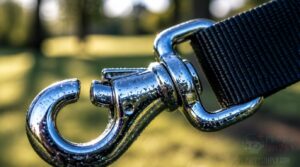
The clip is your last line of defense.
304 grade stainless steel stands up to everyday use well, but 316 grade holds up better near saltwater or pool chemicals.
- Resists rust in wet conditions
- Spring gates allow one-handed use
- Locking latches prevent accidental release
- Rounded tips protect your hands
- Load-rated for consistent pull strength
Passivation smooths the surface, cutting corrosion risk.
Brass Snap Hooks
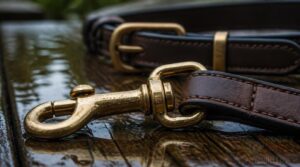
Stainless steel earns its place, but brass brings something different to the table — literally.
Brass snap hooks resist moisture naturally without coatings. Over time, they develop a protective patina that shields the surface rather than weakening it. The swivel eye design also stops leash twisting mid-walk, which is a small thing that makes a real difference.
| Feature | What It Means | Best For |
|---|---|---|
| Brass corrosion resistance | Holds up well against rain and humidity | Outdoor and wet climates |
| Swivel eye | 360° rotation prevents tangling | Active or energetic dogs |
| Locking gate mechanism | Reduces accidental release | Strong pullers |
| Snap hook sizing | Larger snaps carry more load | Medium to large breeds |
| Patina development | Surface hardens with age | Long-term daily use |
Choose a size that matches your dog’s pull strength. Lighter brass snaps suit small dogs. Heavy-duty brass snaps work better for larger breeds. Keep the spring gate clean and occasionally lubricated — smooth operation means safer walks.
Locking Carabiner Clips
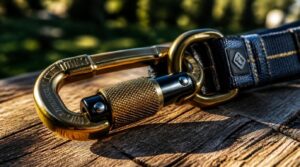
Brass snap hooks cover most situations well, but some dogs need an extra layer of security. That’s where locking carabiner clips earn their place.
Auto-locking models close automatically and require two motions to open — your dog can’t accidentally pop the gate mid-walk. Screwgate designs add a threaded sleeve for manual tightening. Gate force ratings usually reach 20 to 25 kN, far exceeding any dog’s pulling strength.
Wipe clean, check for gate play regularly.
Reinforced Stitching
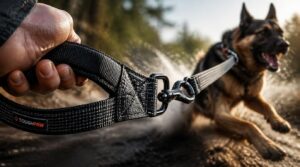
Locking clips only hold as long as the leash itself holds. That’s where reinforced stitching does the quiet, critical work.
Look for box X and bar tack stitches at handle and clip attachment points — these resist yanking better than basic seams. UV-resistant thread prevents sun-weakening over time. Watch for loose threads or cracked seams near hardware. Those are your warning signs.
- Your dog lunges — the seam tears
- The clip stays attached — but the fabric separates
- Your dog is free before you react
Reflective Safety Features

Night walks carry real risk — drivers may spot your dog too late. Reflective leashes use retroreflective technology, either glass bead or microprismatic layers, to bounce headlight beams straight back toward drivers. Microprismatic strips shine brighter at longer distances. Weatherproof reflective coatings hold up in rain and UV exposure without dimming. Look for leashes with reflective stitching woven into seams too.
| Reflective Feature | Why It Matters |
|---|---|
| Glass bead strips | Wide-angle visibility for passing vehicles |
| Microprismatic layers | Maximum brightness at greater distances |
| Reflective stitching | Multi-angle detection from cyclists and pedestrians |
| Weatherproof coating | Consistent nighttime performance in rain or cold |
Leash Materials to Avoid

Not every leash deserves a spot in your hand. Some materials fail quietly — fraying, rusting, or carrying chemicals your dog shouldn’t touch. Here are the ones worth skipping.
Weak Fraying Fabrics
Some leashes look fine until they suddenly don’t. Loosely woven fabrics fall apart from the cut edge outward, and regular bending, washing, and pulling speed that process up. Once the fibers start going, the leash loses tensile strength fast.
No edge finishing — no serging, no binding — means fraying spreads unchecked. Avoid any leash that already shows pulled threads or fuzzing along the seams.
Unknown Vinyl Coatings
Not all vinyl coatings are the same. Cheap or unlabeled versions may contain phthalate plasticizers that leach chemicals over time — linked to liver and reproductive issues in dogs. Poor adhesion means the coating peels, exposing the material underneath. VOC emissions during manufacturing can also linger.
Stick to leashes that clearly label their coating as phthalate-free and TPU-based.
Rust-prone Metal Chains
Metal chains corrode fast — especially near the coast. Saltwater damage works by driving chloride ions into the steel, breaking down its protective oxide layer. Even everyday humidity speeds that process along.
Watch for these warning signs:
- Orange-brown rust patches spreading across links
- Thinning chain walls caused by metal fatigue
- Coating wear that exposes bare steel underneath
A rusted chain leash can snap without warning, taking your control — and your dog’s safety — with it.
Damaged Stitched Seams
Worn stitching is a quiet failure waiting to happen. Thread tension problems, UV degradation, and repeated washing all weaken seams over time.
| Warning Sign | Cause | Risk Level |
|---|---|---|
| Loose, snagging threads | Low thread tension | Moderate |
| Gaps along seam line | Fabric layer slippage | High |
| Fraying near the clip | Missing reinforcement stitching | Critical |
Inspect seams monthly. Damaged stitching separates without warning.
Partially Chewed Leashes
A chewed leash isn’t just damaged — it’s a liability. Once a dog breaks through the outer layer, the structural integrity drops fast.
- Sharp exposed edges can cut the mouth or throat if chewing continues
- Missing fragments may cause GI blockage, vomiting, or reduced appetite
- Bacteria from saliva collects in frayed fibers, creating a hygiene risk
Retire it. Don’t wait for a second walk.
Frequently Asked Questions (FAQs)
What material is best for dog leashes?
TPU-coated polyester wins the leash race — waterproof, odor-resistant, and strong enough for most dogs. It’s phthalate-free when sourced carefully, easy to wipe clean, and holds up through rain, mud, and daily pulling without fraying.
What to avoid in a dog harness?
A loose vest lets your dog back out and escape. A tight one restricts movement and causes chafing. Skip harnesses with poor padding, complex buckles, or no reflective trim — they create more problems than they solve.
What kind of leash do vets recommend?
Vets pretty much universally recommend a fixed 4-to-6-foot leash with a padded handle and locking metal clasp. Nylon or TPU-coated polyester are the top picks — strong, washable, and reliable for most dogs.
What’s the best thing to use as lead for a dog?
TPU-coated polyester is your best all-around choice. It’s waterproof, odor-resistant, and easy to clean. The polyester fabric stays strong without adding bulk, making it reliable for most dogs day to day.
How often should dog leashes be replaced?
Most leashes last 12 to 24 months with regular use. Heavy pullers or outdoor dogs may need replacement every 6 to 12 months. Replace immediately if you spot fraying, rust, or a loose clip.
Are martingale leashes safer than standard leashes?
Ironically, the "safer" leash isn’t about the leash at all — it’s about your dog. Martingale leashes prevent collar escape better, while standard leashes suit calm, well-fitted dogs. Match the design to your dog’s behavior.
Can leash materials cause skin irritation in dogs?
Yes, they can. Rough materials, chemical dyes, and hardware edges can all trigger redness, hair loss, or contact dermatitis. Nylon and synthetic materials are common culprits, especially on dogs with sensitive skin.
Which leash materials work best in saltwater environments?
Biothane and TPU-coated polyester handle saltwater best. They repel salt absorption, resist odor, and wipe clean easily. Pair either with stainless steel hardware to prevent corrosion. Always rinse after beach walks.
Conclusion
What’s the real cost of getting this wrong? A snapped leash near traffic answers that question fast. Knowing what material is safest for dog leashes means matching the right choice to your specific dog—their size, strength, and habits.
TPU-coated polyester leads for most owners. Leather rewards maintenance. Nylon works until it doesn’t. Check hardware, inspect stitching, and retire anything frayed or chewed. Your dog trusts you to make this call.
- https://www.adoptapet.com/blog/health/beware-lead-and-toxic-dog-toys
- https://www.bolderk9.com/blogs/bolder-blog/why-biothane-is-best-for-dog-leashes
- https://evergreendogco.com/blogs/blog/biothane-vs-nylon-blog
- https://www.treelinereview.com/gearreviews/best-dog-leashes
- https://www.consumerreports.org/home-garden/pet-supplies/best-dog-leashes-a3957057656