
This site is supported by our readers. We may earn a commission, at no cost to you, if you purchase through links.

Your dog destroys the couch cushions—not out of spite, but because eight hours of silence with nothing to do is genuinely unbearable for an animal wired for activity. Studies suggest dogs left alone without enrichment show elevated cortisol levels within 30 minutes, a stress response that often channels straight into your furniture, baseboards, or trash can.
The right chew toy doesn’t just save your belongings; it gives your dog a productive outlet that keeps anxiety from compounding through the day. From indestructible rubber sticks packed with frozen peanut butter to puzzle feeders that buy you an extra hour of calm, the options have never been more targeted—and more effective.
Table Of Contents
- Key Takeaways
- 10 Best Chew Toys for Dogs Left Alone
- 1. Indestructible Rubber Chew Stick
- 2. Allrier Interactive Chew Puzzle
- 3. Starmark Interactive Dog Food Dispenser
- 4. WEOK Heartbeat Comfort Cuddler
- 5. Outward Hound Dog Brick Puzzle
- 6. Hippih Durable Dog Puzzle Balls
- 7. Blue Aggressive Dog Chew Toy
- 8. Adjustable Nylon Treat Dispenser
- 9. Wobble Wag Giggle Ball
- 10. Interactive Fox Puppy Toy
- Safe Toys for Unsupervised Chewing
- Best Materials for Solo Chew Toys
- Choosing Toys by Chewing Style
- Treat-Dispensing Toys for Alone Time
- Chew Toys for Separation Anxiety
- Dental Benefits of Daily Chewing
- Cleaning and Inspecting Chew Toys
- Buying Tips for Long-Term Value
- Frequently Asked Questions (FAQs)
- What chew toys are safe to leave a dog alone with?
- How to keep a dog entertained when left alone?
- Can chew toys help dogs with noise phobias?
- How do I introduce a new toy to my dog?
- At what age should puppies start chewing toys?
- Are scented chew toys safe for indoor use?
- How many chew toys should one dog own?
- Conclusion
Key Takeaways
- Dogs left alone without enrichment show elevated stress hormones within 30 minutes, making the right chew toy a behavioral tool as much as a distraction.
- Matching the toy to your dog’s chewing style — gentle, moderate, heavy, or power — is the single most important safety and durability decision you’ll make.
- Treat-dispensing and puzzle toys stretch solo time to 15–60 minutes of active engagement, easing separation anxiety by giving your dog a job to do rather than a problem to spiral into.
- A $25–30 premium rubber or nylon toy lasting several months almost always costs less per year than cycling through cheaper options every few weeks.
10 Best Chew Toys for Dogs Left Alone
Leaving your dog home alone doesn’t have to mean crossed paws and a chewed-up couch cushion. The right toy keeps your dog’s jaws busy, their mind sharp, and their nerves settled until you walk back through the door. Here are the 10 toys worth putting in your cart this year.
Whether you’re gone an hour or a full workday, these interactive dog toys for dogs home alone are designed to hold attention and ease separation anxiety through real play.
1. Indestructible Rubber Chew Stick
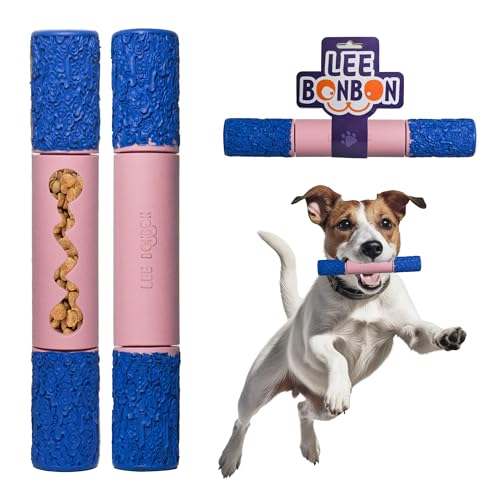
If your dog treats every toy like a deadline, this one’s built for the job. The proprietary natural rubber compound resists punctures and tearing, even with a power chewer gnawing solo for hours. Its thick, cylindrical shape spreads bite force evenly, while the smooth finish avoids snagging or splintering.
Bonus: it’s dishwasher safe and floats, so backyard fetch sessions and quick sanitizing both stay convenient between chews.
| Best For | This chew toy is ideal for medium to large dogs with strong jaws—think aggressive chewers and teething puppies—who need a tough, treat-stuffable toy to stay occupied and out of trouble. |
|---|---|
| Material | High-density rubber |
| Weight | 0.3 kg |
| Best For | All sizes |
| Treat Dispensing | Yes |
| Chewer Level | Heavy/Aggressive |
| Primary Benefit | Long-lasting chew puzzle |
| Additional Features |
|
- One-piece molded rubber construction with no glue or nylon parts means fewer weak points for tough chewers to exploit
- The central treat cavity turns mealtime into a puzzle, keeping dogs engaged for 30 to 60 minutes with kibble, peanut butter, or frozen treats
- Dual-texture surface gives dogs varied chewing sensations along with a better grip, and it doubles as a fetch or tug toy for active play
- At 0.66 lb, it may be too heavy or bulky for very small breeds or tiny puppies
- Some reviewers note that extreme chewers have broken off edges within minutes, so it’s not foolproof for the toughest jaws
- The wide treat openings make it easy for clever dogs to grab the food quickly, which can cut the puzzle-solving time short
2. Allrier Interactive Chew Puzzle
For dogs who need a brain workout alongside the jaw workout, the Allrier Interactive Chew Puzzle delivers both. Its central maze with movable lids hides treats behind openings of varying sizes, so your dog has to actually think before snacking.
Built from BPA-free, food-grade plastic with smoothed edges, it’s rated for medium to large dogs with strong chewers. Non-slip feet keep it steady mid-session, and clear panels let you peek in on the action without interrupting it.
| Best For | Medium to large dogs with strong chewing habits who need extra mental stimulation alongside their chew time. |
|---|---|
| Material | TPR & nylon |
| Weight | 230 g |
| Best For | Small to medium |
| Treat Dispensing | Yes |
| Chewer Level | Light to moderate |
| Primary Benefit | Dental health stimulation |
| Additional Features |
|
- Central maze with movable lids and varying treat openings keeps dogs mentally engaged, not just chewing on autopilot
- Made from BPA-free, food-grade plastic with smoothed edges for safer extended use
- Non-slip feet keep it in place during active play, and clear panels let you monitor your dog without interrupting them
- Designed for medium to large dogs, so it may not be the right fit or scale for smaller breeds
- Plastic construction means it may not hold up as well as rubber or rope toys against extremely aggressive chewers over time
- Multiple moving parts (lids, openings) likely mean more nooks and crannies to clean compared to a simple chew toy
3. Starmark Interactive Dog Food Dispenser
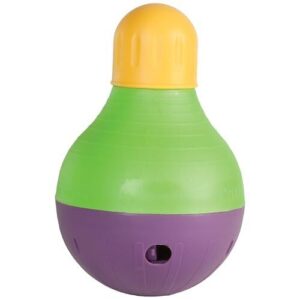
If puzzles are your dog’s thing, the Starmark Bob-A-Lot takes enrichment a step further by turning mealtime into a foraging session. Its dual adjustable openings — one on top, one on the bottom — let you dial in the difficulty as your dog figures out the wobble pattern.
The weighted anti-slip base keeps it moving unpredictably across the floor, extending engagement to 15–60 minutes per session.
One heads-up: it’s noisy on hardwood, so hardwood-floor households may want a mat underneath.
| Best For | Dog owners looking to slow down fast eaters and keep their pup mentally engaged during meals or alone time, whether they have a small puppy or a larger adult dog. |
|---|---|
| Material | Durable rubber |
| Weight | 0.45 kg |
| Best For | All sizes |
| Treat Dispensing | Yes |
| Chewer Level | Moderate |
| Primary Benefit | Slow feeding puzzle |
| Additional Features |
|
- Dual adjustable openings let you customize how challenging the dispensing is
- Weighted, anti-slip base creates an unpredictable wobble that holds a dog’s attention for 15–60 minutes
- Large lower chamber fits up to 3 cups of food, enough for a full meal
- Can be noisy on hardwood or tile floors
- Bottom dispensing door may shift during play and release food faster than intended
- Doesn’t fully open for cleaning, which can make loading kibble a bit fiddly
4. WEOK Heartbeat Comfort Cuddler
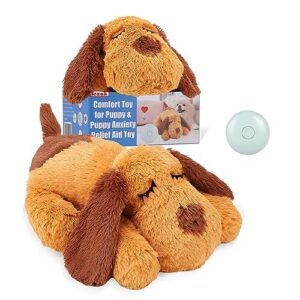
Not every anxious dog needs a chew toy — sometimes they just need something that feels alive. The WEOK Heartbeat Comfort Cuddler pairs a soft, machine-washable plush with a removable module that mimics a real canine heartbeat, giving puppies and rescue pets something steady to settle against in the crate.
It runs on three AAA batteries and isn’t built for heavy chewers, but for separation anxiety and sleep support, it’s genuinely hard to beat.
| Best For | puppies, rescue pets, and anxious dogs or cats who need extra comfort during crate time, travel, or vet visits. |
|---|---|
| Material | Plush fabric |
| Weight | 280 g |
| Best For | All sizes |
| Treat Dispensing | No |
| Chewer Level | Light |
| Primary Benefit | Anxiety relief comfort |
| Additional Features |
|
- Realistic pulsing heartbeat helps calm separation anxiety and reduces whining or barking
- Plush is machine-washable and detaches easily from the electronic module
- Simple press-and-hold controls make it easy to turn on and off
- Not a good fit for aggressive chewers or hyper-active pets, since stitching can tear under rough play
- Requires 3 AAA batteries that aren’t included, and battery life isn’t specified
- The heartbeat sound or vibration may startle very small or timid animals
5. Outward Hound Dog Brick Puzzle
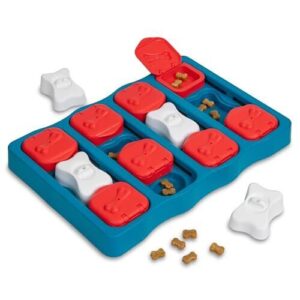
Three puzzles in one toy means your dog can’t coast on autopilot. The Outward Hound Dog Brick combines flip lids, sliding red blocks, and removable bone covers, forcing actual problem-solving instead of one repetitive motion.
It’s BPA-free and dishwasher-safe on the top rack, snapping into a few pieces for thorough cleaning. At roughly 9 by 7 inches, it suits medium dogs best.
Just supervise early sessions, since determined chewers can work those bone pieces loose.
| Best For | Dogs who need extra mental stimulation, fast eaters who could use a slower mealtime, or pups going through injury recovery or limited-activity periods. |
|---|---|
| Material | Food-grade plastic |
| Weight | 0.54 kg |
| Best For | All sizes |
| Treat Dispensing | Yes |
| Chewer Level | Light to moderate |
| Primary Benefit | Slow feeding puzzle |
| Additional Features |
|
- Three different interactive mechanisms (lift lids, sliding pieces, and bone covers) keep dogs engaged and prevent them from solving the puzzle with one repetitive motion
- Made from food-safe, BPA-free plastic that’s also free of PVC, lead, and phthalates
- Adjustable difficulty with an included tip sheet, so you can dial the challenge up or down as your dog gets better at it
- Small bone-shaped pieces can get chewed up or scattered around if your dog isn’t supervised
- Sliding doors and lids can pop loose over time, especially with strong or determined chewers
- Needs regular cleaning and full drying between uses, and can get a bit noisy when your dog plays with it fast
6. Hippih Durable Dog Puzzle Balls
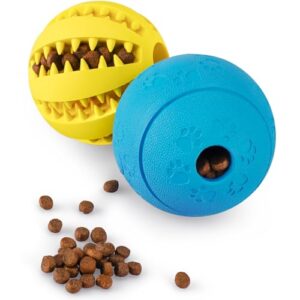
Two balls, double the options. The Hippih set pairs a 2.75-inch yellow ball with a 3.14-inch blue one, both made from extra-tough natural rubber that resists splitting under steady gnawing.
Grooves on each ball hold kibble or treats sized between 0.2 and 0.6 inches, releasing them as your dog rolls or bites down. The yellow ball’s anti-skid texture comes lightly mint-scented, which doubles as a small breath-freshening bonus during chew sessions.
| Best For | Small to medium/large dog owners looking for a durable chew-and-treat toy that supports dental health, slows down eating, and keeps their dog mentally engaged. |
|---|---|
| Material | Natural rubber |
| Weight | Not specified |
| Best For | Small to large |
| Treat Dispensing | Yes |
| Chewer Level | Moderate |
| Primary Benefit | Dental cleaning play |
| Additional Features |
|
- Made from extra-tough natural rubber that resists bite damage and stays gentle on gums
- Treat-dispensing grooves turn chewing into a mental puzzle, encouraging slower eating
- Two ball sizes give owners flexibility for fetch, chew, and training depending on the dog’s size
- The larger blue ball may be too big for dogs under 20 lb, limiting its use for smaller breeds
- Not built for extreme or aggressive chewers, who may wear it down over time
- Treats have to be sized correctly to fit the internal grooves, or they won’t dispense properly
7. Blue Aggressive Dog Chew Toy
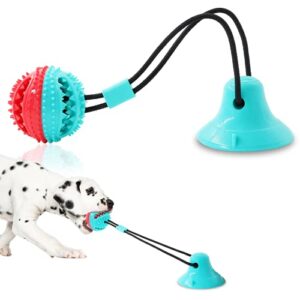
If your dog treats every other toy like a chew toy speed run, this one’s built for the marathon. The Blue Aggressive Dog Chew Toy uses double-layer, high-density rubber with reinforced walls that resist punctures and slicing from forceful jaws.
For an extra challenge, stuff the cavity with peanut butter or kibble and freeze it — just like frozen Kongs for extended enrichment — to turn chew time into a rewarding, hours-long activity.
Irregular ridges massage gums while scraping plaque, and the hollow core takes peanut butter or small treats for extra incentive. It holds its shape through weeks of daily gnawing without crumbling, and it even floats for backyard retrieval games.
| Best For | Aggressive chewers who need a durable, treat-dispensing toy that also supports dental health. |
|---|---|
| Material | Rubber |
| Weight | 0.2 kg |
| Best For | Medium to large |
| Treat Dispensing | Yes |
| Chewer Level | Heavy (claimed) |
| Primary Benefit | Chew outlet dental |
| Additional Features |
|
- Tough, non-toxic rubber with an anti-bite design holds up to forceful jaws and helps protect furniture
- Hollow core doubles as a treat-dispensing puzzle, slowing down eating and scraping plaque off teeth while your dog chews
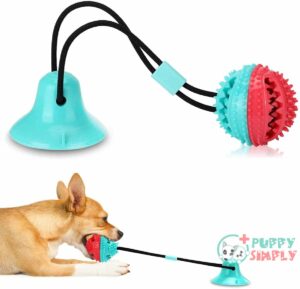
- Comes with an integrated rope and bell for extra interactive play, plus a suction cup base for floor or wall mounting
- The suction cup often struggles to stay attached to most floor or wall surfaces, so it may not stay put
- The rope, bell, and suction cup have been reported to detach after short use, which can pose a choking hazard
- Some reviewers note it may not hold up well against very heavy or persistent chewing
8. Adjustable Nylon Treat Dispenser
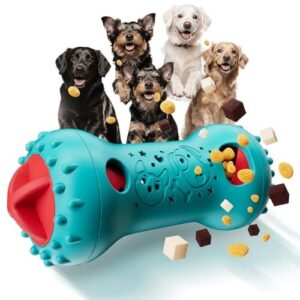
Picky eaters and food-motivated chewers alike get a fair shake with this one. The adjustable nylon treat dispenser features a twist-cap mechanism with multiple hole sizes, letting you dial in slow, medium, or fast release to match your dog’s pace and patience level.
Reinforced nylon construction withstands persistent gnawing, while the detachable lid makes refills and dishwasher cleaning genuinely quick. An internal spacer system keeps treats from clogging, so the flow stays steady even if your dog flips it around.
| Best For | Small-to-medium breed dogs, puppies, and food-motivated pups who scarf down their meals too fast, especially if they’re often left home alone and could use some extra mental stimulation. |
|---|---|
| Material | Food-grade nylon |
| Weight | 0.21 kg |
| Best For | Small to medium |
| Treat Dispensing | Yes |
| Chewer Level | Light to moderate |
| Primary Benefit | Slow eating prevention |
| Additional Features |
|
- Adjustable release switches let you fine-tune the pace, so meals turn into 10-30 minutes of engaging, slow-paced play instead of a two-second gulp-and-done.
- The detachable, dishwasher-safe design means cleanup takes about 30 seconds, no scrubbing required.
- Slows eating by roughly 70%, which helps guard against bloat and overeating while the bone shape and chewing motion double as a light dental workout.
- Not built for large breeds or heavy-duty chewers—the rigid nylon can crack or break under serious gnawing.
- If it does get damaged, it may produce sharp plastic shards, so it needs occasional wear checks.
- Treat capacity is on the small side, so longer play sessions might mean refilling it more than once.
9. Wobble Wag Giggle Ball
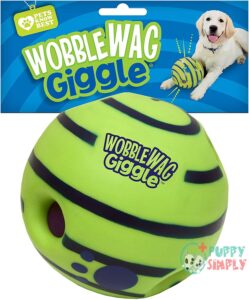
Some dogs need noise to stay interested, and this hollow vinyl sphere delivers exactly that. No batteries are required: internal tubes produce a giggle sound purely from movement, so every roll, paw, or nudge triggers fresh feedback.
Six clutch pockets make carrying easy, and the phthalate-free EVA build keeps things safe. Just know it’s not built for serious chewers, since aggressive gnawing can crack the tubes and silence the fun.
| Best For | dogs who love noisy, interactive toys and owners looking for a low-maintenance way to keep them entertained during solo play or training rewards. |
|---|---|
| Material | EVA vinyl |
| Weight | 36 g |
| Best For | Medium to large |
| Treat Dispensing | No |
| Chewer Level | Light |
| Primary Benefit | Active play fitness |
| Additional Features |
|
- No batteries needed — the giggle sound comes purely from movement, so it’s ready to play right out of the box
- Six clutch pockets make it easy for dogs to grab, carry, and tote around
- Made from flexible, phthalate-free EVA that’s both durable and safe
- Not chew-proof, so aggressive chewers can crack the plastic or damage the internal sound tubes
- The giggle sound can get muffled or stop entirely if the toy gets wet or the tubes become blocked
- At 5.5 inches, it may be too big for very small breeds to carry comfortably
10. Interactive Fox Puppy Toy
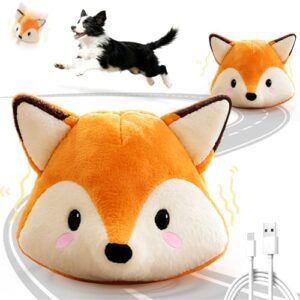
Closing out the list with a snuggly option, this plush fox brings together puzzle-solving and sensory play in one bushy-tailed package. A hidden squeaker in the snout reacts to bite pressure, while internal snack compartments let you hide treats for a slow-release challenge that keeps noses busy.
The detachable crinkle tail adds extra noise, and reinforced stitching helps it survive solo chewing sessions—though it’s best suited for gentle-to-moderate chewers, not the jaw-of-steel crowd.
| Best For | This toy is ideal for puppies and dogs who love hands-free, self-moving play and could use extra mental stimulation throughout the day, especially when their owner is busy elsewhere in the house. |
|---|---|
| Material | Polyester plush |
| Weight | 0.2 kg |
| Best For | All sizes |
| Treat Dispensing | Yes |
| Chewer Level | Light to moderate |
| Primary Benefit | Interactive solo play |
| Additional Features |
|
- Keeps dogs engaged on their own with automatic bouncing, vibrating, and sound-triggered movement, plus a playful voice echo that responds during pauses
- USB-rechargeable battery offers up to 3 hours of continuous play, and the chew-resistant cover unzips for easy machine washing
- The Velcro treat pocket adds a rewarding twist to playtime, encouraging activity without constant supervision
- Not built for tough or aggressive chewers, since the plush exterior and Velcro can give way under heavy biting
- The electronic core inside isn’t waterproof, so only the outer cover can be cleaned
- Battery life tops out around 3 hours, meaning longer play sessions will require a recharge
Safe Toys for Unsupervised Chewing

Leaving a dog home alone with the wrong toy is how emergency vet visits happen, not how calm afternoons happen.
Before you hand over anything for solo playtime, it needs to clear a few non‑negotiable safety checks, the kind that separate a trustworthy chew from a hidden hazard.
Here’s exactly what to look for, and why each one matters.
Proper Toy Sizing
Before you grab any toy off the shelf, measure your dog’s muzzle width and add 0.5 to 1 inch; that’s your safe diameter floor. Size appropriateness varies wildly across breed size variations, so a Chihuahua’s toy will swim in a Lab’s mouth.
Puppy jaw development means snout-height limits matter too. Run the swallow test: it shouldn’t disappear entirely when closed. Reassess after weight changes.
No Detachable Parts
Size matters, but so does what happens once those jaws clamp down repeatedly. Choking hazard prevention depends on solid one-piece construction with no squeakers, ropes, or seams to work loose.
Look for:
- Single-unit molding
- Integrated construction
- Material uniformity
- No fasteners or caps
- Consistent texture throughout
That structural integrity keeps durable chew toys from shedding fragments mid-session, which is exactly what safe chew toys should deliver.
Safe Chew Ratings
Once a toy passes the one-piece construction test, the next checkpoint is its actual chew rating, a 5-point scale measuring chew strength assessment, material integrity, and toxic leaching risks. Higher-rated toys undergo bite force simulations and meet coating safety standards.
Make sure the toy size exceeds mouth opening guidelines are met to avoid choking. Always match weight class suitability to your dog’s size.
A confirmed chew rating tells you whether you’ve got genuinely safe chew material, not just sturdy-looking rubber.
Thumbnail Indent Test
Beyond chew strength assessment, press your thumbnail into the toy; if it leaves an indent, it’s too soft for power chewers, and if it won’t dent at all, it’s likely harder than your dog’s teeth.
This quick material integrity check doubles as chew durability testing, flagging rubber durability testing failures before they become dog toy safety risks during solo play.
Supervised Trial First
Before any toy earns solo play safety clearance, it needs a supervised trial first, no exceptions, even for trusted chewers. Watch for choking hazards, document engagement duration (aim for 5-10 minutes), and track chewing patterns against your dog’s temperament.
If your pup loses interest fast or chews aggressively at weak spots, that’s valuable data, not wasted time, guiding whether this becomes one of your trusted enrichment toys.
Best Materials for Solo Chew Toys
The material a chew toy is made from matters just as much as its size or shape, since it determines whether your dog’s jaw power turns playtime into a hazard. Some materials hold up to aggressive gnawing for months, while others crack, splinter, or break down faster than you’d expect.
Here’s what to look for, and what to steer clear of, before you toss a new toy into the crate.
Food-grade Rubber
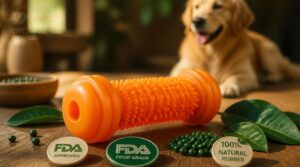
Food-grade rubber earns its spot in your dog’s toy box because it’s built to the same standard as containers holding your own food.
It resists chemical leaching, withstands -40°F to 446°F without cracking, and blocks microbial growth.
Look for:
- FDA compliance
- Natural rubber base
- Non-toxic rubber formula
- NSF certification
A durable rubber toy means peace of mind during alone time.
Reinforced Nylon

Reinforced nylon owes its toughness to glass or carbon fiber woven through the matrix, boosting tensile strength by 20-40% while raising stiffness 15-25% over standard nylon.
That fiber-matrix bond also manages heat well, staying stable above 100°C, and resists wear better, cutting surface erosion nearly in half.
The catch? Manufacturing demands precise compounding, so cheap knockoffs often skip it. Stick with reputable, high-density nylon chews for genuine durability.
Certified Composites

Some chew toys borrow tricks from jet engines, and that’s not an exaggeration. Higher-end composites trace back to aerospace manufacturing standards, built by technicians trained through programs covering novel material fabrication and nondestructive testing methods.
The toughest dog chew toys trace their materials straight back to aerospace engineering standards
Look for:
- Certification validity backed by recognized accreditation
- Damage-assessment protocols borrowed from industry training
- Documented traceability in manufacturing
These safety certifications signal genuinely chew resistant material, not just marketing language on the package.
Avoid Brittle Plastics
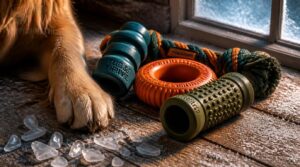
Cold weather turns cheap plastic chews into shrapnel, and that’s a real gastrointestinal safety risk. Look for impact modifier additives that boost flexibility, plus evidence of thermal stress relief during molding, since rushed cooling causes microcracks.
Reputable brands run material aging tests to confirm toughness holds up. Better polymer chain mobility means fewer brittle snaps mid-chew, even in winter temps.
Non-toxic Finishes

Nontoxic finishes on chew toys matter more than most owners realize. Look for products carrying GREENGUARD Gold certification or the EPA Safer Choice label, both indicating low VOC emissions that protect your dog’s indoor air quality.
Plant-based and biobased formulas use natural oils like tung or linseed oil — food-safe, renewable, and free from the synthetic solvents that irritate sensitive respiratory systems during prolonged chewing sessions.
Choosing Toys by Chewing Style

Not every dog chews the same way, and the wrong toy for your dog’s style can become a safety hazard fast. Matching the toy to how your dog actually chews — not just their breed or size — is what makes the difference between engaged solo play and a destroyed living room.
Here’s how to find the right fit across five chewing profiles.
Gentle Chewers
If your dog treats chew toys more like comfort objects than combat zones, they’re likely a gentle chewer. These dogs — often small breeds or seniors — prefer soft texture resistance and teething-style nibbling over aggressive shredding.
- Soft plush toys reduce anxiety during alone time
- Non-toxic materials protect sensitive gums and fragile teeth
- Mental stimulation comes through gentle exploration, not destruction
Food-grade rubber works best here.
Moderate Chewers
Moderate chewers live in the sweet spot — persistent enough to need durable chew toys, but not so aggressive that they’ll demolish everything in sight. Textured rubber or nylon-based options work well here, offering enough resistance to satisfy without risking tooth fractures.
An interactive dog feeder or treat-dispensing puzzle also extends sessions noticeably, turning solo time into genuine mental stimulation.
Heavy Chewers
Heavy chewers are a different story entirely. These dogs will find every weak seam, thin wall, and soft spot on a toy — fast.
Dense, single-body rubber or reinforced nylon controls bite force distribution far better than hollow designs. Watch for deep tooth dents and flattened edges, which signal material fatigue.
Rotating two to four durable chew toys prevents concentrated wear and keeps solo sessions safer.
Power Chewers
Power chewers take heavy chewing to another level — these dogs use their back molars to crush and grind, targeting the same spot until material fatigue sets in. Corners, seams, and thin walls fail first.
Stick to thick-walled indestructible dog toys like the KONG Extreme, where bite force distributes across dense rubber. Watch for deep tooth tracks and compressed ends — both signal it’s time to replace.
Senior Dogs
Senior dogs bring their own set of needs to playtime. Arthritis pain relief and cognitive decline management both factor into toy selection, since nearly half of dogs over seven develop joint issues that make aggressive chewing uncomfortable.
Choose softer options that support:
- Gentle rubber textures for sensitive gums
- Mental stimulation without physical strain
- Slow-dispensing treat toys for engagement
- Mobility-friendly shapes easy to grip
Treat-Dispensing Toys for Alone Time

Treat-dispensing toys turn solo time into a job your dog actually wants to do, which keeps their brain busy instead of just their teeth. The best ones let you control how fast the food comes out, so a few kibbles stretch into a real session instead of a thirty-second snack.
Here’s what to look for when you’re picking one out, and where each option earns its spot on the list.
Adjustable Treat Openings
The best treat-dispensing toys let you tune the release rate by rotating the opening from narrow to wide — no tools needed. A tighter setting slows treat flow for longer engagement, while a wider gap releases kibble in bursts.
Rounded, recessed edges prevent jams from irregular treat shapes, and the mechanism works with everything from tiny biscuits to medium morsels.
Slow-feeding Benefits
Slowing down mealtime isn’t just about manners — it directly promotes digestive health. When your dog works to extract treats piece by piece, they swallow less air, chew more thoroughly, and absorb nutrients more steadily.
That gentler pace means fewer post-meal stomach issues and more consistent stool quality.
For weight-conscious dogs, it also naturally limits calorie intake without strict portioning.
Kibble-based Enrichment
Your dog’s dinner doesn’t have to disappear in thirty seconds. Kibble-based enrichment turns regular meals into problem-solving sessions that trigger natural foraging instincts, keeping your dog mentally engaged while you’re away.
- Adjustable difficulty levels grow with your dog’s abilities
- Food-dispensing puzzles distribute calories across longer sessions
- Treat-dispensing designs reduce gulping and boredom simultaneously
- Mental stimulation benefits compound over consistent daily use
Frozen Treat Options
Frozen treats turn a stuffed KONG or food-filled puzzle toy into high-value enrichment that lasts considerably longer. Load with dairy-free alternatives using almond or coconut milk bases, or blend fruit-based purees for calorie‑controlled snacks naturally lower in sugar.
Always freeze at 0°F or below to maintain texture. Texture‑enhancing stabilizers in commercial frozen fillings help the mixture hold its shape inside the toy.
Longer Engagement Sessions
Staggered activity keeps sessions from plateauing — alternate between a food‑filled puzzle toy and a long‑lasting chew toy every 15–20 minutes to delay fatigue and prevent overstimulation. A 30–60‑minute window suits most dogs comfortably.
Over time, this routine builds familiarity, easing separation anxiety as your dog learns alone time reliably ends with rewarding, calming enrichment.
Chew Toys for Separation Anxiety

When your dog struggles with being alone, the right chew toy can make a real difference in how they cope while you’re gone.
The options below target anxiety at its root — keeping your dog’s brain busy, their stress hormones down, and their mouth too occupied to bark at every creak in the hallway.
Here’s what’s worth considering for dogs who don’t do well with quiet houses.
Calming Chewing Routines
Consistent chew times work like a quiet signal to your dog’s nervous system — same window each day, same toy, same cue word. A 20-minute session of rhythmic chewing lowers cortisol and eases separation anxiety naturally.
Pairing a slightly chilled chew with a familiar scent before you leave reduces arousal levels, helping your dog settle into solo play faster.
Departure Distraction
That jangle of keys or grab for your coat? Your dog clocks it instantly.
Redirecting pre-exit focus onto a chew toy before the door routine starts keeps anxiety from snowballing. Pair it with predictable goodbye routines: same cue word, same toy placement, same calm tone.
Gradual departure practice, starting with 30‑second exits, builds tolerance so managing door anxiety becomes second nature, not a daily battle.
Comfort-based Toys
Practice exits build tolerance, but some dogs still need something to hold onto, literally. Comfort objects for dogs like the WEOK Heartbeat Comfort Cuddler mimic warmth and heartbeat rhythm, easing isolation stress.
- Weighted grounding sensations that feel like snuggling
- Tactile texture variety (short pile, satin panels)
- Hypoallergenic scent that calms without overwhelming
- Embroidered features, no choking-risk plastic eyes
- Machine washable covers for easy cleanup
Mental Stimulation
Comfort helps the body relax, but the brain needs a job, too. Mental stimulation through dog enrichment toys keeps dogs occupied past the worry stage:
| Mechanism | Effect |
|---|---|
| Olfactory cue engagement | Sustains interest |
| Problem solving sequencing | Builds confidence |
| Unpredictable movement tracking | Sharpens focus |
| Food dispensing puzzle | Prevents fatigue |
An interactive feeder taps sensory input variety, turning idle hours into purposeful work.
Reduced Barking Triggers
A bored, anxious dog often barks at every passing sound, but a chew toy gives that nervous energy somewhere else to go. Pair it with environmental stimulus management (closing blinds, white noise) and you’ve covered both sides of barking.
- Sound masking softens trigger noises
- Desensitization training builds tolerance
- Routine consistency lowers reactivity
- Chewing replaces vocal stress release
That’s real behavioral intervention for separation anxiety, not just busywork.
Dental Benefits of Daily Chewing

Every chew session doubles as a mini dental cleaning, whether your dog realizes it or not. The right toy turns idle gnawing into real, measurable oral health benefits, from cleaner teeth to a stronger bite. Here’s what daily chewing actually does for your dog’s mouth.
Plaque Scraping Action
Every bite your dog takes on a sturdy chew is doing dentist‑grade work behind the scenes. The mechanical scraping action mimics biofilm disruption, breaking up dental plaque along the gumline before it hardens into tartar.
This targeted gumline cleaning reduces gingival inflammation and smooths tooth surfaces, discouraging bacteria from resettling. It’s plaque removal through chewing; no toothbrush required, just a good long‑lasting chew toy doing its job.
Fresher Breath Support
Sniffing out the real cause of doggy breath usually leads straight to bacteria, not just last night’s dinner. Chewing boosts saliva production, washing away food particles while supporting sulfur compound neutralization at the source.
It also controls tongue bacteria reduction, since that’s where odor-causing microbes thrive. Pair a solid chew session with enzymatic breath fresheners, and you’ve got a genuinely balanced oral microbiome.
Stronger Jaw Muscles
Jaw muscle exercise happens every time your dog gnaws on something tough, and that’s no small benefit. Daily chewing drives masseter muscle hypertrophy and slow-twitch fiber adaptation, building endurance for longer sessions.
This also improves jaw joint leverage, bite force efficiency, and mandible stability, especially in power chewers tackling longlasting chew toys. It’s a built-in strength workout disguised as one of the simplest dog enrichment activities around.
Gum Stimulation
Think of every chew session as a built-in massage parlor for your dog’s mouth. As textured rubber and nylon surfaces glide along the gumline, they trigger circulation improvement and support tissue firmness around each tooth.
This action also aids saliva distribution and plaque loosening, while strengthening capillary flow for healthier, more resilient gum tissue over time.
Five gum perks from daily chewing:
- Better blood flow to gum tissue
- Firmer gum-to-tooth fit
- Natural saliva spread for mineral support
- Loosened surface plaque near the gumline
- Stronger capillary strength against minor bleeding
Safer Chewing Frequency
More chewing isn’t always better chewing—jaw muscle fatigue can sneak up fast in enthusiastic dogs. Aim for an ideal session length of 15-30 minutes daily, broken into shorter blocks to ease the load.
Build a daily chew rotation, watch for discomfort signals like drooling or stiffness, and manage chew intensity based on your dog’s style. Combine this with monthly toy inspection to catch wear before it becomes a hazard.
Cleaning and Inspecting Chew Toys
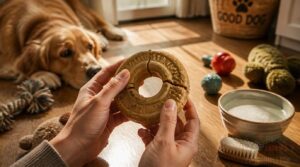
A great chew toy doesn’t stay safe forever, even the toughest rubber wears down with enough jaw power behind it.
Keeping your dog’s toy box hazard-free takes more than picking the right product; it means checking on that product regularly.
Here’s exactly what to look for and how often to look for it.
Weekly Washing Schedule
Saliva builds up faster than you’d think, so wash toys after every long solo session and at minimum once a week for lighter use. Use warm water with mild soap, scrub with a soft brush, and rinse twice to eliminate soap residue.
Dishwasher-safe rubber toys go on the top rack without heat. Air dry completely, rotating toys so every piece gets cleaned regularly.
Monthly Damage Checks
Weekly washing keeps toys clean, but once a month you need to go deeper. Set aside five minutes to inspect each toy systematically — checking for deformation, material wear, and loose parts.
- Identify surface cracks, thinning rubber, or nylon fraying
- Assess whether shapes have flattened or softened noticeably
- Confirm all connectors and plugs remain firmly attached
- Log condition, date, and any action taken
Tracking replacement logs over time reveals predictive wear patterns worth knowing.
Cracks and Split Edges
Once a month, run your fingers slowly along every edge and seam — that’s where material stress concentrates first. Rubber toys develop split flaps along molded rims, while nylon shows fine radiating fissures near openings.
Temperature swings widen existing microcracks noticeably.
Discard anything with split edges, surface crazing, or exposed composite layers immediately; those rough surfaces aren’t just worn-out — they’re actively fragmenting.
Frayed Rope Risks
Rope toys fail differently than rubber — instead of cracking, they fray. Loose strands and exposed core fibers are your signal to pull the toy immediately.
Those shed fibers accumulate in your dog’s mouth and digestive tract, risking gastrointestinal obstruction, particularly in smaller breeds. Frayed edges also abrade gum tissue and weaken the rope’s tensile strength, making sudden snapping during unsupervised play far more likely.
Replacement Tracking
Tracking replacements turns guesswork into a system. Log each toy’s purchase date and wear milestones — a simple notes app works fine — so you know exactly when rubber started splitting or nylon fragments appeared.
- Note brand, material, and chewing style
- Schedule safety swaps every 2–4 weeks for power chewers
- Review logs monthly to estimate annual replacement costs
That data makes budgeting straightforward.
Buying Tips for Long-Term Value

Spending more upfront on a chew toy almost always costs you less over the course of a year. A few smart buying habits can help you stretch your budget without sacrificing safety or durability. Here’s what to keep in mind before you buy.
Budget Versus Premium Toys
Budget toys might save you a few dollars upfront, but replace every 1–4 weeks for moderate chewers — costs stack fast.
Premium toys, priced $15–30, last 2–6 months under similar chewing intensity, cutting your yearly spending substantially.
Food‑grade rubber and reinforced nylon resist tearing far longer than lower‑grade plastics, keeping your dog engaged and your wallet intact.
Durability Guarantees
Not all warranties are created equal, so read the fine print before you buy.
The Starmark Interactive Dog Food Dispenser covers manufacturing defects for 24 months, while the Allrier Interactive Chew Puzzle offers 12-month material and workmanship protection.
The Outward Hound Dog Brick goes further with a lifetime replacement program for material failure — real chew durability backing you can actually count on.
Multi-dog Households
Running a multi-dog household means one durable toy can pull double duty — but only if it’s sized right for each dog.
A single West Paw Zogoflex Toppl or KONG Extreme can rotate through your pack, reducing repeat purchases while keeping resource guarding in check by distributing identical toys across separate feeding zones.
Replacement Frequency
Replacement frequency hinges on your dog’s size, chewing intensity, and toy material — and those three factors rarely match manufacturer timelines.
- Foam or plush — replace within 1–2 weeks if shredding begins
- Rubber toys — daily chewers wear through them in 3–6 months
- Nylon chews — moderate chewers get 6–12 months per toy
- Giant breeds — plan replacements every 1–3 months, regardless of toy type
Cost Per Month
Monthly chew toy costs usually land between $15 and $60, depending on durability and how aggressively your dog chews.
| Toy Type | Est. Monthly Cost |
|---|---|
| Budget rubber/plush | $10–$20 |
| Premium durable toys | $3–$8 |
Lifecycle budgeting matters here — a $30 toy lasting eight months beats a $10 toy replaced monthly. Factor in roughly $5 for cleaning supplies, and total cost of ownership stays manageable year-round.
Frequently Asked Questions (FAQs)
What chew toys are safe to leave a dog alone with?
Not every toy is safe solo. The safest options use durable rubber or nylon, pass size-to-head ratio checks, carry non-toxic certifications, and have no detachable parts that pose a choking or ingestion hazard.
How to keep a dog entertained when left alone?
Treat-dispensing toys, puzzle feeders, and comfort cuddlers give your dog a job to do while you’re gone, turning solo time into an engaging, anxiety-reducing routine that fights boredom and separation stress.
Can chew toys help dogs with noise phobias?
Yes — chew toys can genuinely help dogs manage noise phobias. Repetitive chewing triggers endorphin release, naturally dulling fear responses to storms or fireworks and shifting focus away from the triggering sounds.
How do I introduce a new toy to my dog?
Start in a calm, familiar space, let your dog sniff the toy freely, then reward any interaction with praise or a small treat to build curiosity and a positive first impression.
At what age should puppies start chewing toys?
Like a seedling testing new soil, puppies begin early mouth exploration around 3 to 4 weeks, graduating to soft chew toys by 8 weeks as permanent tooth eruption begins near 4 to 6 months.
Are scented chew toys safe for indoor use?
Scented chew toys are generally safe indoors when they use non-toxic, water-based scents and carry BPA-free, lead-free labeling. Avoid strong concentrations of cinnamon, citrus, or peppermint, which can irritate your dog’s mucous membranes.
How many chew toys should one dog own?
Most dogs do well with 5 to 10 toys total, but you only need 2 to 3 dedicated chew toys in rotation at any given time to meet daily chewing needs without cluttering your space.
Conclusion
Picture your dog curled up mid‑afternoon, jaw working steadily at a rubber chew, cortisol levels dropping instead of spiking—that’s not luck, it’s the right tool doing its job quietly.
The best chew toys for dogs left alone don’t just protect your furniture; they give your dog a structured way to cope with silence.
Pick one matched to their chewing style, freeze it, and walk out the door knowing they’re going to be just fine.
- https://www.gqvet.com/is-your-dogs-chew-toy-safe-a-guide-for-gilbert-pet-owners
- https://sharehappyoutfits.com/blogs/dog-gear-accessories/nylon-plant-based-dog-chews
- https://wearethecure.org/chews-wisely-a-guide-to-safe-dog-chews-and-non-toxic-toys
- https://animalarkanimalhospital.com/blog/chew-toys-safe-for-dogs
- https://projecthivepetcompany.com/blogs/news/what-s-the-best-chew-toy-material-for-dogs-1