This site is supported by our readers. We may earn a commission, at no cost to you, if you purchase through links.
A collar that fits poorly doesn’t just fail—it can silently undermine months of training progress while putting your dog at risk. Pressure applied at the wrong angle, a loose e-collar contact point that delivers inconsistent stimulation, a martingale that over-tightens on a narrow-necked sight hound—these aren’t edge cases. They’re common mistakes made by well-meaning owners who skipped one foundational step.
Knowing how to fit a training collar on a dog correctly separates tools that work from tools that cause harm. The details matter more than most people expect, and getting them right is straightforward once you know what to look for.
Table Of Contents
- Key Takeaways
- What is a Dog Training Collar?
- Choosing The Right Training Collar
- Why Proper Fit is Essential
- Measuring Your Dog’s Neck Correctly
- How to Fit a Prong or Pinch Collar
- Fitting an Electronic or Remote Collar
- How to Fit a Martingale or Limited-Slip Collar
- Introducing The Collar to Your Dog
- Checking Fit During Training Sessions
- Training Collar Safety Tips and Maintenance
- Frequently Asked Questions (FAQs)
- Conclusion
Key Takeaways
- Collar fit isn’t just about comfort — even a few millimeters off can break training consistency, cause skin damage, and erode your dog’s trust before you’ve given a single command.
- Every collar type has a specific placement rule: prong collars sit high behind the ears, e-collar contact points go on muscle away from the trachea, and martingales must tighten to a two-finger gap — not beyond.
- Your dog’s body language during the first few wears tells you more than any checklist — pawing, lip licking, or frozen posture means you need to slow down the introduction process.
- Fit isn’t a one-time task — puppies can outgrow a collar in weeks, weather changes neck size, and activity shifts tension, so the two-finger test should happen before every single session.
What is a Dog Training Collar?
A dog training collar is a specialized tool designed to help communicate boundaries and reinforce commands during the training process. Not all collars work the same way, and the differences between them matter more than most people realize.
If you have a bigger breed, picking the right fit gets even trickier — this guide to best training collars for large dogs breaks down what actually works for dogs with more size and strength behind them.
Here are the main types you’ll likely come across.
Common Types of Training Collars
Not all training collars work the same way, and knowing the difference matters. Each one delivers correction differently, suited to specific dog sizes and temperaments:
- Flat buckle and martingale collars — gentle, everyday options prioritizing collar safety
- Prong collars — metal links offering precise correction levels for strong pullers
- E-collars — remote-controlled with multiple training modes and stimulation settings
- Vibration collars — tone-based, ideal for sensitive dogs
It’s important to choose from the variety of dog collar types based on your dog’s specific needs and behavior.
How Training Collars Aid Training
Knowing which collar does what’s only half the picture — understanding how these tools actually work in practice is where real progress begins.
A well-fitted training collar delivers clear communication through consistent, timely feedback. Whether you’re building off leash reliability or using an e-collar for focus control, pairing collar cues with positive reinforcement reduces conflict and sharpens your dog’s response without confusion.
For more details on the correct placement for effectiveness, refer to professional advice used in training environments.
When to Consider Using One
Once your dog reacts to basic cues on a flat collar, you might weigh a Dog Training Collar for persistent pulling or safety risks. Owner readiness, clear Training Goals, and understanding Collar Alternatives matter just as much as the tool itself.
Consider a training collar when:
- Standard cues fail in real-world settings
- Safety precautions demand extra control
- Professional guidance endorses your choice
Choosing The Right Training Collar
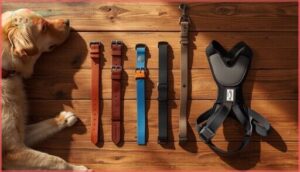
Not every collar works for every dog, and picking the wrong one can set your training back before it even starts. The right choice comes down to a few key factors that are worth thinking through carefully.
Here’s what to keep in mind when making your decision.
Matching Collar Type to Your Dog
Choosing the right collar starts with honestly evaluating your dog’s temperament, not just their size. A confident, easygoing dog usually manages a flat or martingale training collar well, while a high-drive dog may need a prong or head collar for safe control.
Match your dog training collar to your dog’s specific behavior patterns and training objectives — canine comfort and proper fit and safety always come first.
Sizing and Breed Considerations
Breed Specific Needs and Sizing Challenges can’t be ignored—neck size variations across breeds mean a standard approach rarely works in dog training.
For example, a Greyhound’s long, slim neck calls for a wide martingale, while heavy-coated breeds need different collar material options for contact.
Always fit your training collar to your dog’s anatomy, coat type, and obedience level.
Consulting a Professional Trainer
Every seasoned handler eventually seeks guidance from a professional trainer—certification is your first checkpoint. Scan client reviews to gauge training ethics before that first meeting.
In your initial session, expect a thorough discussion and hands-on collar adjustment. Prioritizing proper fit and safety means your trainer will demonstrate, then coach you, ensuring you leave confident in choosing the right collar and maintaining training collar safety at home.
Why Proper Fit is Essential
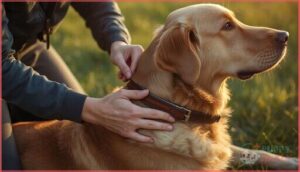
Fit isn’t just a technical detail — it’s the foundation everything else is built on. A collar that’s too loose won’t work, and one that’s too tight can cause real harm.
Getting the fit right starts with knowing what to look for — this guide to dog collar types and sizing breaks it down by neck size and collar style.
A collar that fits correctly is the foundation of safe, effective training — everything else depends on it
Here’s why getting it right matters across three key areas.
Safety and Comfort for Your Dog
Ever noticed how a collar can make or break your dog’s comfort? Prioritizing proper fit and safety protects pet wellbeing and maximizes canine comfort.
For Training Collar Safety, get your fit right by doing three things:
- Choose collar material that won’t rub or chafe.
- Regularly inspect for hair loss or irritation.
- Adjust after grooming or weight changes.
Maximizing Training Effectiveness
Think of Collar Calibration as tuning an instrument—if it’s off, Training Consistency and Dog Motivation suffer. A Training Collar that fits well delivers clear, timely cues, letting you reinforce Basic Obedience and layer in Positive Reinforcement.
This clarity speeds Behavioral Analysis and Effective Dog Training, turning reward systems into powerful motivators and building a dog’s understanding session after session.
Preventing Injury and Discomfort
A poor fit doesn’t just limit results — it causes real harm. Collar safety starts with knowing what to watch for.
- Check for pressure sores where contact points rest on skin
- Part the fur weekly to spot skin irritation early
- Use the two-finger rule to avoid neck strain
- Watch for discomfort signs like flinching or scratching
- Rotate collar position every 1–2 hours during extended sessions
Measuring Your Dog’s Neck Correctly
Getting the measurement right is the foundation of everything else. A collar that’s even slightly off can affect your dog’s comfort, safety, and how well the training actually works.
Here’s what you’ll need and how to do it properly.
Tools Needed for Measurement

Getting the measurement right starts with having the right tools on hand. A fabric flexible tape is your best option — it conforms to your dog’s neck without distorting the reading. No tape? The string method works just as well. Keep pen and paper nearby for recording sizes accurately.
| Tool | Purpose |
|---|---|
| Flexible measuring tape | Primary neck measurement |
| String or cable | Alternative string method |
| Ruler application | Measures string length |
| Current collar reference | Cross-checks existing fit |
| Pen and paper | Recording sizes for collar selection guide |
Step-by-Step Measuring Instructions

Once your measurement tools are ready, locate the spot on your dog’s neck based on collar type—mid-neck for flat collars, high behind the ears for prong collars. Wrap the tape snugly on bare fur, note the number, and repeat twice for accuracy.
For Collar Sizing and Fit Adjustment, remember:
- Measure on bare fur
- Use consistent pressure
- Record both inches and centimeters
Adjusting for Growth or Coat Changes

As you improve your measuring technique, remember that dogs are living works in progress. Puppies can grow out of a training collar in just weeks, and seasonal coat thickness changes everything.
Growth monitoring and weight changes demand your attention. Adjustment techniques—adding links or letting out a buckle—keep collar fit and safety reliable for every training session, regardless of the season.
How to Fit a Prong or Pinch Collar
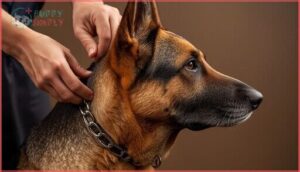
Prong collars have a reputation that often scares people off, but when fitted correctly, they’re one of the more precise tools you can use. The key is knowing exactly where to place it, how snug is snug enough, and how to confirm the pressure is distributed evenly.
Here’s how to get each of those steps right.
Positioning The Collar Correctly
Collar alignment starts the moment you put the prong collar on. Place it high on the neck, just behind the ears — not low near the shoulders where it loses effectiveness.
Rotate the collar so the rings sit on the right side for clean leash attachment.
Proper neck placement is what makes every correction technique land clearly, without unnecessary force.
Ensuring Snugness Without Pinching
Once the collar is positioned high on the neck, collar adjustment becomes your next priority. Slide two fingers flat between the strap and your dog’s neck — snug contact, no forcing. For small breeds, one finger is enough.
Part the fur during skin inspection to check for folded hair underneath, since fur considerations matter. Trapped coat creates pinch points even when the fit feels right from the outside.
Checking for Safe, Even Pressure
Even tension is the whole point. Once the prong collar is on, run through these pressure point management checks before your first command:
- Lift and release — the collar should drop back level, not twist.
- Pull the leash gently — links should tighten together, not bunch.
- Rotate the collar — resistance should feel identical at every position.
- Inspect the skin — no red lines or indentations.
- Recheck two-finger fit after rotation.
Fitting an Electronic or Remote Collar
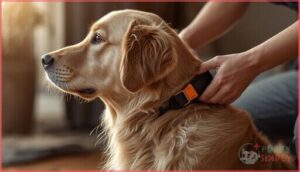
Electronic collars are more technical than most, and small fitting mistakes can affect both comfort and performance. Getting it right comes down to three things: contact point placement, skin contact, and tension.
Here’s how to handle each one correctly.
Placing Contact Points Properly
Where you place the contact points makes or breaks the entire training session. For proper fit and safety, position the receiver box to the side of your dog’s neck — just below the ear — keeping the posts on muscle, not the trachea. This contact point placement, guided by neck anatomy, reduces skin irritation and pressure sores markedly.
| Neck Position | Benefit |
|---|---|
| Side, below ear | Avoids trachea; stable muscle contact |
| Upper third of neck | Prevents forward sliding during sniffing |
| Away from spine | Reduces rocking and contact loss |
Ensuring Consistent Skin Contact
Consistent skin contact is the backbone of reliable e-collar communication. Fur thickness is the biggest obstacle — long or dense coats push contact points away from skin, making collar adjustment essential before every session.
Part the coat with your fingers, check that both posts rest on bare skin, and consider longer contact points for heavy-coated breeds. Proper fit and safety depend on this daily habit.
Avoiding Over-Tightening
Over-tightening is one of the most common e-collar mistakes, and it quietly undermines both dog comfort and neck health. Aim for two flat fingers between the contact points and your dog’s skin — snug, but never compressing.
Proper fitting means the training collar stays secure without digging in. Rotate its position every hour or two, and remember: proper fit and safety always come before a quick fix.
How to Fit a Martingale or Limited-Slip Collar
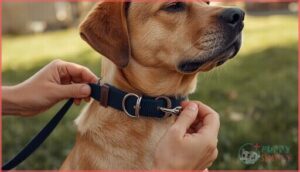
Martingale and limited-slip collars are a smart choice for dogs that tend to back out of standard collars, offering gentle correction without the risks of a fixed collar.
Getting the fit right comes down to two things: how the loop tightens and how to keep it from going too far in either direction.
Here’s what you need to check before your dog ever wears one.
Adjusting The Loop for Safe Tightening
Loop adjustment is where collar safety either holds or falls apart. Follow these tightening techniques each time you fit the collar:
- Pull the D ring up — the hardware rectangles should sit two inches apart.
- Run one to two fingers under the fully tightened collar to confirm proper fit and safety.
- Watch for symmetry checks — both loop sides should close evenly.
- Shorten the loop if it slips past the dog’s ears.
- Complete a hardware inspection for fraying or sticking before every session.
Preventing Slippage or Choking
A martingale that slips is just a loose leash waiting to happen. For slippage control, the loop should tighten just enough to stop backward escape without compressing the airway — that’s your choke prevention threshold.
During leash training, check collar adjustment every few minutes, since movement shifts fit. Fit monitoring keeps neck safety intact, making proper fit and safety your non-negotiable baseline every session.
Introducing The Collar to Your Dog

Getting the fit right is only half the battle — how you introduce the collar matters just as much. A dog that associates the collar with stress will fight the training process from day one.
Here’s how to make that first impression a good one.
Creating Positive Associations
Association is everything in dog training. When introducing a training collar, pair each fitting with high-value rewards — think chicken or cheese — delivered within seconds of fastening it. This counterconditioning method shifts your dog’s emotional response from uncertainty to anticipation.
Keep early sessions under three minutes, reward calm behavior consistently, and you’ll build a foundation where the collar predicts good things, not stress.
Monitoring Initial Reactions
Once the collar is on, watch your dog closely — their body language tells you more than any checklist. Canine anxiety shows up fast, and catching it early protects both dog safety and training outcomes. Look for these stress signals:
- Repeated lip licking with no food present
- Yawning while alert
- Tucked tail or frozen posture
- Pawing at the collar
- Restless pacing or panting in a cool room
Any of these means slow down.
Gradual Increase in Collar Wear Time
Once you’ve spotted those stress signals — or better yet, avoided them — collar acclimation becomes a straightforward progression. Start with 5–10 minute indoor sessions, then build slowly.
| Phase | Daily Wear Time |
|---|---|
| Days 1–3 | 5–10 minutes |
| Days 4–7 | Up to 30 minutes |
| Week 2+ | 1–4 hours supervised |
During training sessions, cap e-collar use at 8–10 hours total. Rotate contact points every few hours for skin protection and always confirm proper fit and safety before adding time.
Checking Fit During Training Sessions
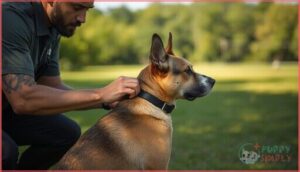
Fitting a collar correctly before training starts is only half the job. Once your dog is moving, working, and sweating, the fit can shift in ways you won’t always notice right away. Here’s what to watch for once sessions are underway.
Signs of Improper Fit
Your dog won’t stay quiet about a poor fit — you just have to know what to listen for. Redness, skin irritation, or collar chafing along the neck strain the skin fast. Hair loss and pressure sores under e-collar contact points signal the training collar is too tight.
Proper fit and safety go hand in hand, so never ignore these early warnings when choosing the right dog training collar.
Adjusting as Needed for Activity
Activity levels shift constantly during a session, and your training collar needs to keep pace. A snug fit in the backyard may underperform on a hunting field, where environmental factors and distractions demand stimulation adjustment. Choosing the right collar means adapting it to the moment.
Keep these activity-based fit checks in mind:
- Tighten martingale loops during vigorous running to prevent slippage
- Increase e-collar stimulation incrementally for high-distraction environments
- Switch to activity-specific training modes on electronic collars when needed
- Account for dog temperament — sensitive dogs need minimal adjustment increments
- Verify proper fit and safety after every environment change
Regular Inspection for Wear and Tear
Neglect is a quiet saboteur in dog training. Inspect your training collar before every session — check stitching, hardware, and contact points for fraying, rust, or cracks.
| Wear Detection Sign | Maintenance Tip |
|---|---|
| Frayed collar material | Replace immediately |
| Corroded contact points | Clean or retire collar |
| Cracked plastic housing | Stop use; moisture risk |
Tear prevention and proper fit and safety depend on choosing the right dog training collar — and keeping it inspection-schedule-ready.
Training Collar Safety Tips and Maintenance

A well-fitted collar doesn’t stay that way on its own — it needs consistent attention to keep working safely. Between regular wear, outdoor conditions, and your dog’s natural movement, things shift faster than you’d expect.
Here’s what to stay on top of to keep both the collar and your dog in good shape.
Frequency of Fit Checks
How often should you check your training collar’s fit? More often than you think. A quick daily check using the two-finger test catches small shifts before they cause irritation.
Puppies need checks every few days due to rapid growth, while adult dogs do well every two to four weeks.
After swimming, grooming, or vigorous activity, always recheck — environmental effects and activity levels change fit fast.
Cleaning and Caring for Collars
A dirty training collar works against you. Nylon and fabric dog training collars need deep cleaning every one to two weeks, while leather conditioning monthly keeps leather collars supple and crack-free. For your eCollar, wipe the receiver with a damp cloth only — never submerge it.
Daily cleaning after wet outings prevents bacterial buildup, and rust prevention on metal hardware starts with simply towel-drying buckles immediately after rinsing.
When to Replace Your Training Collar
Even a well-maintained training collar reaches the end of its useful life. Watch for wear signs like fraying straps, cracked buckles, or rust on metal hardware — these aren’t cosmetic issues, they’re safety failures waiting to happen.
For your eCollar, worn contact points or a receiver that won’t hold a charge signals replacement time.
Prioritizing dog comfort over replacement costs is simply part of choosing the right collar and maintaining proper fit and safety.
Frequently Asked Questions (FAQs)
Can training collars be used on puppies?
Most professional trainers recommend waiting until a puppy is at least 6 months old before introducing a training collar, since younger puppies struggle to connect the sensation with the behavior being corrected.
How long should a dog wear a training collar daily?
Most dogs shouldn’t wear a training collar more than 8 to 12 hours daily. Shorter training sessions of 10 to 20 minutes work best, with regular breaks and skin health checks every few hours.
Are training collars safe for all dog breeds?
No, training collars aren’t safe for every breed. Breed considerations, health risks, and dog temperament all matter. Proper fit and safety depend on choosing the right collar designed for your specific dog.
Can a dog sleep while wearing a training collar?
No, a dog shouldn’t sleep in a training collar. Overnight collar removal is essential for sleep safety risks like snagging, skin irritation prevention, and pressure sores. Remove it after every session.
How do weather conditions affect collar fit and function?
Weather shifts collar fit more than most owners expect. Cold thickens your dog’s neck fur, heat causes mild tissue swelling, and humidity softens skin — all quietly changing how snugly that collar sits.
Conclusion
The simplest part of training often carries the heaviest consequences—and knowing how to fit a training collar on a dog is exactly that kind of detail. A few millimeters of adjustment, one missed contact point, one overlooked pressure imbalance: these small oversights quietly erode trust between you and your dog before a single command is given.
Get the fit right, and the collar disappears into the background, letting your training do exactly what it was designed to do.
- https://wolfpak.com/blogs/news/what-is-the-two-finger-rule-for-dog-collars
- https://www.educatorcollars.com/blog/proper-remote-dog-training-collar-fit
- https://www.boulderbarks.com/blogs/dog-blog/how-tight-should-a-dog-collar-be-avoiding-common-mistakes
- https://www.askthedogguy.com/2-finger-rule-dog-collars/
- https://www.masterclass.com/articles/types-of-dog-collars