This site is supported by our readers. We may earn a commission, at no cost to you, if you purchase through links.

The Pomeranian Husky mix sounds like something a dog lover dreamed up on a lazy afternoon — take the wolf-like mystique of a Siberian Husky, shrink it down with Pomeranian charm, and somehow end up with a dog that fits in your apartment but still thinks it could lead a sled team. That’s basically what a Pomsky is, and the reality matches the fantasy more often than you’d expect.
These dogs pack a surprising amount of personality into a compact frame — usually 10 to 35 pounds depending on the generation — with striking blue or heterochromic eyes, a thick double coat, and an energy level that’ll keep you honest about your daily step count.
They’re not for everyone, though. Intelligent, vocal, and deeply attached to their people, Pomskies come with a specific set of needs that casual dog owners often underestimate. Here’s what ownership actually looks like.
Table Of Contents
- Key Takeaways
- Pomeranian Husky Mix Overview
- Pomsky History and Parent Breeds
- Pomsky Appearance and Traits
- Pomsky Temperament and Behavior
- Pomsky Care and Ownership Needs
- Frequently Asked Questions (FAQs)
- How much do Pomsky puppies cost?
- What is a pomsky husky mix?
- What is a Pomeranian husky mix?
- How do you breed a Pomeranian husky mix?
- Can a Huskie mate with a Pomeranian?
- How much does a Pomeranian husky mix cost?
- Is a Pomeranian mix a hybrid?
- Are Pomeranian Husky Mixes Hypoallergenic?
- How Big Do Pomeranian Husky Mixes Typically Grow?
- What is the Average Lifespan of a Pomeranian Husky Mix?
- Conclusion
Key Takeaways
- Pomskies come in four size tiers ranging from under 10 lbs to 35 lbs, but no universal breed standard exists, so size labels from breeders are educated guesses, not guarantees.
- Their double coat, striking eyes, and wolf-like looks are charming until you realize they shed heavily year-round and need daily brushing during peak seasons to keep your furniture fur-free.
- These dogs are whip-smart but stubborn, meaning they’ll learn commands fast and then decide they don’t feel like following them — short, consistent training sessions with positive reinforcement are your best bet.
- Owning a Pomsky isn’t cheap: puppies run $1,500–$5,000 upfront, annual care adds $900–$1,500, and surprise vet bills for breed-specific issues like hip dysplasia or patellar luxation can hit nearly $1,750.
Pomeranian Husky Mix Overview
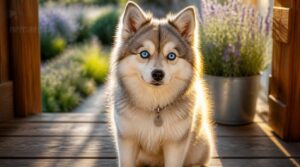
If you’ve stumbled across a Pomsky, you already know it’s hard to look away. This pint-sized dog packs a lot into one fluffy package — from size and lifespan to what kind of owner actually fits this breed. Here’s what you need to know before falling completely in love.
It’s a cross between a Pomeranian and a Siberian Husky — two breeds that top the list of dogs that look like Huskies, which explains that unmistakable wolfish charm.
What is a Pomsky?
Picture a Siberian Husky shrunk to apartment-friendly proportions — that’s basically what a Pomsky is. This crossbreed pairs a purebred Siberian Husky with a purebred Pomeranian, blending two Spitz-lineage dogs into one compact, fluffy package.
The result is a designer dog breed that leans playful, alert, and undeniably eye-catching, without the couch-consuming size of a full Husky. These dogs often feature a thick double coat that combines Husky density with Pomeranian fluffiness.
Designer Hybrid Classification
So what exactly makes a Pomsky a "designer" dog? The term refers to a deliberate crossbreed — two purebred dogs intentionally paired to combine specific traits, rather than a random mix.
The Pomsky isn’t recognized by the AKC, though organizations like the PCA and IPA are pushing for official status. Until then, it sits firmly in designer hybrid territory — celebrated by fans, debated by purists.
Pomsky Size Categories
Pomsky sizing is where things get a little wild. This Pomeranian Husky mix doesn’t come in one tidy package — you’ve got four size tiers, and the naming conventions shift depending on the breeder.
- Micro/Teacup Pomsky — under 10 lbs, 10 inches or shorter
- Toy — 10–15 lbs, roughly 10–12 inches tall
- Mini — 15–20 lbs, 12–15 inches
- Standard — 20–35 lbs, up to 18 inches
No universal breed standard locks these in, so treat the labels as guidelines, not guarantees.
Typical Lifespan
Most Pomeranian Husky mixes clock in at 12 to 15 years — solid numbers for a dog this size. Smaller individuals often edge toward the higher end, since compact builds tend to age more gracefully.
Genetics, diet, and consistent vet care do the heavy lifting here. Catch problems early, keep weight in check, and you’re looking at a long run together.
Best Owner Fit
Who’s actually cut out for a Pomsky? Honestly, not everyone — and that’s fine.
- Daily 45–60 minutes of activity is non-negotiable
- Apartment compatible, provided mental stimulation is consistent
- Companionship-first owners who hate leaving pets alone
This Pomeranian Husky Mix rewards people with active lifestyles and flexible schedules. If solo hours are long, separation anxiety hits fast.
Owners who want the full picture before committing can explore Pomeranian Husky mix traits and care needs to understand what daily life with this breed really looks like.
Pomsky History and Parent Breeds

The Pomsky didn’t come from centuries of careful breed development — it came from someone looking at a Husky and a Pomeranian and thinking, "What if?"
Understanding where this breed comes from helps you know exactly what you’re getting. Here’s a closer look at how Pomskies are bred, what first-generation crosses mean, and where things stand with official recognition.
How Pomskies Are Bred
Getting a Pomeranian Husky mix into the world isn’t as simple as letting two dogs meet in a backyard. Because of the dramatic size difference, artificial insemination is usually required — placing the Pomeranian as sire and the Siberian Husky as dam to keep the pregnancy safe.
Breeder health screening on both parents helps reduce the risk of passing on inherited conditions.
First-Generation Crosses
Most Pomskies you’ll come across are first-generation crosses — meaning one purebred Siberian Husky parent and one purebred Pomeranian, full stop.
That 50/50 genetic split often triggers hybrid vigor, where offspring outperform both parents in health or vitality. The catch? You can’t always predict which traits win out, so each puppy is genuinely its own surprise package.
Breed Recognition Status
The AKC doesn’t recognize the Pomsky — and getting there is a long road. Full AKC recognition requires a formal parent club, three-generation pedigrees, and a stable breeding population.
Organizations like the Pomsky Club of America are pushing forward, but this designer breed remains outside official conformation shows for now, landing it firmly in hybrid territory.
Pomsky Appearance and Traits
No two Pomskies look exactly alike, which is honestly a big part of their charm. Depending on which parent’s genes take the lead, your Pomsky could look like a miniature Husky or a fluffier, fox-like version of a Pom.
Here’s a closer look at the physical traits that define this breed.
Height and Weight Range

Size in this Pomeranian Husky mix is a genuine wildcard. Your Pomsky could stand 8 to 15 inches and weigh from 3 to 20 pounds, driven by parent breed genetics and genetic size variability.
Track your Pomsky’s growth with these checkpoints:
- Weigh your puppy every month
- Compare height to parent lineage
- Flag rapid weight gain early
- Schedule routine vet weigh-ins
Coat Colors and Patterns

Your Pomsky’s coat is basically a genetic lottery — and honestly, the prizes are wonderful. From solid black or white to bi-color tuxedo markings, tan point accents, and white blaze patterns, no two look exactly alike. The merle gene creates striking marbled patches but carries real health risks when bred merle-to-merle, so always ask breeders about parent coat genetics first.
| Pattern | Description | Key Trait |
|---|---|---|
| Solid | Single black, white, cream, or chocolate tone | Color stays stable across seasonal molts |
| Bi-color | Base color with white on chest, legs, or face | Can produce a tuxedo-style look |
| Merle | Irregular lighter patches over a darker base | May trigger odd-colored or blue eyes |
| Tan Point | Lighter tan marks on muzzle, brows, and paws | Creates sharp contrast on dark coats |
| White Blaze | Splash or stripe marking across the face | Shaped by specific pigment gene variants |
Eye Color Variations

Those coat patterns we just covered? They often hint at what’s coming with eye color, too — since the same genes shaping pigment in the fur also influence the iris.
Pomskies can carry blue, brown, hazel, or amber eyes, and many sport heterochromia — each eye a different shade entirely. Lower melanin levels scatter light differently through iris collagen, producing those striking ice-blue tones Husky fans love.
Fluffy Double Coat
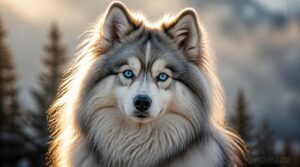
Those striking eyes sit beneath one of the breed’s most iconic features — the fluffy double coat that makes a Pomsky look like it walked straight out of a fantasy novel.
Two layers make this work: a dense insulating undercoat beneath longer guard hairs that add volume and weather protection. Together, they create that signature puffiness both parent breeds are famous for.
Tail, Ears, and Build
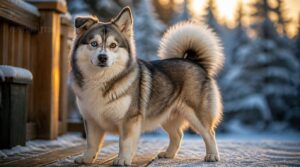
Beneath all that fluff, the Pomsky’s build is surprisingly athletic — a compact, moderately wide chest on a frame that sits longer than it’s tall.
Ears range from fully erect to semi-erect depending on which parent won that genetic lottery. The tail usually curls over the back, ranging 4–9 inches, and doubles as a mood signal and a built-in nose warmer when resting.
Pomsky Temperament and Behavior
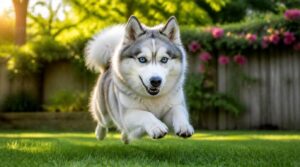
A Pomsky’s personality is honestly one of its biggest selling points — and one of its biggest plot twists. These dogs bring a lot of energy, charm, and opinions to the table, so knowing what you’re working with ahead of time makes all the difference.
Here’s what to expect regarding how a Pomsky actually thinks, acts, and behaves day to day.
Playful and Affectionate Nature
Pomskies don’t just love you — they show it constantly. Expect tail wags and full-body wiggles the moment you walk through the door, followed closely by an invitation to play tug-of-war or chase.
Energy peaks in the morning and late afternoon, so plan for it. Between bursts, they’ll happily curl in your lap, nuzzling close like the world’s fluffiest shadow.
Intelligence and Stubbornness
Smart doesn’t always mean cooperative. The Pomsky’s pattern recognition skills are impressive — they pick up commands fast — but that same clever brain will test your patience the moment training feels repetitive.
Clicker training cuts through stubborn streaks best. Three techniques that actually work:
- Keep sessions to 10–15 minutes
- Rotate locations to generalize commands
- Use mental stimulation games to redirect high energy
Consistency beats confrontation every time.
Barking and Howling
Think of it as getting two vocal breeds for the price of one. The Pomsky inherits the Husky’s howl and the Pomeranian’s sharp, high-pitched bark — a combination that turns doorbells, mail carriers, and evening shadows into full announcements.
Desensitization techniques work well here. Brief, controlled exposure to common barking triggers, paired with a consistent "quiet" cue, reduces reactive behavior over several weeks.
Prey Drive Concerns
That Husky heritage doesn’t just bring the howl — it brings the hunt. The Pomsky carries a genuine active prey drive that can "switch on" the moment a squirrel darts across your path, making recall unreliable exactly when you need it most.
Sudden lunging creates real pursuit injury risks for you and your dog. Structured outlets like fetch or tug redirect that energy safely.
Separation Anxiety Risks
Leave for five minutes and your Pomsky might redecorate the door. Separation anxiety hits this breed hard — attachment figure dependence makes calm alone-time genuinely difficult to build.
Watch for:
- Escape attempt injuries from chewing at gates
- Panting and trembling (stress physiology escalation)
- Destruction near exits (destructive behavior triggers)
- Howling that worsens each departure
- Fear pattern reinforcement when you return mid-panic
Pomsky Care and Ownership Needs

Owning a Pomsky is a real commitment — these dogs need more than just love and a cozy spot on the couch. Between their diet, exercise, grooming, and training, there’s a solid routine involved that you’ll want to know going in. Here’s a breakdown of what daily care actually looks like for this breed.
Food and Diet Needs
Feeding a Pomsky isn’t complicated, but it does require some attention. Start with a complete and balanced commercial dog food matched to their life stage — puppy, adult, or senior formulas each hit different nutrient targets. Portion by weight, not appetite; these dogs will happily overeat.
Keep fresh water available at all times, and introduce any new foods gradually to catch sensitivities early.
Exercise Requirements
Pomskies pack a lot of energy into a small frame. Aim for 30 to 60 minutes of daily activity, split across two walks to keep things manageable.
Puppies need shorter, gentler sessions — their joints are still developing. Older dogs benefit from easier, low-impact routes.
Toss in fetch or a puzzle toy a few times weekly; without mental stimulation, these high-energy dogs get restless fast.
Training and Socialization
These dogs are smart — sometimes too smart. That stubbornness from both parent breeds means positive reinforcement works far better than corrections. Keep sessions to 10–15 minutes.
Start puppy socialization early: new people, sounds, and environments build confidence. Group classes pair obedience foundations with real-world distractions, which is exactly what a Pomsky needs.
Grooming and Shedding
Training a Pomsky takes patience — so does keeping up with their coat.
That fluffy double coat sheds heavily, especially during spring and fall. Daily brushing during peak seasons keeps fur off your furniture. A deshedding tool targets the undercoat and can cut loose hair by up to 60 percent. Bathe every four to eight weeks, and schedule professional grooming every few months for a thorough reset.
Health and Puppy Costs
Grooming costs are predictable — vet bills less so.
The Pomeranian Husky mix carries breed health predispositions like hip dysplasia, eye conditions, and patellar luxation. First-year costs — vaccines, parasite prevention, microchipping, spay/neuter — can run $534 to $1,285. Keep an emergency fund too; unexpected visits alone can hit $280 to $1,750. Budget honestly before falling for those blue eyes.
Budget honestly before those Pomsky blue eyes cost you up to $1,750 in surprise vet bills
Frequently Asked Questions (FAQs)
How much do Pomsky puppies cost?
Expect to spend $1,500 to $5,000 for a puppy from a reputable breeder. Rare coat colors or blue eyes push costs higher. Annual care — food, grooming, and vet visits — adds roughly $900 to $1,500 more.
What is a pomsky husky mix?
A Pomsky is a crossbreed combining a Pomeranian and Siberian Husky, producing a compact, fluffy dog weighing 10 to 40 pounds. No two look identical — coat, color, and build vary widely by litter.
What is a Pomeranian husky mix?
A Pomeranian Husky mix — the Pomsky — is a designer crossbreed combining a purebred Pomeranian with a Siberian Husky, producing a compact, fluffy companion that captures the Husky’s striking looks in a much smaller package.
How do you breed a Pomeranian husky mix?
Breeding a Pomsky requires artificial insemination due to the size gap between parents. The Husky acts as the dam to prevent complications. Responsible breeders run genetic health screening on both dogs beforehand.
Can a Huskie mate with a Pomeranian?
Technically, yes — but it’s extremely rare naturally. The size disparity makes natural mating risky or impossible, so responsible breeders rely on artificial insemination, using the Husky as the dam and the Pomeranian as the sire.
How much does a Pomeranian husky mix cost?
Prices range from $2,500 to over $5,000 for a puppy from a reputable breeder. Rare coat colors or blue eyes push costs higher, while rescue adoption can drop the price below $1,
Is a Pomeranian mix a hybrid?
Yes, a Pomeranian mix is considered a designer hybrid — an intentional cross between a purebred Pomeranian and another breed. Kennel clubs usually don’t grant official recognition to these mixed breed dogs.
Are Pomeranian Husky Mixes Hypoallergenic?
No dog is truly hypoallergenic — dander and saliva are the real culprits, not fur. Pomskies shed heavily year-round, so if allergies are a concern, this double coat breed isn’t your best match.
How Big Do Pomeranian Husky Mixes Typically Grow?
Most Pomskies reach their full adult size by around 12 months, usually weighing 20 to 30 pounds and standing 15 to 18 inches tall, though genetics from either parent can shift those numbers noticeably.
What is the Average Lifespan of a Pomeranian Husky Mix?
Like most good things, how long it lasts depends on how well it’s tended. A Pomeranian Husky Mix usually carries a life expectancy of 12 to 15 years, shaped by nutrition, genetics, and consistent veterinary care.
Conclusion
A Pomsky will test your patience, steal your couch, and somehow become the best decision you ever made. The Pomeranian Husky mix rewards owners who match its energy, respect its intelligence, and commit to consistent training.
Skip the grooming, skip the exercise, skip the socialization — and you’ll end up with a beautiful, chaotic little disaster. But show up for this dog the way it shows up for you, and you’ve got a genuinely wonderful companion.