This site is supported by our readers. We may earn a commission, at no cost to you, if you purchase through links.
Some mushrooms sitting in your fridge right now could benefit your dog’s immune system, gut health, and vitamin D levels.
Others—the kind that pop up after a rainstorm in your backyard—can destroy a dog’s liver within 48 hours.
That gap between healthy snack and "life-threatening emergency" is exactly why the question of whether dogs can eat mushrooms deserves a precise answer, not a blanket yes or no.
The type, preparation, and source matter enormously.
What follows breaks down which mushrooms are safe, which are deadly, and how to protect your dog from both.
Table Of Contents
- Key Takeaways
- Can Dogs Eat Mushrooms? The Quick Answer
- Nutritional Benefits of Mushrooms for Dogs
- Safe Store-Bought Mushrooms Dogs Can Eat
- Which Wild Mushrooms Are Toxic to Dogs?
- How to Tell if a Mushroom is Poisonous
- Symptoms of Mushroom Poisoning in Dogs
- What to Do if Your Dog Eats a Mushroom
- How to Safely Feed Mushrooms to Your Dog
- Top 5 Mushroom Supplements and Treats for Dogs
- How to Prevent Mushroom Poisoning in Dogs
- Frequently Asked Questions (FAQs)
- What happens if a dog eats mushrooms?
- Can dogs eat mushrooms?
- Are Mushrooms poisonous to dogs?
- Can dogs Eat Shiitake mushrooms?
- Why do dogs like mushrooms so much?
- What are the three toxic meats for dogs?
- Can dogs eat mushrooms raw?
- Are mushrooms good for health?
- Can puppies eat mushrooms?
- Can dogs eat store-bought mushrooms?
- Conclusion
Key Takeaways
- Store-bought mushrooms like white button, cremini, and shiitake are safe for dogs when cooked plain and served in small, weight-appropriate portions — but wild mushrooms are a completely different story and should be treated as toxic by default.
- Wild species like the Death Cap and Destroying Angel release amatoxins that can trigger fatal liver failure within 24–72 hours, often with a deceptive symptom-free window that makes the danger easy to miss.
- Beyond safety, the right mushrooms genuinely earn their place in your dog’s bowl — beta-glucans support immune function, prebiotic fiber feeds healthy gut bacteria, and B vitamins fuel energy metabolism.
- If your dog eats an unknown mushroom, don’t wait for symptoms — collect a sample, note the time, and call your vet or a 24-hour poison hotline immediately, since delayed treatment is what turns a close call into a tragedy.
Can Dogs Eat Mushrooms? The Quick Answer

Yes, dogs can eat mushrooms — but the answer gets complicated fast. The type of mushroom matters more than most people realize, and wild versus store-bought is the dividing line.
Here’s what you need to know before sharing any mushroom with your dog.
Before anything else, check out this guide on safe foods and risks for dogs — it gives you a solid baseline for understanding what your pup can and can’t handle.
Safe Store-bought Mushrooms Vs. Wild Mushrooms
Store-bought mushrooms win on every front: labeling reliability, supply chain traceability, and consistent dose variability you can actually control. Safe mushroom varieties for dogs like white button and cremini go through regulated production, which lowers contamination risk greatly.
Wild mushrooms? Whole different story. Toxin stability means cooking doesn’t make them safe, and toxic mushroom species harmful to dogs can hide in plain sight.
When Mushrooms Are Dangerous for Dogs
Wild mushrooms aren’t just a concern when eaten.
Puffball exposure is a real risk too — inhaled spores can inflame your dog’s lungs and trigger fever, labored breathing, and serious illness.
Fragmented identification after chewing makes pinpointing poisonous mushrooms nearly impossible, even for experts.
Delayed organ failure is the silent danger — symptoms may seem mild before kidneys and liver quietly shut down.
Mushroom poisoning’s deadliest trick is silence — organs fail long after symptoms seem to pass
Seasonal risk peaks in spring and fall. According to veterinary data, most UK mushrooms are non‑toxic for dogs, but identification remains difficult.
Veterinarian Guidance on Feeding Mushrooms
Given the risks, most vets recommend a simple rule: stick to plain, cooked, store-bought mushrooms only. Seasoning-Free Preparation matters more than people realize — garlic, onion, and butter aren’t just flavoring, they’re hazards.
Follow Weight-Based Servings and practice Toxicity Risk Screening before introducing anything new. When in doubt, that Veterinary Checkpoint Guidance exists for a reason — use it.
Nutritional Benefits of Mushrooms for Dogs
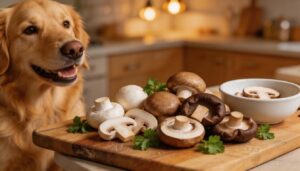
Store-bought mushrooms aren’t just a safe treat — they actually bring something useful to your dog’s bowl. The right varieties pack a surprising range of nutrients that support everything from immunity to digestion.
Here’s what’s inside those fungi worth knowing about.
Vitamins and Minerals in Edible Mushrooms
Edible mushrooms are quietly impressive on the nutrient front. Their nutritional composition of edible mushrooms for pets includes solid B‑Complex Content — think riboflavin, niacin, folate, and vitamin B6 — plus a meaningful Vitamin D Boost when UV-exposed during processing. You’re also getting Selenium and Zinc, healthy Potassium Levels, and traces of Iron and Copper.
Key nutritional benefits of mushrooms for canine health:
- Vitamin B and vitamin D support energy metabolism and bone health
- Selenium acts as an antioxidant, protecting cells from damage
- Potassium helps regulate muscle function and heart rhythm
Antioxidants, Beta-glucans, and Immune Support
Mushrooms like Turkey Tail, Reishi, and Chaga pack something special: beta-1,3-D-glucan. This compound binds to Dectin-1 receptors on your dog’s immune cells, triggering innate immune training — fundamentally teaching the immune system to respond faster and smarter. That aids oxidative stress mitigation and cytokine modulation, helping dial inflammation up or down as needed.
| Mushroom | Key Compound | Immune Benefit |
|---|---|---|
| Turkey Tail | Beta-1,3-D-glucan | Innate immune training |
| Reishi | Triterpenoids | Cytokine modulation |
| Chaga | Antioxidants | Oxidative stress mitigation |
Prebiotic Fiber and Digestive Health
Here’s something your dog’s gut will thank you for: mushrooms are rich in prebiotic fiber that fuels beneficial bacteria through saccharolytic fermentation, producing short-chain fatty acids like butyrate.
These compounds support gut epithelial health and microbial diversity boost. Prebiotic fiber benefits your dog through:
- Firmer, healthier stools
- Stronger intestinal barrier function
- More balanced immune signaling
Protein Content and Low-calorie Value
Don’t let their small size fool you — mushrooms punch above their weight, nutritionally. With roughly 3.1 g of digestible protein and just 22 kcal per 100 g, their calorie-protein ratio makes them a smart occasional addition to your dog’s bowl.
| Nutrient | Per 100g |
|---|---|
| Protein | 3.1 g |
| Calories | 22 kcal |
That’s solid nutritional value without the portion calorie impact of heavier foods.
Safe Store-Bought Mushrooms Dogs Can Eat

Not all mushrooms are off the table for your dog — some are actually a safe, nutritious addition to their diet. The key is sticking to varieties you’d find at your local grocery store, prepared the right way.
Here are the ones worth knowing about.
White Button Mushrooms
White button mushrooms — Agaricus bisporus — hold roughly 90% market share of U.S. mushroom sales, and they’re a safe option for dogs when prepared correctly. Their controlled cultivation methods mean no wild toxins, and their light brown spore print color is reassuringly far from dangerous look‑alikes.
Five things to know:
- Cook them plain — no butter, garlic, or seasoning
- Bruising color change from white to pink is normal, not harmful
- Shelf life is 7–10 days refrigerated; discard anything slimy
- Safe consumption of store‑bought mushrooms for dogs means small, bite‑sized pieces only
- Watch for stomach upset on first introduction
Cremini and Portobello Mushrooms
Cremini and portobello mushrooms are actually the same species — just caught at different points in life. Cremini are harvested young, giving them a firmer texture contrast and milder flavor depth, while portobellos grow into meaty, full-capped adults.
Both are safe for dogs when cooking methods stay simple — plain, no seasoning.
Follow the same storage practices as white button mushrooms: refrigerate promptly, use within a week.
Shiitake Mushrooms
Shiitake mushrooms bring more to the bowl than just flavor. Native to East Asia and widely cultivated today, they deliver a solid Vitamin D2 boost, lentinan beta-glucan for immune support, selenium enrichment, and a fiber prebiotic effect, your dog’s gut will appreciate. Shiitake enzymes for canine digestion also make nutrients easier to absorb.
- B vitamins that support energy and nerve health
- Lentinan compounds linked to stronger immune response
- Low-calorie at roughly 34 calories per 100g — great for weight‑conscious dogs
- Selenium promotes healthy cell function and antioxidant defense
- Prebiotic fiber feeds beneficial gut bacteria naturally
Always cook them plain. No oil, no seasoning — just simple preparation.
Oyster, Enoki, and King Oyster Mushrooms
Three more grocery-store favorites worth knowing: oyster, enoki, and king oyster mushrooms.
Oyster mushrooms grow in clusters with fan-shaped caps and cook down silky-soft. Enoki’s long, thin stems stay delicate in broths. King oyster’s thick stem-to-cap ratio means satisfying, chewy texture.
All three are safe store-bought mushrooms for dogs — plain, cooked, refrigerated, and served in appropriate portions.
Which Wild Mushrooms Are Toxic to Dogs?
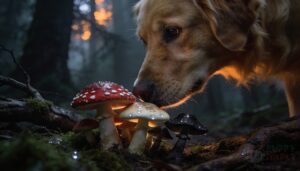
Wild mushrooms are a different story entirely — and the risks are real. Some species are so toxic that even a small nibble can trigger liver failure or seizures within hours.
Here are the ones you need to know about.
Death Cap and Destroying Angel
Two mushrooms deserve special mention regarding fatal risk: the Death Cap (Amanita phalloides) and the Destroying Angel.
Both release amatoxins that block protein production at the cellular level — triggering liver failure within 24–72 hours.
Watch for these warning signs in your yard:
- Off-white or pale cap with white gills underneath
- A skirt-like ring on the upper stem
- A cup-shaped volva buried at the base
- Emergence near tree roots (mycorrhizal associations make forest edges high-risk)
- Sudden appearance after heavy rain due to rain-triggered sporulation
Your dog can look completely fine for 6–24 hours post‑ingestion.
That delay is deceptive — and dangerous.
Fly Agaric and Panther Cap
Amanita muscaria — the Fly Agaric — is the one that dogs (and curious kids) always seem drawn to. iconic red cap with white spots isn’t just decorative; it signals ibotenic acid toxicity and muscimol neuroeffects.
Amanita pantherina runs the same chemistry but wears a subtler brown cap. Both grow in mycorrhizal tree association across overlapping geographic ranges. Fall seasonality peaks their presence — watch wooded walks carefully.
Deadly Galerina and False Morel
Less flashy than the Fly Agaric, Galerina marginata — the funeral bell — is potentially more dangerous because it blends in. It shares habitat overlap with edible wood-growing mushrooms, fruits heavily from September through November, and produces microscopic spores with a rusty-brown spore print.
Its toxin mechanism mirrors the death cap’s amatoxins.
False morel follows similar seasonal fruiting patterns.
Both are veterinary emergency response to mushroom ingestion territory—no waiting.
Magic Mushrooms and Webcaps
Magic mushrooms carry psilocybin toxicity that hits fast — dogs show dilated pupils, wobbly gait, anxiety, and vocalization within hours. Larger doses bring tremors and seizures, making this a veterinary emergency response to mushroom ingestion situation immediately.
Webcaps are quieter but equally serious. Their orellanine kidney damage has a delayed renal failure pattern — your dog may seem fine for days before kidney function collapses.
Cortina veil identification helps distinguish webcaps in the field, but don’t rely on that. Treat any wild mushroom exposure as toxic.
How to Tell if a Mushroom is Poisonous
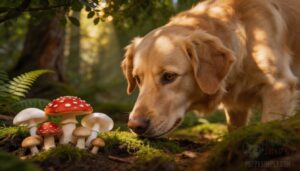
Knowing what to look for on a mushroom can make a real difference — especially if your dog is the curious type who’ll sniff out anything in the yard. There’s no perfect foolproof test, but certain physical features show up again and again on the most dangerous species.
what to watch for.
Warning Signs: White Gills, Red Coloration, Ring on Stem
Three warning signs do most of the heavy lifting when identifying poisonous mushrooms for dogs: white gills, a red cap, and a ring around the stem.
White Gill Identification matters because pale, cream-colored gills appear on several deadly genera. Red Cap Warning signals rise when redness combines with other cues. Stem Annulus Detection — spotting that skirt-like ring — completes the picture.
Never rely on just one feature.
Bulbous Base and Volva Identification
Look past the ring around the stem and white gills — the base tells the real story. Volva Morphology means a cup-like sac wraps the stipe base, a hallmark of Amanita phalloides.
Bulbous Base Patterns, Universal Veil Remnants, and Stipe Base Inspection all matter here. Dig gently around the base; Cross-Section Analysis can confirm it.
When identifying poisonous mushrooms for dogs, a swollen base is enough reason to walk away.
Why Wild Mushroom ID is Unreliable for Pet Owners
Even experienced foragers misidentify wild mushrooms regularly — so your chances as a pet owner in a panic are slim. Variable cap color, damaged specimens, and missing habitat data all muddy the picture fast. Seasonal appearance changes and poor lighting make it worse.
When identifying toxic mushroom species for dogs, a half-eaten fragment tells you almost nothing reliable.
When to Assume Toxicity
When in doubt, assume it’s toxic — full stop. The clinical signs and symptoms of mushroom toxicity can appear within 30 minutes or stretch past 24 hours, so "nothing happened yet" isn’t reassuring.
- Unknown species risk means even a small taste matters.
- Size-based susceptibility makes smaller dogs especially vulnerable to rapid onset signs.
- Multiple mushroom ingestion multiplies the dose-size threshold fast.
Treat it as a veterinary emergency until proven otherwise.
Symptoms of Mushroom Poisoning in Dogs
Mushroom poisoning doesn’t always look the same in every dog — symptoms depend on the species eaten and how much your dog got into.
signs show up fast, while others can take a day or two to appear, which is why knowing what to watch for matters so much.
Here’s what mushroom poisoning can actually look like.
Vomiting, Diarrhea, and Excessive Drooling
Vomiting and diarrhea are often the first symptoms of mushroom poisoning in dogs — and they hit fast. Within hours of ingestion, your dog may also start drooling heavily, a sign that nausea has already set in.
These symptoms together create serious dehydration risk and electrolyte imbalance quickly. Repeated fluid loss also raises aspiration hazard and organ strain, making this a veterinary emergency response situation — don’t wait.
Lethargy, Weakness, and Ataxia
After the vomiting settles, watch for something quieter, but just as alarming — your dog going still. Lethargy, weakness, and ataxia are core clinical signs of toxicity that point to neurological involvement.
A wobbly, "drunk" gait, wide stance, and sluggish alertness, scoring below normal all signal your vet needs to run a full neurologic assessment and gait evaluation immediately.
Seizures, Tremors, and Neurological Signs
Things can escalate fast from there. Neurotoxic mushrooms — especially Amanita muscaria — push dogs into seizures: focal motor seizures (one limb twitching), generalized tonic‑clonic episodes with full‑body stiffening and jerking, or atonic collapse where muscle tone simply drops.
Tremors, neurological autonomic signs like drooling and incontinence, and confused postictal behavior afterward are all serious neurological manifestations of mushroom poisoning.
Get to a vet immediately.
Liver and Kidney Failure Warning Signs
Seizures are scary, but silent organ damage is often what kills. Cyclopeptide mushrooms like the death cap quietly destroy the liver and kidneys. Watch for:
- Yellowing eyes or gums (jaundice)
- Dark urine or reduced urine output
- Pale, clay-colored stool
- Abdominal swelling from fluid buildup
- Vomiting and diarrhea returning after a brief calm
Liver failure and kidney failure can develop 24–48 hours post-ingestion.
Timeline of Symptom Progression
Symptoms rarely all hit at once. The initial vomiting window opens within hours of ingestion, often with drooling onset timing running close behind. Diarrhea follows shortly after.
Then comes a neurologic delay period — ataxia and tremors can emerge hours later. The full observation window stretches 24–48 hours, when liver failure and kidney failure become the real danger through distinct symptom progression phases.
What to Do if Your Dog Eats a Mushroom
Finding a half-eaten mushroom in your dog’s mouth is every pet owner’s stomach-drop moment. The good news is that acting fast and staying calm makes a real difference in how things turn out.
Here’s exactly what to do, step by step.
Immediate Steps to Take at Home

First, secure the area — move your dog away from any remaining mushrooms. Record ingestion time and the estimated amount eaten; this directly shapes the veterinary emergency response to mushroom ingestion.
Don’t attempt induced vomiting or activated charcoal without professional instruction. Avoid home remedies entirely.
Monitor essential signs like breathing and alertness, and prepare a sample photo of the mushroom while you call your vet.
Preserving a Mushroom Sample for Identification

That sample your dog left behind? It could save its life.
Follow these steps to preserve it properly:
- Collect the whole specimen — cap, stem, and base — by digging gently rather than snapping it off.
- Use Paper Bag Storage, never plastic, to prevent moisture buildup that accelerates decay.
- Apply Drying Techniques: air‑dry or dehydrate 24–48 hours until crisp.
- Take a Spore Print Collection by placing the cap gill‑side down on paper before drying.
- Complete Labeling Documentation — note location, time, and substrate — then wrap carefully for Specimen Packaging.
These diagnostic steps for unknown mushroom ingestion dramatically improve identifying toxic mushroom species for dogs.
Contacting Pet Poison Helpline or Your Vet

Once you’ve secured that mushroom sample, don’t wait — call timing matters enormously here. Both the Pet Poison Helpline and ASPCA Animal Poison Control Center run 24-hour poison control hotlines.
Have your dog’s weight, the ingestion time, and a mushroom description ready. Note that Pet Poison Helpline charges a helpline fee per incident. After-hours guidance will route you to emergency care if needed.
Veterinary Treatment and Supportive Care

Once your dog is in the clinic, the team moves fast. Veterinary emergency response to mushroom ingestion follows a clear protocol:
- Gastrointestinal Decontamination — activated charcoal binds lingering toxins; induced vomiting is avoided if your dog is already drowsy or seizing
- Intravenous Fluids and Electrolyte Correction — restores hydration and stabilizes kidney function
- Neurological Support and Coagulation Monitoring — anticonvulsants manage seizures; repeated bloodwork tracks liver and clotting status
Does Pet Insurance Cover Mushroom Poisoning?

Most accident and illness plans treat mushroom poisoning as a toxic ingestion, so veterinary emergency response to mushroom ingestion is often covered under accident coverage. That includes emergency vet claims for diagnostics, fluids, and hospitalization.
Watch for policy exclusions around pre-existing toxicity or waiting periods.
Reimbursement rates can reach 90%, making pet insurance coverage for poisoning emergencies genuinely worth having before disaster strikes.
How to Safely Feed Mushrooms to Your Dog
So you’ve decided to share a few mushrooms with your dog — great, just make sure you do it right.
A little prep and portion control go a long way in keeping things safe and beneficial.
Here’s exactly what you need to know before adding mushrooms to your dog’s bowl.
Always Cook Mushrooms Plain Without Seasonings
Plain cooking is non‑negotiable — cooked mushrooms without seasonings are the only safe option for dogs. Garlic‑free preparation and no salt added aren’t just preferences; garlic and onion compounds destroy red blood cells, and excess salt causes dehydration.
Follow these preparation guidelines for feeding mushrooms to dogs:
- Use seasoning‑free cooking: water only, no butter or oils
- Plain water boiling keeps storebought mushrooms safe and digestible
- Soft texture benefits digestion and reduces choking risk
- Avoid commercial seasoning blends — many contain hidden garlic powder
- Plain white and cremini varieties respond well to simple steaming or boiling
Serving Size Guidelines by Dog Weight
Once you’ve got the cooking method down, portion size is next.
Mushrooms count toward your dog’s daily treat calorie cap — keep that total at 10% or less of daily calories.
Weight-based portioning makes this simple:
| Dog Size | Serving Size |
|---|---|
| Small (2–15 lbs) | 1–2 teaspoons |
| Medium (16–60 lbs) | 1–2 tablespoons |
| Large (61–90 lbs) | ¼ cup |
| Extra-Large (90+ lbs) | ½ cup |
Start at the low end — always.
Introducing Mushrooms to Puppies Safely
Puppies need an even slower gradual introduction than adult dogs. Their digestive systems are still developing, so start with one small piece size — about a teaspoon of plain, cooked mushroom — and wait 48 hours before offering more.
Always allow a full temperature cooldown before serving. Run a puppy sensitivity check by watching for loose stool, gas, or vomiting.
Veterinary approval is smart before starting.
Mushrooms as Meal Toppers, Broth, or Treats
Once your pup manages a teaspoon without issue, you can get creative with how you serve mushrooms.
- Meal topper: Finely chop cooked mushrooms and mix into wet food for easy Texture Preference matching
- Broth Dilution: Simmer plain mushrooms in water, strain, and add a light splash for Temperature Acceptance over kibble
- Batch Preparation: Cook a small weekly batch, refrigerate, and portion as needed
- Treats: Bite-sized cooked pieces work well for Allergy Screening during first servings
- Puree: Blend cooked mushrooms into a spoonable topper — great for safe consumption of storebought mushrooms for dogs
Skip salt, garlic, and onion entirely.
Foods to Never Combine With Mushrooms
Skipping salt and garlic is just the start. Raw mushrooms are harder to digest and more likely to cause bloating. Dairy adds lactose load that worsens GI upset. Alcohol paired with coprine-containing species triggers a disulfiram-like reaction — flushing, vomiting, rapid heart rate.
Chunky foods raise choking risk. Seasoned oils, onions, garlic and anything with mycotoxins or unknown wild ingredients? Hard no.
Top 5 Mushroom Supplements and Treats for Dogs
If you’d like to go beyond whole mushrooms and give your dog a more consistent dose of those beneficial compounds, supplements and functional treats are a great option. Many are formulated with medicinal mushrooms like turkey tail, lion’s mane, or reishi — the same ones studied for immune and cognitive support.
Here are five worth considering.
1. Dole Strawberry Pineapple Dog Chews
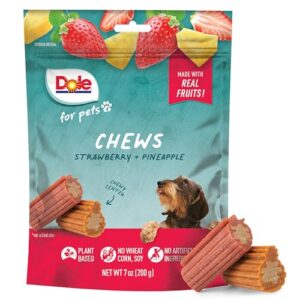
Not all dog treats need meat to be worth reaching for.
Dole’s Strawberry Pineapple Dog Chews packs real fruit flavor — strawberry and pineapple — into a plant-based chew free from wheat, corn, soy, and artificial additives.
The base ingredients include sweet potato flour, tapioca, and rice flour, keeping things simple and allergen‑friendly.
At 98 kcal per treat, they’re a reasonable occasional snack.
Just watch sizing — the firm texture can be tough on smaller dogs or delicate teeth.
| Best For | Dogs with food sensitivities or owners looking for a plant-based, fruit-flavored treat alternative to meat-based snacks. |
|---|---|
| Form | Chew |
| Intended Use | Treat |
| Age Range | All life stages |
| Preservative-Free | Yes |
| Contains Mushrooms | No |
| Animal Protein | No |
| Additional Features |
|
- Real strawberry and pineapple flavors with no artificial colors, flavors, or preservatives — a clean ingredient list you can actually feel good about.
- Free from wheat, corn, and soy, making it a solid pick for dogs with common food allergies.
- Resealable bag makes it easy to toss in a bag for training sessions or trips.
- The firm texture can be really tough on small breeds or dogs with sensitive teeth — definitely supervise chew time.
- No size guidance on the packaging, so you’re on your own figuring out the right portion for your dog.
- Only comes in a 7 oz bag, so frequent buyers will be restocking pretty often.
2. Badlands Ranch Beef Superfood Dog Food
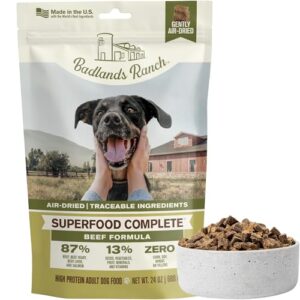
If you want real food — not just a treat — Badlands Ranch Beef Superfood Complete is worth a look.
It’s air-dried at low temperatures, locking in nutrients from 87% animal protein: beef, beef heart, beef liver, and salmon.
The remaining 13% is a superfood blend that includes lion’s mane mushroom, turmeric, and blueberries.
No fillers, no corn, no soy.
At $42.99 for 24 oz, it’s a premium choice — but the ingredient quality shows.
| Best For | Dog owners who want a clean, nutrient-dense food for adult dogs and don’t mind paying a premium for real-ingredient quality. |
|---|---|
| Form | Pellet |
| Intended Use | Meal/Treat/Topper |
| Age Range | Adult dogs |
| Preservative-Free | Yes |
| Contains Mushrooms | Yes |
| Animal Protein | Yes |
| Additional Features |
|
- 87% animal protein from whole sources like beef, liver, and salmon — no fillers or by-products
- Packed with superfoods (turmeric, lion’s mane, blueberries) that support digestion, joints, and immunity
- Shelf-stable and ready to serve — no refrigeration, prep, or added water needed
- At ~$43 for 24 oz, costs can spiral fast, especially for large or multiple dogs
- Large breeds may need an entire bag per day, making it seriously expensive as a sole diet
- Small pellet size isn’t ideal for big dogs that need more to chew on
3. Badlands Ranch Air Dried Fish Turkey Dog Food
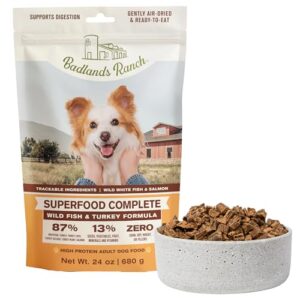
Another solid option from Badlands Ranch — this time built around wild-caught whitefish, turkey, turkey organs, and salmon.
It’s air-dried at low temperatures, so nutrients stay intact without refrigeration or prep.
Lion’s mane mushroom is right there in the ingredient list, alongside turmeric, chia, blueberry, and pumpkin.
no fillers, no grain, no by-products.
At 38% protein minimum and $42.99 for 24 oz, it’s a premium pick — especially useful if your dog does better on fish-based protein than beef.
| Best For | Dogs who do better on fish-based protein, seniors needing an energy boost, or owners who want a clean, nutrient-dense food without the fuss of refrigeration. |
|---|---|
| Form | Pellet |
| Intended Use | Meal/Treat/Topper |
| Age Range | Adult dogs |
| Preservative-Free | Yes |
| Contains Mushrooms | Yes |
| Animal Protein | Yes |
| Additional Features |
|
- 87% animal protein from real whitefish, turkey, and salmon — no fillers, grains, or by-products
- Packed with superfoods like lion’s mane mushroom, turmeric, and chia that actually support joints, digestion, and coat health
- No prep needed — just scoop and serve, which makes it great for travel or busy days
- At $42.99 for just 1.5 lbs, costs can add up fast — especially if you have a bigger dog
- The fish smell is strong, and some owners find it hard to deal with
- A small number of dogs had stomach issues, so it may not be the best fit for very sensitive pups
4. HolistaPet Organic Immune Chew Treat
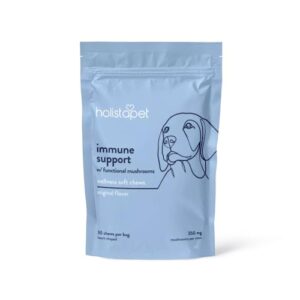
HolistaPet packs a serious mushroom lineup into one soft chew — maitake, reishi, shiitake, lion’s mane, and turkey tail at 350 mg per chew. That’s five functional mushrooms in a single daily treat.
It also includes 300 mg of fish oil, 100 mg of colostrum, and 75 mg of vitamin C, so you’re getting immune and joint support together.
The formula is non‑GMO, gluten‑free, and dairy‑free. No artificial anything. If your dog tolerates chewables well, this one’s worth a look.
| Best For | Dog owners looking for a daily wellness chew that covers immune support, joint health, and more — especially for active or senior dogs who do well with soft chewable treats. |
|---|---|
| Form | Chewable Tablet |
| Intended Use | Supplement |
| Age Range | Dogs |
| Preservative-Free | Yes |
| Contains Mushrooms | Yes |
| Animal Protein | No |
| Additional Features |
|
- Five functional mushrooms in one chew — maitake, reishi, shiitake, lion’s mane, and turkey tail — plus fish oil and vitamin C for solid all-around support
- Clean formula with no artificial ingredients, non-GMO, gluten-free, and dairy-free
- Doubles up on benefits, tackling both immune health and joint comfort in a single daily treat
- No third-party testing or clinical data to back up the health claims
- Picky dogs may turn their nose up at the flavor
- Not a safe pick for dogs with mushroom allergies without checking with your vet first
5. Dr Mercola Fermented Mushroom Pet Supplement
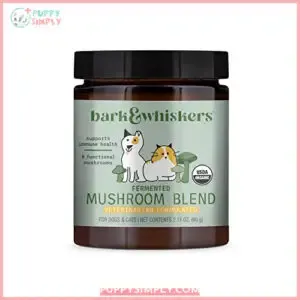
Dr. Mercola’s Fermented Mushroom blend takes a whole-food approach — eight species, including reishi, cordyceps, lion’s mane, turkey tail, and maitake, all fermented for better bioavailability. Each scoop delivers beta-glucans, L-ergothioneine, chelated minerals, and natural glucosamine.
It’s gluten-free, additive-free, and vet-formulated for both dogs and cats.
At $19.97 for 60 scoops, the value is solid.
Fair warning: some pets refuse the taste, and a few owners reported loose stools early on. Start slow and watch how your dog responds.
| Best For | Senior and adult cats and dogs whose owners want a clean, multi-mushroom immune and digestive boost without fillers or additives. |
|---|---|
| Form | Powder |
| Intended Use | Supplement |
| Age Range | Adult/Senior dogs/cats |
| Preservative-Free | Yes |
| Contains Mushrooms | Yes |
| Animal Protein | No |
| Additional Features |
|
- Eight fermented mushroom species in one scoop — reishi, lion’s mane, cordyceps, and more — covering immune, joint, and gut support all at once
- Clean formula with no gluten, fillers, or artificial additives, making it a good fit for pets on limited-ingredient diets
- 60 scoops at $19.97 is genuinely reasonable for a vet-formulated mushroom blend
- Picky pets may refuse it outright — palatability complaints are pretty common in reviews
- Some pets experienced loose stools or digestive upset when starting, so slow introduction is a must
- No clinical trial data backs the health claims, and the packaging has had some quality issues (loose lids, spills) — plus it’s non-returnable
How to Prevent Mushroom Poisoning in Dogs
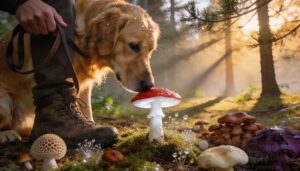
Preventing mushroom poisoning starts long before your dog ever sniffs something suspicious. A few simple habits can make a real difference in keeping them safe. Here’s what you can do.
Inspecting Your Yard After Rain
After rain, mushrooms can pop up overnight in Moisture Hotspots—mulch beds, leaf litter, and shady corners. A Mulch Inspection and Leaf Litter Scan help catch wild mushroom growth early. Use a Flashlight Survey for dim spots.
Prevention strategies to avoid mushroom ingestion start with a careful Shade Zone Check, since environmental factors and seasonal mushroom emergence patterns boost risk for dogs.
Keeping Dogs Leashed in Wooded Areas
Your yard sweep matters, but wooded trails bring a whole new level of risk. A proper Gear Fit keeps control tight when your dog suddenly dives toward leaf litter. Match your Leash Length to trail visibility — a standard 6-foot lead beats a retractable every time.
- Scent Timing is real: post-rain humidity intensifies ground odors
- Obstacle Navigation around logs limits nose-to-floor moments
- Reward Redirection and a solid "leave it" stop, scavenging before it starts
Restricting Access to Compost and Leaf Litter
Compost and leaf piles are ground zero for wild mushroom growth. A secure compost lid with a latching fence around the bin cuts off access fast.
Add mulch ground cover over bare soil, and consider a bitter deterrent spray on edges dogs favor.
Moisture control matters too — drier piles smell less, draw less attention, and keep preventing dog mushroom poisoning simpler.
Training Dogs to Avoid Scavenging
Physical barriers help, but training seals the deal.
Leash redirection lets you steer your dog away the moment interest sparks — before anything reaches their mouth. Pair that with a solid Leave It Cue, and you’ve got real control over Structured Scavenging Walks.
For persistent foragers, Basket Muzzle Use adds a safety layer.
Impulse Control Feeding at home also builds the self‑restraint that transfers outdoors.
Frequently Asked Questions (FAQs)
What happens if a dog eats mushrooms?
It depends entirely on what they ate. Some mushrooms trigger mild stomach upset; others cause organ-specific damage or nervous system failure.
Delayed symptom onset means your dog might seem fine — then crash within days.
Can dogs eat mushrooms?
Yes, dogs can eat certain mushrooms — but only store-bought, plain-cooked varieties in small amounts. Wild mushrooms are a different story. Many are toxic, and some can be deadly.
Are Mushrooms poisonous to dogs?
Some mushrooms are absolutely poisonous to dogs. Wild species like death cap carry toxins that trigger liver failure, seizures, and death. Store-bought varieties, prepared plain, are generally safe.
Can dogs Eat Shiitake mushrooms?
Store-bought shiitake mushrooms are safe for dogs in small, plain, cooked portions. Skip raw or seasoned versions — heat deactivation of toxins matters.
Watch for allergic reactions or digestive upset after the first serving.
Why do dogs like mushrooms so much?
It comes down to umami attraction, olfactory curiosity, and soft mouthfeel. Mushrooms smell meaty, taste protein-like, and feel easy to chew — three things dogs are naturally wired to chase.
What are the three toxic meats for dogs?
Three major offenders: processed deli meats loaded with nitrate preservatives, bacon and fatty pork (a pancreatitis trigger), and sausage or hot dogs packed with dangerously high sodium content.
Can dogs eat mushrooms raw?
Raw mushrooms aren’t ideal. Chitin indigestibility strains your dog’s digestive enzyme load, and raw toxin activation can trigger stomach upset risk.
Stick to plain, cooked portions to stay within safe raw feeding limits.
Are mushrooms good for health?
Yes, mushrooms offer real health benefits — supporting Heart Health, Blood Sugar balance, Bone Strength, Mood Enhancement, and Skin Health through their immune system support, medicinal mushroom benefits, and immunomodulating properties of fungi packed with nutritional benefits.
Can puppies eat mushrooms?
Puppies can eat plain, cooked store-bought mushrooms in tiny amounts, but their developing livers and smaller bodies make age-related toxicity a real concern. Always consult your vet first.
Can dogs eat store-bought mushrooms?
Store-bought mushrooms are generally safe for dogs when cooked plain — no seasoning risks, no wild-mushroom mix-ups. Stick to small portions and skip the raw ones to keep digestive tolerance smooth.
Conclusion
The safest approach to mushrooms and dogs seems straightforward: some are snacks, others are nightmares. Yet, the line between healthy treat and toxic threat blurs with every new discovery. On the question of can dogs eat mushrooms, your safest bet is informed caution.
Stick to store-bought, dog-safe varieties like white button or shiitake. Avoid wild mushrooms entirely. By choosing knowledge over chance, you safeguard your dog’s health and give them a fun, nutritious treat.