This site is supported by our readers. We may earn a commission, at no cost to you, if you purchase through links.
Most dog owners pull the treat pouch away too fast—and then wonder why their dog stops listening.
It’s one of the most common training frustrations, and it usually comes down to mistaking "dog does the thing" for "dog has learned the thing." Those aren’t the same.
A dog who sits for a treat in your kitchen hasn’t mastered the behavior.
A dog who sits reliably in a busy park, on the first cue, without a snack visible—that dog has.
Knowing when to phase out treats in dog training means reading that difference clearly, then following a process that keeps your dog motivated long after the treat bag stays in the drawer.
Table Of Contents
- Key Takeaways
- Why Are Treats Used in Dog Training?
- When Should You Phase Out Treats?
- Step-by-Step Guide to Phasing Out Treats
- Common Mistakes When Reducing Treats
- Reinforcement Schedules for Lasting Results
- Should You Stop Using Treats Completely?
- Frequently Asked Questions (FAQs)
- Should you phase out dog treats?
- Should you treat your dog while training?
- Is it OK if my dog only responds to treats?
- How do you train a dog to learn a new skill?
- When to stop using treats for dog training?
- What is the 90/10 rule for dogs?
- Can treats cause weight gain in dogs?
- How do treats affect dogs with food allergies?
- What age should puppies start treat-based training?
- Are some dog breeds harder to wean off treats?
- Conclusion
Key Takeaways
- phase out treats until your dog responds correctly at least 80–90% of the time across different places and distractions—not just in your kitchen.
- fade the lure early (after 10–15 reps), then reduce treat frequency gradually using a variable schedule, so your dog responds to your cue—not the sight of food.
- warning signs like hesitation, attention drift, or an extinction burst—these mean you’ve pulled back too fast and need to rebuild your reinforcement schedule.
- occasional rewards, real-life perks like walks and sniff breaks, and well‑timed praise keep your dog motivated long‑term.
Why Are Treats Used in Dog Training?
most powerful tools are one of the most powerful tools you have when teaching your dog something new.
Pairing treats with the right techniques makes a real difference, especially for high-energy pups—training a hyperactive dog takes a bit more strategy but the payoff is absolutely worth it.
But there’s more to it than just handing over a biscuit—how and when you use them makes all the difference.
Here’s what you need to understand before you start.
The Role of Treats in Positive Reinforcement
Treats work because dogs are hardwired to value food — no training required. That’s what makes them such a powerful teaching tool. When you deliver a high-value treat within one second of the right behavior, your dog instantly connects the action to the reward.
Pair that with marker pairing, and you’ve built a clear communication system that keeps motivation high from the very first session. Choosing treats with natural ingredient importance provides ideal nutrition.
Luring Vs. Rewarding Behaviors
Knowing when you’re luring versus rewarding makes a real difference in your results. Luring uses a visible treat to physically guide your dog — think of it as a magnet for their nose. Rewarding comes after the behavior.
Cue separation matters here: your dog should respond to your cue, not the sight of food. Lure fading techniques, marker usage, and precise timing keep phasing out treats smooth and effective.
Understanding operant conditioning principles helps guide the shift from luring to rewarding.
Building Motivation and Engagement
Once your dog understands the difference between a lure and a reward, motivation becomes your next focus.
Strong reward systems in dog training keep learning fun and build reliability over time:
- Use High-Value Treats like freeze‑dried liver in distracting spots.
- Try Interactive Food Games to spark natural curiosity.
- Apply Reward Pairing Techniques — combine praise with food immediately.
Life Rewards Integration and Engagement Building Methods support phasing out treats naturally through intermittent reinforcement.
When Should You Phase Out Treats?

Timing matters more than most people think regarding reducing treats. Pull back too soon and your dog gets confused; wait too long and you risk building a habit that’s hard to break.
Here’s how to know when the moment is actually right.
Mastery of Behaviors as a Prerequisite
Before phasing out treats, your dog needs to genuinely master a behavior — not just perform it sometimes.
That means meeting fluency criteria: low latency benchmarks (responding within one second), precision standards like a square sit, and duration requirements such as holding a stay for 30 seconds. Distraction tolerance matters too. Aim for 90% success across varied environments before shifting your reinforcement schedule.
Recognizing Reliable Responses
Reliability is your green light to start phasing out treats.
Once your pup is consistently nailing commands, you can gradually reduce treats—just make sure you’ve built that foundation right by understanding how to use puppy training treats effectively from the start.
Before you shift your reinforcement schedule, check these four signs of reliable responses:
- Your dog responds correctly 8 out of 10 times
- Latency measurement stays short — one quick cue, one fast response
- Distraction proofing holds across different settings
- Context generalization and cue consistency show up without non‑food rewards visible
Signs You’re Phasing Out Treats Too Soon
If your dog starts showing delayed response times, that’s your first clue.
Watch for hesitation cues like pausing mid-behavior, attention drift toward the environment, or frustration signals like whining and pawing.
An extinction burst — where your dog frantically repeats behaviors — means you’ve cut treats too quickly.
These signs tell you to slow down and rebuild your reinforcement schedule before moving forward.
Step-by-Step Guide to Phasing Out Treats
Once your dog has the basics down, it’s time to start pulling back on treats — but how you do it matters. Rushing the process can undo a lot of good work, so a gradual, structured approach makes all the difference.
Here’s a simple four-step process to guide you through it.
Step 1 – Fade The Lure Early

The lure is a teaching tool, not a permanent fixture. Start fading it after just 10–15 consistent repetitions — that’s your Early Timing Benefit window. Here’s your four-step fade sequence:
- Lure Dependency Test – Give the verbal cue alone. No hand movement. Does your dog sit? Good.
- Verbal Cue Wait – Say the cue, pause 2–3 seconds, then intervene only if needed.
- Empty Hand Motion – Mimic the luring path with nothing in your hand, reward from your pocket.
- Gradual Signal Reduction – Slowly shrink that gesture until a subtle finger point does the job.
This keeps your positive reinforcement training cue-driven, not food-driven.
Step 2 – Reduce Treat Frequency Gradually

Think of this like easing off the gas — you don’t slam the brakes.
Once your dog hits 80–90% reliability, start your Fixed Ratio Shift: reward every second correct response, then every third. From there, Variable Ratio Introduction kicks in — unpredictable treats, like a slot machine, build stronger behavior.
| Training Phase | Treat Frequency | Success Rate Target |
|---|---|---|
| Continuous | Every response | 80–90% correct |
| Fixed Ratio | Every 2nd–3rd response | 90% before dropping |
| Variable Ratio | Unpredictable intervals | Maintain 80%+ always |
| Distraction Level Adjustment | Reset to higher frequency | 80% in new settings |
Track your Success Rate Monitoring each session. If responses slow, pull back and reward more often. Phasing out treats works only when you adjust by context — high‑distraction environments need higher treat rates. That’s intermittent reinforcement done right.
Step 3 – Introduce Alternative Rewards

Treats aren’t the only currency your dog values. As you phase out treats, swap in rewards that genuinely excite your dog:
- play-based rewards after a solid recall
- Petting and affectionate praise for calm, reliable sits
- High-value toys for toy‑motivated dogs during intermittent reinforcement
- Life‑reward integration, like opening the door after a polite wait
- Enthusiastic verbal praise, especially once conditioned alongside food
Step 4 – Use Jackpot Rewards Strategically

A jackpot reward is your secret weapon against treat dependency. When your dog nails a tough recall past another dog or holds a long stay in a noisy park, that’s your moment.
Deliver three to five small treats rapidly — that’s jackpot value they’ll remember. Keep jackpot criteria high, jackpot timing precise, and use them sparingly within your variable reinforcement schedule for lasting results.
Common Mistakes When Reducing Treats

Even with the best intentions, it’s easy to make a few slip-ups when you start pulling back on treats.
These mistakes can stall your dog’s progress or leave them confused about what you expect.
Here are the most common ones to watch out for.
Cutting Out Rewards Too Quickly
One of the most common missteps is cutting treats too fast, too soon. When you drop rewards abruptly, Motivation Decline sets in quickly — dogs start ignoring cues they once followed without hesitation.
You’ll also notice Extinction Bursts, Response Slowdown, Cue Confusion, and Frustration Buildup.
Solid reinforcement schedules in dog training, built on intermittent reinforcement, protect your reward systems and prevent treat dependency from simply reversing your progress.
Expecting Reliability in All Situations
Another common mistake is perform reliably everywhere just because it nailed it at home. That’s not how dogs learn.
Contextual Generalization takes deliberate practice across many environments. Without Distraction Proofing and Confidence Building in varied settings, Environmental Variability will break Cue Consistency fast.
When phasing out treats, always match your reinforcement schedules in dog training to the difficulty of each new location.
Relying on Unconditioned Praise
Verbal praise sounds like the perfect free reward, but it often fails when you’re phasing out treats. Praise Overuse is a real problem — if your dog hears “good boy” while napping on the couch, that phrase loses its power in training. Household Desensitization, Praise Inconsistency, Genetic Temperament, and Low‑Distraction Failure all quietly undermine an unconditioned praise‑based reward system.
- Over‑praised dogs ignore session praise 90% more often
- Busy homes turn verbal cues into background noise within weeks
- Independent breeds respond minimally to praise without tangible backups
- Inconsistent tone confuses dogs, slowing responses considerably
- Outdoor distractions override praise in nearly 95% of trials
Condition praise first through positive reinforcement and intermittent reinforcement pairing before leaning on it alone.
Removing Food Rewards Entirely
cold turkey on food rewards is one of the biggest mistakes you can make.
Extinction Risk is real — when food disappears completely, motivation decline follows quickly.
off‑leash reliability can drop by half, and recalls fail in busy parks without occasional treat backups.
Even with non‑food alternatives, intermittent reinforcement keeps your reward system strong.
breed‑specific tolerance varies, but no dog thrives without food entirely.
Reinforcement Schedules for Lasting Results
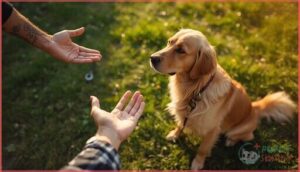
How often you reward your dog matters just as much as what you use as a reward.
Shifting from treats every single time to a smarter, more varied approach is what keeps training solid long-term.
Here’s what that actually looks like in practice.
Continuous Vs. Intermittent Reinforcement
Continuous reinforcement builds new behaviors fast — every correct response gets a reward, which clarifies the behavior-reward link quickly. But it burns through treats and fades just as fast when rewards stop.
Intermittent reinforcement is different. It strengthens extinction resistance, so your dog keeps responding even without a treat each time. Shift timing matters: switch schedules after 10–20 reliable repetitions for better resource efficiency and lasting response patterns.
Using Variable Reward Schedules
Randomizing rewards is where things really click. Think of it like a slot machine — your dog never knows which response wins the treat, so they keep trying.
That’s variable ratio at work, and it builds extinction resistance fast. Reward sits after 3 responses, then 5, then 2.
This reward randomization strategy crushes treat dependency while keeping motivation sky-high through the phasing out food rewards process.
Tailoring Rewards to Your Dog’s Needs
Not every dog is wired the same way — and your reward system should reflect that. A reward preference assessment helps you figure out what actually drives your dog.
- Age-Based Rewards: Puppies need frequent tiny treats; seniors do better with soft chews and calm praise.
- Health Considerations: Overweight or allergy-prone dogs benefit from toy-based rewards over food.
- Sensory Preferences: Strong-smelling treats like dried meat outperform bland biscuits in distracting environments.
- Environment-Specific Rewards: Use higher-value rewards outdoors; quiet praise often works fine indoors.
- Treat Dependency Check: Vary rewards regularly to keep dog behavior modification on track.
Should You Stop Using Treats Completely?

Phasing out treats doesn’t mean cutting them out forever.
Food rewards still have a place, even with a well-trained dog. Here’s how treats, real-life rewards, and praise each play a lasting role in keeping your dog motivated.
Why Occasional Food Rewards Still Matter
Ditching treats entirely can quietly undo months of solid work.
Dogs trained with occasional food rewards show far stronger long-term retention than those relying on praise alone.
That’s the beauty of a variable schedule — your dog never stops wondering, "Is this the time?" That uncertainty sharpens attention and boosts persistence, helping you overcome treat dependency without sacrificing the reliability you’ve worked so hard to build.
A variable reward schedule keeps dogs engaged by making every response feel like a winning chance
Maintaining Motivation With Real-Life Rewards
Real-life rewards are hiding in plain sight.
Every walk, meal, and greeting is a chance to reinforce good behavior without reaching for your treat pouch.
Door Access Incentives, Sniff Break Rewards, Play Session Incentives, Social Greeting Rewards, and Freedom Access Motivators all support reward‑based training naturally.
Weaving these into daily routines keeps your dog motivated, making overcoming treat dependency feel easy rather than like a battle.
The Ongoing Role of Praise and Play
Treats may fade, but praise and play never really retire. Used well, they carry the weight of positive reinforcement long after treat dependency is behind you. Here’s how they keep working:
- Praise Timing — Deliver praise immediately after the behavior
- Intermittent Praise — Reward 3 of 4 responses unpredictably
- Energy Matching — Match your play style to your dog’s drive
- Play Variety — Rotate tug, fetch, and chase as rewards
- Real‑World Play — Weave short play bursts into everyday moments
Frequently Asked Questions (FAQs)
Should you phase out dog treats?
Yes, but not entirely. Smart trainers use positive reinforcement long‑term, adjusting treat timing, reward hierarchy, and variable schedules to match your dog’s temperament, training environment, and your own consistency as an owner.
Should you treat your dog while training?
Absolutely. Treats are the backbone of reward-based training. With the right treat types and reward timing, positive reinforcement drives dog motivation quickly.
Owner consistency and training environment shape how well your dog responds.
Is it OK if my dog only responds to treats?
It’s not ideal. If your dog only responds with treats visible, you’ve got treat dependency — and that hurts cue reliability when it matters most.
Reward-based training works best with variable reinforcement, not guarantees.
How do you train a dog to learn a new skill?
Start with continuous reinforcement — reward every correct response. Use high-value rewards, timing precision within one second, and cue consistency.
Gradually introduce play integration and a variable schedule as the behavior becomes reliable.
When to stop using treats for dog training?
phase out treats when your dog reliably reacts to training cues about 80–90% of the time, across distraction levels, without lures or repeated prompts — that’s when reward‑based training shifts into maintenance mode.
What is the 90/10 rule for dogs?
The 90/10 rule means your dog hits the reliability threshold — responding correctly 9 out of 10 times. That consistency standard is your mastery standard, signaling the fade timing for rewards has arrived.
Can treats cause weight gain in dogs?
Yes, food treats can cause weight gain.
Many treats pack 5 to 20 calories each, and those add up fast.
Keeping treat portion size small and choosing low-calorie alternatives protect your dog’s health.
How do treats affect dogs with food allergies?
If your dog has food allergies, treats can trigger reactions fast. Focus on hypoallergenic options, watch for symptoms, and stay within calorie limits to keep reward-based training safe and effective.
What age should puppies start treat-based training?
Ready to start training?
Most puppies begin treat-based training at 8 weeks old. That’s when their developmental window opens, brain plasticity peaks, and digestive tolerance allows small, simple rewards during the socialization period.
Are some dog breeds harder to wean off treats?
Yes — some breeds are harder to wean off treats.
Food-Motivation Breeds like Labradors crave food rewards, while Independent Working Dogs and Scent-Hound Distractions make positive reinforcement methods trickier to shift away from treats entirely.
Conclusion
Think of treats as training wheels—useful at the start, but not meant to stay forever. Knowing when to phase out treats in dog training is really about trusting the work you’ve put in.
Once your dog responds reliably across different places and distractions, you’ve earned that shift. Keep the occasional reward in your back pocket, swap in praise and play, and your dog will keep showing up—not for the snack, but for you.
- https://brutusandbarnaby.com/blogs/dog-tips/how-to-fade-treats-in-training-when-and-how
- https://www.animalbehaviorcollege.com/blog/pet-training/how-to-fade-dog-training-treats/
- https://palmbeachdogtraining.com/wean-your-dog-off-food-reinforcement-in-training/
- https://www.akc.org/expert-advice/training/when-can-i-stop-treating/
- https://rebarkable.com/how-to-reduce-treats-training/