This site is supported by our readers. We may earn a commission, at no cost to you, if you purchase through links.
Your child stares at a new toy for three seconds before tossing it aside. Your dog demolishes the latest chew toy in under five minutes. These moments signal a need for something different—puzzle toys for beginners that challenge growing minds without causing frustration.
Mental stimulation matters as much as physical activity for healthy development, yet many parents and pet owners don’t realize how simple puzzle toys can transform boredom into focused engagement. The right beginner puzzle builds confidence through small wins while developing problem-solving skills that extend far beyond playtime.
Choosing your first puzzle toy requires understanding developmental stages, safety considerations, and how to match difficulty levels to current abilities.
Table Of Contents
- Key Takeaways
- What Are Puzzle Toys for Beginners?
- Benefits of Beginner Puzzle Toys
- Types of Beginner Puzzle Toys
- Choosing The Right Puzzle Toy for Beginners
- Top Puzzle Toys for Beginners: Product Reviews
- 1. Kong Interactive Dog Toy
- 2. Mesh Pouch Storage Bags
- 3. Melissa Doug Wooden Stack Sort Toy
- 4. Melissa Doug Jungle Friends Wooden Puzzle
- 5. Haba Wooden Motor Skills Board
- 6. Haba Wooden Animal Puzzle Blocks
- 7. Melissa Doug Wooden Safari Puzzle
- 8. Melissa Doug Musical Instrument Puzzle
- 9. Melissa Doug Sound Puzzle Toy
- 10. Hape Wooden Alphabet Blocks Puzzle
- Tips for Introducing Puzzle Toys Successfully
- Frequently Asked Questions (FAQs)
- Conclusion
Key Takeaways
- Beginner puzzle toys build problem-solving skills and cognitive development through simple, one-step challenges that deliver immediate success without causing frustration, making them ideal for children aged 12 months to 8 years and dogs at any developmental stage.
- Effective puzzle selection requires matching the toy’s difficulty to your learner’s current abilities by considering age-appropriate features, safety certifications, durable materials, and progressive design elements that support gradual skill advancement.
- Mental stimulation from puzzle play reduces boredom and stress by up to 30% while strengthening working memory, visuospatial reasoning, fine motor coordination, and executive function skills that transfer to everyday tasks.
- Success with puzzle toys depends on starting with treat-dispensing or manipulation-based options, rotating toys weekly to maintain interest, tracking progress through success rates, and adjusting challenge levels when learners consistently achieve 80% completion or drop below 40%.
What Are Puzzle Toys for Beginners?
Puzzle toys for beginners are designed with simple, one-step solutions that let your dog or child experience success right away. These toys use basic actions like nudging, lifting, or matching to reveal treats or complete a task.
Many of these beginner-friendly toys can also double as gentle exercise for your puppy, keeping them physically active while they work through the mental challenge.
Understanding what makes a puzzle toy suitable for first-timers helps you choose options that build confidence without causing frustration.
Pairing these toys with positive reinforcement techniques creates a rewarding learning experience that keeps your dog engaged and eager to solve the next challenge.
Definition and Key Features
Beginner puzzles introduce your child or dog to problem-solving through straightforward challenges. These educational toys share five essential features:
For pups who need extra outlets for their energy, consider pairing puzzle play with strategies like preventing fence digging through increased exercise and enrichment.
- Simple, limited-step solutions that prevent frustration
- Clear reward systems using treats or accessible outcomes
- Safety features with appropriate sizing and no choking hazards
- Durable, non-toxic toy materials designed for repeated use
- Progressive puzzle design supporting critical thinking development
Each element works together to build confidence and engagement.
Understanding the apple head Chihuahua lifespan can also help owners set realistic expectations and plan for long-term care needs.
How Beginner Puzzle Toys Work
Most puzzle toys work through a simple cause-and-effect sequence. Your child or dog removes a lid, slides a compartment, or nudges a flap to access a hidden treat.
These puzzle mechanisms use visual and tactile cues to spark exploration, building problem-solving skills with each success.
By mastering one-step challenges first, beginners develop critical thinking and cognitive development without frustration—setting the stage for more complex brain teasers ahead.
These same puzzle-based strategies that build problem-solving skills in kids also work wonders for energetic pets—like using interactive toys to reduce husky howling through mental stimulation.
Signs Your Dog or Child is Ready for Puzzle Toys
Before handing over a puzzle toy, watch for curiosity signs—does your learner explore new objects within five minutes? Look for readiness indicators like problem-solving attempts, frustration tolerance during brief challenges, and steady focus lasting two to five minutes.
These learning behaviors signal developing critical thinking and cognitive development. When you spot sustained engagement and calm persistence, brain development has reached the right stage for puzzle play.
Benefits of Beginner Puzzle Toys
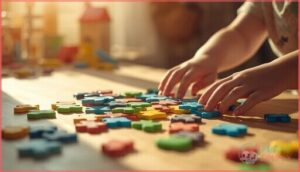
Puzzle toys offer more than just entertainment for beginners. They build essential skills that support healthy development and create positive learning experiences.
Understanding these benefits helps you choose the right puzzle toy and use it effectively.
Mental Stimulation and Cognitive Development
Your child’s brain is wiring itself for a lifetime of learning, and puzzle play accelerates that process. Research shows early puzzle exposure strengthens cognitive development in measurable ways:
- Working memory expands as children hold visual patterns in mind while manipulating pieces
- Visuospatial reasoning sharpens through block design and spatial transformation tasks
- Cognitive flexibility improves when kids practice task-switching between puzzle types
- Executive function skills like inhibition and set shifting develop faster with structured puzzle activities
Problem solving becomes second nature.
Reducing Boredom and Stress
Mental relief arrives when your child settles into focused play. Structured puzzle activities reduce idle time by up to 30% and lower observable stress behaviors like restlessness.
Calming techniques through play therapy work—regular engagement with brain teasers decreases cortisol levels and extends post-activity rest periods.
Anxiety reduction becomes tangible as puzzle toys transform scattered energy into sustained attention and routine-induced calmness.
Supporting Problem-Solving Skills
Strategy development begins when you guide your child through sequenced puzzles that demand planning ahead. Problem-solving skills sharpen as they predict outcomes and adjust their approach—cognitive development research links early exposure to beginner jigsaw puzzles with improved persistence and attention span.
These critical thinking activities build mental stimulation through easy puzzles that reward goal-directed behavior, strengthening learning strategies and skill building with every completed challenge.
Improving Fine Motor and Coordination Skills
Grip strength and hand-eye coordination improve when your child manipulates puzzle pieces during dexterity training. Fine motor control develops through pincer grasp and finger isolation—research shows measurable gains in placement accuracy after four to eight weeks of focused puzzle play.
These cognitive enhancement activities transfer directly to everyday tasks like buttoning and zipping, building spatial awareness alongside problem-solving skills and critical thinking abilities.
Types of Beginner Puzzle Toys
Beginner puzzle toys come in several basic formats, each designed to match different learning styles and developmental stages. You’ll find options that focus on physical manipulation, sensory exploration, and reward-based problem solving.
Understanding these categories helps you select puzzles that align with your child’s or dog’s natural abilities and interests.
Treat-Dispensing Puzzle Toys
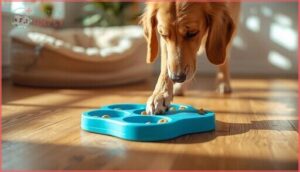
Treat-dispensing toys like the Dog Smart Interactive Treat Puzzle and Nina Ottosson designs hold edible rewards that your dog releases through simple actions—nudging, rotating, or lifting compartments. These toys support Cognitive Development while promoting Pet Mental Health through problem-solving.
Key features include:
- Gradual difficulty increases to match beginner skill levels
- Clear feedback through treat release reinforcing successful attempts
- Puzzle Toy Safety with non-toxic, dishwasher-safe materials
- Short sessions preventing frustration during Interactive Games
Interactive and Manipulation-Based Puzzles
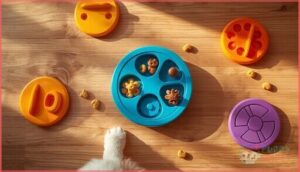
Sliding panels, flipping lids, and rotating discs transform simple play into hands-on problem-solving adventures. Interactive dog toys like the Dog Smart Interactive Treat Puzzle require your beginner to physically manipulate components, building motor skills through deliberate cause-and-effect discoveries. Each movement toward the hidden reward teaches problem-solving skills while increasing puzzle complexity gradually.
| Feature | Beginner Benefit |
|---|---|
| Sliding panels | Develops hand-eye coordination |
| Rotating compartments | Teaches sequential thinking |
| Flip-top lids | Strengthens fine motor control |
Scent-Based and Sensory Puzzle Toys
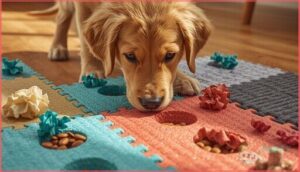
Your beginner’s nose becomes their problem-solving powerhouse with scent detection puzzles that tap into natural investigative behaviors. Vanilla and beef aromas increase engagement time by up to 40% in initial sessions, transforming sensory play into effective cognitive training.
Combine tactile stimulation through crinkle materials with aroma therapy elements to broaden puzzle complexity gradually.
These interactive dog toys support canine cognitive development while building dog training and enrichment foundations through multisensory exploration that maintains novelty without overwhelming young learners.
DIY and Simple Homemade Puzzle Ideas
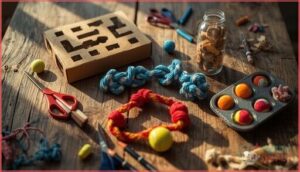
You can craft effective puzzle toys from everyday materials without spending a dime. Cardboard maze constructions with treat-sized openings develop problem-solving skills, while fabric puzzles using knotted socks challenge coordination.
Bottle games require supervised rotation to dispense rewards, and muffin challenges with tennis ball covers transform snack time into child development activities that blend learning and fun through educational games.
Choosing The Right Puzzle Toy for Beginners
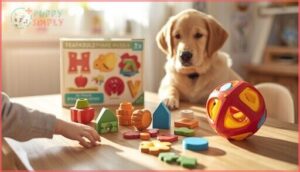
Choosing the right puzzle toy means matching it to your child’s or dog’s current abilities and safety needs. You’ll want to examine age, material quality, difficulty level, and size to guarantee the toy fosters development without causing frustration.
These factors work together to create a positive puzzle experience that builds confidence and skills.
Age and Developmental Suitability
Choosing the right puzzle requires matching it to your child’s growth milestones and cognitive development. Age-appropriate toys support learning stages without overwhelming or boring them.
- Children aged 12–24 months need simple puzzles with visible outcomes that build hand-eye coordination and early problem-solving skills
- Preschoolers (3–5 years) thrive with multi-step puzzles that encourage learning and fun through longer engagement
- School-age kids (6–8 years) benefit from strategy-based challenges that support executive function and child development
- For puppies, match toys to their teething stage and developmental needs
Material Safety and Durability
Once you’ve found age-appropriate puzzle toys, safety becomes your next concern. You need materials that meet ASTM F963 or EN71 safety certifications, ensuring non-toxic coatings and flame resistance where applicable. Durability tests confirm pieces won’t detach under normal use, preventing choking hazards.
| Safety Feature | What to Look For | Why It Matters |
|---|---|---|
| Toxic Material Standards | ASTM F963 or EN71 certified | Protects from harmful chemicals |
| Non-Toxic Coatings | BPA-free paints and finishes | Safe for mouthing and handling |
| Durability | Third-party testing verification | Prevents breakage and choking risks |
Educational toys and learning toys should withstand repeated handling while keeping your child safe.
Matching Puzzle Difficulty to Skill Level
You’ve checked the safety labels—now match the puzzle’s complexity to what your child can actually handle without getting stuck or losing interest. This approach fosters the development of cognitive skills in children.
Start with lower piece counts in beginner jigsaw puzzles, then follow a puzzle progression that respects natural learning curves. Skill assessment guides challenge adjustment, building problem-solving skills while maximizing puzzle educational value at appropriate difficulty levels.
Size and Breed Considerations for Dogs
Breed size matters when selecting dog puzzle toys for beginners. Larger breeds need durable construction to prevent breakage, while smaller dogs require toys sized to avoid choking risks.
Dog mouth structure influences puzzle toy safety. Narrow jaws struggle with deep compartments, so opt for shallow designs.
Match breed energy levels to canine cognitive load. High-energy working breeds thrive on interactive treat puzzles that channel natural problem-solving instincts.
Top Puzzle Toys for Beginners: Product Reviews
You’ve narrowed down your needs and understand what makes a good beginner puzzle toy. Now it’s time to look at specific products that deliver on those requirements.
The following reviews cover ten puzzle toys that support early learning and skill development for children and dogs just starting their puzzle journey.
1. Kong Interactive Dog Toy
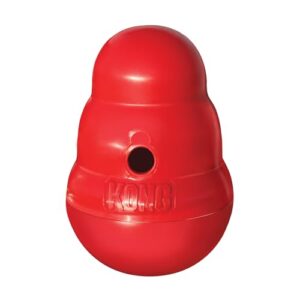
The Kong Classic stands out as a proven entry point for dog puzzle toys for beginners. You’ll stuff its hollow rubber interior with treats or peanut butter, creating an interactive treat puzzle that holds your dog’s attention during extended extraction sessions.
This durable toy aids dog training by promoting problem-solving while slowing mealtime—key for pet engagement. Its irregular shape encourages interactive play without damaging teeth, and toy durability means it withstands enthusiastic chewers.
Veterinarians recommend it as an ideal dog smart option, matching low puzzle difficulty with high reward for novice problem-solvers according to pet toy recommendations.
| Best For | Dog owners looking for a beginner-friendly puzzle toy that keeps their pet mentally stimulated while slowing down fast eaters. |
|---|---|
| Primary Material | Strong Plastic |
| Age Range | Medium to Large Dogs |
| Educational Focus | Slow Eating |
| Durability | Dishwasher Safe |
| Skill Development | Mental Stimulation |
| Price Point | Premium |
| Additional Features |
|
- Durable rubber construction that stands up to heavy chewers and is dishwasher safe for easy cleaning
- Works as both a mental challenge and slow feeder, helping dogs problem-solve while preventing gulping
- Recommended by vets and trainers as the perfect starter puzzle with adjustable difficulty based on what you stuff inside
- Can get noisy when dogs push it around on hard floors
- Smart dogs might figure it out quickly, reducing the challenge over time
- May cause frustration for anxious dogs or those new to puzzle toys
2. Mesh Pouch Storage Bags
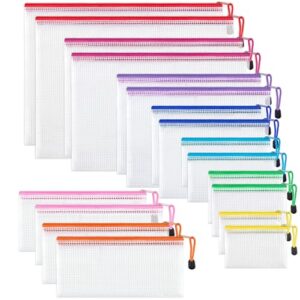
Organizing puzzle toys becomes simpler when you use mesh pouch storage bags to keep small pieces secure. These transparent storage solutions let you see contents at a glance, helping children develop early organizational skills.
Mesh materials provide airflow that prevents moisture buildup from edible treats in brain teasers, while reinforced seams guarantee bag durability through repeated use.
You’ll find they work well for puzzle organization across educational toys and toys for kids, holding wooden knobs or tokens from any puzzle box safely between play sessions. Look for double-stitched closures to maintain mesh safety standards.
| Best For | Parents and teachers who need to organize small puzzle pieces, toys, and accessories while keeping contents visible and easy to access. |
|---|---|
| Primary Material | PVC Mesh |
| Age Range | All Ages |
| Educational Focus | Organization |
| Durability | Long-Lasting |
| Skill Development | Organization Skills |
| Price Point | Budget |
| Additional Features |
|
- Transparent mesh design lets you quickly identify contents without opening each bag, saving time during cleanup and playtime
- Waterproof PVC material protects items from spills and moisture while allowing airflow to prevent mold with edible puzzle treats
- Multiple sizes and colors help you organize different toy sets and teach kids sorting skills through color-coding systems
- Zippers may break or come off with frequent use, requiring careful handling especially with younger children
- Not ideal for heavy items or rough play since the mesh material can stretch or tear over time
- Bags need regular maintenance checks to ensure closures stay functional and seams remain intact.
3. Melissa Doug Wooden Stack Sort Toy
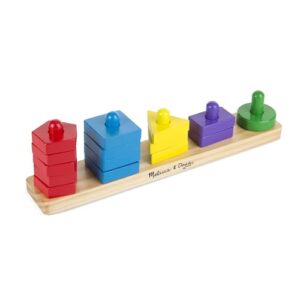
The Melissa & Doug Wooden Stack and Sort Board transforms color and shape recognition into a hands-on learning experience that builds problem-solving confidence in toddlers as young as two years old. This wooden puzzle features 15 colorful pieces that children stack onto four pegs, developing fine motor skills and hand-eye coordination through natural manipulation.
The printed key on the wooden toy’s base provides gentle guidance without removing the challenge, while solid wood construction ensures toy durability through countless learning sessions. You’ll notice improvements in counting abilities and color recognition as your child masters each stacking sequence.
| Best For | Parents looking for a durable, educational toy that helps toddlers aged 2 and up develop fine motor skills, color recognition, and shape sorting abilities through hands-on play. |
|---|---|
| Primary Material | Solid Wood |
| Age Range | 2+ |
| Educational Focus | Motor Skills & Colors |
| Durability | Durable |
| Skill Development | Fine Motor Skills |
| Price Point | $17.99 |
| Additional Features |
|
- Solid wood construction ensures the toy lasts through years of active play and learning
- Helps kids develop multiple skills at once—counting, matching, stacking, color recognition, and hand-eye coordination
- Printed guide on the base gives helpful hints without taking away the challenge of figuring it out
- Wooden pieces can be noisy when dropped on hard floors and might hurt if thrown
- Base has a thin, curved bottom that makes it tip over easily during play
- Some packages arrive with a strong paint smell that needs to air out before use
4. Melissa Doug Jungle Friends Wooden Puzzle
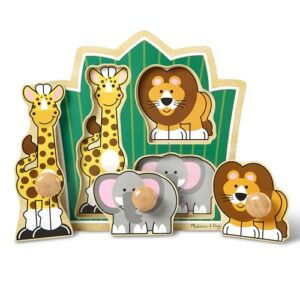
Around 12 months old, your toddler is ready for their first real puzzle challenge—and this three-piece wooden puzzle delivers exactly that. The Melissa & Doug Jungle Friends features extra-thick wooden puzzle pieces with jumbo pegs that little hands can grasp easily, while matching pictures underneath guide proper placement.
This jungle theme benefits early learners through bright safari animals (lion, elephant, giraffe) that support color recognition and shape matching. The sturdy wooden puzzle design withstands daily use, making it one of the best puzzles for developing hand-eye coordination and visual perception in beginning puzzlers.
| Best For | Parents looking for a sturdy first puzzle that helps 12-month-olds develop fine motor skills and learn basic animal recognition through easy-to-grasp jumbo pegs. |
|---|---|
| Primary Material | Wood |
| Age Range | 1+ |
| Educational Focus | Animal Recognition |
| Durability | Sturdy |
| Skill Development | Hand-Eye Coordination |
| Price Point | $11.50 |
| Additional Features |
|
- Extra-thick wooden construction and oversized knobs make it perfect for tiny hands just learning to grip and place puzzle pieces
- Matching pictures underneath each piece give helpful visual cues that build confidence and reduce frustration during early learning
- Holds up to daily toddler use and can be passed down to younger siblings, making it a solid investment at $11.50
- Only three pieces total, so most kids outgrow the challenge level pretty quickly as they approach age two
- The printed pictures on pieces can peel off if your toddler tends to mouth toys, requiring close supervision during play
- Heavy wooden construction means it could hurt if thrown during a toddler meltdown, so it’s not the safest option for unsupervised play
5. Haba Wooden Motor Skills Board
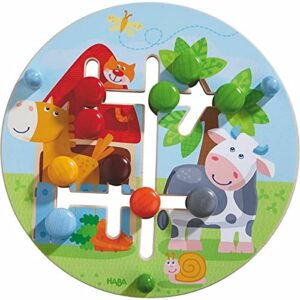
When your toddler reaches 12 months, this double-sided wooden puzzle board becomes a powerful tool for fine motor training and cognitive development. You’ll find a farm scene on one side and geometric shapes on the other, each supporting problem-solving skills as your child slides colored pieces along recessed tracks.
The German-made plywood construction meets ASTM safety standards, ensuring wooden toy safety during daily use. This Montessori-inspired design strengthens hand-eye coordination while introducing color and shape recognition—key cognitive benefits that support early STEM learning and child engagement strategies through hands-on sensory play.
| Best For | Parents looking for a durable, Montessori-inspired toy that helps toddlers aged 1-2 build fine motor skills and learn colors, shapes, and problem-solving through hands-on play. |
|---|---|
| Primary Material | Plywood |
| Age Range | 1-2 |
| Educational Focus | Shape & Color Recognition |
| Durability | High-Quality |
| Skill Development | Fine Motor Skills |
| Price Point | Mid-Range |
| Additional Features |
|
- Double-sided design with farm animals and geometric shapes keeps kids engaged while teaching color matching, shape recognition, and hand-eye coordination
- Made in Germany from sustainably sourced wood and meets strict U.S. and European safety standards, so you can trust the quality and durability
- No loose parts to lose or create choking hazards, making it safe for car rides and easy to clean up after playtime
- Some toddlers need help figuring out how to slide the pieces at first, so expect to guide them through it initially
- Younger kids under 3 might struggle with the fine motor skills needed to use the board effectively
- Sessions usually last around 10 minutes before kids lose interest, so it’s more of a short activity than an extended playtime option
6. Haba Wooden Animal Puzzle Blocks
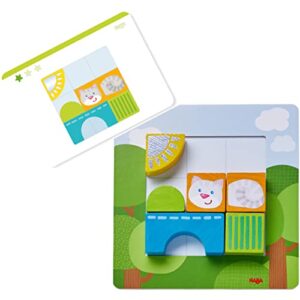
Between ages 2 and 4, you’ll see your child’s problem-solving skills blossom with these 18 colorful wooden tiles from Haba’s Animal Squares set. Your toddler grasps chunky beech blocks and matches them to 24 pattern challenges across 12 double-sided cards, strengthening fine motor skills and hand-eye coordination.
This wooden puzzle design fosters cognitive development through three difficulty levels—starting with full templates, then shape outlines, and finally abstract patterns.
You’re encouraging color recognition and animal identification while your child builds concentration, making this one of the best puzzles for sustained preschool learning.
| Best For | Parents looking for a durable wooden puzzle that grows with their toddler from age 2 to 4, supporting fine motor skills and problem-solving through progressive difficulty levels. |
|---|---|
| Primary Material | German Beech Wood |
| Age Range | 2+ |
| Educational Focus | Problem-Solving |
| Durability | Durable |
| Skill Development | Fine Motor Skills |
| Price Point | $24.99 |
| Additional Features |
|
- Three difficulty levels keep the puzzle engaging as your child’s skills develop, from simple pattern matching to abstract problem-solving
- Made from sustainably sourced German beech wood with smooth edges, built to last through years of play
- Combines multiple learning benefits in one toy—fine motor skills, color recognition, shape matching, and language development through animal themes
- The 24 pattern challenges might not provide enough variety for older preschoolers who quickly master the highest difficulty level
- Two-year-olds may struggle with the template cards initially and need significant adult guidance to understand the matching concept
- At $24.99, it’s pricier than many basic wooden puzzles, though the quality and multi-level design justify the cost for long-term use
7. Melissa Doug Wooden Safari Puzzle
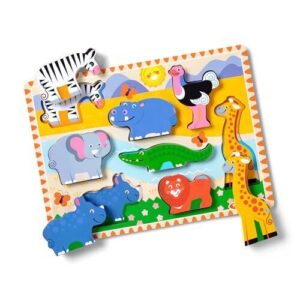
Your child’s readiness for jigsaw puzzles begins around age 2 with this safari theme puzzle—8 chunky wooden pieces that strengthen fine motor skills as small hands lift and match elephants, lions, and zebras.
The FSC-certified wooden puzzle design offers toy safety features like smooth edges and non-toxic finishes, supporting cognitive development through shape recognition.
At $9.09, you’re investing in one of the best puzzles for educational toys that builds hand-eye coordination, though some parents note the pieces lack pegs for easier removal.
| Best For | Parents of toddlers aged 2-4 who want a simple, sturdy first puzzle that teaches animal recognition and builds fine motor skills without overwhelming little learners. |
|---|---|
| Primary Material | Wood |
| Age Range | 2+ |
| Educational Focus | Animal Matching |
| Durability | FSC-Certified |
| Skill Development | Hand-Eye Coordination |
| Price Point | $9.09 |
| Additional Features |
|
- Chunky wooden pieces are perfect for small hands to grip and maneuver, making it easier for beginners to succeed
- FSC-certified wood with smooth edges and non-toxic finish means it’s safe for toddlers who are still exploring with their mouths
- At $9.09, it’s an affordable entry point into puzzle play that supports early learning without breaking the bank
- Pieces can be hard to remove from the board since they don’t have pegs or knobs to grab onto
- Some units arrive with quality issues like chipped or broken pieces right out of the box
- Only 8 pieces means kids may outgrow the challenge quickly, especially if they’re on the older end of the age range
8. Melissa Doug Musical Instrument Puzzle
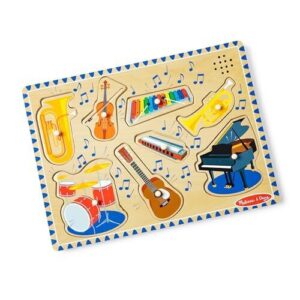
When you combine jigsaw puzzles with musical learning, your toddler gets double the educational value. Eight wooden instrument pieces trigger realistic sound effects as your child lifts and replaces each one, teaching instrument recognition while developing problem-solving skills.
Ages 2-5 will master hand-eye coordination through these puzzle games, though you’ll need 2 AAA batteries and bright lighting for consistent sound effects.
At around $15, this ranks among the best puzzles for sensory exploration, despite occasional reports of finicky sound mechanisms in low-light conditions.
| Best For | Parents looking for a screen-free toy that combines early music education with fine motor skill development for toddlers ages 2-5. |
|---|---|
| Primary Material | Wood |
| Age Range | 2-5 |
| Educational Focus | Music Appreciation |
| Durability | Sturdy |
| Skill Development | Fine Motor Development |
| Price Point | Mid-Range |
| Additional Features |
|
- Teaches instrument recognition through realistic sounds that play when pieces are lifted or placed, making learning interactive and engaging
- Sturdy wooden construction with easy-to-grasp pegs supports fine motor development and stands up to regular toddler use
- Offers dual learning benefits by combining traditional puzzle problem-solving with sensory music exploration
- Sound effects require bright lighting to activate properly and may not work reliably in dimmer rooms or during evening play
- Batteries sold separately, adding to the initial cost and requiring replacement over time
- Some users report inconsistent sound quality or malfunctioning audio mechanisms that can frustrate young children
9. Melissa Doug Sound Puzzle Toy
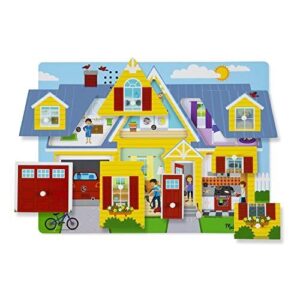
Sound effects aren’t just entertainment—they’re powerful tools for auditory learning and child development. This household-themed wooden construction features eight pieces that trigger realistic sounds when you lift them, revealing hidden pictures underneath.
Your toddler develops problem-solving skills through matching shapes while building sound-recognition abilities, making it one of the best puzzles for sensory integration. Ages 2-5 benefit most from these brain teasers, though puzzle safety requires proper battery management and adequate lighting.
At roughly $15, it’s solid value despite occasional sound-activation quirks that some puzzles for kids experience.
| Best For | Parents looking for an engaging, screen-free toy that helps toddlers ages 2-5 develop listening skills, hand-eye coordination, and problem-solving abilities through interactive sound play. |
|---|---|
| Primary Material | Wood |
| Age Range | 2-5 |
| Educational Focus | Auditory Processing |
| Durability | Sturdy |
| Skill Development | Motor Processing |
| Price Point | Mid-Range |
| Additional Features |
|
- Realistic household sounds paired with hidden pictures make learning fun and help kids connect sounds to everyday activities
- Sturdy wooden construction holds up well to repeated play while developing fine motor skills through puzzle piece matching
- Affordable price point around $15 offers solid value for a multi-sensory learning toy
- Requires 2 AAA batteries that aren’t included and may drain quickly if the puzzle isn’t turned off properly
- Sound activation depends on bright, direct light and may not work well in dimmer rooms or settings
- Some users report the puzzle occasionally makes noise on its own when lighting changes, which can be disruptive
10. Hape Wooden Alphabet Blocks Puzzle
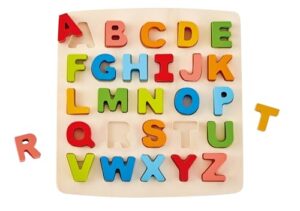
Letter-shaped blocks paired with a matching base release wooden puzzle benefits that go beyond simple play. Your child aged 2 to 5 builds alphabet learning while developing problem-solving skills through hands-on manipulation. This block design encourages letter recognition and early phonetic awareness, supporting child development milestones in literacy and fine motor control.
At around $23, it ranks among the best puzzles for educational value. The solid wood construction with non-toxic finishes meets safety standards, making it a reliable choice in educational toys for cognitive development.
| Best For | Parents looking for a durable wooden alphabet puzzle that teaches letter recognition and fine motor skills to toddlers and preschoolers aged 2 to 5. |
|---|---|
| Primary Material | Wood |
| Age Range | 2-4 |
| Educational Focus | Literacy Skills |
| Durability | High-Quality |
| Skill Development | Hand-Eye Coordination |
| Price Point | $22.99 |
| Additional Features |
|
- Solid wood construction with non-toxic, child-safe finishes that hold up to repeated use in home or classroom settings
- Supports early literacy development through hands-on letter matching, sequencing, and spatial awareness activities
- Easy to clean and maintain with simple wipe-down care, plus compatibility with other Hape wooden toys for expanded play
- Some buyers reported chipped or worn paint after delivery or heavy use over time
- Only includes uppercase letters, so no lowercase learning option for children ready to recognize both cases
- May not suit kids with specific sensitivities to wood finishes or certain materials
Tips for Introducing Puzzle Toys Successfully
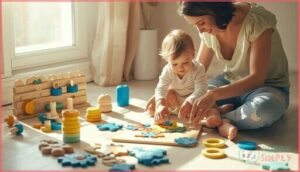
Getting started with puzzle toys doesn’t have to be complicated, but a few simple strategies can make all the difference between success and frustration. The right approach helps build confidence and keeps your child or dog motivated to keep learning.
Here’s how to introduce puzzle toys in a way that sets everyone up for long-term enjoyment and growth.
Encouraging Engagement and Avoiding Frustration
You’ll protect learning momentum by starting simple and celebrating each small win with positive reinforcement. Watch for frustration signs like tossing pieces or losing focus, then switch gears before they disengage completely.
Effective engagement strategies include setting short goals and offering subtle hints that fade as problem-solving skills grow. This balanced approach maximizes the cognitive development benefits of puzzles while keeping introduction to puzzling positive and rewarding.
Rotating Puzzle Toys for Ongoing Interest
Novelty keeps your learner hooked, so rotating puzzle toys for kids and brain teasers every week preserves that spark of discovery. A structured rotation schedule delivers sustained cognitive benefits while supporting problem-solving skills and spatial awareness.
- Swap in two to three puzzles weekly to prevent boredom
- Mix treat-dispensing toys with manipulation challenges for variety
- Conduct toy safety checks for wear or choking hazards
- Track engagement metrics like focus duration
- Introduce new textures to stimulate critical thinking
Monitoring Progress and Adjusting Challenge Level
You’ll know when to adjust difficulty levels once you track weekly success rates—aim for 80% before increasing complexity, or drop back below 40%. Record time on task, hints required, and frustration signals in a simple log.
Track weekly success rates and adjust puzzle difficulty once your learner hits 80% mastery or falls below 40%
This progress tracking fosters cognitive development and problem-solving skills, ensuring each challenge level aligns with your learner’s spatial awareness and critical thinking growth.
Frequently Asked Questions (FAQs)
Can puzzle toys help with separation anxiety?
Puzzle toys offer emotional support by keeping your child or dog mentally engaged during brief separations.
They provide anxiety relief through focused problem-solving skills, though they work best as part of gradual separation techniques.
How often should I clean puzzle toys?
After each play session, rinse your child’s puzzle toys with hot water and mild soap to control bacteria.
For daily-use items, follow a sanitation schedule of cleaning every 24 hours to guarantee proper toy hygiene and mold prevention.
Are puzzle toys safe for unsupervised play?
Most puzzle toys require supervision to prevent choking hazards and injury. Material safety and toy durability vary, so monitor your child closely during play.
These supervision tips help develop problem-solving skills while keeping kids safe.
What if my pet ignores the puzzle toy?
If your pet ignores the puzzle toy, start with shorter sessions and higher-value treats.
Lower the difficulty, add scent cues, and confirm readiness through relaxed body language before increasing challenge levels gradually.
Can multiple pets share the same puzzle toy?
Like a shared blanket that risks tug-of-war, communal play with puzzle toys demands supervision. Most dog games aren’t designed for multi-pet use, as canine enrichment works best when pets access separate feeding stations to prevent resource guarding during shared puzzle benefits.
Conclusion
Like planting seeds that grow into towering oaks, selecting the right puzzle toys for beginners sets the foundation for lifelong learning habits. You’ve explored options that match developmental stages, reviewed products balancing challenge with achievable success, and learned strategies to maintain engagement without overwhelming young minds.
Now your next step involves observation—watching how your child or dog responds, adjusting difficulty accordingly, and celebrating small victories that build confidence through purposeful play.
- https://jigsawjungle.com/blogs/news/types-of-puzzles-for-adults-kids
- https://illinoisearlylearning.org/blogs/growing/puzzle-play/
- https://pmc.ncbi.nlm.nih.gov/articles/PMC3289766/
- https://www.chinaprinting4u.com/blog/how-to-design-a-great-jigsaw-puzzle-tips-and-principles
- https://busytoddler.com/puzzles-for-kids/