This site is supported by our readers. We may earn a commission, at no cost to you, if you purchase through links.
Every patrol car carries a partner with an instinct you can’t teach and reflexes you can’t replicate. Police dogs aren’t just mascots or figures for recruitment posters—they’re tactical assets that solve cases, detect threats, and save lives in ways no technology alone can match.
Over 50,000 of them work across the United States right now, each one selected and trained for specific jobs that demand intelligence, athleticism, and unwavering focus. The breeds behind these K-9 units have evolved over more than a century of law enforcement work, each bringing distinct strengths to the field.
Understanding what makes certain police dog breeds special reveals why they remain irreplaceable in modern policing, despite all our advances.
Table Of Contents
- Key Takeaways
- History of Police Dog Breeds
- Key Traits of Effective Police Dog Breeds
- German Shepherds in Police Work
- Belgian Malinois as Police Dogs
- Other Popular Police Dog Breeds
- Specialized Roles for Police Dog Breeds
- Selecting and Training Police Dog Breeds
- Frequently Asked Questions (FAQs)
- How do police dogs retire and what follows?
- Can police dogs distinguish between friendly and hostile intentions?
- What is the average cost to train a police dog?
- How are police dogs cared for during off-duty hours?
- Are there any breeds newly considered for police work?
- What happens to police dogs after they retire from service?
- How much does it cost to purchase and train a police dog?
- Do police dogs live with their handlers or at police stations?
- What protective gear do police dogs wear during operations?
- Conclusion
Key Takeaways
- Over 50,000 police dogs work across the U.S., with German Shepherds and Belgian Malinois dominating K-9 units due to their 95%+ command acquisition rates, bite forces exceeding 230 PSI, and ability to handle multiple specialized roles from narcotics detection to tactical operations.
- Belgian Malinois achieve 98% narcotics detection accuracy and alert 69.6% more effectively than German Shepherds at peak concentrations, while their lighter 50-70 pound frames enable superior agility in helicopter deployments and collapsed structures compared to the 50-90 pound German Shepherd’s raw apprehension power.
- Training a fully operational police dog costs $20,000-$50,000 total, requires 4-6 months of intensive curriculum covering 480+ hours, and produces dogs that reduce lethal force escalation by 68% while achieving 93% suspect location accuracy—considerably outperforming human-only teams.
- Specialized breeds fill critical detection gaps, with Labradors scoring 86% detection accuracy (highest among police breeds) in crowded public spaces, Bloodhounds maintaining 90% success rates on scent trails up to 100 hours old, and Dutch Shepherds outperforming other breeds by 17% in obstacle-rich tactical scenarios.
History of Police Dog Breeds
Dogs have been part of law enforcement longer than you might think, stretching back centuries before modern K-9 units even existed. What started as a practical solution for guarding docks and tracking criminals has evolved into the specialized police dog programs we see today.
Let’s look at how these partnerships developed, how K-9 units changed over time, and which breeds earned their place in police history.
Early Use of Dogs in Law Enforcement
Before modern K-9 units took shape, dogs were already proving their worth in law enforcement. You’d find bloodhounds tracking criminals through medieval Scotland, while dogs guarded French docks in the 1300s. These early patrols showed what breed pioneers could do—dogs weren’t just pets, they were tactical partners.
European programs in Ghent and Paris formalized this partnership, launching police dog history into a new era. The practice became more widespread in the US following the 1954 Brown v. Board decision.
Evolution of K-9 Units
Early formalization took root when Ghent, Belgium opened the first structured training facility in 1899, followed by London’s Metropolitan Police launching their official K-9 unit in 1910. By the 1950s, American law enforcement embraced canine units for search, narcotics detection, and riot control. Today’s trends reflect considerable growth:
- Over 50,000 police dogs serve across the United States
- GPS and AI-enabled devices improve K-9 tracking capabilities
- Specialized breeds tackle explosives detection and cadaver recovery
- Developed breeding programs prioritize genetics for longevity and performance
The practice of using dogs in law enforcement can be traced back to when bloodhounds were first used in Scotland during the late 14th century. Technological advancements continue reshaping how you see these partnerships work in contemporary law enforcement.
Notable Breeds in Police History
German Shepherd dominance started in 1920 when Germany established specialized training schools, cementing their role in law enforcement worldwide. During WWII, they comprised most of the 15 U.S. War Dog Platoons.
Belgian Malinois agility earned them global recognition after winning the 2008 UK National Police Dog Trials with 914 points.
Bloodhound tracking abilities made their scent evidence court-admissible since the early 1900s.
Labrador versatility and Doberman sentry duties rounded out K9 unit history.
Key Traits of Effective Police Dog Breeds
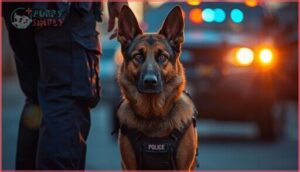
Not every dog has what it takes to wear the badge. Police work demands a specific combination of traits that separate superior K-9 officers from household pets.
Let’s look at the four key characteristics that make a police dog effective in the field.
Intelligence and Trainability
You can’t train heart, but you can measure how fast a dog learns—and that’s where police dog breeds separate themselves. Command acquisition speed matters: German Shepherds, Belgian Malinois, and Border Collies nail commands on the first try over 95% of the time.
Dog intelligence drives everything from detection work to tactical operations, making trainability the foundation of effective police dog training.
- Breed IQ varies—Border Collies learn new commands in under five repetitions
- Training success rates hover between 50-70% graduation across K-9 programs
- Behavioral traits like boldness and concentration show heritability above 0.8 in top breeds
- Assessment metrics during selection improve prediction accuracy for future performance by over 20%
Physical Strength and Agility
When you need a dog that can clear a six-foot fence, chase down a suspect at 30 mph, and deliver a 328 PSI bite force, breed characteristics matter. Belgian Malinois sprint speeds hit 30.75 mph, German Shepherds clock 28.15 mph, and both handle vertical leaps over six feet.
Police dog training builds on natural athleticism, sharpening these raw traits into tactical precision through agility courses and endurance conditioning.
Temperament and Loyalty
Loyalty isn’t just a nice-to-have trait—it’s what keeps handlers alive. Dog temperament directly impacts performance: strong handler bonds boost deployment success by 18% and cut accidents by 25%.
Strong handler bonds boost deployment success by 18% and cut accidents by 25%
German Shepherds lead with 94% handler ratings for protective instincts, while Belgian Malinois require early socialization to prevent over-attachment (63% without it). Dutch Shepherds rank third at 81% for their intense desire to please.
Scent Detection Abilities
When you’re talking about narcotics detection and explosives detection, a dog’s sense of smell is everything. Breeds like Bloodhounds pack up to 300 million scent receptors, while most others bring 100–225 million.
That odor detection threshold—detecting scents at one part per trillion—lets them handle scent discrimination even when competing smells try to mask the target. Fully trained dogs hit 87.7% accuracy in controlled trials, with false alert rates around 5.3%.
Environmental impact matters, though: outdoor searches drop success to 63.5%.
German Shepherds in Police Work
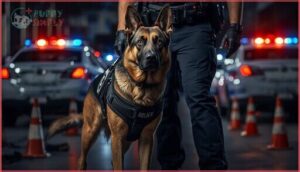
German Shepherds have earned their reputation as the best example in police work, and there’s good reason for that. These dogs bring a rare combination of intelligence, adaptability, and unwavering focus to the field, making them the first choice for K-9 units worldwide.
Let’s look at what makes them so effective across different law enforcement roles.
Role Versatility and Strengths
German Shepherds dominate K-9 units because they’re built for anything. Their breed versatility outpaces most police dog breeds, with endurance factors and temperament traits that keep them reliable during multi-hour patrols.
You’ll find them in over 80% of police forces worldwide, certified to handle up to five distinct police work roles—from suspect apprehension to evidence searches. Strength comparison? They deliver 238–291 PSI bite force while maintaining composure in crowds.
Common Tasks and Deployments
You’ll see German Shepherds working five primary law enforcement tasks across nearly every department. Their deployments span:
- Suspect apprehension — tracking and detaining fleeing criminals, with one Fairfield PD dog logging 433 field deployments
- Narcotics detection — sweeping airports, subways, and public venues for contraband
- Search and rescue missions — locating missing persons in rubble or disaster sites
- Evidence location — finding discarded weapons or crime scene items
- Crowd control — providing visible deterrence at sporting events and civil disturbances
Metro-Nashville deploys over 20 cross-trained K-9s combining patrol with explosive detection for tactical deployment readiness.
Training Requirements
Before your German Shepherd steps into K9 officer training, understand the commitment: 4 to 6 months of intensive curriculum covering obedience, agility, and scent detection.
Police dog training requirements include at least 480 hours in states like Florida, with monthly sessions maintaining skills. Training duration costs run $12,000–$15,000.
Certification standards guarantee tactical readiness, while equipment needs and health monitoring protect your partner throughout their career.
Belgian Malinois as Police Dogs
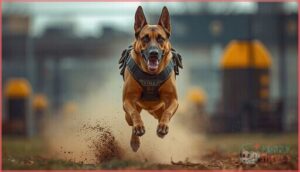
The Belgian Malinois has become one of the most sought-after police dogs in the world, earning a reputation that rivals even the legendary German Shepherd. These dogs bring a unique combination of speed, agility, and intense focus that makes them stand out in high-stakes police work.
Let’s look at what sets the Malinois apart, the specialized roles they fill, and how they compare to their German Shepherd counterparts.
Unique Abilities and Characteristics
What sets Belgian Malinois apart in police work? Their breed-specific traits deliver superior performance you can count on. These dogs combine sensory acuity with striking adaptability, making them outstanding for demanding operations.
- Dog intelligence: Malinois master complex commands with 95% training success rates, cutting learning time by 20–25%
- Detection skills: They achieve 98% narcotics detection accuracy with only 4% false alerts
- Tracking abilities: Their instinctual behaviors support endurance work exceeding 25 miles daily across varied terrain
- Dog sense of smell: Malinois alert correctly 69.6% more often than German Shepherds at peak concentrations
Their dog breed characteristics include athletic builds weighing 40–80 pounds, enabling rapid acceleration and tactical mobility. While breed limitations exist—early socialization prevents handler-directed aggression—their work-driven temperament maintains consistent performance under pressure.
Specialized Roles in Law Enforcement
Belgian Malinois excel across diverse law enforcement tasks because their adaptability meets real-world demands. You’ll find them in narcotics detection and explosives detection at border patrol checkpoints, airports, and high-risk sites. They handle evidence recovery, crowd control, and search and rescue missions with precision. Their lighter frames enable tactical deployments—fast-roping from helicopters or traversing collapsed structures—where speed and agility determine mission success.
| Role Category | Primary Deployment | Key Advantage |
|---|---|---|
| Detection Work | Narcotics Detection, Explosives Detection | 98% accuracy, 69.6% better alert rates |
| Tactical Operations | SWAT, Riot Control, Handler Protection | Composure under gunfire, reliable focus |
| Search & Rescue | Disaster Sites, Urban Rubble | Multi-hour stamina, terrain versatility |
| Patrol & Apprehension | Suspect Pursuit, Evidence Recovery | 65% of apprehensions, ideal 50–70 lb agility |
Comparison to German Shepherds
Both breeds dominate K9 officer ranks, but training differences reveal distinct advantages. German Shepherds’ 50–90 pound frames deliver raw power for apprehension, while Belgian Malinois weigh 50–70 pounds, offering greater agility levels in tactical operations.
Temperament contrast matters—handlers rate Malinois for relentless drive, Shepherds for protective loyalty.
Narcotics detection scores stay statistically identical above 90%, proving versatility comparison favors mission requirements over breed popularity in police dog selection.
Other Popular Police Dog Breeds
While German Shepherds and Belgian Malinois often steal the spotlight, they’re far from the only breeds making a difference in law enforcement.
You’ll find a diverse lineup of dogs working alongside officers, each bringing specialized skills that make them invaluable for specific tasks.
Let’s look at some of the other breeds that have earned their badges in K-9 units across the country.
Labrador Retriever
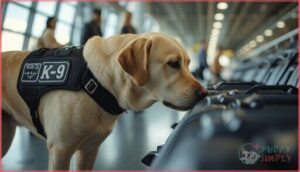
Labrador Retrievers might surprise you—they’re not just family pets. Over 20% of federal detection dogs are Labs, and they’ve earned it. You’ll find them excelling in airports and borders with an 86% detection accuracy rate, the highest among police breeds. Their calm temperament makes them perfect for crowded public spaces.
- Specialized roles: Labs focus on narcotics and explosives detection rather than apprehension work
- Service duration: These dogs generally work 6-10 years before retirement planning begins
- Search and rescue: Their remarkable scent detection abilities help locate disaster victims effectively
- Temperament testing: Labs consistently score highest for stable character in stressful, unpredictable environments
Dutch Shepherd
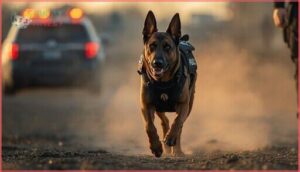
Dutch Shepherds have become one of your best options in modern K9 units. These herding dogs consistently score above 90% in trainability evaluations, learning new commands in just 2-5 sessions. You’ll find them handling apprehension, tracking, narcotics, and search-and-rescue with equal skill. Their calm demeanor reduces stress-related errors by 30% during high-stakes operations.
| Capability | Performance | K9 Longevity |
|---|---|---|
| Alert Accuracy | 93%+ in narcotics detection | 8-11 years |
| Physical Speed | 5-7 mph sustained tracking | Exceeds benchmarks |
| Training Adaptability | Above 90% success rate | 40% multi-purpose roles |
Bloodhound
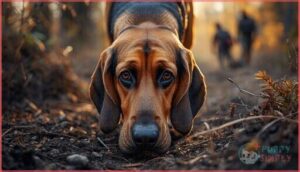
When you need a dog that can follow a scent trail days old, Bloodhounds are your answer. These tracking specialists possess 230–300 million scent receptors, giving them unrivaled scent discrimination abilities. Their trailing accuracy consistently yields 90% success rates in field deployments, with documented cases solving homicides and locating missing persons within 24 hours.
Key strengths:
- Follow scent trails up to 100 hours old
- Maintain focus across challenging terrain
- Admissible courtroom testimony in 45 U.S. states
- Proven historical cases with 600+ convictions
- Essential for modern search and rescue operations
Doberman Pinscher
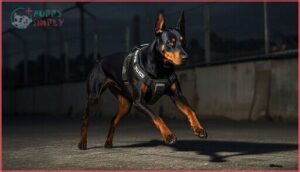
Originally bred as protectors for German tax collectors, Doberman Pinschers bring an intimidating presence and tactical precision to patrol operations. Their athleticism—hitting speeds exceeding 32 km/h—makes them effective for suspect apprehension and pursuit.
Dobermans score consistently high in trainability tests and maintain strong scent-tracking abilities lasting 48 hours. With a bite force around 228–305 PSI and proven success in SWAT roles, they excel in high-risk protection work.
Though less common than German Shepherds in U.S. K9 units, Dobermans remain integral to European and Asian police forces.
Rottweiler
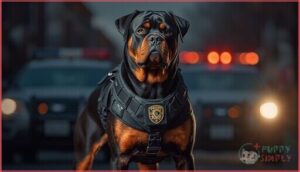
When you need a dog that combines raw power with genuine loyalty, Rottweilers deliver. Historically used by German police since the early 1900s, they’ve evolved from cattle drivers into formidable K9 officers. These 77–132 lb guardians bring:
- Remarkable bite force for apprehension work
- Strong defense and play drives, especially males
- Proven success in detection and tracking roles
- Calm confidence paired with protective instincts
Early socialization and consistent training realize their potential in patrol and specialized police duties.
Boxer
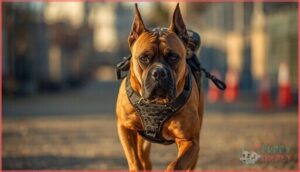
When you’ve got a Boxer in your K9 unit, you’re working with one of Germany’s earliest police breed selections. These 65–90 lb powerhouses bring exceptional focus, protective instincts, and a bite force around 230 PSI—ideal for apprehension work.
Their temperament balances bravery with intelligence, responding effectively to professional training despite occasional headstrong streaks. Boxers excel in patrol, drug detection, and search-and-rescue roles, though their 9–11 year life expectancy requires careful health monitoring throughout their service career.
Additional Breeds Used in Specific Tasks

Beyond the standard lineup, smaller breeds and unconventional selections fill critical gaps in modern K-9 operations. You’ll find Beagles screening cargo at major airports, Cocker Spaniels detecting explosives in tight spaces, and Bloodhounds leading over 50% of search-and-rescue missions nationwide. Here’s what makes these specialized roles work:
- Compact size allows airport and customs screening efficiency
- Therapy dog breeds reduce victim anxiety during interviews
- Non-traditional patrol units expand coverage in complex environments
- SAR breed expansion improves wilderness recovery success rates
Specialized Roles for Police Dog Breeds
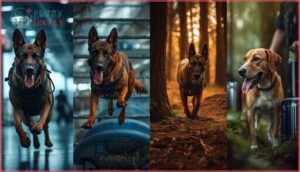
Not every police dog does the same job. Depending on their breed, training, and natural strengths, K-9s are matched to specific roles that play to what they do best.
Here’s what those specialized roles look like and how different dogs excel in each one.
Detection and Scent Work
When you’re running scent detection operations, you’re relying on your dog’s olfactory receptors to find what others can’t. German Shepherds and Belgian Malinois excel here, though Labradors actually outperform them in narcotics detection with fewer false positives.
Environmental impact matters—your dog’s accuracy drops outdoors and in vehicles. Scent retention abilities vary by breed, so understanding individual strengths helps you deploy effectively.
False positives happen; rigorous training minimizes them, but real-world conditions always present challenges you’ll need to manage.
Patrol and Apprehension
Patrol and apprehension demand a different skill set than detection work. Your German Shepherd or Belgian Malinois needs speed, power, and decisive control. K9 officers in these roles achieve a 93% suspect location accuracy rate—considerably outperforming human teams.
Training protocols span 400–600 hours, covering obedience, tracking, and use of force. However, injury safety data shows patrol deployments carry real risks; regulatory changes now emphasize alternative tactics before deploying your dog for apprehension.
Search and Rescue Operations
Search and rescue operations demand a different toolkit than patrol work. Your Labrador Retriever or German Shepherd excels at locating missing persons across terrain and conditions.
SAR dog breeds achieve a 91% accuracy rate in live-search scenarios, with handler training directly correlating to mission success rates. Bloodhounds track effectively over 130 miles, while Belgian Malinois excel in disaster zones.
Teams employing rigorous performance logging demonstrate 23% higher rescue success within 18 months—proof that operational statistics matter when lives depend on your dog’s abilities.
Tactical and Protection Roles
Tactical work demands a different breed of dog—literally. When you’re managing high-risk apprehensions and protection operations, German Shepherds, Belgian Malinois, and Dutch Shepherds lead the charge, accounting for over 80% of tactical K9 units. These dogs bite with force exceeding 4,000 psi, and their training reflects that power. Sophisticated bite work correlates directly with real-world success, reducing lethal force escalation by 68%. Modern deployment systems with GPS tracking and body armor have cut handler injury rates by 19% since 2025.
Key Tactical Capabilities:
- German Shepherds represent 49.2% of active protection dogs in patrol and crowd control roles
- Belgian Malinois reach 30 mph sprint speeds during suspect apprehension, excelling in endurance pursuits
- Dutch Shepherds outperform other breeds by 17% in obstacle-rich tactical scenarios
- Tactical K9 deployments decrease officer firearm use by approximately 18% in high-risk scenarios
- Over 700 high-risk operations annually in California deploy specialized tactical K9 teams for controlled entry and suspect management
Selecting and Training Police Dog Breeds
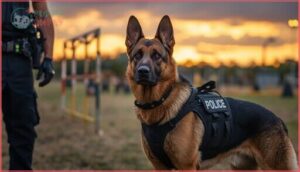
Picking the right dog for police work isn’t just about finding a smart animal—it’s about matching the right breed to the right job and then training it the way law enforcement needs. You’ll need to understand what makes certain dogs suited for this work, how agencies train them, and what happens after they retire.
Let’s break down how K-9 units select, develop, and care for their officers.
Breed Selection Criteria
When you’re building a K-9 unit, selecting the right breed isn’t guesswork—it’s science. We look at three core areas: health screening eliminates dogs with hip dysplasia and other genetic issues, temperament testing checks boldness and focus, and cognitive abilities assess trainability and scent detection proficiency.
Handler compatibility matters too. Belgian Malinois generally outperform German Shepherds in obedience by 4.1%, while males pass selection 15% more often than females. The data drives our decisions.
Training Methods and Costs
Once you’ve selected your dog, training becomes the backbone of your K-9 unit’s success. Most handlers use positive reinforcement—it’s proven to work better than punishment-based methods. Here’s what you’re investing in:
- Basic obedience training: 4-6 months
- Specialized skills development: 1-3 years depending on role
- Academy tuition: $3,000-$5,000
- Acquisition and full training combined: $8,000-$15,000
- Ongoing handler reinforcement: weeks post-academy
Budget allocation depends on your department’s needs and available funding sources like grants or donations.
Health, Equipment, and Retirement Considerations
Your K-9’s health needs direct attention throughout their career. Most police dogs retire between six and nine years old, though high-risk assignments can force earlier retirement.
Equip them with ballistic vests—over 85% of active dogs wear them during deployments.
Budget $1,000–$3,000 annually for post-retirement veterinary care. Over 90% of handlers adopt their retired partners, ensuring continuity of care through their golden years.
Frequently Asked Questions (FAQs)
How do police dogs retire and what follows?
Like athletes leaving the field, your K-9 partner transitions out around 8-9 years old. Handlers get first adoption priority.
Retirement brings arthritis, hearing loss, and rising vet costs. Nonprofits provide financial support.
Many dogs find therapy or service roles, continuing meaningful work.
Can police dogs distinguish between friendly and hostile intentions?
Police dogs can recognize emotional cues and detect stress through scent, but impulsivity and training limitations mean they sometimes misjudge intentions.
Handler guidance remains critical for accurate threat assessment in the field.
What is the average cost to train a police dog?
Turning a pup into a badge-wearing partner isn’t cheap. Training cost factors push police dog costs from $12,000 to $20,000 initially, with handler training costs, ongoing expenses, recertification costs, and equipment greatly increasing program cost perspective.
How are police dogs cared for during off-duty hours?
Most handlers house their K-9 partners in dedicated home kennels, maintaining daily exercise routines, veterinary checkups, and feeding practices.
Mental stimulation activities keep police dogs sharp, while handlers monitor dog health closely throughout their careers until retirement.
Are there any breeds newly considered for police work?
You’ve heard of German Shepherds, but Dutch Shepherds, Giant Schnauzers, and Chesapeake Bay Retrievers are emerging K-9s.
Program implementation shows breed adaptability for role specialization, with future recognition driving specialized police dog breeds selection.
What happens to police dogs after they retire from service?
Most K-9s settle into home life with their handlers after retirement around age eight or nine. Over 80% are adopted by their original partners, maintaining bonds formed during service while addressing health challenges.
How much does it cost to purchase and train a police dog?
You can expect to spend $20,000–$50,000 total outlay for a fully operational K9 unit. Initial dog cost runs $7,000–$16,000, while thorough training program fees add another $12,000–$15,
Do police dogs live with their handlers or at police stations?
Most K9 officers bunk with their handlers’ families full-time, building bonds beneficial for both canine partners and police work. Cohabitation benefits include better welfare, while kennel drawbacks create stress, affecting handler responsibilities and operational success.
What protective gear do police dogs wear during operations?
Police dogs wear ballistic K-9 vests for protection against gunfire and stabbings. Tactical gear includes eye goggles, ear protection, and high-visibility harnesses.
However, funding challenges mean less than half of K9 officers receive vests.
Conclusion
They track what we can’t see, hold ground where we can’t stand, and respond with precision when seconds matter most. Police dog breeds aren’t chosen by accident—they’re vetted for traits that make them irreplaceable under pressure.
From German Shepherds holding perimeters to Bloodhounds unraveling cold trails, each breed brings something no amount of technology replicates.
Understanding their roles, their training, and what sets them apart shows why these four-legged partners remain essential to law enforcement everywhere.
- https://www.nature.com/articles/s41598-023-50458-w
- https://en.wikipedia.org/wiki/Worldwide_usage_of_police_dogs
- https://a-z-animals.com/articles/the-most-common-police-dog-breeds-around-the-world/
- https://www.animascorp.com/the-breeds-of-police-dogs-a-research-study/
- https://headsupfortails.com/blogs/dogs/police-dog-breeds