This site is supported by our readers. We may earn a commission, at no cost to you, if you purchase through links.

A dog’s pregnancy moves faster than most owners expect. From conception to delivery, the entire journey usually spans only 58 to 68 days—roughly nine weeks.
That short window means every stage happens quickly, and the signs can sneak up on you if you’re not watching closely. Knowing how long a dog is pregnant matters more than you’d think.
It shapes everything from when you schedule vet visits to how you adjust her diet and activity level. Understanding the timeline, the signs to watch for, and the care she needs along the way will keep both her and her puppies on track.
Table Of Contents
- Key Takeaways
- How Long Are Dogs Pregnant?
- Signs Your Dog is Pregnant
- How Veterinarians Diagnose Dog Pregnancy
- Stages of Dog Pregnancy Week by Week
- Caring for Your Pregnant Dog
- Frequently Asked Questions (FAQs)
- How many months is a dog pregnant for?
- How do I stop my dog from getting pregnant after she got stuck?
- How long does a dog pregnancy last?
- When does a dog give birth?
- What is the normal gestation period of a dog?
- How long does it take a dog to get pregnant?
- Can a dog be 3 months pregnant?
- How long after mating can you tell a dog is pregnant?
- How many puppies can a dog have for the first time?
- How do dogs hormonal changes affect behavior?
- Conclusion
Key Takeaways
- A dog’s pregnancy lasts roughly 58 to 68 days (about nine weeks), with the exact timeline shifting based on breed size—smaller dogs tend to deliver a few days earlier than larger breeds.
- Early pregnancy signs like nipple swelling, subtle weight gain, and behavioral changes (nesting, social withdrawal) typically appear around weeks 4–5, so catching them requires close, consistent observation.
- Your vet can confirm pregnancy through hormone tests (relaxin and progesterone), abdominal palpation around week four, or ultrasound as early as week three—each method works best at a specific stage.
- Proper prenatal care—gradually increasing calories by 15–25%, keeping exercise gentle and short, and scheduling regular vet checkups—gives both mom and her puppies the healthiest possible start.
How Long Are Dogs Pregnant?
If you’re expecting puppies, the first question on your mind is probably “how long until they arrive?”
Understanding the timeline helps you prepare, and so does knowing the key milestones and signs your dog is ready to begin.
Dog pregnancy is surprisingly quick compared to humans, but the exact timeline can vary.
Let’s look at what determines how long your dog will be pregnant and what you can expect.
Average Gestation Period
Your dog’s pregnancy usually lasts about 63 days from the moment of fertilization—that’s roughly nine weeks from start to finish. Most canine reproductive health experts measure gestation length from ovulation, which gives us the most accurate pregnancy duration for tracking fetal development and prenatal care for dogs.
Here’s what you should know about the typical gestation period:
- Most pregnancies fall between 58 and 68 days, with delivery usually happening right around day 63
- Toy breeds often deliver earlier (around 58-66 days), while giant breeds may reach 65-68 days
- Your veterinarian calculates the due date based on breeding timing, not just when mating occurred
Pregnancy duration in dogs can be compared to the general, which also varies by species and breed.
Factors That May Affect Pregnancy Duration
While the typical gestation period holds steady around 63 days, several factors can nudge your dog’s pregnancy timing a bit earlier or later. Genetic influence plays a role—some bloodlines naturally deliver sooner.
Maternal age and nutritional effects matter too, as older dogs or those with suboptimal diets may experience subtle shifts. Environmental factors and fetal growth rate can also affect when labor begins during canine reproductive health events.
Notably, studies in humans show that biological factors affecting conception can substantially influence the time to pregnancy.
Breed Size and Pregnancy Length
One surprising element often overlooked: larger breeds usually carry their litters for 63 to 66 days, while smaller dogs often whelp closer to 58 to 63 days.
Larger breeds carry their litters up to a week longer than smaller dogs, a subtle size-driven shift most owners never expect
This gestation variance reflects breed factors tied to uterine capacity and litter size—big dogs frequently deliver fewer puppies, which can subtly extend pregnancy duration. Understanding these pregnancy stages helps you anticipate your dog’s whelping window and prepare accordingly during canine reproduction.
Signs Your Dog is Pregnant

Spotting pregnancy in dogs isn’t always straightforward, especially in the first few weeks when changes are subtle.
Early signs like subtle appetite shifts and slight lethargy are easier to catch when you understand the week-by-week pregnancy timeline for dogs.
Your dog’s body and behavior will shift as the pregnancy progresses, giving you clues along the way. Here’s what to watch for from the earliest days through the final stretch before delivery.
Early Physical Changes
Your dog’s body doesn’t waste time announcing pregnancy. Within the first few weeks, you’ll notice breast changes—nipples darken and swell as milk-producing glands gear up. Abdominal enlargement becomes subtle but visible by week four due to uterine expansion. Hormonal shifts drive these physical symptoms, and understanding dog pregnancy stages helps you recognize what’s normal.
- Breast tissue becomes pinkish and slightly swollen by weeks 4-5
- Abdomen appears rounder as the uterus enlarges to house embryos
- Teats darken in color with increased blood flow
- Weight gain occurs from fluid retention and metabolic changes
Behavioral Changes During Pregnancy
Pregnancy anxiety reshapes your dog’s canine mood in predictable ways. You’ll see social withdrawal as she bonds more closely with you and seeks quieter spaces.
Nesting behavior emerges around week five—she’ll rearrange blankets or inspect corners repeatedly, driven by maternal instinct. These dog pregnancy symptoms reflect hormonal shifts that prepare her mentally for motherhood, so don’t worry if she seems clingy or less playful than usual.
Mid to Late Pregnancy Symptoms
As your dog moves through the final weeks, her body visibly transforms. Swelling in the abdomen signals rapid fetal development, while restlessness and nesting intensify—classic dog pregnancy symptoms tied to whelping preparation.
Watch for breathing changes or appetite shifts, as these pregnancy symptoms in dogs can hint at pregnancy complications. Maintaining consistent prenatal care and monitoring canine health ensures a smoother progression into postpartum care.
How Veterinarians Diagnose Dog Pregnancy
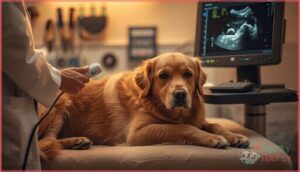
Spotting pregnancy in dogs isn’t always straightforward, especially in the early weeks.
That’s why veterinarians rely on a handful of reliable diagnostic methods to confirm what’s going on. Here’s what your vet will likely use during those checkups.
Hormone Tests
Blood tells a story — and in canine endocrinology, your vet knows exactly how to read it. Early pregnancy exams rely on measuring specific hormones to confirm conception and track fetal development. A relaxin test detects a pregnancy-specific protein, while progesterone checks confirm an LH surge occurred. These hormone levels guide everything.
- Relaxin Test — detects pregnancy-specific hormones early on
- Progesterone Checks — confirm successful ovulation via LH surge
- Hormone Levels Panel — monitors fetal development progression
Palpation
Your vet’s hands are actually a powerful diagnostic tool. During an abdominal exam, veterinary palpation uses gentle, steady pressure to assess tissue and detect uterine changes linked to dog pregnancy stages.
This diagnostic touch technique helps confirm pregnancy around week four. It’s quick, non-invasive, and guides your vet toward the next steps in monitoring your pregnant dog’s canine pregnancy progression.
Ultrasound
Ultrasound Technology is where prenatal care gets a real boost. This safe, non-ionizing tool gives your vet a live window into your dog’s womb during pregnancy scanning.
Using Diagnostic Modes like B-mode imaging, we can confirm dog pregnancy stages with clarity. Image Quality improves with the right probe frequency, and Fetal Monitoring helps track heartbeats early on — all under solid veterinary guidance.
- Detects embryos as early as week three or four
- Reveals fetal heartbeats using M-mode assessment
- Tracks puppy growth and positioning throughout dog pregnancy stages
- Guides prenatal care decisions without any radiation exposure
X-Ray
X-rays become one of your most powerful diagnostic tools during the final weeks of canine pregnancy. This medical imaging technique lets us count puppies and check their positioning before delivery — critical information for pregnancy care planning.
Xray Technology does involve radiation, so radiation safety protocols keep your dog protected. Veterinary care teams use image quality standards and proper shielding to guarantee this remains a safe, reliable diagnostic tool throughout the gestation period.
Stages of Dog Pregnancy Week by Week
Once your dog has been bred, a lot happens behind the scenes — and most of it you won’t see coming. Knowing what’s going on week by week helps you stay ahead of any changes and keep your dog comfortable throughout.
Here’s how the pregnancy unfolds from start to finish.
Weeks 1-3: Fertilization and Implantation

These first three weeks are where the magic quietly begins. During this phase of dog pregnancy, fertilization kicks off a cascade of rapid biological changes. Here’s what’s happening inside your dog:
- Fertilization and Genetic Activation — The zygote forms and begins activating its own genome, guiding early cell divisions.
- Embryo Formation — The morula develops into a blastocyst, ready for implantation.
- Uterine Changes and Hormonal Shifts — Progesterone rises to prepare the endometrium, supporting the embryo’s attachment.
Throughout this early gestation period, your dog’s reproductive health is shifting silently — no visible signs yet, but development is already well underway.
Weeks 4-6: Embryo Development

Once implantation settles in, weeks four through six mark a dramatic shift — your dog’s embryos are now actively shaping into recognizable fetuses. The Neural Tube closes and begins forming the brain and spinal cord. Organ Development accelerates as the heart starts beating around day 22. Placenta Growth establishes nutrient exchange, while Embryo Formation structures solidify rapidly.
| Week | Key Developmental Landmark | What’s Happening |
|---|---|---|
| Week 4 | Fetal Heartbeat begins | Heart tube forms and starts beating |
| Week 4–5 | Neural Tube closure | Brain and spinal cord begin developing |
| Week 5 | Organ Development | Liver, kidneys, and lung buds emerge |
| Week 5–6 | Placenta Growth | Nutrient and gas exchange becomes functional |
| Week 6 | Embryo Formation completes | Limb buds, facial features, and somites visible |
During this window of dog pregnancy, each embryo reaches roughly 8 millimeters in length. That’s remarkably small — yet already unmistakably alive. Understanding this phase of Gestation Period helps you appreciate just how quickly dog health and pregnancy evolve behind the scenes.
Weeks 7-9: Final Development and Preparation

Now things really pick up. Where weeks four through six laid the groundwork, weeks seven through nine are all about Fetal Organ Maturation and final growth.
Your fetuses gain fat, organs finish maturing, and Mammary Gland Prep begins for nursing. Increased Rest becomes important here — your dog needs it.
By Week Nine, whelping is close. Keep an eye on dog nutrition and health throughout.
Caring for Your Pregnant Dog

Once you know your dog is pregnant, the way you care for her over those next few weeks makes a real difference.
From what she eats to how much exercise she gets, the details add up.
Here’s what you need to focus on to keep her healthy and comfortable throughout the process.
Nutrition and Diet Requirements
What you feed your dog during pregnancy shapes fetal development more than you might expect. Proper nutrient balance — think quality protein, essential fatty acids, and key prenatal vitamins — becomes the foundation of canine nutrition during this time.
Gradually increase calories by 15–25%, feed smaller meals, and consult your vet about pregnancy supplements. Good dog nutrition and health starts with intentional pet care during pregnancy.
Exercise and Activity Guidelines
Surprisingly, keeping your dog active during pregnancy actually promotes a healthier outcome for both mom and puppies. Think of prenatal fitness as gentle maintenance — not a workout challenge. Canine exercise during dog pregnancy doesn’t need to be intense to be effective. Safe activities and pregnancy workouts should prioritize low-impact movement and comfort.
- Warm up first — A 5-minute gentle walk increases blood flow and protects joints before any activity.
- Keep it moderate — Aim for slight breathlessness only; avoid sprinting or jumping entirely.
- Watch the clock — Short 10–15-minute sessions work better than long, draining ones.
- Skip the heat — Schedule activity during cooler parts of the day to reduce overexertion risk.
- Listen to her body — Persistent fatigue or panting means it’s time to rest and reassess.
Consistent pet care during pregnancy means balancing dog health and wellness with your dog’s changing energy levels. Postpartum recovery starts now — gentle routine today builds strength for delivery tomorrow.
Veterinary Care and Checkups
Regular prenatal exams are one of the smartest investments you can make during this time. Your vet will use health monitoring techniques — blood work, ultrasound, and palpation — to track fetal growth and catch complications early.
Veterinary guidance also covers pregnancy nutrition planning and postpartum care prep. Think of each checkup as a progress report: reassuring, informative, and essential to veterinary medicine done right.
Preparing for Labor and Delivery
Three signs of dog labor you can’t ignore: restlessness, nesting, and a drop in body temperature. Once whelping begins, have your whelping box ready and warm.
- Watch for labor signs — pacing and hiding often start 12–24 hours before delivery.
- Prepare your whelping box — line it with clean towels in a quiet, draft-free space.
- Monitor the delivery process — each puppy usually arrives within 1–2 hours.
- Plan postpartum care and newborn health checks — contact your vet if labor exceeds 12 hours.
Frequently Asked Questions (FAQs)
How many months is a dog pregnant for?
Most dogs stay pregnant for roughly two months. Canine Duration from conception to birth usually falls between 58 and 68 days — which, in Month Conversion terms, means about 9 to 3 Average Months.
How do I stop my dog from getting pregnant after she got stuck?
Act fast — contact your vet within 24 to 48 hours after mating.
Your veterinarian can assess whether your dog is pregnant and guide the safest veterinary intervention for your situation.
Pregnancy prevention options include emergency spay and contraception methods.
How long does a dog pregnancy last?
Think of canine reproduction as a surprisingly swift journey.
Dog pregnancy usually lasts around 63 days—roughly nine weeks—though gestation stages can stretch anywhere from 58 to 70 days depending on breed size and fetal development timing.
When does a dog give birth?
Most dogs give birth around day 63 of dog pregnancy. Watch for Labor Signs like nesting and restlessness — these signal whelping is near.
The Birth Process and Puppy Delivery usually unfold within 3–12 hours, followed by essential Postpartum Care.
What is the normal gestation period of a dog?
The normal gestation period for a pregnant dog is roughly 63 days from ovulation—about nine weeks total.
Fetal development progresses through distinct pregnancy stages, though your dog’s exact breeding timeline may shift a few days based on fertilization timing.
How long does it take a dog to get pregnant?
Conception time depends on your dog’s Estrous Cycle. During the dog heat cycle, fertilization can happen within hours of successful breeding.
Fertility factors like ovulation timing shift pregnancy confirmation windows, but conception itself is remarkably quick once conditions align.
Can a dog be 3 months pregnant?
No — a dog pregnant for 3 months would far exceed the normal gestation timeline.
Most dogs deliver between days 56 and
Beyond 70 days, you’re looking at serious canine health risks.
Your vet should evaluate immediately.
How long after mating can you tell a dog is pregnant?
After mating, most signs of pregnancy confirmation emerge around days 20 to
Watch for subtle conception signs like appetite shifts or nipple changes — early markers that, alongside proper breeding timing, hint at fetal development underway.
How many puppies can a dog have for the first time?
First Time Breeding usually yields one to six puppies, though Breed Variations play a big role.
Litter Size Factors like the dam’s health and Puppy Count averages shift with size — smaller breeds lean toward fewer.
How do dogs hormonal changes affect behavior?
Surprisingly, even ancient breeders noticed this: hormones reshape everything.
Hormone Driven Aggression, Social Bonding shifts, Stress Hormones, and Reproductive Cycle changes all drive Behavioral Changes.
Maintaining Hormonal Balance through your vet aids Fertility Issues and a calmer, healthier dog.
Conclusion
Nine weeks might as well be nine days in terms of how long a dog is pregnant—the entire timeline truly moves like lightning.
But armed with the right knowledge, you simply won’t be caught off guard. Watch for the early signs, keep your vet closely involved, and adjust her nutrition and activity level as each stage unfolds. Stay attentive throughout, and you’ll give her and those puppies the strongest possible start in life.