This site is supported by our readers. We may earn a commission, at no cost to you, if you purchase through links.

Your dog’s brain needs a workout just as much as their body does, yet most pet owners focus entirely on physical exercise while mental stimulation gets overlooked. A bored mind doesn’t just sit idle—it finds outlets, often in the form of chewed furniture, excessive barking, or anxious behaviors that leave you frustrated and your dog unfulfilled.
Puzzle toys help dogs mentally by engaging their problem-solving abilities, tapping into natural foraging instincts, and providing the cognitive challenges that keep their minds sharp and satisfied. These interactive tools transform mealtime or playtime into brain-training sessions that reduce destructive habits, lower stress levels, and support long-term cognitive health.
Understanding how these toys work and choosing the right ones for your dog’s skill level can turn daily mental exercise into an essential part of their wellness routine.
Table Of Contents
- Key Takeaways
- What Are Puzzle Toys for Dogs?
- How Puzzle Toys Stimulate Canine Minds
- Cognitive Benefits of Puzzle Toys
- Behavioral Improvements With Puzzle Toys
- Physical and Emotional Wellness Support
- Types of Puzzle Toys and Their Uses
- Choosing The Right Puzzle Toy for Your Dog
- Tips for Introducing Puzzle Toys Successfully
- Top 5 Puzzle Toys for Mental Stimulation
- Frequently Asked Questions (FAQs)
- Conclusion
Key Takeaways
- Puzzle toys engage your dog’s problem-solving abilities and natural foraging instincts, providing essential mental exercise that reduces destructive behaviors like excessive chewing, barking, and anxiety-driven habits.
- These interactive tools strengthen cognitive function across all life stages by building memory, encouraging independent thinking, and maintaining neural pathways that protect against age-related mental decline in senior dogs.
- Matching puzzle difficulty to your dog’s current skill level prevents frustration while promoting steady progress—start with simple one- or two-step challenges and gradually increase complexity as your dog masters each level.
- Beyond mental stimulation, puzzle toys slow down fast eaters to improve digestion, provide healthy energy outlets that complement physical exercise, and build confidence through achievement-based rewards.
What Are Puzzle Toys for Dogs?
Puzzle toys are interactive tools designed to challenge your dog’s mind by requiring them to solve problems in exchange for a reward, usually food or treats. These toys come in various forms—from sliding compartments to hidden treat pockets—each designed to engage different cognitive skills and natural behaviors.
Pairing puzzle toys with daily walks creates a balanced routine that keeps your dog mentally sharp and physically healthy.
Understanding what makes a puzzle toy effective starts with knowing the core features, challenge types, and materials that best suit your dog’s needs.
Definition and Core Features
A puzzle toy is an interactive object that challenges your dog to think and reason to access a hidden reward, usually treats or kibble. Core features include movable components like sliding panels or rotating dials, adjustable difficulty levels, and food-based reinforcement that links problem solving to cognitive development.
These interactive elements promote mental stimulation and improve your dog’s overall mental health through deliberate engagement.
Types of Challenges Puzzle Toys Offer
These interactive toys engage your dog through distinct challenge types, each targeting different cognitive skills. Treat dispensing puzzles vary in how rewards are released—some drop one piece at a time, while others require multiple actions to release a final prize.
Common challenge formats include:
- Sliding compartments that reveal treats when pushed in sequence
- Rotating dials requiring precise movements to access rewards
- Layered fabrics hiding kibble for sniffing and foraging
- Lift-and-flip mechanisms combining fine motor skills with problem solving
- Maze pathways where dogs route treats through multiple dead ends
Each format strengthens memory, spatial reasoning, and sustained focus. These toys can also help prevent boredom and destructive habits by offering.
Materials and Durability Considerations
When selecting dog puzzle toys, material selection determines both safety and longevity. Look for BPA-free plastics or high-quality rubber blends that pass durability tests for heavy chewers.
Safety certifications confirm non-toxic coatings, while surface textures should resist gouging without irritating gums.
Structural integrity matters—reinforced seams and interlocking components prevent breakage during intense play, ensuring your interactive dog toys withstand daily problem-solving sessions.
How Puzzle Toys Stimulate Canine Minds

Your dog’s brain thrives on challenges that mirror the work their ancestors did in the wild. Puzzle toys tap into this need by creating mental tasks that require focus, strategy, and persistence.
Let’s examine the three core ways these toys stimulate your dog’s cognitive abilities.
Mental Enrichment Through Problem-solving
When your dog nudges, paws, or sniffs out hidden treats from compartments, they’re building Problem Solving Skills and sharpening Canine Intelligence through each attempt. Puzzle Toys demand sustained Mental Stimulation, engaging memory circuits and spatial reasoning for 5 to 15 minutes per session.
This hands-on Cognitive Enrichment for Dogs strengthens neural pathways, supporting long-term Brain Health and Canine Cognitive Development as they master progressively challenging tasks. Teaching pets and people effective is also recognized as essential for overall well-being.
Encouraging Natural Instincts and Curiosity
Your dog’s innate drive to explore, sniff, and forage comes alive when you introduce puzzle toys that hide treats. These tools provide Sensory Stimulation and Natural Exploration, tapping into Instinctual Play behaviors that spark Curiosity Development and Mental Stimulation.
Each sniff, paw, and nudge reinforces Problem Solving through Interactive Play, supporting Canine Enrichment and Dog Mental Health while promoting Cognitive Development in a rewarding, species-appropriate way.
Promoting Independent Thinking
Autonomy transforms how your dog approaches challenges, building Critical Thinking and Mental Agility through self-directed exploration.
Puzzle Toys encourage Independent Learning by letting your furry friend:
- Test different strategies without immediate guidance
- Learn from trial and error at their own pace
- Choose which method to attempt first
- Build confidence through personal discoveries
- Develop Problem Solving skills that strengthen Canine Cognitive Function
This process fosters lasting Cognitive Development and Mental Stimulation.
Cognitive Benefits of Puzzle Toys

Puzzle toys do more than just keep your dog busy—they actively shape how their brain works. When your dog engages with these challenges regularly, you’ll see measurable improvements in memory, problem-solving speed, and overall cognitive function.
Here’s how puzzle toys support your dog’s mental development across different stages of life.
Enhancing Memory and Learning Skills
Think of your dog’s brain as a muscle that gets stronger with every puzzle session. Puzzle toys sharpen short-term memory by making your dog recall where treats hide, while repeated wins build long-term recall patterns. Clear cues during play boost learning speed, and varied reward locations train flexible problem-solving skills that stick.
| Memory Type | How Puzzles Help | Training Tip |
|---|---|---|
| Short-term | Recalling treat locations during sessions | Use consistent hiding spots initially |
| Long-term | Building routine recall across multiple plays | Repeat successful solutions regularly |
| Working memory | Testing multiple strategies per session | Gradually increase puzzle complexity |
Supporting Long-term Brain Health
Regular mental stimulation through puzzle toys protects your dog’s cognitive function well into senior years. Canine cognitive stimulation maintains neuroplasticity, the brain’s ability to form new connections, which preserves mental sharpness as aging minds slow.
Consistent cognitive enrichment fosters overall mental health and dog cognitive development by keeping neural pathways active. Structured brain development activities reduce age-related decline, helping your furry friend stay alert and engaged throughout life.
Adapting to Your Dog’s Cognitive Level
Matching puzzle difficulty to your dog’s cognitive abilities ensures steady progress without frustration. Cognitive assessment every 2 to 4 weeks lets you track canine intelligence and adjust challenges as your furry friend masters new skills.
- Start simple and add steps gradually to support dog learning and mental adaptation
- Observe attention span to pace cognitive enrichment sessions effectively
- Rotate puzzle types to broaden cognitive abilities and encourage flexible problem solving
Proper difficulty alignment strengthens dog cognitive development while maintaining engagement and confidence.
Behavioral Improvements With Puzzle Toys
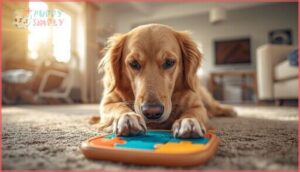
Puzzle toys don’t just sharpen your dog’s mind—they reshape how your dog behaves day to day. When your furry friend has a productive outlet for mental energy, you’ll notice fewer problem behaviors and a calmer, more balanced companion.
Let’s look at three specific ways puzzle toys improve your dog’s behavior.
Reducing Boredom and Destructive Habits
When your dog shreds couch cushions or digs through trash, it’s often a signal that mental stimulation is lacking. Puzzle toys become boredom busters by replacing idle time with purposeful problem-solving, reducing destructive behaviors like chewing baseboards or scratching doors. Interactive toys channel energy into canine enrichment activities that discourage habit formation around unwanted actions, while dog engagement stays high through varied challenges.
| Boredom Sign | Destructive Habit | Puzzle Toy Solution |
|---|---|---|
| Restlessness | Excessive chewing | Treat-dispensing challenges |
| Whining | Digging furniture | Interactive puzzle boards |
| Pacing | Shredding items | Snuffle mat foraging |
| Attention-seeking | Scratching doors | Rotating toy variety |
| Hyperactivity | Trash raiding | Daily enrichment routine |
Dog puzzle toys provide structured mental stimulation that prevents boredom from escalating into property damage or disruptive behaviors.
Alleviating Anxiety and Stress
Beyond curbing destructive behavior, puzzle toys offer anxiety relief by engaging your dog’s senses and shifting focus away from stressors like thunderstorms or separation anxiety. Slow, deliberate problem-solving lowers cortisol levels, supporting stress management and mental wellbeing through predictable rewards that reinforce calm responses.
- Focused play diverts attention from triggers, promoting pet anxiety relief during loud events
- Tactile engagement soothes nervous energy, supporting dog mental health and wellness
- Routine puzzle sessions signal safety, easing separation anxiety through consistent calming techniques
Encouraging Focus and Patience
Puzzle toys strengthen your dog’s ability to build concentration by demanding multi-step problem-solving skills until a reward emerges. Strategic exploration through interactive toys teaches your furry friend to pause and reassess, turning mental stimulation into controlled, purposeful engagement rather than frantic trial and error.
Start with quiet playzone sessions, then track progress as you introduce gradual challenge levels that boost cognitive abilities without overwhelming patience.
Physical and Emotional Wellness Support

Puzzle toys don’t just sharpen your dog’s mind—they also support physical health and emotional balance in ways you mightn’t expect. From slowing down mealtime to building self-assurance, these tools offer benefits that extend well beyond mental exercise.
Let’s look at three key ways puzzle toys contribute to your dog’s overall wellness.
Slowing Down Fast Eaters for Better Digestion
When your furry friend gulps kibble in seconds, you’re not just watching bad eating habits—you’re risking bloat and poor digestion health. Puzzle toys and slow feeders transform meal timing into a mindful activity, requiring your dog to work for each bite through food pacing challenges.
Treat dispensing toys and food dispensing toys extend eating sessions, giving the stomach time to process food gradually and improving overall dog feeding and nutrition outcomes.
Providing a Healthy Outlet for Energy
When you need energy release methods that go beyond a walk, interactive toys and dog puzzle toys deliver both physical stimulation and mental fatigue. These boredom busters turn playful exercise into calming activities by requiring your pup to manipulate, sniff, and solve challenges that drain excess stamina.
Rotating dog mental stimulation options keeps sessions fresh, ensuring consistent mental stimulation across days rather than repetitive bursts.
Boosting Confidence Through Achievement
Success creates momentum, and each solved challenge offers mental milestones that strengthen your dog’s belief in their cognitive abilities. Dog puzzle toys become confidence boosters when you match difficulty to skill level, letting problem-solving skills grow through safe practice.
- Skill mastery develops as repeated wins prove competence in new tasks
- Positive reinforcement links effort to achievement rewards, reducing hesitation
- Mental stimulation through progressive challenges sustains curiosity and self-assurance
- Canine mental health improves when successful experiences build trust in their abilities
Types of Puzzle Toys and Their Uses
Not all puzzle toys work the same way, and understanding the different types helps you choose what’s right for your dog. Each category targets specific behaviors, from natural foraging instincts to mealtime management.
Here are the main types of puzzle toys and how they benefit your furry friend.
Treat-dispensing Toys

When your dog rolls a treat-dispensing ball across the floor, you’re watching canine enrichment in action. These food-dispensing toys release kibble or treats through adjustable openings as your dog nudges, bats, or tips them, turning mealtime into interactive play.
Reward systems built into these puzzle toys encourage sustained problem-solving while slowing down fast eaters, making them essential tools for dog mental stimulation and digestive health.
Interactive Puzzle Boards
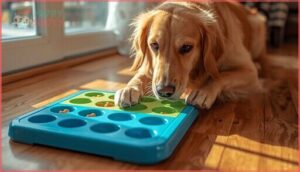
Interactive puzzle boards transform your furry friend’s downtime into a cognitive challenge, featuring sliding covers, rotating disks, and hidden compartments that demand deliberate problem solving.
These dog training and behavior tools offer:
- Flat surfaces with recesses requiring distinct motions like flipping or lifting
- Adjustable difficulty through sequence actions and layered compartments
- Durable materials including high-density plastic or natural hardwood
- Non-slip bottoms and raised rims for safe interactive play
- Removable components for easy cleaning and customization
Regular sessions with these interactive toys build focus while extending feeding time naturally.
Snuffle Mats and Scent-based Toys

Your dog’s nose holds up to 300 million scent receptors—that’s why snuffle mats and scent-based toys tap directly into canine olfaction for powerful mental stimulation.
Dogs have 300 million scent receptors, making snuffle mats and scent toys exceptionally effective for mental stimulation
These foraging toys hide kibble within fabric folds or perforated pockets, encouraging deliberate nose games rather than quick gulping. Most feature machine-washable fleece on non-slip bases, turning mealtime into enriching scent work that calms anxious dogs while engaging natural hunting instincts.
Slow Feeder Puzzles
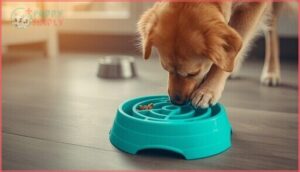
Raised ridges and rotating chambers transform your dog’s bowl into a multi-step challenge that extends meal duration by two to fifteen times compared with standard dishes.
Slow feeders combine problem-solving with safer digestion, offering adjustable puzzle complexity that matches your dog’s skill level while delivering the mental stimulation of food-dispensing toys.
Most feature dishwasher-safe, BPA-free materials with smooth edges for feeder safety during engaged nose-and-paw work.
Choosing The Right Puzzle Toy for Your Dog
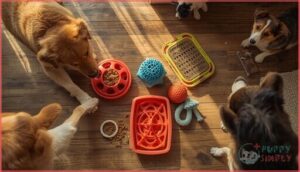
Not every puzzle toy works for every dog, and picking the wrong one can lead to frustration or even safety concerns. You’ll want to think about your dog’s breed tendencies, size, current skill level, and age before you buy. The right match keeps your dog engaged without overwhelming them, so let’s walk through what to examine.
Assessing Breed, Size, and Age Needs
Your furry friend’s unique profile shapes which puzzle toy will truly click. Breed considerations matter—working breeds often crave fast-paced challenges, while independent types prefer manipulation tasks. Size factors influence portion control and component safety, especially for toy breeds needing shorter sessions.
Age groups determine complexity; puppies benefit from low-resistance introductions, while seniors require larger pieces to reduce frustration. Energy levels and health conditions like hip dysplasia guide your choice toward mental stimulation that promotes overall wellness.
Matching Difficulty to Your Dog’s Skills
Once you’ve matched your dog’s profile, skill assessment becomes your next move. Start with puzzles requiring one or two simple steps, then track how many attempts your dog needs before succeeding. If you notice yawning or looking away frequently, ease back a notch to restore confidence.
Here’s how to calibrate difficulty levels effectively:
- Choose puzzles that deliver quick wins initially to build momentum
- Add one new element at a time as problem-solving skills improve
- Alternate easier and harder tasks within sessions to sustain engagement
- Reassess weekly based on success rate and frustration cues
- Introduce new toys only after consistent mastery of the previous level
This progressive challenge approach prevents discouragement while sharpening cognitive abilities. Use consistent cues and small, high-value rewards to reinforce correct patterns. If your dog stalls for more than sixty seconds, provide a brief hand prompt to re-engage their focus.
Document each session so you can tailor future puzzles to your dog’s unique learning curve and maintain mental stimulation without overwhelming their intelligence.
Selecting Safe and Durable Options
After you’ve found the right difficulty level, material safety and durability tests become your priorities. Look for toys carrying third-party certifications and bite-strength ratings from the maker. Choose food-grade plastics, natural rubber, or hardwoods finished with pet-safe sealants.
Inspect weekly for cracks or loose parts, clean after each session with pet-safe soap, and rotate interactive toys every few days to prevent wear.
Tips for Introducing Puzzle Toys Successfully

Introducing a puzzle toy the right way can make or break your dog’s experience with mental enrichment. The key is starting slow, staying present during those first sessions, and keeping things fresh so novelty doesn’t wear off.
Let’s walk through three practical strategies that set your dog up for puzzle-solving success.
Starting With Simple Puzzles
When you introduce puzzle toys, begin with a design that has 2 to 3 removable pieces and a single solution path to build confidence. Keep initial sessions under 5 minutes to maintain dog engagement and prevent frustration.
A low-resistance toy with simple challenges fosters problem solving without overwhelming your pet, laying the groundwork for cognitive development and sustained mental stimulation as their interactive skills grow.
Supervising Play for Safety
You’ve chosen a beginner puzzle—now keep your dog safe during each session. Active supervision means you maintain visual contact to spot frustration or choking risks before they escalate. Set up safe play areas free of small parts and sharp edges, and have emergency planning in place with a first aid kit nearby. Dog monitoring during puzzle time prevents injury and builds trust.
- Watch for signs of stress like excessive panting or tail tucking.
- Remove damaged toys immediately to guarantee dog toy safety.
- Keep sessions short and calm to support positive dog behavior modification.
Rotating Toys to Maintain Interest
Regular toy rotation strategies keep puzzle toys fresh and exciting for your dog. Swap four to six interactive toys every three to seven days to maintain dog engagement metrics and curiosity.
Balance puzzle toy variety with treat-dispensing and scent-based options to cover different skills. Rotation schedules prevent boredom, sustain mental stimulation, and support long-term dog mental health without overwhelming your companion.
Top 5 Puzzle Toys for Mental Stimulation
Choosing the right puzzle toy can make all the difference in keeping your dog mentally engaged and entertained. The market offers countless options, but some stand out for their design, durability, and ability to challenge dogs at various skill levels.
Here are five puzzle toys that deliver real cognitive benefits while keeping your furry friend happily occupied.
1. Livekey Pet Snuffle Mat
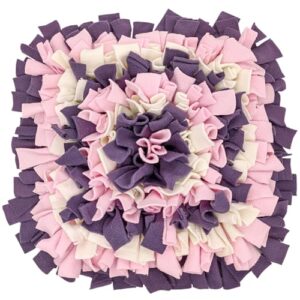
Your dog’s food bowl can become a cognitive challenge when you swap it for the Livekey Pet Snuffle Mat. This 17.7-inch square mat uses dense anti-pilling polar fleece with multiple fabric strips that mimic natural foraging environments.
You scatter kibble within the folds, forcing your dog to use their nose and problem-solving skills rather than simply gulping food. The hand-stitched construction resists tearing during enthusiastic sniffing sessions, while the machine-washable design ensures practical long-term use.
It’s particularly effective for slowing fast eaters and redirecting anxious energy into productive mental work.
| Best For | Dogs who eat too fast, get bored easily, or need mental stimulation through natural foraging activities. |
|---|---|
| Material | Anti-pilling polar fleece |
| Difficulty Level | Easy |
| Washable | Machine washable |
| Primary Use | Foraging and slow feeding |
| Size Suitability | All breeds and sizes |
| Durability Features | Tear-resistant fiber |
| Additional Features |
|
- Slows down mealtime and encourages healthier eating habits through interactive foraging
- Machine washable with durable, hand-stitched construction that resists tearing
- Works for all dog breeds and sizes as both a feeding tool and anxiety reliever
- Requires regular washing and takes a long time to dry completely
- Some dogs may solve it too quickly, finding treats in under two minutes
- Needs routine maintenance to keep it clean and hygienic
2. Tuffy Durable Dog Toy
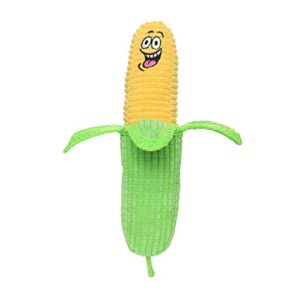
For dogs that love interactive tug-and-fetch sessions, the Tuffy Durable Dog Toy combines engagement with cognitive benefits through its layered construction.
This corn-shaped toy uses up to four layers of industrial-grade nylon bonded with seven rows of stitching, creating a resilient structure that withstands enthusiastic play. The internal squeaker sits in a protective pouch, challenging your dog to work for auditory rewards while reducing choking hazards.
It floats in water and tolerates machine washing, making it practical for varied play environments that keep your dog’s mind actively engaged.
| Best For | Dog owners looking for a durable toy for moderate chewers who enjoy interactive play like tug-of-war and fetch, especially puppies going through the teething phase. |
|---|---|
| Material | Up to 4 fabric layers |
| Difficulty Level | Not applicable |
| Washable | Machine washable |
| Primary Use | Interactive play |
| Size Suitability | Large size available |
| Durability Features | 7 rows of stitching |
| Additional Features |
|
- Built tough with up to 4 layers of fabric and 7 rows of stitching to handle rough play sessions
- Floats in water and is machine washable, so you can easily clean it after muddy park trips or pool time
- Has a protected squeaker inside that keeps dogs engaged without creating a safety hazard
- Not designed for aggressive chewers or dogs who like to gnaw on toys for extended periods
- Some users found it didn’t hold up as long as they hoped, especially with power chewers
- Needs supervision during playtime since no dog toy is truly indestructible
3. Loobani Wooden Dog Puzzle Toy
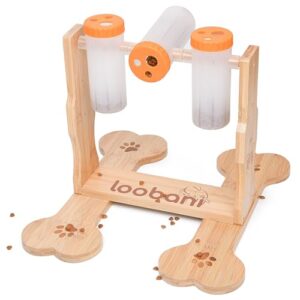
If your furry friend thrives on multi-step challenges, the Loobani Wooden Dog Puzzle Toy offers cognitive complexity through its compartment-based design. This bright yellow puzzle measures approximately 30 cm by 40 cm by 32 cm, fitting medium to large dogs comfortably.
Three detachable bottles act as treat dispensers, requiring your dog to nudge, push, or flip components with nose or paw to access hidden rewards.
The durable wood construction features non-toxic finishes and disassembles for thorough cleaning, while nonslip feet maintain stability during enthusiastic problem-solving sessions.
| Best For | Dogs that need serious mental stimulation and enjoy working through multi-step challenges to earn their treats. |
|---|---|
| Material | Wooden with plastic bottles |
| Difficulty Level | Intermediate |
| Washable | Not washable |
| Primary Use | Treat dispensing puzzle |
| Size Suitability | Adjustable for all sizes |
| Durability Features | Heavy-duty base |
| Additional Features |
|
- Three adjustable bottles let you customize the difficulty as your dog gets better at solving it
- Sturdy wooden build with a heavy base that won’t slide around when your dog’s going at it
- Holds up to 8 cups of food, so you can use it as both a puzzle toy and a slow feeder
- Some dogs will just chew the lids or bottles instead of solving the puzzle properly
- Assembly can be tricky, and a few people have mentioned issues with the screws
- Not great for really aggressive chewers who might destroy the wooden parts
4. Outward Hound Puppy Hide N Slide Toy
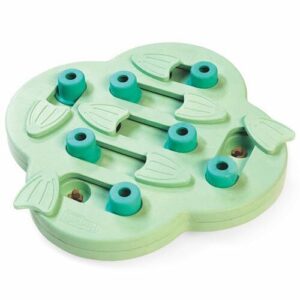
Puppies and smaller breeds need gentler cognitive workouts, which is exactly where the Outward Hound Puppy Hide N’ Slide Toy shines. This Level 2 intermediate puzzle features 14 treat compartments concealed beneath swiveling flippers and sliding blocks, challenging your pup to use multiple problem-solving strategies.
Measuring 11.6 by 11.6 by 2 inches, it holds a quarter cup of food and doubles as a mealtime puzzle feeder. The BPA-free construction combines plastic and wood with nonslip feet, while easy hand washing keeps hygiene straightforward between enrichment sessions.
| Best For | Puppies and small to medium dogs who are new to puzzle toys or need moderate mental stimulation without overwhelming difficulty. |
|---|---|
| Material | BPA-free plastic |
| Difficulty Level | Level 2 Intermediate |
| Washable | Top-rack dishwasher safe |
| Primary Use | Puzzle feeder |
| Size Suitability | Puppies and adult dogs |
| Durability Features | Food-safe materials |
| Additional Features |
|
- 14 treat compartments with sliding blocks and swiveling flippers offer varied play patterns to keep dogs engaged
- Can hold 1/4 cup of food and works as a puzzle feeder to slow down eating and improve digestion
- Made from food-safe, BPA-free materials with nonslip feet for stable play
- May not provide enough challenge for highly intelligent or experienced puzzle-solving dogs
- Requires supervision since white bone pieces and other parts can become choking hazards if detached
- Can be noisy during play and may lack durability with aggressive chewers
5. Potaroma Dog Puzzle Feeder Toy
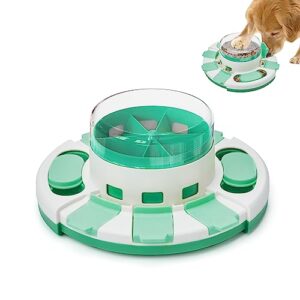
When your dog needs both mental challenge and mealtime management, the Potaroma Dog Puzzle Feeder Toy delivers two levels of difficulty in one compact design. This 5 by 5 by 0.7 inch feeder combines sliding lids and treat-dispensing compartments made from food-grade PP plastic, while non-slip rubber mats and a weighted base prevent tipping during vigorous problem-solving sessions.
You’ll appreciate the non-removable parts that simplify cleaning and reduce choking risks, making it suitable for all breed sizes from puppies to large adults.
| Best For | Dog owners looking to slow down fast eaters while keeping their pups mentally stimulated with a durable, stable puzzle toy that works for any breed or size. |
|---|---|
| Material | Food-grade PP plastic |
| Difficulty Level | 2-level puzzle |
| Washable | Hand wash only |
| Primary Use | Slow feeder puzzle |
| Size Suitability | All breeds and sizes |
| Durability Features | Weighted base with non-slip mats |
| Additional Features |
|
- Two-level puzzle design keeps dogs engaged and helps reduce boredom-related behaviors like chewing and barking
- Non-slip base and weighted design prevent the toy from sliding around during mealtime or play
- Simple one-piece construction with no removable parts makes cleaning easy and eliminates choking hazards
- Dogs who are puzzle pros might solve it too quickly and lose interest
- The plastic top can get damaged if your dog likes to chew instead of solve
- Suction cups don’t grip well on every floor type, and you’ll need to hand wash it since it’s not dishwasher safe
Frequently Asked Questions (FAQs)
What are the benefits of puzzle toys for dogs?
Puzzle toys sharpen focus, reduce anxiety, and curb destructive habits while slowing down mealtime to aid digestion. They channel mental energy into constructive tasks, building confidence and independent problem-solving skills.
Can puzzle toys replace daily walks and exercise?
No—while puzzle toys exercise your dog’s brain, they don’t provide the cardiovascular health, muscle conditioning, or social exposure that daily walks deliver.
Combine both for balanced physical and mental wellness.
How often should I give puzzle toys?
There’s no one-size-fits-all answer, but most adult dogs benefit from puzzle sessions three to four times weekly.
Puppies need shorter, more frequent challenges, while seniors thrive with gentler, less demanding puzzles.
What if my dog ignores the puzzle toy?
If your dog won’t interact with the toy, it’s likely too difficult, they’re not hungry, or they need you to demonstrate how it works by guiding them through the puzzle initially.
Are puzzle toys safe for aggressive chewers?
Many worry that puzzles won’t last, but models built for aggressive chewers use reinforced rubber and hard plastic.
You should supervise play, inspect regularly for cracks, and retire damaged toys promptly to prevent choking.
Do senior dogs benefit from puzzle toys?
Yes, senior dogs benefit greatly from puzzle toys. Mental exercise helps maintain cognitive function, reduces boredom from slower routines, and alleviates anxiety while supporting brain health and emotional wellbeing as they age.
Conclusion
What if the solution to your dog’s restless energy was never about more walks, but smarter play? Understanding how puzzle toys help dogs mentally reveals they’re not optional enrichment—they’re essential brain maintenance.
These tools tap into problem-solving drives, calm anxious minds, and prevent destructive habits before they start. Choose toys that match your dog’s skill level, rotate them regularly, and watch mental exhaustion replace boredom. A challenged mind is a content companion.