This site is supported by our readers. We may earn a commission, at no cost to you, if you purchase through links.

Your dog spots a deer at 400 meters and disappears into the treeline.
You’re shouting, but the wind’s against you, and your voice doesn’t reach.
That moment—the one every off‑leash hiker dreads—is exactly where a reliable training collar earns its place.
Most dogs can follow trail rules at close range.
The real test comes when prey drive kicks in, terrain opens up, or the gap between you and your dog grows faster than you expected.
Dog training collars for off‑leash hiking and camping close that gap.
The right one gives you communication, not just control—and that difference matters more than most owners realize before they need it.
Table Of Contents
- Key Takeaways
- Why Remote Training Collars Matter for Hiking Dogs
- What to Look for in a Hiking Training Collar
- Types of Remote Training Collars for Trail Use
- Top 10 Dog Training Collars for Off-Leash Hiking and Camping
- 1. Hi Kiss Dog Training Leash
- 2. PetSafe Gentle Leader Headcollar
- 3. Buddy Biscuits Bacon Training Treats
- 4. Dogtra Pathfinder 2 GPS Training Collar
- 5. Invisible Fence GPS Dog Collar
- 6. Garmin Alpha 200i Dog Tracking System
- 7. Myiwb iOS GPS Waterproof Dog Collar
- 8. Weenect Dog XT GPS Collar
- 9. Patpet Waterproof Dog Training Collar
- 10. SportDOG FieldTrainer 425X Remote Collar
- GPS Vs. Remote Training Collars for Off-Leash Safety
- How Remote Dog Training Collars Work on The Trail
- Responsible and Ethical Use of Training Collars Outdoors
- Durability, Battery, and Comfort Standards for Trail Collars
- Frequently Asked Questions (FAQs)
- Conclusion
Key Takeaways
- training collar isn’t a substitute for solid recall training — it’s a backup layer that only works when the foundation is already there.
- Match the collar type to your dog’s temperament: tone-only for well-trained dogs, vibration for deaf or sensitive dogs, static for high prey drive, and GPS for remote terrain where your dog can outrun your voice.
- Range claims on the box don’t hold in the field — dense canopy can cut signal by up to 60%, and mountainous terrain creates dead zones, so test your collar’s real range before you need it.
- For multi-day trips, battery management matters as much as waterproofing — IP68 beats IPX7 for extended backcountry use, and you’ll want a backup power source for any GPS-integrated collar.
Why Remote Training Collars Matter for Hiking Dogs

Off-leash hiking gives your dog freedom, but that freedom needs a safety net. A remote training collar bridges the gap between your voice and your dog’s instincts — especially when wildlife, distance, or terrain breaks that connection.
Before hitting the trail, it helps to know whether your dog is actually built for off-leash adventures — some breeds handle that freedom far better than others.
Here’s what makes these collars worth carrying on every trail.
Improving Recall Reliability in High-Distraction Environments
A deer bolts across the trail, and your dog is already moving. Begin with a single recall cue to establish consistency.
In high-distraction environments, recall drops up to 25 percent. That’s where cue timing and focus checks become critical.
Practice progressive distraction training — quiet spaces first, then busy trails. Use high value rewards consistently.
Arousal management keeps responses sharp when it matters most. Recall reinforcement built this way holds, even off‑leash.
Communicating Beyond Voice Range on Open Terrain
Voice only carries so far. On open terrain, your dog can be 100 meters out before you realize shouting isn’t working.
That’s where long‑range collars close the gap. Pair them with:
- Flag Visual Cues at landmarks for clear sighting
- High‑Contrast Hand Signals backed by tone alerts
- Reflective Gear Signaling for low‑light visibility
Redundant Communication Protocols and smart Cue Timing Strategies keep off‑leash control reliable when signal strength in mountainous terrain drops.
Reducing Risk of Wildlife Pursuit
High prey drive turns a calm trail into a chase. Remote training collars interrupt that instinct fast—before your dog locks onto a deer and disappears.
| Wildlife Risk Factor | Collar Response |
|---|---|
| Sudden scent trail | Instant tone cue |
| Chase initiation | Static correction |
Combine recall reinforcement, Noise Discipline, and smart Camp Placement. Scent Management and proper Food Storage reduce encounter triggers too.
Supporting Safety Without Replacing Foundational Training
A collar isn’t a shortcut.
It’s a safety layer on top of solid obedience.
Gradual Distance Progression, Environmental Cue Training, and Positive Reward Timing build the foundation.
Handler Observation Skills catch problems before the collar needs to activate.
Think of responsible use of training collars on the trail as your last line—not your first.
Foundational training is always step one.
What to Look for in a Hiking Training Collar

Not every collar holds up when the trail gets rough. The right one depends on a few key specs that actually matter outdoors.
Here’s what to look for before you buy.
Long Range for Open and Wooded Terrain
Range isn’t just a number on a box. In open meadows, reliable signal runs 300–800 meters.
Dense canopy cuts that by up to 60%. Three terrain factors that silently shrink your range:
- Elevation Boost Effects extend signal on ridges by 20–40%
- Canopy Attenuation Factors gut wooded range fast
- Terrain Multipath Interference creates dead zones in ravines
Choose collars with Adaptive Power Management and Antenna Boom Optimization for consistent off-leash hiking control.
Waterproof Construction for Rain, Streams, and Mud
Trail weather doesn’t wait for you. Rain hits. Streams appear. Mud is everywhere.
Your collar needs to handle all of it.
| Feature | IPX7 Rating | IP68 Rating |
|---|---|---|
| Submersion Depth | 1 meter | 1+ meters |
| Duration | 30 minutes | Continuous |
| Mud/Grit Protection | Moderate | Full |
| Seam Sealing | Standard | Reinforced |
| Gasketed Openings | Partial | Complete |
Look for Hydrophobic Coating, a Drainage Layer, and Microtextured Surface to shed water fast. Waterproof construction isn’t optional—it’s the baseline.
Adjustable Stimulation Intensity Levels
Not every dog needs the same correction. That’s why intensity step granularity matters—fine-tuned adjustments let you start at a low stimulation level and work up gradually.
Look for custom position profiles, a lockout safety feature to prevent accidental changes on trail, and clear feedback display indicators. Whether using tone-only collars, vibration collars, or static correction e-collars, precise control keeps communication consistent.
Reliable Battery Life for Full-Day Hikes
dead collar mid-trail is a real problem. rechargeable systems last 12 to 48 hours, but cold weather conditions drain batteries faster.
low power modes and turn off GPS when you don’t need it. Fast charging times — usually under two hours — help you top up at camp.
Spare battery packs and solar charging options keep you covered on multi-day trips.
Durable and Drop-Resistant Remote Design
Your remote takes a beating. Look for polycarbonate housing with impact-absorbing corners and gel damping pads that cushion drops up to 1.5 meters. A durable remote design manages real trail conditions.
- Rubberized button caps resist moisture and tearing
- Laser engraved labels stay readable after heavy use
- IPX7 waterproof rating manages rain, mud, and stream crossings
Rugged builds last. Flimsy ones don’t.
Types of Remote Training Collars for Trail Use
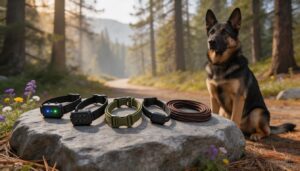
Not all training collars work the same way, and the difference matters on the trail.
Your dog’s temperament, prey drive, and distance from you will shape which type fits best.
Here are the five main collar types worth knowing before you choose.
Tone-Only Collars for Attention and Recall
Think of a tone-only collar as your dog’s personal alarm clock — no shock, just a sharp audible cue that snaps attention back to you. Cue consistency matters most here.
Short tone duration, paired with positive reinforcement, builds reliable dog recall over time. Train with progressive distance, starting close.
Look for IPX7 waterproof rating and solid battery life for full trail days.
Vibration Collars for Deaf or Sensitive Dogs
Not every dog hears your voice. For deaf or noise-sensitive dogs, vibration feedback replaces sound entirely.
Unlike tone-only collars, these rely on Tactile Cue Design — soft contact materials pulse directly against the neck.
Most offer Vibration Pattern Options and a Gradual Intensity Ramp, so you start low and adjust. Pair each buzz with Visual Cue Pairing, and your dog learns fast.
Look for adjustable intensity levels, solid battery life, and water resistance for outdoor gear.
Static Correction Collars With Adjustable Levels
Static correction collars take customization further. You’re working with Progressive Level Training — starting low, then nudging intensity up until your dog responds. That’s Incremental Shock Calibration in practice: find the Minimum Effective Threshold, not the maximum.
Most static correction e-collars offer Sensitivity-Based Intensity ranges and Customizable Stimulation Profiles for different dogs.
For off-leash hiking, prioritize adjustable intensity levels, solid battery life, and reliable water resistance.
GPS-Integrated Training Collars for Off-Grid Use
GPS collars go further than static correction. They combine remote stimulation control with off‑grid navigation for pets — real tracking, real terrain.
Top features to look for:
- Satellite Constellation Support — six-constellation accuracy puts your dog within 1–3 ft
- Low-Power Mode + Solar Charging Integration — battery life up to 80 hrs on some models
- Emergency SOS Alerts + Cross-Platform App Sync — IP67 waterproof rating, full backcountry coverage
Virtual Fence Collars for Campsite Boundaries
Virtual fences take GPS collars one step further. Instead of just tracking, they hold your dog inside a defined boundary — no posts, no wire.
| Feature | What It Means for You |
|---|---|
| Boundary Zone Customization | Set radii from 30–1,000 meters |
| Offline Fence Mode | Boundaries stay active without cell service |
| Multi-Zone Management | Separate play and camp zones via app |
| Terrain Accuracy Challenges | Hills and dense canopy reduce GPS precision |
Battery Life Considerations for Camping Dog Collars matter here — virtual fence technology draws more power than standard tracking. Expect 16–40 hours of active use. Offleash hiking safety depends on knowing your charge level before the trailhead.
Top 10 Dog Training Collars for Off-Leash Hiking and Camping
Not every collar fits every trail dog — and that’s exactly why this list covers the full range. Whether you need GPS tracking, long-distance recall, or a simple training tool, there’s something here for your setup.
Here are the top 10 dog training collars worth considering for off-leash hiking and camping.
1. Hi Kiss Dog Training Leash
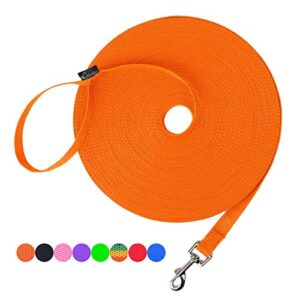
Before your dog earns full off-leash freedom, a long line builds the bridge. The Hi Kiss 50-ft nylon lead gives you room to practice recall without losing control.
It weighs just 7 oz, so it won’t slow you down on the trail. The swivel snap resists twisting during active movement. One caution: strong chewers can work through the nylon fast. For dogs over 60 lb, go with the reinforced version.
| Best For | Dog owners training medium to large breeds who need room to practice recall and off-leash skills on trails, open fields, or unfenced property. |
|---|---|
| Material | Nylon |
| Waterproof | No |
| Dog Size | Medium/Large |
| Training Mode | Recall/Obedience |
| Battery Type | None |
| App Required | No |
| Additional Features |
|
- 50 feet of freedom lets your dog roam while you stay in control during recall and obedience training
- At just 7 oz, it’s light enough to toss in a bag without a second thought
- The swivel snap keeps twisting and tangling to a minimum during active movement
- Strong chewers can work through the nylon quickly—not ideal for aggressive biters
- The clip is on the lighter side, so it may not hold up under the force of a powerful dog over 60 lb
- Managing 50 feet of line takes some practice; without a winder or holder, it tangles easily
2. PetSafe Gentle Leader Headcollar

Pullers don’t need punishment — they need redirection. The PetSafe Gentle Leader sits behind the ears and loops around the snout, steering your dog’s head instead of yanking the neck.
That simple mechanic cuts pulling fast. At just 1.6 oz, it won’t add trail weight.
It’s vet- and trainer-recommended, and fits most breeds — skip it for short-snouted dogs like Bulldogs.
Give your dog a few sessions to adjust before hitting the trail.
| Best For | Dog owners struggling with pullers who haven’t had luck with regular collars or harnesses. |
|---|---|
| Material | Nylon |
| Waterproof | No |
| Dog Size | All Sizes |
| Training Mode | No-Pull Control |
| Battery Type | None |
| App Required | No |
| Additional Features |
|
- Redirects pulling at the source — steering the head means the body follows, naturally
- Super lightweight at 1.6 oz, so it won’t bother your dog on longer walks or runs
- Vet- and trainer-recommended, and lets dogs eat, drink, and pant without restriction
- Not a fit for short-snouted breeds like Bulldogs or Pugs
- Some dogs fight it at first — expect a break-in period before it clicks
- Can slip off if fitted loosely, so pairing it with a harness or collar is smart for strong pullers
3. Buddy Biscuits Bacon Training Treats

Training out here only works if your dog actually wants to listen. That’s where Buddy Biscuits Bacon Training Bites earn their spot in your pack.
Each treat is just 1.5 calories — small enough to reward repeatedly without guilt. You get roughly 500 per bag, soft and chewy, built on a real pork liver base with natural bacon flavor.
No corn, no soy, no artificial junk. The resealable pouch keeps them fresh mile after mile.
| Best For | Dog owners who train frequently and want a low-calorie, clean-ingredient treat that works for dogs of all sizes and ages. |
|---|---|
| Material | Nylon |
| Waterproof | No |
| Dog Size | All Sizes |
| Training Mode | Reward-Based |
| Battery Type | None |
| App Required | No |
| Additional Features |
|
- 500 soft, chewy treats per bag at just 1.5 calories each — great for repeat rewarding without overfeeding
- Made with real pork liver and natural bacon flavor, no corn, soy, or artificial stuff
- Resealable pouch keeps them fresh and easy to take anywhere
- Pretty tiny, which can be frustrating to handle — especially for people with larger dogs
- Pricier than a lot of other training treat options out there
- Freshness drops fast if you forget to seal the pouch after each use
4. Dogtra Pathfinder 2 GPS Training Collar
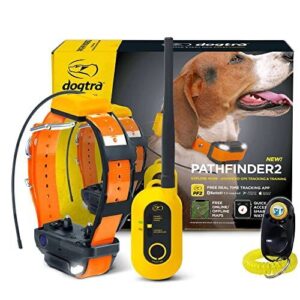
Nine miles of GPS range — no cell signal needed. Offline maps work in the deepest backcountry.
The Dogtra Pathfinder 2 tracks up to 21 dogs with 2-second location updates, so you always know where your pack is.
The 100-level stimulation system gives you tone, vibration, and static options.
Battery lasts about 24 hours, charges in 3.5 hours. It’s waterproof, built for rough terrain, and carries no subscription fee.
At $429.99, it’s built for serious handlers.
| Best For | Hunters, ranchers, and working-dog handlers who need reliable off-grid GPS tracking across large properties or remote terrain. |
|---|---|
| Material | Nylon |
| Waterproof | Yes |
| Dog Size | 35 lb+ |
| Training Mode | Tone/Vibration/Shock |
| Battery Type | Rechargeable Li-ion |
| App Required | Yes (iOS/Android) |
| Additional Features |
|
- Tracks up to 21 dogs with real-time 2-second GPS updates — no cell signal required
- No subscription fees, so the upfront cost covers everything you need
- Rugged, waterproof build with a 24-hour battery and fast 3.5-hour charge
- Your phone has to stay Bluetooth-connected and the app open for full functionality, including the E-Fence
- At $429.99, it feels steep if you’re only tracking one or two dogs
- The app can be clunky to navigate, especially when switching between multiple dogs on the fly
5. Invisible Fence GPS Dog Collar
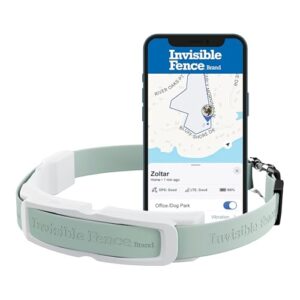
Virtual boundaries without physical posts — that’s the pitch. The Invisible Fence GPS Dog Collar lets you draw custom zones in the app and get real-time alerts when your dog crosses them.
You can fit it on most medium to large dogs with neck sizes 15–28 inches. Battery claims 72 hours, but expect less under heavy GPS use. It needs cellular service and an ongoing subscription.
Lost Dog Mode helps locate a wandering dog fast. Remove the shock points if beep-only works for your dog.
| Best For | Dog owners with medium to large breeds who want off-leash freedom without installing a permanent fence — especially on farms, large yards, or properties where traditional fencing isn’t practical. |
|---|---|
| Material | Nylon |
| Waterproof | Yes |
| Dog Size | Medium/Large |
| Training Mode | Boundary/Shock |
| Battery Type | Li-ion Rechargeable |
| App Required | Yes (iOS/Android) |
| Additional Features |
|
- Draw custom boundaries anywhere — no posts, no digging, no permanent setup required
- Lost Dog Mode gives you real-time tracking if your dog wanders beyond their zone
- Waterproof build and removable shock points make it adaptable to different training styles
- Battery rarely hits the advertised 72 hours — heavy GPS use can drain it in under a day
- GPS accuracy drops in wooded areas or poor satellite coverage, which can trigger false alerts
- Requires an active cellular subscription, and the ongoing cost isn’t disclosed upfront
6. Garmin Alpha 200i Dog Tracking System
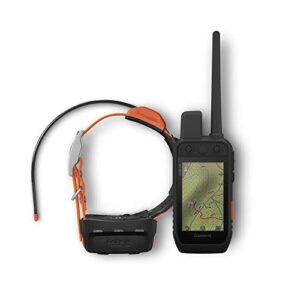
This is the premier quality. The Garmin Alpha 200i tracks up to 20 dogs across 9 miles, with 2.5-second position updates.
Pair it with the T 5 collar and you get tone, vibration, and 18 static levels — all adjustable without removing your gloves.
The built-in InReach satellite communicator lets you send SOS alerts and two-way messages from anywhere, no cell signal needed.
Battery runs 20 hours standalone, 15 with InReach active. It costs $1,099.99 — professional-grade price for professional-grade control.
| Best For | Serious hunters and field workers who run multiple dogs in remote terrain and need real-time tracking, training control, and satellite communication all in one device. |
|---|---|
| Material | Nylon |
| Waterproof | Yes |
| Dog Size | All Sizes |
| Training Mode | Tone/Vibration/Shock |
| Battery Type | Removable Rechargeable |
| App Required | Yes (iOS/Android) |
| Additional Features |
|
- Tracks up to 20 dogs at once with 2.5-second updates across roughly 9 miles — serious range for serious work
- Built-in InReach satellite messaging and SOS means you’re never truly off the grid, even without cell service
- Glove-friendly side buttons let you make training adjustments on the fly without fumbling with the touchscreen
- InReach features require an ongoing Iridium satellite subscription, adding to the already steep $1,099.99 price tag
- Battery drops from 20 hours to 15 when InReach is running — long days out may call for a spare
- Bulkier than older Alpha models, and the touchscreen can trigger accidentally if you’re not using the screen lock
7. Myiwb iOS GPS Waterproof Dog Collar

Not everyone needs military-grade tracking.
If you’re an iPhone user on a budget, the Myiwb collar does the job simply.
It connects to Apple’s Find My app — no subscription, no extra software.
Just $33.99 with a CR2032 battery lasting up to 12 months.
It’s IP68-rated, withstands rain and stream crossings, and has 360° reflective strips visible at 50 meters.
One catch: Android users are locked out completely.
But for iOS hikers keeping tabs on one dog, it’s a clean, low-maintenance option.
| Best For | iPhone users who want a simple, no-subscription way to track their dog on hikes, walks, or outdoor adventures without breaking the bank. |
|---|---|
| Material | Nylon |
| Waterproof | IP68 |
| Dog Size | XS–Large |
| Training Mode | Location Tracking |
| Battery Type | CR2032 Replaceable |
| App Required | Yes (iOS Find My) |
| Additional Features |
|
- Connects straight to Apple Find My — no extra app or monthly fees, just $33.99 once
- IP68-rated and tough enough for rain, streams, and active dogs up to 286 lb of pull force
- CR2032 battery lasts up to 12 months, with low-battery alerts sent right to your iPhone
- Completely useless for Android users — it only works with iOS
- Can feel bulky on small dogs, and some users report the fit loosening over time
- Directional accuracy in Find My isn’t always reliable, which can be frustrating when you really need it
8. Weenect Dog XT GPS Collar
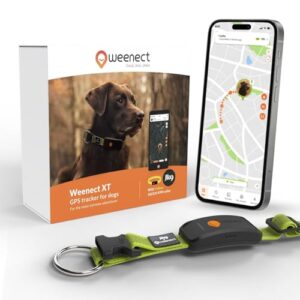
Want global reach? The Weenect Dog XT delivers it.
At $45.49, it tracks your dog in real time — every second in Superlive mode — across 100+ countries on AT&T, T-Mobile, and Verizon networks.
The built-in LED flashlight helps at dusk, and the remote buzzer facilitates recall training straight from your phone.
Just know: it runs on a subscription starting at $5.56/month, and dense forests or dead zones can interrupt the signal.
| Best For | Dog owners who travel internationally or adventure off-leash in wide-open areas and want real-time GPS tracking without distance limits. |
|---|---|
| Material | Plastic/Nylon |
| Waterproof | No |
| Dog Size | All Sizes |
| Training Mode | Ring/Buzzer |
| Battery Type | Rechargeable |
| App Required | Yes (iOS/Android) |
| Additional Features |
|
- Tracks every second in Superlive mode across 100 countries on major US networks
- Built-in LED flashlight and remote buzzer make night walks and recall training a lot easier
- Activity history lets you see where your dog went and how much exercise they actually got
- Subscription is required — no active plan means no tracking, period
- Signal drops in dense forests or dead zones, with geofence alerts sometimes lagging by a couple of blocks
- Plastic build and some reported battery issues raise questions about long-term durability
9. Patpet Waterproof Dog Training Collar
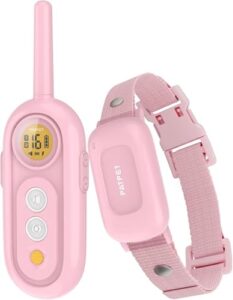
Not every hiker needs a GPS subscription. The Patpet Model 357 keeps it simple — and affordable at $29.99.
It reaches up to 2,000 feet. Three modes: beep, vibration, and adjustable shock (0–16 levels). The IPX7-rated receiver manages streams, mud, and rain without hesitation. Battery charges in two hours and lasts up to a week.
One caveat: the shock function can degrade over time. Lean on beep and vibration first. They’ll carry most of your trail work anyway.
| Best For | Budget-conscious dog owners who train off-leash in wet or unpredictable outdoor conditions and want a simple, no-frills collar without a recurring subscription. |
|---|---|
| Material | Nylon |
| Waterproof | IPX7 |
| Dog Size | 10–100 lb |
| Training Mode | Beep/Vibration/Shock |
| Battery Type | Rechargeable |
| App Required | No |
| Additional Features |
|
- Reaches up to 2,000 feet, giving you solid range for trail and field training
- IPX7 waterproofing means rain, mud, and stream crossings aren’t a problem
- Three training modes let you start gentle and adjust as needed
- The shock function can wear out over time, leaving you dependent on beep and vibration
- Battery may need charging every few days with regular use
- The remote feels a bit fragile — a bad drop could damage the antenna or housing
10. SportDOG FieldTrainer 425X Remote Collar
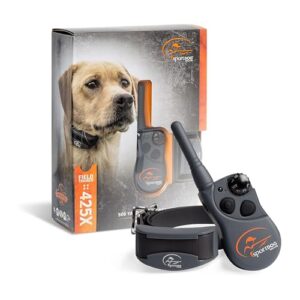
Step up in budget, and the SportDOG FieldTrainer 425X earns it. At $123.99, you get 500 yards of range, 21 static levels, plus tone and vibration modes.
The DryTek design manages full submersion — up to 25 feet. Battery lasts 50–70 hours on a single charge.
The compact remote works one-handed, even mid-climb. One watch-out: thick-coated dogs may need longer contact probes, which sometimes are back-ordered.
Worth planning ahead.
| Best For | Hunters, field trainers, and active dog owners who need a rugged, waterproof collar that can handle real outdoor conditions with multiple dogs. |
|---|---|
| Material | Plastic/Nylon |
| Waterproof | IPX8 (25 ft) |
| Dog Size | 8 lb+ |
| Training Mode | Tone/Vibration/Shock |
| Battery Type | Li-ion Rechargeable |
| App Required | No |
| Additional Features |
|
- 500-yard range with 21 stimulation levels gives you serious control whether you’re on a trail or in the field
- Fully submersible up to 25 feet — mud, rain, and creek crossings are no problem
- One remote handles up to three dogs, which is a big win for multi-dog households
- The low-battery indicator is easy to miss, so you might get caught off guard mid-session
- Thick or long-coated breeds may need longer contact probes, and those are often back-ordered
- The remote’s small buttons can be frustrating if you’re wearing gloves or have larger hands
GPS Vs. Remote Training Collars for Off-Leash Safety
Choosing between a GPS collar and a remote training collar isn’t always straightforward — both solve different problems on the trail. Your dog’s behavior, your hiking terrain, and how far you roam all push you toward one or the other.
Here’s how to figure out which setup actually fits your situation.
When a Remote Training Collar is The Right Choice
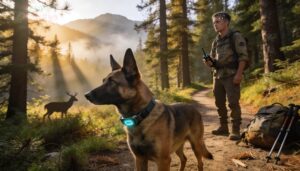
A remote training collar earns its place when your dog’s instincts outrun your voice. For hiking dogs with high prey drive, terrain-specific cueing and an emergency stop protocol can prevent a chase before it starts. Progressive intensity training builds reliable handler-dog communication at distance—even with weather‑resilient signal in open terrain.
| Situation | Remote Collar Advantage |
|---|---|
| Wildlife encounter | Immediate off‑leash control |
| Long open terrain | Range up to 1 km |
Responsible use on the trail starts here.
When a GPS Tracking Collar is The Better Option

GPS shines when your dog wanders beyond recall range. Real-time location updates every 1–60 seconds let you track exact movement across rugged terrain. Geofence alerts notify you instantly if boundaries are crossed.
| Feature | GPS Collar | Remote Collar |
|---|---|---|
| Real-time location | ✓ | ✗ |
| Multi-dog tracking | Up to 21 | Up to 3 |
| Battery life camping | 2–7 days | 12–70 hours |
Two-way communication and satellite coverage make GPS essential for off-leash hiking safety.
Combining Training and GPS Features in One Device
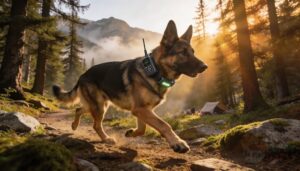
Some dogs need both — a training cue and a live location. Integrated devices handle that.
| Feature | GPS-Only | GPS + Training |
|---|---|---|
| Real-time geofencing | ✓ | ✓ |
| Dual alerts (tone/static) | ✗ | ✓ |
| Battery optimization modes | Limited | Sophisticated |
Sensor fusion improves boundary accuracy in dense woods. Easy-to-use UI lets you switch between recall and virtual fence technology fast. One device. Full control.
Subscription Vs. No-Subscription GPS Collar Costs

Two collars, two very different price stories.
| Factor | Subscription GPS Collar | No-Subscription GPS Collar |
|---|---|---|
| Upfront Hardware Price | $100–$180 | $150–$260 |
| Monthly Fee | $5–$25 | $0 |
| Data Plan Expenses | Ongoing | None |
| Long-Term Ownership Cost | Higher over 5 years | Lower overall |
| Hardware Durability Savings | Moderate | Significant |
Subscription models and monthly fees for GPS tracking add up fast.
Battery life considerations for pet tracking devices matter too — poor durability means early replacement costs.
Offline Mapping for Backcountry and Remote Trails

Cell service dies fast in the backcountry. That’s where offline maps pull their weight.
Download Offline Topo Layers before you leave. Use GPX Track Import to load your route. Mark water sources and hazards with Custom Waypoints. Enable Low Data Rendering to save battery. Keep maps sorted with Region Pack Organization so you find what you need quickly.
| Offline Mapping Feature | Trail Benefit |
|---|---|
| Topo Layers | Shows elevation and slope ahead |
| GPX Track Import | Loads pre-planned dog-friendly routes |
| Custom Waypoints | Marks water, hazards, rest spots |
| Low Data Rendering | Extends battery on long hikes |
| Region Pack Organization | Quick access to downloaded map zones |
Backcountry dog tracking depends on this setup.
How Remote Dog Training Collars Work on The Trail
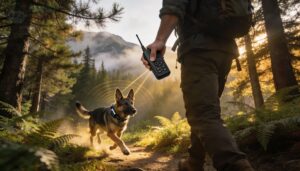
Knowing how these collars actually work changes how you use them. From the transmitter in your hand to the receiver on your dog’s neck, every part has a job.
Here’s what’s happening behind the scenes on the trail.
Handheld Transmitter and Receiver Mechanics
Think of it like a walkie-talkie for your dog. Your handheld transmitter encodes a command — tone, vibration, or static — using signal modulation and channel hopping to cut through interference.
The collar receiver decodes it instantly. Antenna orientation affects range, so keep the transmitter upright.
Telemetry feedback shows battery status. The binding procedure pairs your specific remote to your dog’s collar only.
Probe Contact, Fit, and Repositioning Guidelines
Good signal starts before you hit the trail. Check probe angle first — tips should meet skin perpendicularly, not at a slant.
Your snug-fitting collar receiver needs two fingers of neck clearance, no more. Practice fit verification at home.
On longer hikes, contact rotation every one to two hours prevents irritation. Reposition timing matters most after stumbles — recheck immediately, while your dog is calm.
Signal Range Limitations in Mountainous Terrain
Fit sorted — now the terrain matters. Mountains don’t play fair with signals.
Shadow zone effects hit hardest in valleys, where ridges block line-of-sight entirely. Diffraction losses increase with elevation gain impact. Weather attenuation from rain or fog shortens range further. Multipath interference causes unpredictable dead spots.
range limitations in mountainous terrain means range testing methods before your off-leash hiking route, not during it.
Tone, Vibration, and Static Modes Explained
Signals sorted. Now, how you use them matters.
Most collars offer three cues — each distinct by design:
- Tone — a sharp audible beep; grabs attention fast
- Vibration — a tactile pulse; ideal for sensory differentiation with deaf or noise-sensitive dogs
- Static — a brief electrical pulse; adjustable intensity for progressive stimulation
Follow ethical cue use: tone first, always.
Multi-Dog Control From a Single Remote
Running two or three dogs off-leash changes everything. One remote manages it—if the system offers Channel Assignment and Individualized Programming for each collar.
| Feature | What It Does | Why It Matters |
|---|---|---|
| Channel Assignment | Isolates each dog’s signal | Prevents Cross Dog Safety errors |
| Synchronized Cueing | Sends cues to all dogs at once | Useful for group recall |
| Battery Balancing | Monitors all receiver levels | No collar dies mid-trail |
Most multi-dog remotes manage up to four collars simultaneously.
Responsible and Ethical Use of Training Collars Outdoors

A collar is only as good as the hands using it. Even the best gear on the market can backfire if you skip the groundwork or rush the process.
responsible trail use actually looks like.
Common Mistakes Owners Make With E-Collars on Trails
Most e-collar mistakes happen before the trail even starts. A loose collar shifts and misses skin contact. High stimulation start levels can spook your dog instantly.
Skipping leash basics before going off-leash breaks recall reliability fast. Cold battery failure mid-hike leaves you with zero control.
Inconsistent cue pairing — collar without verbal commands — just confuses your dog. Responsible use of training collars on the trail starts at home.
Conditioning Your Dog Before Field Deployment
Building trust before the trail takes more planning than most handlers expect. Start conditioning at home, then outdoors in low-distraction zones.
- Distraction Drills — Gradually introduce wildlife sounds, scents, and movement to sharpen prey drive management and wildlife avoidance training.
- Session Timing — Train when your dog is rested. Handler Readiness means fresher dogs, stronger responses.
- Fit Checks — Verify contact points before each session.
Consistency builds dog obedience reinforcement naturally.
Pairing Remote Collars With Positive Reinforcement
The collar isn’t the teacher — you are. Use it as a Signal Reward Bridge: pair the remote stimulus with a high-value treat within one second of the correct behavior.
The collar communicates, but you teach — pair every stimulus with reward within one second
That’s Reward Timing done right. Start with tone-only collars, then introduce Gradual Intensity as needed.
Cue Consistency matters most. Dog obedience reinforcement only sticks when the dog sees the collar as communication, not punishment.
Avoiding Skin Irritation During Extended Hikes
Skin irritation sneaks up fast on long hikes — for your dog, too. Reposition the collar every 1–2 hours to prevent pressure sores. Choose collars with neoprene padding and lightweight construction.
High-density nylon and waterproof capabilities reduce bacterial buildup in wet conditions. Wear smooth clothing design under harnesses. Apply barrier cream on friction zones.
Use moisture-wicking fabrics and maintain hydration for skin health throughout the trail.
Managing Prey Drive and Wildlife Encounter Risks
High-drive dogs treat every trail like a hunting ground. Know your dog’s prey drive before hiking in wildlife-heavy areas.
- Run a Prey Drive Assessment before off-leash hiking
- Train an Emergency Drop Cue consistently at home first
- Use High-Value Rewards the moment wildlife appears
- Introduce Scent Work Diversion to redirect instincts safely
- Identify Wildlife Safe Zones and adjust leash freedom accordingly
Layered safety strategies for off-leash hiking dogs keep everyone protected.
Durability, Battery, and Comfort Standards for Trail Collars

Not every collar survives a week in the backcountry — and that’s where most buyers get burned. The right trail collar holds up through creek crossings, muddy scrambles, and back-to-back camp nights without losing charge or falling apart.
Here’s what actually separates durable, trail-ready collars from the ones that won’t last the season.
IPX7 and IP68 Waterproof Ratings Compared
Not all waterproof ratings are equal. IPX7 waterproof means the collar manages submersion up to 1 meter for 30 minutes — fine for stream crossings.
IP68 waterproof goes deeper, longer, and adds dust tightness, impact protection; IPX7 lacks entirely.
Depth rating differences matter on rugged trails.
Seal longevity depends on maintenance requirements like post-hike rinsing.
For multi-day trips, choose IP68 durable construction.
Rechargeable Vs. Replaceable Battery Options
Beyond waterproofing, battery type shapes your trail experience just as much. Rechargeable collars offer lower cost over time and less waste — better environmental impact, better battery recycling potential.
Replaceable battery options give instant field performance: fresh cells, no downtime. Some replaceable designs offer battery life lasting up to 12 months.
Quick charging capability on rechargeables can restore power fast, though battery performance in cold drops noticeably.
Battery Management on Multi-Day Camping Trips
Multi-day trips demand real Energy Budget Planning. Map out each device’s daily draw before you leave.
A 20Ah camping battery covers most collar charging across a 2–4 day trip. Solar Panel Orientation matters too — angle panels toward peak sun to top up between sessions.
Enable Battery Health Monitoring and Power Prioritization: collar first, phone second.
Always carry Backup Power Management in a waterproof pouch.
Collar Materials Built for Rugged Terrain
Your collar takes the same beating your boots do.
Ballistic Nylon Durability manages dense brush and rocky scrambles without fraying.
Cordura Abrasion Resistance fights off thorns and snags.
Reinforced Polyester Webbing holds firm on steep pulls.
Stainless Steel Hardware won’t rust after stream crossings.
Neoprene Closed-Cell Padding cushions the neck all day — soft, waterproof, and trail-ready.
Reflective Strips and Night Visibility Features
Darkness changes everything on the trail. Reflective strips with 12mm strip width optimization bounce light back toward headlamps and flashlights — that’s retroreflective brightness doing its job.
Angle coverage design ensures visibility from multiple directions, not just head‑on.
Weather resistance coating keeps strips functional through rain and mud.
Add safety lights for low‑light detection when reflective alone isn’t enough.
Frequently Asked Questions (FAQs)
Can puppies use remote training collars safely?
Not before six months. Puppies need time to develop first.
Focus on supervised training sessions, gradual stimulation increase, and stress signal monitoring. Age-appropriate use and proper fit and comfort matter most.
How do collars perform in extreme cold weather?
Cold kills battery life fast. Lithium cells lose output below freezing — cold-induced latency slows response time. Keep the remote inside your jacket. Fully charge before heading out.
Which collar brands offer the best warranties?
LupinePet and Mendota Pet lead with lifetime warranty brands that cover accidental damage. SportDOG offers a solid 2-year warranty. Dogtra provides a clear 1-year warranty with documented coverage details.
Are training collars allowed in national parks?
It depends on the park. Most don’t ban training collars outright, but leash length restrictions, wildlife protection rules, and park policy overview varies.
Always check permit requirements before your trip.
Violations carry enforcement penalties.
How often should collar probes be replaced?
There’s no fixed schedule. Replace collar probes when tips look worn, pitted, or bent, after muddy trail use, or if stimulation feels inconsistent.
Keep a spare probe kit in your pack.
Conclusion
Imagine your dog as a wildflower, free to roam but still connected to its roots. With the right dog training collars for off leash hiking and camping, you nurture that freedom while keeping safety within reach.
These tools bridge distance, not just control. They let you guide your dog through life’s adventures, near or far.
Choose wisely, and your bond will flourish, untethered but unbroken, on every trail.