
This site is supported by our readers. We may earn a commission, at no cost to you, if you purchase through links.
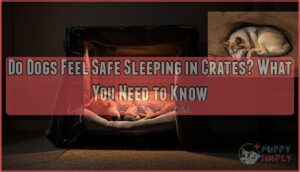
Picture a wolf curled in a shallow den, tucked away from wind and predators—safe, hidden, at rest.
That ancient instinct didn’t disappear when dogs moved into our homes. It got passed down, generation after generation, right into your living room.
So when your dog slinks into a crate and sighs, that’s not resignation. That’s biology doing exactly what it was designed to do.
Whether dogs feel safe sleeping in crates depends less on the crate itself and more on how you introduce it, size it, and use it.
Get those details right, and the crate stops being a cage—it becomes the den your dog was always wired to want.
Table Of Contents
- Key Takeaways
- Do Dogs Feel Safe Sleeping in Crates?
- Benefits of Crate Sleeping for Dogs
- Factors Influencing Crate Safety and Comfort
- How Long Can Dogs Sleep in Crates Safely?
- Making The Crate a Safe Haven
- Signs Your Dog is Uncomfortable in The Crate
- Alternatives to Crate Sleeping
- Common Crate Training Mistakes to Avoid
- Tips for Successful Crate Sleeping
- Frequently Asked Questions (FAQs)
- Can a dog sleep in a crate at night?
- Why do dogs crate at night?
- Is it cruel to crate a dog at night?
- How do I get my Dog to sleep in a crate?
- What is the 7 7 7 rule for dogs?
- What is the 10 minute rule for dogs?
- Can crate training affect a dogs social behavior?
- What crate materials are safest for chewing dogs?
- How do multiple dogs share crates effectively?
- Are certain dog breeds unsuited for crate sleeping?
- Conclusion
Key Takeaways
- Dogs are naturally wired to seek den-like spaces, so a crate can feel safe and comforting when it’s introduced gently and never used as punishment.
- A crate becomes a true safe haven when it’s the right size, placed in a calm spot, lined with comfy bedding and familiar scents, and paired with positive, gradual training.
- Crate time has limits—most adult dogs handle 6–8 hours at night while puppies, seniors, and high‑need dogs require much shorter stretches and frequent breaks to avoid physical and emotional harm.
- Your dog’s body language is the final judge of safety, and clear stress signals mean you may need to adjust crate use or switch to alternatives like beds, gated areas, or custom sleep setups.
Do Dogs Feel Safe Sleeping in Crates?
Whether a crate feels safe or scary to your dog depends on how it’s used and how your dog naturally sees enclosed spaces. In this section, you’ll see how dog’s denning instincts, body language, and behavior can tell you what the crate really means to them.
Understanding those instincts is the key, and helping your dog feel comfortable in their crate starts with working with their nature, not against it.
We’ll walk through a few simple cues so you can judge for yourself before choosing how and where your dog sleeps.
Natural Denning Instincts in Dogs
Your dog’s love of tight spaces isn’t quirky — it’s ancient. Ancestral Den Behavior runs deep in their DNA, inherited from wolves who raised pups in sheltered dens. This Evolutionary Comfort Zone shaped how dogs feel safe today.
Breed-Specific Den Preferences and Genetic Denning Signals explain why your dog gravitates toward:
- Tucking under furniture
- Curling in corners
- Squeezing into covered spots
Signs Your Dog Feels Secure in a Crate
So dog’s den instincts are real — but how do you know the crate is actually working for them?
Watch for these five signs of genuine canine comfort and security:
| Sign | What It Looks Like |
|---|---|
| Voluntary entry | Walks in without being asked |
| Relaxed posture | Sprawls on their side or back |
| Calm vocalizations | Settles quietly, maybe sighs softly |
| Toy engagement | Chews or plays, then naps |
| Consistent routine | Heads to crate at bedtime unprompted |
When dogs feel safe, their dog behavior tells you everything.
Ensuring proper crate comfort is essential for a happy dog.
Behavioral Cues of Comfort Vs. Distress
When your pup happily chooses the crate, you’ve seen canine comfort and security in action; now look closer at the details.
Loose sprawl and slow Posture Shifts signal dogs feel safe, while Eye Whales, Tail Tension, and frantic Vocal Patterns point to stress, even separation anxiety.
Watch Displacement Behaviors and restless dog sleep habits; that dog behavior matters a lot.
Understanding dog body language cues helps identify subtle stress signs.
Benefits of Crate Sleeping for Dogs
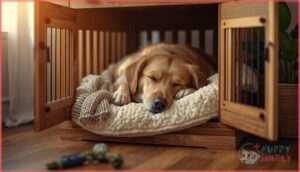
Once your dog learns that the crate is a safe spot, it can actually bring some real benefits for both of you.
From giving your dog a secure place to relax to helping you keep daily life more predictable, crate sleep can work in your favor.
Here are the key ways a well-used crate can help.
Security and Personal Space
Ever notice how a Den-like Enclosure draws out a sense of calm in your dog?
Crates offer Personal Territory and clear Boundary Respect, giving your dog a safe nook away from chaos.
With Secure Placement and subtle Privacy Cues, you’re not just offering a box—you’re handing over a trusted retreat. That’s one of the biggest crate benefits for canine comfort and security.
Reduced Anxiety and Stress
Stepping back from chaos matters — for your dog just as much as for you. Crates activate your dog’s denning instinct, promoting Alpha Wave Promotion and real Cortisol Reduction. Sensory Isolation cuts overstimulation, supporting self-soothing without your intervention. A Predictable Routine stabilizes stress hormones, easing separation anxiety naturally. These crate benefits shape healthier dog sleep habits and lasting canine comfort and security.
Crates tap into your dog’s ancient denning instinct, quietly lowering stress hormones and building lasting calm
- Cortisol drops by up to three times in dogs with consistent crate routines
- Alpha and theta brain waves replace high-alert stress responses during crate rest
- Anxious vocalizations fall by half when Sensory Isolation limits household noise
- Separation anxiety symptoms shrink as dogs build emotional independence
- Dogs self-soothe faster, shifting from fight-or-flight to calm rest-and-digest states
Aid in House Training and Routine
When you pair Crate Timing with a clear Potty Schedule, house training gets easier and safer.
You take your puppy straight outside after crate sleep, use planned Nighttime Breaks every three to four hours, and follow Consistent Feeding times.
This crate training and management helps dog sleep habits, reinforces strong Boundary Cues, and protects dog welfare and overall pet safety.
Factors Influencing Crate Safety and Comfort
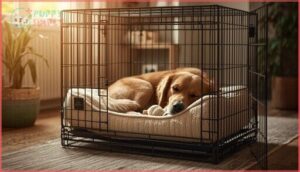
Not every crate setup works the same way for every dog — and that’s where the details really matter. A few key factors can make the difference between a dog who settles in easily and one who wants out immediately. Here’s what to pay attention to.
Crate Size and Layout
Think of crate size as your dog’s bedroom, not a storage box.
Use Adjustable Crate Dimensions and smart Divider Panel Placement so the Interior Space Ratio lets them stand, turn, and stretch.
Follow simple Bedding Thickness Guidelines so padding stays flat.
Check Door Latch Security every time; good crate training and management protects dog comfort, dog wellbeing, and crate usage.
Location and Environment of The Crate
dog’s crate shapes their sense of pet safety and security. Choose a spot with low Traffic Flow, steady Temperature Control, and gentle Noise Levels—far from busy hallways, loud appliances, or harsh Light Stimulation.
Family Proximity matters, too; dogs rest easier when they sense you nearby. Smart crate training and management starts with a calm, cozy environment for dog comfort and happiness.
Proper Crate Introduction
The first few days with a new dog crate are everything. Rushing this step is the #1 mistake owners make.
- Open Door Exploration – Let your dog sniff freely, without closing the door yet.
- Treat Trail Technique – Toss treats gradually deeper inside.
- Short Session Timing – Keep early sessions under 5 minutes.
Non‑slip Mat Placement and Cue Word Consistency seal the deal for lasting pet safety.
How Long Can Dogs Sleep in Crates Safely?
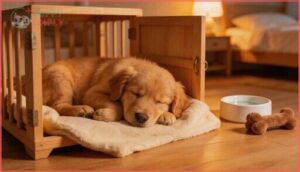
How long your dog can safely sleep in a crate isn’t one-size-fits-all, and that’s where many owners worry. Age, bladder control, and your daily routine all change what’s reasonable versus what’s just too long.
Next, we’ll walk through simple time guidelines and common sleeping setup options so you can choose what’s safest for your dog.
Recommended Nighttime Crate Durations
Most healthy adult dogs sleep comfortably in a crate for 6 to 8 hours overnight. Some calm dogs can manage 8 to 10 hours — but don’t treat that as a daily goal.
Exercise impact is real: a well-tired dog settles far more easily. Health considerations matter too, so always end the night with a potty trip right before bed.
Age-related Crate Time Guidelines
Age isn’t just a number in the context of crate training — it’s your guide. Puppy Age Rules matter here: an 8‑week‑old handles roughly 2 daytime hours max, while a 4‑month‑old can handle 3 to 4.
Adult Daily Hours settle around 4 to 6. Senior Crate Breaks should shrink — elderly dogs with joint issues need Elderly Joint Care and breaks every 30 to 60 minutes.
Risks of Excessive Crating
Too much crate time doesn’t just cramp your dog’s style — it genuinely hurts them. The crating debate often ignores these real crate risks:
- Urinary infections from holding it too long
- Joint stiffness and muscle loss from limited movement
- Learned helplessness — they stop reacting entirely
- Weight gain and social isolation that derail dog behavior modification
Dog health depends on balance.
Making The Crate a Safe Haven
Now that you know how long crate time should be, the next step is making that space feel truly safe. You don’t have to guess or reinvent the wheel here—small, simple choices can make a big difference in how your dog feels.
Let’s walk through a few specific ways you can turn the crate into a calm, cozy haven.
Choosing The Right Bedding and Toys

Picking the right bedding makes a real difference. For small dogs under 25 pounds, a 24×18-inch pad fits snugly. Larger breeds need orthopedic foam with bolstered edges to cushion joints and mimic den walls.
Waterproof pads handle accidents without soaking through.
For toys, stick to chew-safe options like Kong rubber toys — they won’t break into dangerous pieces.
Simple choices, big crate benefits.
Using Familiar Scents for Comfort

Bedding sets the stage, but scent seals the deal.
Tuck Owner Scented Blankets — a worn t‑shirt works perfectly — inside the crate.
Your dog reads that smell as “safe.”
Add Familiar Home Toys and consider Pheromone‑Infused Pads or subtle Calming Aromatherapy Sprays on bedding.
Consistent Scent Cues train your dog’s nose to recognize the crate as den, not detention.
Creating a Positive Association With The Crate
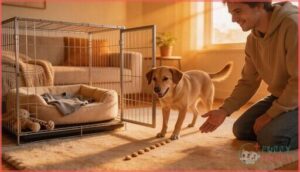
positive crate association doesn’t happen overnight — it’s a process rooted in canine psychology and consistency.
Start with Treat-Driven Entry: toss high-value rewards inside and let your dog choose to enter. Use Cue Consistency with one word like "crate" every time. Practice Gradual Door Closure only after your dog settles calmly. Add Playful Crate Games and Comfort Scent Integration to reinforce that the crate is genuinely theirs.
Signs Your Dog is Uncomfortable in The Crate

Not every dog takes to crate sleeping right away — and some never really warm up to it.
Knowing the difference between a dog who’s adjusting and one who’s genuinely struggling can save you both a lot of stress.
Here are the key signs to watch for.
Stress Signals and Crate Aversion
Your dog can’t say "I hate this thing" — but their body sure can. Watch for these stress signals:
- Body Language Cues: Rigid posture, tucked tail, pinned ears, or frozen wide-eyed staring
- Vocal Distress Signs: Whining, barking, or howling that intensifies over time
- Physiological Indicators: Excessive panting, drooling, or trembling unrelated to heat
- Escape Behaviors and Toy Avoidance: Frantically scratching bars or ignoring food they’d normally devour
These aren’t stubbornness — they’re canine psychology speaking plainly.
When Crate Use May Be Unsuitable
Although your denning instinct can make crates look cozy, some situations make crate risks too high for real dog comfort.
Medical Health Constraints, like arthritis or diabetes, mean they need space and bathroom breaks. Confinement Phobia, separation anxiety, Extended Crating Risks, Behavioral Problem Masking, or an Inadequate Crate Environment all signal it’s time to explore alternatives to crate sleeping.
Addressing Separation Anxiety
Separation anxiety isn’t a stubbornness problem — it’s a real emotional response that needs structured support. With the right dog behavior modification techniques, most dogs improve substantially.
- Trigger Desensitization: Practice departure cue training by handling keys or bags without leaving, until your dog stops reacting.
- Calming Aromatherapy + Pheromone Diffusers: Lavender scents and dog-appeasing pheromones near the crate genuinely ease tension.
- Routine Consistency: Predictable schedules reduce anticipatory anxiety fast.
Alternatives to Crate Sleeping

If a crate doesn’t seem right for your dog, you still have plenty of safe ways to set up sleep. Many dogs relax best in spaces that are open but still predictable and cozy.
Next, we’ll look at some simple crate-free setups you can use to give your dog a secure place to rest at night.
Dog Beds and Open Sleeping Areas
Not every dog needs a crate to feel secure. A quality dog bed works beautifully for confident, house-trained dogs.
Orthopedic foam beds cradle achy joints, while support edge designs mimic den walls without full enclosure.
Elevated cot beds boost airflow and pet safety. Open mattress styles suit sprawlers perfectly.
Calming open designs genuinely improve dog comfort and overall sleep quality.
Pros and Cons of Co-sleeping
Co-sleeping has real appeal. Co-sleeping. The emotional bond deepens when your dog curls up beside you — oxytocin levels rise in both of you, and many owners feel genuinely less stressed.
But sleep quality can take a hit. A restless dog fragments your rest without you even realizing it.
There are also health risks: dander, parasites, and dirt from outdoor walks land right on your pillow. Worth considering carefully.
Custom Sleep Spaces for Different Dog Needs
co-sleeping feels crowded, you still have dog sleeping arrangements supporting dog comfort, dog health, and hygiene.
- Puppy Den Modules split play/sleep, supporting crate training and usage.
- Senior Orthopedic Beds cushion joints with memory foam.
- Elevated Breed Cots keep dogs cool, clean, and dry.
- Anxious Dog Enclosures give darker dens matching canine behavior and psychology.
- Wall‑Mounted Beds save space.
Common Crate Training Mistakes to Avoid
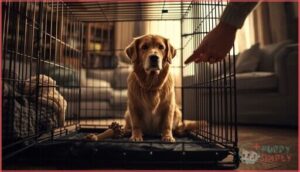
Even the best intentions can go sideways when crate training if you’re not watching for a few key missteps.
Small habits—like using the crate as a time-out spot or leaving your dog crated too long—can quietly undo all the progress you’ve made.
Here are the most common mistakes dog owners make, and how to steer clear of them.
Using The Crate as Punishment
Never use the crate as punishment — this is one of the fastest ways to trigger Trust Erosion. Once your dog links confinement with Stress Indicators like fear or scolding, Punishment Association takes hold and undoes everything you’ve built.
Here’s what that looks like in practice:
| What You Do | What Your Dog Learns |
|---|---|
| Crate after scolding | Crate = danger |
| Forced confinement | Avoid entering |
| Yell, then lock in | Fear the handler |
| Inconsistent use | Confusion and anxiety |
| Punishment-based crating | Training Reversal begins |
Recovery Strategies exist, but rebuilding takes far longer than the damage did.
Over-crating and Lack of Enrichment
Over-crating is just as damaging as punishment.
When dogs spend more than 6–8 hours confined daily, Muscle Atrophy sets in, Anxiety Buildup follows, and Immune Suppression becomes a real risk.
Behavioral Regression — think obsessive licking, withdrawal, aggression — signals an Enrichment Deficit.
Good Crate Training and Management means balancing confinement with toys, movement, and connection.
Your dog needs more than four walls.
Ignoring Individual Dog Preferences
Your dog’s preferences are data. Ignoring them is Owner Bias in action.
When your dog consistently leaves an open crate to sleep elsewhere, that’s a Preference Signal — a Feedback Loop worth respecting. Choice Respect and Space Autonomy aren’t soft ideas; they’re core to dog behavior and psychology.
Watch for these canine reactions:
- Repeatedly napping on the floor instead of inside the crate
- Entering only under pressure, never voluntarily
- Visibly relaxing the moment they leave the crate
Pet owner responsibilities include adjusting the plan.
Tips for Successful Crate Sleeping

Getting crate sleeping right comes down to a few key habits that make all the difference. Once you’ve avoided the common pitfalls, it’s time to build on what actually works.
Here are the tips that set you and your dog up for real success.
Gradual Crate Training Techniques
Curious how to make a dog crate feel like a safe bedroom, not a jail? Think from the perspective of gradual training: tiny steps that feel easy and safe, not rushed or forced. You’ll use Treat Placement, Door Open Sessions, Owner Proximity, and a simple Cue Word to build trust, then layer in Progressive Timing so your dog rests calmly instead of panicking.
| Step Focus | Quick Example |
|---|---|
| Treat Placement | Toss treats just inside, then farther back so your dog chooses to walk in. |
| Door Open Sessions | Let them relax inside briefly with the door open, then step out calmly. |
| Owner Proximity | Sit right beside the crate at first so they can see and smell you nearby. |
| Cue Word | Say your Cue Word (“crate”) once as they enter, then reward inside. |
| Progressive Timing | Close the door for seconds, then minutes, always opening before whining starts. |
Used this way, Crate Training and Management aligns with dog behavior and psychology and aids real pet safety and security, not control for its own sake.
Balancing Crate Time With Exercise and Interaction
Think of the Exercise‑Crate Ratio like a bank account — the more Pre‑crate Play you deposit, the calmer your dog’s crate time feels. Responsible pet ownership means balancing confinement with real connection.
- Give 30–60 minutes of exercise before crating
- Schedule Midday Walk Breaks to reset energy
- Offer Post‑crate Enrichment like sniff games or lick mats
- Build in Scheduled Social Time every evening
- Use Crate Training and Management alongside Dog Health and Wellness practices
Dog Behavior and Psychology confirms that movement and belonging directly support Pet Safety and Security.
Monitoring Your Dog’s Well-being
As your dog rests in the crate, you quietly track Sleep Metrics through calm Body Language, steady Heart Rate, and simple Temperature Checks.
An Activity Tracker plus quick notes on dog psychology and behavior, dog health and wellness, pet safety and health, dog wellbeing and happiness, and animal welfare and ethics keeps you focused on real comfort, not just routine.
Frequently Asked Questions (FAQs)
Can a dog sleep in a crate at night?
Studio den: dog crate, dogs sleeping in crates.
Crate Training Benefits, Nighttime Crate Temperature, Owner Proximity Benefits, Crate Light Levels, Pre‑sleep Exercise Routine, Health Monitoring Indicators together safely support Pet Safety, Dog Wellbeing and Happiness.
Why do dogs crate at night?
Crating at night leverages your dog’s natural instinct for a secure den.
It provides temperature regulation, hazard prevention, and sleep cycle alignment — syncing perfectly with your routine and their nighttime hormones.
Is it cruel to crate a dog at night?
Moonlit room, your dog in a dog crate: Nighttime Crate Ethics say dog crating isn’t cruel when
Owner Responsibility Limits, Legal Regulations, pet safety, animal welfare, crate benefits and risks, Alternative Night Safety, Psychological Impact.
How do I get my Dog to sleep in a crate?
Use Calm Pre‑Sleep Activities, Cue Consistency, Nighttime Routine around the dog crate; pair crate training, dog crating, Treat Placement, gentle Crate Door Management, so dogs sleeping in crates gain crate benefits and risks safely overnight.
What is the 7 7 7 rule for dogs?
Think of it as a confidence playlist.
The 7-7-7 rule guides puppies through seven surfaces, people, and challenges using positive reinforcement — building trust, easing crate training, and shaping calm, adaptable behavior through structured socialization steps.
What is the 10 minute rule for dogs?
The 10-minute rule balances Training Session Length, Crying Intervention Timing, and Gradual Duration Increase. Start crate training at 10 minutes, rewarding calm behavior within the Dopamine Reward Window for lasting results.
Can crate training affect a dogs social behavior?
Yes, crate training genuinely shapes a dog’s social behavior.
Done right, it builds Confidence Building and Independence Skills, fueling Anxiety Reduction. Dogs trained this way thrive in Social Play and Pack Integration.
What crate materials are safest for chewing dogs?
For serious chewers, pick Aluminum durability, Steel reinforcement, Non‑toxic coatings over Chew‑resistant plastics or Wire mesh safety.
Supporting crate training, Dog Crate Usage, Crate Benefits and Risks, Pet Safety and Wellbeing, Animal Welfare and Comfort.
How do multiple dogs share crates effectively?
Multiple dogs share crates effectively when you prioritize Separate crate training, Size matching, Divider panels for safety, Supervised introductions, and Rotating schedules so dogs can sleep, reducing canine confinement and supporting crate culture and dog behavior.
Are certain dog breeds unsuited for crate sleeping?
Some breeds genuinely struggle with crate sleeping. Escape-prone breeds like Huskies, anxiety-prone breeds like Belgian Malinois, and high-energy herders such as Border Collies often find confinement stressful rather than comforting.
Conclusion
Here’s the thing—the moment you stop trying to make your dog love the crate and simply set it up right, they often just… do.
Do dogs feel safe sleeping in crates? Most of them genuinely can, because that quiet, enclosed space speaks directly to something ancient in their DNA.
Give it the right size, the right introduction, and a little patience.
Your dog isn’t waiting to be convinced—they’re waiting for you to get it ready.
- https://dogtech.com.au/how-does-your-dog-really-feel-about-that-crate/
- https://www.gomineofficial.com/dog-crate-sizes-by-breed-find-the-perfect-fit/
- https://www.preventivevet.com/dogs/crate-training-at-night-for-puppies
- https://primopads.com/blogs/news/should-dogs-sleep-in-crates
- https://www.omlet.us/guide/dogs/crate_training/crate_training_an_older_dog/