This site is supported by our readers. We may earn a commission, at no cost to you, if you purchase through links.
Your dog nails the sit command at home, but the moment you step outside, treats are spilling from your pockets and your hands are fumbling while your enthusiastic pup is already jumping for the next command. The mechanics of training often get overlooked—we focus on technique and consistency, yet struggle with the simple act of delivering rewards efficiently.
A treat pouch solves this practical challenge, but only if it’s attached correctly. The wrong placement leaves you twisting awkwardly or creates distracting jingling sounds, while a poorly secured pouch can slide around your waist or even fall off mid-session.
Getting the attachment right transforms your training setup from a frustrating juggling act into a fluid reward system that keeps both hands free and your focus where it belongs—on your dog.
Table Of Contents
Key Takeaways
- Proper treat pouch placement, slightly behind your hip on your dominant side, keeps treats instantly accessible within the critical 1-second reward window while minimizing distractions that pull your dog’s focus away from training.
- Belt loops, clip-on systems, and crossbody styles each offer distinct advantages, but the best attachment method combines secure fastening with one-handed operation so you can deliver timely rewards without fumbling or breaking your training rhythm.
- Positioning your pouch for ergonomic reach and balanced weight distribution prevents the awkward twisting and physical strain that derail long training sessions, keeping both you and your dog comfortable and focused.
- Regular cleaning, proper storage in airtight containers, and routine inspections for wear ensure your treat pouch remains hygienic and functional across hundreds of sessions, protecting both treat freshness and equipment reliability.
Why Use a Treat Pouch for Training?
A treat pouch isn’t just another training gadget—it’s a breakthrough that keeps your hands free and your rewards ready when your dog nails that perfect sit or recall.
The best models combine durable, easy-to-clean materials with features like adjustable waist straps and built-in waste bag dispensers that make every session smoother.
Timing makes or breaks effective training, and fumbling through pockets or bags while your dog loses focus sabotages even the best sessions.
Let’s look at the key reasons a quality treat pouch becomes an essential part of your training toolkit.
Benefits of Hands-free Treat Access
Hands-free training transforms your reward system by keeping treats instantly accessible without fumbling through pockets. You’ll deliver positive reinforcement the moment your dog completes a cue, which strengthens the connection between action and reward.
Quick access also improves trainer safety—you maintain better control and posture while your hands stay ready to guide or steady your dog during decisive moments. Many trainers also appreciate the that comes from hands-free gear during active sessions.
Importance of Timely Rewards
The window between your dog’s correct action and your reward determines how quickly they learn. Quick access to treats lets you reinforce positive behavior within seconds, which builds motivation and strengthens the command reinforcement loop.
Quick treat access strengthens training by letting you reinforce correct behavior within seconds, closing the loop between action and reward
Timely reward timing transforms each session:
- Boosts motivation by linking effort to instant recognition
- Strengthens behavior through immediate positive reinforcement
- Enhances engagement with short feedback intervals
- Builds consistency across training sessions
- Reduces confusion about which action earned the reward
Research has shown that immediate rewards increase intrinsic motivation, making timely reinforcement especially effective in training scenarios.
Enhancing Training Consistency and Focus
Beyond speed, a treat pouch builds the foundation for reliable training routines. When your reward timing stays consistent across sessions, your dog learns to anticipate structure, which sharpens their focus techniques and motivation.
| Consistency Factor | Impact on Training |
|---|---|
| Same pouch placement | Builds trainer muscle memory |
| Standardized treat size | Prevents mixed signals |
| Uniform cues | Maintains performance stability |
| Predictable session structure | Reduces anxiety, boosts confidence |
Handsfree training with quick access keeps your dog’s attention locked on you, not your fumbling hands.
That’s why trainers rely on treat pouches to keep rewards instantly accessible without breaking focus during critical training moments.
Choosing The Right Treat Pouch
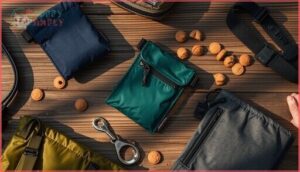
Before you can master how to attach your treat pouch, you need to pick one that actually works for your training style and your dog’s needs.
The right pouch won’t just hold treats—it’ll make your training sessions smoother, faster, and less frustrating. Let’s break down what features matter, the different types you’ll encounter, and how to evaluate which one fits your situation.
Key Features for Effective Training
A great treat pouch delivers quick access through a wide opening and one-handed operation, so you can reward within that critical 1-second window.
Look for hands-free design with secure belt clip or waistband pouch attachment options, water-resistant fabric for pouch durability, and closures that won’t fumble during sessions. These features maintain training consistency and keep your focus where it belongs—on your dog.
Types of Treat Pouches and Their Pros/cons
You’ll find five main types of treat pouches, each with distinct trade-offs. Magnetic closures offer one-handed opening but may spill if jarred. Velcro options provide fast access yet wear over time and create noise.
Zipper systems prevent spillages but add bulk. Silicone designs resist odors and wipe clean easily. Belt clip fabric pouches distribute weight evenly with multiple compartments for treat variety.
Size, Material, and Durability Considerations
Treat Pouch Sizing directly affects how many rewards you can carry, with most designs holding 0.5 to 2.0 cups depending on pocket depth.
Material Selection matters for longevity, with nylon resisting abrasion during daily use, while TPU-coated fabrics wipe clean easily.
Durability Testing shows that stainless steel hardware and reinforced Closure Systems withstand thousands of training sessions, ensuring your dog training equipment stays reliable through repeated waist belt attachment.
Best Ways to Attach a Treat Pouch
How you attach your treat pouch can make or break your training session. The right attachment method keeps treats accessible without getting in your way, while the wrong one creates fumbling, frustration, and missed opportunities to reward your dog.
Let’s look at the most effective attachment styles and how each one facilitates different training situations.
Belt and Waistband Attachment Methods
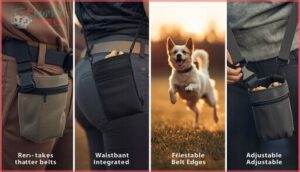
The right belt attachment keeps your hands free and your focus sharp. When you’re working with a high-energy pup, secure fasteners matter.
Here are your main options:
- Belt Loop Systems thread your belt through reinforced fabric loops, keeping the pouch parallel to your body and preventing swing during movement.
- Waistband Integration distributes weight evenly across your waist, reducing pressure points during longer sessions.
- Clip On Designs attach directly to your belt edge, offering quick on-off convenience with adjustable positioning.
- Strap configurations with adjustable length let you customize fit and cant angle for ideal reach.
Most loops accommodate belts between 1.25 and 1.75 inches wide, with reinforced stitching that resists pulling when loaded with treats.
Clip-on and Magnetic Closure Options

When you need one-handed operation during fast-paced sessions, magnetic closures and clip designs offer instant access without fumbling. Magnetic systems use small neodymium magnets rated to hold up to 1.5 pounds of force, closing automatically when you release the pouch. Clip-on designs feature spring-loaded jaws in stainless steel or coated finishes that resist moisture and wear.
| Attachment Type | Primary Advantage |
|---|---|
| Magnetic Closure | One-handed quick release |
| Spring-Loaded Clip | Secure grip on fabric edges |
| Hybrid Clip-Magnet | Redundant hold for safety |
| Magnetic Snap | Low-force snap feel |
Smooth edge finishes reduce fabric snagging, while rubberized sleeves protect magnets from dirt. Inspect clips regularly for bent prongs or cracks after heavy use, and clean magnets with a damp cloth to prevent corrosion that weakens attachment strength.
Over-the-shoulder and Crossbody Styles
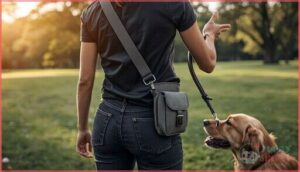
When your hands need to stay free for leash control and commands, crossbody styles keep your treat pouch accessible without waist belt constraints. Crossbody benefits include weight distribution across your torso using 40- to 56-inch shoulder straps, reducing fatigue during long sessions.
Strap adjustments let you switch wear styles quickly, while padded bag materials improve shoulder comfort. Choose attachment options with reinforced clips and water-resistant fabrics for durability.
Positioning The Treat Pouch for Training

Once you’ve chosen your attachment method, where you position the treat pouch on your body makes all the difference in your training success. The right placement keeps treats accessible without turning your dog into a pouch-focused distraction machine, while also ensuring you can move comfortably and safely during sessions.
Let’s look at the key positioning strategies that will simplify your training and keep both you and your dog focused on what matters.
Ideal Placement for Quick Treat Access
Quick access rewards depend on how you position your treat pouch at the waist—your dominant side allows for natural hand movement without awkward twisting. For ideal trainer ergonomics and treat accessibility, follow these placement principles:
- Align the pouch opening toward your hip for smooth, inward scooping motions that won’t pull your waist belt or shirt
- Keep it slightly forward and inward to guarantee convenient carrying without torso rotation
- Tilt the opening for quick release to prevent spills during sudden turns
Minimizing Distractions for Your Dog
Position your pouch slightly behind your hip—out of your dog’s direct line of sight—to keep your training environment calm and your dog focused on you, not the treat source. This placement aids distraction control and impulse control by removing visual temptation during reward timing.
For loose-leash walking or training in public, wear the pouch on your non-leash side to simplify distraction management and leash handling.
Comfort and Safety for The Trainer
Comfort matters just as much as function. Wearing your pouch centered on the front of your waist ensures balanced weight distribution across both hips, reducing lower-back strain during long sessions.
Choose secure attachment options—a sturdy waist belt or reinforced belt clip—that won’t slide or dig in. Trainer safety improves with ergonomic design, quick-drying materials for personal hygiene, and a strap that sits comfortably on your hips without constant readjustment.
Maintenance and Safety Tips for Treat Pouches

Your treat pouch works hard during training sessions, so it needs regular care to stay functional and safe.
Proper maintenance keeps your pouch hygienic, extends its lifespan, and ensures treats remain fresh and appealing to your dog. Here’s what you need to focus on to keep your training gear in top shape.
Cleaning and Care for Longevity
A well-maintained treat pouch supports you through hundreds of training sessions, but only if you clean it regularly. After each use, wipe the interior with a damp microfiber cloth to prevent residue buildup and odor control.
For deeper cleaning, choose machine-washable pouches when possible, or hand-wash with mild soap and lukewarm water. Air dry completely before storing to protect material durability and prevent mold.
Proper Storage to Keep Treats Fresh
Even washable materials and durable materials won’t protect your rewards if poor storage ruins them. Proper storage in airtight packaging preserves treat shelf life and maintains the high-value motivation your dog needs during sessions.
Here are freshness tips for ideal humidity control:
- Store treats in airtight containers at 50–70°F to prevent moisture loss
- Use weather-resistant storage containers away from heat sources
- Keep your treat pouch in a cool, dry spot between training sessions
- Replace stale rewards regularly to maintain training effectiveness
Inspecting for Wear and Safe Materials
Regular wear detection keeps your treat pouch safe and functional. Check fabric durability by examining seams for splits and zippers for skipped teeth after heavy use.
Material safety matters—choose durable materials with toxicity testing that meet pet accessory standards. Inspect secure closures for looseness and weatherresistant coatings for rubbing off. Replace washable materials showing delamination or fraying before pouch maintenance becomes a safety issue.
Frequently Asked Questions (FAQs)
Can you use a treat pouch for training?
Yes, a treat pouch transforms training sessions by keeping rewards within reach—usually one to two seconds—enabling you to reinforce positive behavior instantly, maintain rhythm, and strengthen your dog’s motivation through consistent, timely rewards.
Can I wear multiple treat pouches at once?
You can wear two treat pouches at once for balanced weight and treat separation, positioning them on opposite sides of your waist belt to improve access speed, dual comfort, and attachment security during training.
How do I prevent treat pouch from bouncing?
A wildly bouncing treat pouch can derail focus—secure it with two-point belt attachment, choose shallow designs, tighten adjustment straps, and position at hip level for pouch stability and bounce reduction during movement.
Whats the best pouch position for small dogs?
For small dogs, position your treat pouch at waist or hip level to keep your dog stable without lifting.
A front chest style reduces bounce and keeps your dog facing forward.
Can treat pouches fit on running belts?
Most running belts accommodate slim treat pouches through belt loops or clips, provided the pouch stays under 5 inches wide.
Placement near your hip bone reduces bounce, and magnetic closures enable one-handed access during pauses.
How tight should the waistband be adjusted?
Adjust your waist belt snugly so the treat pouch stays secure without digging in. You should fit two fingers between the waistband and your body, allowing comfortable movement while preventing the attachment from sliding during training sessions.
You should ensure this fit is correct to allow for the best results.
Conclusion
A well-positioned treat pouch becomes the bridge between intention and execution, turning scattered moments into flawless training wins. When you’ve found the best way to attach a treat pouch while training, your hands stay free, your timing sharpens, and your dog learns faster because you’re no longer fighting your equipment.
The right attachment isn’t just convenience—it’s the difference between fumbling through sessions and building the confident, responsive partnership you’ve been working toward.
- https://www.lakotacreekkennels.com/puppy-training/
- https://woodroofchiro.com/blog/how-walking-your-dog-hurts-your-low-back
- https://leashrr.com/use-a-treat-pouch-effectively/
- https://www.terrouxdogtraining.com/post/a-trainer-s-perspective-best-treat-pouches
- https://www.whole-dog-journal.com/food/five-best-dog-training-treat-pouches/