This site is supported by our readers. We may earn a commission, at no cost to you, if you purchase through links.

Your dog has burned a hole in the carpet from pacing, chewed through two leashes, and still looks at you like you owe him a marathon. Some breeds don’t just want exercise—demand it like a second job. But between unpredictable weather, packed schedules, and the occasional reactive-dog meltdown on the sidewalk, getting that daily run in isn’t always possible.
That’s where the best dog treadmills earn their place—not as a gimmick, but as a practical tool that serious dog owners, rehabilitation vets, and working-dog trainers have quietly relied on for years. What separates a safe, well-built machine from a wobbly hazard is worth knowing before you spend a cent.
Table Of Contents
- Key Takeaways
- What is a Dog Treadmill?
- Dog Treadmill Benefits for Your Pup
- Consistency in Exercise Regardless of Weather
- Safe, Controlled Workouts for Reactive or Anxious Dogs
- Weight Management and Cardiovascular Conditioning
- Rehabilitation Support After Injury or Surgery
- Targeted Exercise for High-energy and Working Breeds
- Behavioral Improvements From Reduced Boredom and Stress
- Mental Stimulation and Confidence-building Indoors
- Key Factors When Choosing Dog Treadmills
- Size and Weight Capacity for Your Dog’s Breed
- Running Surface Length, Width, and Traction
- Speed Control Range and Incline Options
- Noise Levels and Motor Smoothness at Low Speeds
- Side Rails, Barriers, and Safety Key Systems
- Foldability, Storage, and Portability at Home
- Exercise Programs, Timers, and Digital Displays
- Budget, Warranty, and User Review Considerations
- Top 10 Dog Treadmills to Buy
- 1. DogPACER Full Size Treadmill
- 2. PawPaw Dog Treadmill for Large Dogs
- 3. PETSITE Dog Treadmill with LCD Display
- 4. Lifepro PawRunner Dog Treadmill
- 5. Goplus Dog Treadmill Indoor Exercise Machine
- 6. dogPACER MiniPACER Dog Treadmill
- 7. GoPet Small Dog Treadwheel
- 8. PawPaw Dog Treadmill with Brake
- 9. Moysoon Adjustable Dog Treadmill with Ramp
- 10. Petbobi Dog Treadmill Rotatable Display
- Safe Setup, Training, and Daily Use
- Dog Treadmill Safety and Maintenance
- Essential Safety Features to Prioritize Before Buying
- Emergency Stop Buttons and Auto Shutoff Functions
- Side Panels, Fences, and Leash Attachment Points
- Non-slip, Cushioned Belt Surfaces for Joint Protection
- Cleaning Hair and Debris for Smooth Belt Movement
- Regular Inspections for Wear, Noise, and Overheating
- When to Pause Treadmill Use and Call Your Vet
- Frequently Asked Questions (FAQs)
- What type of treadmill is best for dogs?
- What words do dogs hear best?
- Is it worth buying a dog treadmill?
- What does a 30 minute walk do for a dog?
- How do I find the best dog treadmills?
- Are dog treadmills safe?
- What size treadmill for a small dog?
- How much does a dog treadmill cost?
- Why should you buy a dog treadmill?
- How do I Make my Dog’s treadmill more comfortable?
- Conclusion
Key Takeaways
- Dog treadmills aren’t just rainy-day gadgets—vets, trainers, and rehab specialists rely on them to manage weight, support post-surgery recovery, and calm anxious dogs who struggle with outdoor triggers.
- Before your dog takes a single step on the belt, get a vet check first—skipping that puts joints, heart health, and recovery at real risk.
- The right fit matters more than fancy features: match belt length, width, and weight capacity to your dog’s size, and prioritize a non-slip surface, side rails, and an emergency stop before anything else.
- Start slow—introduce the treadmill with the motor off, keep early sessions under 10 minutes, and build speed and duration gradually so your dog stays confident rather than stressed.
What is a Dog Treadmill?
dog treadmill is a piece of exercise equipment made specifically for your dog’s body and natural stride.
It gives your pup a safe, controlled space to walk or run when outdoor exercise isn’t a good option.
For setup ideas that keep dogs active without trashing the lawn, see this guide to choosing durable outdoor dog runs.
Below, you’ll see the main dog treadmill options and how each one can fit different spaces and dogs.
How Dog Treadmills Differ From Human Treadmills
Although they look alike, a dog treadmill is fitness equipment for dogs, not a human treadmill, whether motorized treadmill or non‑motorized treadmill.
- Belt texture grips paws and limits slipping.
- Low deck height lets dogs step on it safely.
- Narrow speed range starts very slow for control.
- Noise dampening and a safety strap points keep them centered and secure.
Motorized Vs Non-motorized Dog Treadmills
Once you know how this Fitness Equipment for Dogs differs from yours, the next choice is Motorized Treadmill or NonMotorized Treadmill.
Motorized models offer precise speed control and incline, but higher Energy Consumption, more Acoustic Footprint, and placement limits.
Nonmotorized units encourage Self‑Propelled Gait, better Portability Weight, and Maintenance Simplicity, supporting Dog Health and Wellness that Dog Treadmill Reviews highlight.
Consider the adjustable speed settings for customized workouts.
Treadmills Vs Treadwheels for Small Dogs
Once you’ve weighed motorized versus non‑motorized, the next choice for small pups is a treadmill or treadwheel.
A dog treadmill usually needs more Space Requirements, offers steadier speeds, and adds Noise Levels.
Treadwheels are manual, quieter, boost Portability, and cost less in a Cost Comparison.
Dog Treadmill Reviews note an easier Training Curve and solid canine exercise for pet fitness.
low impact exercise can help older dogs stay healthy.
Which Dogs Benefit Most From Treadmills
Not every dog needs a treadmill, but some really thrive with one.
High‑Energy Breeds like Border Collies and Huskies, Overweight Dogs needing gentle canine exercise, Rehab Patients rebuilding strength post‑surgery, Anxious Dogs that struggle outdoors, and Working Dogs maintaining peak conditioning all benefit most:
- High‑Energy Breeds burning excess drive
- Overweight Dogs with controlled pet fitness goals
- Rehab Patients needing structured dog training
- Anxious Dogs avoiding outdoor triggers
- Working Dogs staying conditioned year‑round
Indoor Exercise Vs Outdoor Walks Comparison
On busy or stormy days, you might lean on Indoor Dog Training Solutions like Dog Treadmills, which remove Weather Impact and give predictable Surface Traction and Joint Load.
Outdoor Dog Walking adds smells and real‑world Dog Exercise challenges but higher Distraction Levels.
Progress Tracking is easier indoors, so Pet Fitness and Exercise stay consistent and measurable across weeks of training.
Vet Guidance Before Starting Treadmill Exercise
Although a treadmill looks simple, your dog needs Pre‑Exercise Clearance from a vet first.
That visit ties Pet Health and Wellness to smart Pet Care and Training, not guesswork.
- Cardio Screening, Dog Health, Animal Health.
- Orthopedic Assessment for safer joints.
- Post‑Surgery Rehab sets controlled pacing.
- Stress Signal Monitoring—panting, whining, reluctance—stops sessions.
- Veterinary Medicine and Health guide long‑term care decisions well.
Dog Treadmill Benefits for Your Pup
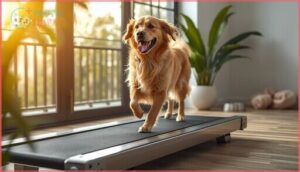
A dog treadmill does a lot more than just keep your pup moving on a rainy day.
From calming anxious dogs to speeding up post-surgery recovery, the benefits go deeper than most owners expect.
Regular dog treadmill sessions can calm anxious pups and speed post-surgery recovery more than most owners realize
Here’s a closer look at what regular treadmill time can actually do for your dog.
Consistency in Exercise Regardless of Weather
Snow, heat, or rain outside? A Dog Treadmill gives you a Weather‑proof routine and Year‑round scheduling so Dog Fitness and Exercise don’t depend on icy sidewalks or blazing pavement.
With Indoor climate control, you set Consistent pacing and build a Seasonal training plan as part of your Indoor Dog Training, using Pet Exercise Equipment for safe, repeatable Indoor Activities daily.
Safe, Controlled Workouts for Reactive or Anxious Dogs
If your dog reacts to every passing stranger or noise outside, a dog treadmill gives you a calm, enclosed space with zero surprise triggers. You control Trigger Exposure completely — quiet room, steady pace, no chaos.
Use Micro‑Break Sessions and Calm Cue Training to reward relaxed movement. Side‑Rail Barriers and Leash Pressure Management keep anxious dogs safe, making Indoor Dog Training genuinely stress‑free.
Weight Management and Cardiovascular Conditioning
Regular treadmill sessions do more than just tire your pup out — they support genuine Canine Fitness through consistent Calorie Burn Tracking and Endurance Building. Keeping your dog in steady Heart Rate Zones boosts Metabolic Rate and drives real Fat Loss Strategies over time.
As Fitness Equipment goes, a dog treadmill delivers reliable Dog Health and Fitness gains that casual outdoor walks often can’t match.
Rehabilitation Support After Injury or Surgery
A recovering dog needs careful, controlled movement — and that’s exactly where a dog treadmill earns its place in veterinary medicine and health routines.
With progressive loading, you can gradually rebuild joint mobility without overexertion. It facilitates pain management by keeping sessions short and paced. Canine rehabilitation and therapy programs increasingly use animal fitness equipment like this for balance training and safe wound healing recovery.
Targeted Exercise for High-energy and Working Breeds
Beyond Recovery Protocols, a dog treadmill also shines for high‑energy and working breeds that you can’t easily tire them out outside.
You can program Stamina Conditioning and Endurance Intervals with steady speeds and inclines, add Skill Drills or Agility Simulations, and fit Pet Fitness into busy weeks while supporting Canine Rehabilitation and Therapy, Canine Wellness and Nutrition‑focused exercise for your dog.
Behavioral Improvements From Reduced Boredom and Stress
After working those high‑energy or working breeds, you’ll notice behavior changes at home.
Scheduled Dog Exercise on treadmill gives Calm Energy Release and Boredom Relief, so there’s less restless pacing, barking, or zooming. That structure provides Anxiety Reduction, Focused Attention in Dog Training and Behavior, Improved Socialization, and Canine Wellness and Nutrition, Animal Health and Nutrition, plus Pet Owner Resources.
Mental Stimulation and Confidence-building Indoors
Less boredom also means more room to grow. A dog treadmill builds real confidence through Predictable Sessions — same spot, same smells, same routine. Pair that with Scent Games near the belt, Clicker Marking at Step‑On Milestones, and Lead Guidance to keep movement calm and controlled.
- Use scent cues near the deck to create positive associations
- Click and reward the moment one paw touches the belt
- Keep sessions short and end before your dog shows stress
- Practice with the belt off first, then introduce slow movement
- Repeat at the same time daily so your dog anticipates it
Key Factors When Choosing Dog Treadmills
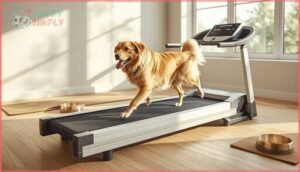
Choosing the right dog treadmill comes down to matching the machine to your dog’s body, energy level, and home setup.
A few core features make the biggest difference in safety, comfort, and how easily you can use it day to day.
Here’s what to pay attention to as you compare the options below.
Size and Weight Capacity for Your Dog’s Breed
Choosing a dog treadmill starts with Breed Size Matching, not fancy features.
You want Weight Limits that cover your dog’s current weight plus a buffer, and a Platform Load rating strong enough for strides.
For large dogs, many pet owners also watch Belt Width and size, while Adjustable Length options help multi‑dog homes share fitness equipment and dog treadmills.
Running Surface Length, Width, and Traction
On any dog treadmill, the running surface is where dog running feels safe or shaky.
Choose Belt Length Options around 40–60 inches and Width Stability near 16–20 inches.
Quality Traction Materials with Surface Grip Zones keep paws secure during exercise on this fitness equipment:
- Longer belts allow a natural stride.
- Moderate, Adjustable Width helps balance.
- Textured, non-slip belts prevent slipping.
Speed Control Range and Incline Options
Speed Precision matters more than you’d think. Most dog treadmills span 0.5 to 12 mph, with quick 0.5 mph increments for smooth transitions.
Incline Variety — generally 0 to 15 percent — adds challenge without switching exercise equipment.
Programmable Gradients and Adjustable Ramp settings let you build custom routines, while Low‑Speed Smoothness keeps your dog comfortable during gentle warm-ups on any Motorized Treadmill built for dog exercise.
Noise Levels and Motor Smoothness at Low Speeds
While you might focus on size first, noise at slow speeds matters just as much. In Dog Treadmills, Torque Ripple can cause Motor Hum and Low‑Speed Vibration that spooks sensitive pups.
Look for Motorized Treadmills with good Resonance Damping and low Bearing Noise. Manual Treadmills are simpler Exercise Equipment but still affect overall Dog Exercise comfort in your home environment.
Side Rails, Barriers, and Safety Key Systems
Strong safety design turns a Dog Treadmill from risky to truly reassuring. Look for Adjustable Rail Height so Side Rails fit your dog’s build, plus Padded Barrier Edges that prevent scrapes.
A Magnetic Safety Key clipped to a leash, built with Chew‑Resistant Materials, should stop the belt instantly, while a Quick‑Release Rail Mechanism simplifies daily Dog Care and Pet Care.
Foldability, Storage, and Portability at Home
Ever wish your dog gear folded away like a slim suitcase? Compact Frame Design that folds to 8–12 inches with snap locks turns a dog treadmill into true Home Exercise Equipment.
Lightweight Aluminum Build, Easy‑Roll Wheels, padded grips, Integrated Storage Compartments, Wall‑Mount Options, and anti‑skid feet so dog treadmills support indoor pet activities and everyday fitness technology effortlessly.
Exercise Programs, Timers, and Digital Displays
Think of modern Dog Treadmills as smart Home Exercise Equipment for your pup.
Preset Workouts automatically vary Speed Adjustments so you can repeat the same Exercise plan on busy days. Countdown Timers let you set time, distance, or calories, while LCD Metrics and Calorie Tracking keep sessions consistent, supporting practical Fitness Technology, Pet Care, and Health every day at home.
Budget, Warranty, and User Review Considerations
Those programs are great, but you need Dog Treadmills that fit your Budget Range and routine.
Entry Fitness Products around 150 to 600 USD can work, while pricier options may add quieter motors and longer Warranty Length.
Check Return Policies, Spare Parts Availability, and Pet Owner Product Reviews.
Use Comparisons and Honest Reviews to judge Review Authenticity and long‑term support.
Top 10 Dog Treadmills to Buy
With so many dog treadmills on the market, picking the right one can feel overwhelming.
We’ve narrowed it down to ten solid options that cover different sizes, budgets, and exercise needs. Here’s what made the cut.
1. DogPACER Full Size Treadmill
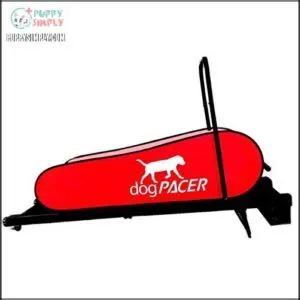
With its fold-away convenience and full-size running deck, the DogPACER Full Size Treadmill suits most multi-dog homes. You get a large 71" x 16.5" running surface, speeds from gentle rehab walks to 7.5 mph trots, and preset or manual workouts on a simple console.
The LF 3.1 model accommodates dogs up to 179 lb while staying compact at 76.77" long with a patented folding frame.
Just note reports of belt squeaks, display failures, and the need for periodic belt adjustments.
| Best For | Multi-dog or high-energy dog households that need a full-size indoor treadmill to keep dogs exercised regardless of weather or busy schedules. |
|---|---|
| Power type | Motorized electric |
| Dog size | Toy to giant dogs |
| Max capacity | 179 lb capacity |
| Primary material | Metal frame |
| Use location | Indoor home use |
| Exercise purpose | Year-round cardio exercise |
| Additional Features |
|
- Large 71" x 16.5" running surface that works for most dog sizes up to 179 lb.
- Patented folding design saves space while still offering a full-size treadmill.
- Built-in programs and adjustable speeds support everything from gentle rehab walks to faster conditioning.
- Some owners report squeaking, belt noise, and a need for regular belt adjustments.
- The computer display has been reported to fail by some users, which can affect usability.
- Customer support and replacement parts may be harder to get in certain regions, like Canada.
2. PawPaw Dog Treadmill for Large Dogs
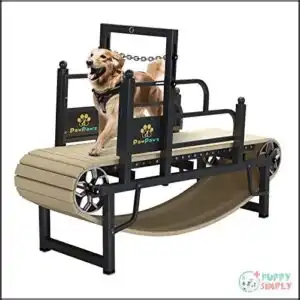
While the DogPACER suits most homes, you may want something built for big, powerful dogs.
The PawPaw Dog Treadmill is a non‑electric slatmill with a carbon steel frame and solid wood belt, sized for large breeds up to about 220 pounds and 31.5 inches at the withers.
It handles heavy use with a frame rated to 330 pounds, side rails, leash attachment, and an emergency brake.
At USD 740 and 110 pounds, it’s sturdy but harder to move and assemble.
| Best For | Dog owners with large or high-energy breeds who need a durable, motor-free treadmill that lets their dog set the pace. |
|---|---|
| Power type | Non-motorized |
| Dog size | Medium and large dogs |
| Max capacity | 330 lb capacity |
| Primary material | Carbon steel and wood |
| Use location | Indoor use |
| Exercise purpose | Weatherproof daily exercise |
| Additional Features |
|
- Solid carbon steel frame holds up to 330 lbs, so even the biggest dogs can use it without worry
- No motor means your dog controls the speed naturally — they can slow down or stop whenever they need to
- Works great as a rain-day or hot-weather alternative when outdoor walks just aren’t happening
- Assembly can be a two-person job, and the instructions aren’t always clear
- At 110 lbs, it’s not easy to move around once it’s set up
- Some users ran into quality quirks like stiff wheel bearings or an uneven surface
3. PETSITE Dog Treadmill with LCD Display
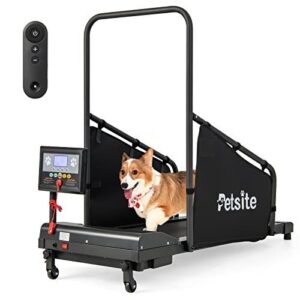
If your dog is smaller or mid-sized, the PETSITE Dog Treadmill is worth a close look. It runs from 0.5 to 7.5 mph, includes 12 preset programs, and features a 39" x 14.5" four-layer belt that cushions joints and grips paws well.
The LCD display and 65-foot remote make it easy to monitor and adjust workouts without hovering over your dog. Two side fences, a crossbar leash attachment, and an auto shutoff after 30 minutes keep safety simple and reliable.
| Best For | Small to medium-sized dogs whose owners want a safe, feature-packed treadmill for indoor exercise when walks aren’t an option. |
|---|---|
| Power type | Motorized electric |
| Dog size | Small and medium dogs |
| Max capacity | Capacity not specified |
| Primary material | Alloy steel frame |
| Use location | Indoor use |
| Exercise purpose | Training and rehabilitation |
| Additional Features |
|
- Wide speed range (0.5–7.5 mph) with 12 preset programs gives you a lot of flexibility for different fitness levels and training goals
- The 65-foot remote and LCD display make it easy to manage workouts without crowding your dog
- Built-in safety features—side fences, leash crossbar, and auto shutoff—give you real peace of mind
- Too small for large breeds, so it’s a no-go if you’ve got a big dog
- Some buyers have run into assembly headaches and quality control issues, including damaged or dead-on-arrival units
- Returns can be a hassle—you may need to ship it back yourself, which isn’t cheap at 220 lbs
4. Lifepro PawRunner Dog Treadmill
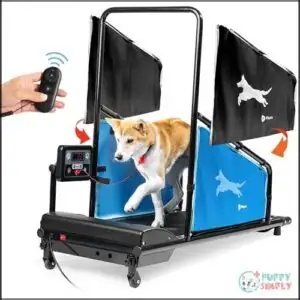
Compact, in-home friendly, the Lifepro PawRunner is built for small to medium dogs that need reliable indoor miles. You get an ultra-quiet motor, a 48" x 22.8" running area, and a remote so you can tweak speed without crowding your dog.
The 0.5–7.5 mph range works for slow rehab walks or brisk conditioning.
A safety key, emergency stop button, and side panels add peace of mind, though flimsy side screens and shorter belt length may limit some medium breeds indoors.
| Best For | small to medium dogs who need quiet, convenient indoor exercise for daily walks, weight control, or gentle rehab when outdoor walks aren’t ideal. |
|---|---|
| Power type | Motorized electric |
| Dog size | Small and medium dogs |
| Max capacity | Capacity not specified |
| Primary material | Alloy steel frame |
| Use location | Indoor use |
| Exercise purpose | Low-impact health support |
| Additional Features |
|
- Ultra-quiet motor and compact, in-home friendly design that fits easily in most living spaces.
- Remote control, safety key, and emergency stop button make it easy and safer to adjust workouts on the fly.
- Great for improving circulation, managing weight, and burning off pent-up energy on rainy or hot days.
- Not suitable for large dogs, and the shorter belt can be limiting for some medium breeds.
- Side screens can feel flimsy and may need extra support or setup to feel secure.
- Some users report quality control issues, and a bit of extra equipment may be needed for added stability.
5. Goplus Dog Treadmill Indoor Exercise Machine
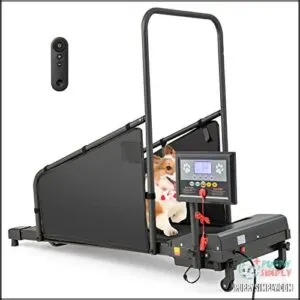
indoor-friendly workhorse lets your small‑to‑medium dog log miles without leaving the living room.
You get 0.5–7.5 mph speed, three incline levels, a digital LCD for distance, calories, and time, plus 12 preset programs and 8–99 minute timers with four quick speed keys.
The remote (up to about 65 feet), safety key, and washable front baffle add control and safety.
Just know some owners report tricky assembly, flaky remotes, and occasional damaged deliveries, so factor that into expectations.
| Best For | Small to medium dogs who need reliable indoor exercise—especially high-energy or overweight pups or those who can’t always get long outdoor walks. |
|---|---|
| Power type | Motorized electric |
| Dog size | Small and medium dogs |
| Max capacity | Capacity not specified |
| Primary material | Metal frame |
| Use location | Indoor use |
| Exercise purpose | Customizable fitness workouts |
| Additional Features |
|
- Adjustable 0.5–7.5 mph speed, three incline levels, and 12 preset programs let you fine-tune workouts for different dogs and fitness goals.
- Clear digital LCD shows distance, calories, and training data, plus a long-range remote, safety key, and washable baffle keep things safer and more convenient.
- Great for bad weather, busy schedules, or dogs with arthritis or mobility issues who still need controlled, low-impact exercise.
- Some buyers report damaged units on arrival or treadmills that don’t work properly out of the box.
- Remote control quality can be hit-or-miss, with occasional connectivity or reliability issues.
- Assembly can be frustrating and may require extra time, tools, or a second person—plus some dogs may take a while to warm up to using it.
6. dogPACER MiniPACER Dog Treadmill
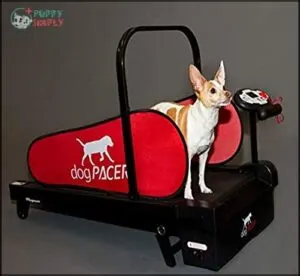
Small but mighty, the dogPACER MiniPACER punches well above its weight for dogs up to 55 lbs. Its carbon steel frame feels solid, and the 38" x 16" running belt gives smaller breeds enough room to stretch their stride.
Speed adjusts from 0.5 to 7.5 mph in tiny 0.1 mph steps — so you can ease your pup in gradually. The built‑in 4.5-degree incline adds a gentle challenge without overdoing it.
Just note: some users find the side guards a bit flimsy.
| Best For | Small to medium dogs up to 55 lbs who need a reliable way to burn energy and stay fit indoors, especially in apartments or bad weather. |
|---|---|
| Power type | Motorized electric |
| Dog size | Small dogs up to 55 lb |
| Max capacity | 55 lb capacity |
| Primary material | Carbon steel frame |
| Use location | Indoor use |
| Exercise purpose | Controlled indoor conditioning |
| Additional Features |
|
- Compact, portable design with a 38" x 16" running area that works well in small spaces and for smaller breeds.
- Adjustable speed from 0.5 to 7.5 MPH in 0.1 MPH steps plus pre-set fitness programs, so you can dial in gentle walks or more challenging sessions.
- Sturdy carbon steel frame that feels solid and supports dogs up to 55 lbs, making it a durable option for regular use.
- Not ideal for larger or very high-energy dogs that need more space or more intense exercise than this setup offers.
- Some users report the side guards feel flimsy and not very reassuring for nervous or new-to-treadmill dogs.
- Customer service and warranty support (especially for AK purchases) can be slow or limited, and terms may not be super clear upfront.
7. GoPet Small Dog Treadwheel
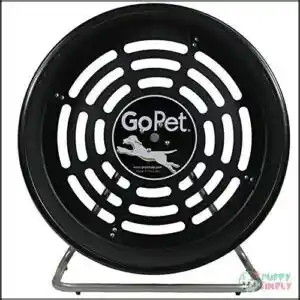
Think of it as a hamster wheel — but built for your tiny dog. The GoPet Small Dog Treadwheel (Model CG4012) is a non-motorized, dog-powered wheel designed for pups up to 25 pounds.
No electricity needed. Your dog sets the pace naturally, which makes it feel less like a workout and more like play.
The 40" x 12" running surface gives small breeds room to move, while the cushioned mat protects their paws.
It’s pricier at $1,301.49, but it works unsupervised too.
| Best For | Small, high-energy or overweight dogs (up to 25 lbs) whose owners want a safe, off-leash way to exercise them at home, even when no one’s around. |
|---|---|
| Power type | Non-motorized treadwheel |
| Dog size | Toy dogs up to 25 lb |
| Max capacity | 25 lb capacity |
| Primary material | Plastic structure |
| Use location | Indoor or outdoor |
| Exercise purpose | Self-paced off-leash running |
| Additional Features |
|
- Non-motorized and dog-powered, so pups can run at their own natural pace without needing electricity.
- Provides a 40" x 12" cushioned running surface that’s easy to clean, secure, and comfortable for small dogs.
- Great for unsupervised use to relieve boredom and support weight loss or daily exercise when owners are busy or away.
- Very expensive, at around 1,301.49 USD, which puts it out of reach for many dog owners.
- Some dogs may be hesitant or refuse to use the treadwheel, and it tends not to work well for most cats.
- Requires a decent amount of floor space (19"L x 42"W x 45"H) and the return policy includes a steep 35% restocking fee plus return shipping.
8. PawPaw Dog Treadmill with Brake
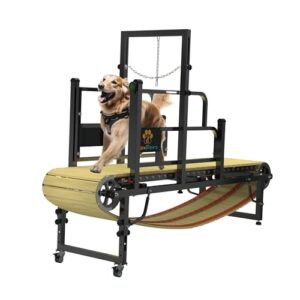
No motor, no problem. The PawPaw Dog Treadmill with Brake keeps things refreshingly simple — your dog powers the belt, and you control the pace with a manual brake.
Built from solid carbon steel with a wood-surface belt and aluminum rollers, it’s sturdy enough for dogs up to 220 pounds. The brake lets you slow things down gently, protecting joints without sudden stops.
At 69" x 22", it fits most living spaces and suits small to large breeds comfortably.
| Best For | high-energy small to large dogs whose owners want a sturdy, non-electric indoor treadmill for exercise, conditioning, or rehab when outdoor walks aren’t ideal. |
|---|---|
| Power type | Non-motorized |
| Dog size | Medium and large dogs |
| Max capacity | 330 lb capacity |
| Primary material | Carbon steel and wood |
| Use location | Indoor use |
| Exercise purpose | Intensive sprint training |
| Additional Features |
|
- Solid carbon steel frame, wood belt, and aluminum rollers give it a durable, gym-quality feel for dogs up to 330 lb.
- Non-electric design lets dogs control their own pace, with adjustable height to suit different breeds and training goals.
- Great for bad weather days, rehab, and burning off excess energy without leaving the house.
- Assembly can be tedious, with instructions that may feel unclear or incomplete.
- Heavy and bulky at 110 lb, so moving or repositioning it can be a hassle.
- Not all models include the handbrake, and some users may find the noise level noticeable indoors.
9. Moysoon Adjustable Dog Treadmill with Ramp
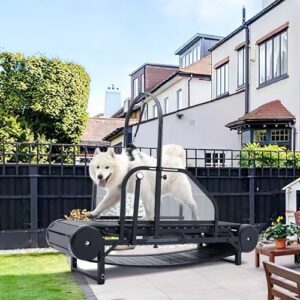
Want more control without a noisy motor? The Moysoon Adjustable Dog Treadmill with Ramp uses a non‑motorized, low‑resistance belt, so your dog sets the pace while you fine‑tune it with a handbrake.
An adjustable ramp lets you increase incline as fitness improves, and the upgraded PE running surface adds grip and comfort.
Acrylic side panels, wheel covers, and a sturdy alloy‑steel frame (up to 300 lb capacity) help keep powerful, high‑energy dogs contained, safe, and properly challenged indoors, day after day.
| Best For | Owners of medium to large, high-energy dogs who want a safe, motor-free indoor workout with adjustable incline and extra safety features. |
|---|---|
| Power type | Non-motorized |
| Dog size | Small to large dogs |
| Max capacity | 300 lb capacity |
| Primary material | Alloy steel frame |
| Use location | Indoor use |
| Exercise purpose | High-energy conditioning |
| Additional Features |
|
- Non-motorized design lets your dog control the pace, while the handbrake gives you extra control for safer training.
- Adjustable ramp and upgraded PE running surface help you tailor workouts and keep runs more comfortable and grippy.
- Sturdy alloy-steel frame with acrylic side panels and wheel covers adds stability, safety, and containment for strong, active dogs.
- Can be noisy and tricky to assemble, especially when putting the belt together.
- May not be ideal for very large breeds or dogs with special physical needs.
- Higher price point than some dog treadmills, and a few users report materials feeling cheaper than expected, plus it needs regular maintenance.
10. Petbobi Dog Treadmill Rotatable Display
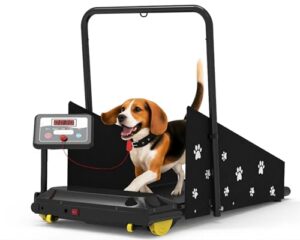
If you prefer a powered option with more feedback on each session, the Petbobi Dog Treadmill Rotatable Display steps in.
You get a low‑noise motor, enclosed side panels, and a top leash ring to help steady small and medium dogs up to 265 lb.
The 360° pivoting screen lets you watch speed, time, distance, and calories from any angle while you supervise.
A smart remote, magnetic safety key, and indoor‑friendly design round out a strong value around USD 219.99 today.
| Best For | Small and medium dogs who need a safe, low-noise indoor workout, especially in homes where owners want clear workout feedback and remote control convenience. |
|---|---|
| Power type | Motorized electric |
| Dog size | Small and medium dogs |
| Max capacity | 265 lb capacity |
| Primary material | Material not specified |
| Use location | Indoor use |
| Exercise purpose | Quiet indoor workouts |
| Additional Features |
|
- Enclosed side panels, top leash ring, and magnetic safety key help keep dogs safer and more stable during use.
- 360° rotatable display makes it easy to monitor speed, time, distance, and calories from any angle.
- Smart remote control and onboard panel let you adjust workouts without standing right next to the treadmill.
- Capacity is limited to dogs up to 265 lbs, so it won’t work for larger or heavier dogs.
- Requires assembly and ongoing maintenance, which may not suit owners who want a plug-and-play solution.
- May not be appropriate for dogs with certain health or mobility issues, so a vet check is recommended first.
Safe Setup, Training, and Daily Use
Getting your dog comfortable on a treadmill takes patience, the right setup, and a little know-how. Whether you’re starting from scratch or fine-tuning your routine, the steps below will keep things safe and stress-free for both of you.
Here’s everything you need to know to do it right.
Setting Up The Treadmill in a Safe Space
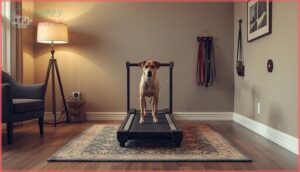
Before each Indoor Workout with your Dog Treadmill, you’ll want open space, not cluttered.
Give it a meter of space on all sides, focus on Flooring Leveling over rugs, and check Lighting Visibility.
Add Temperature Control, solid Safety Gear Placement, easy Emergency Stop Access, and you’ve built a Home Exercise corner supporting Pet Care and Wellness for today’s Pet Owners.
Introducing Your Dog to The Treadmill Slowly
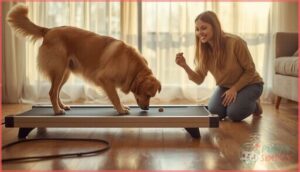
Once your space is ready, the real work begins — helping your dog feel safe around unfamiliar equipment. Gradual Desensitization is your best tool here.
Belt Familiarization with the dog treadmill completely off. Let your dog sniff it freely.
Reward Timing matters: treat calm behavior immediately. Keep Session Length short — a few minutes max.
Leash Guidance helps, but never force it.
Using Leashes and Harnesses Correctly on Treadmills
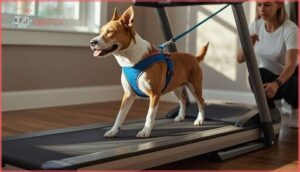
Once your dog steps on confidently, your leash and gear setup matter more than most people realize.
Always attach the tether to a gear — never a collar — keeping pressure on your dog’s torso for safe tension management.
A bungee leash helps absorb sudden lunges.
Keep attachment points clear of moving parts to prevent entanglement, and never leave your dog unattended.
Recommended Starting Speeds, Time, and Frequency
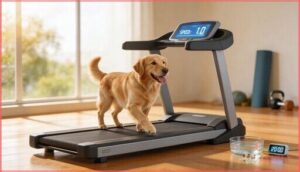
Usually, you’ll want a gentle Warm‑up Pace on the treadmill so dogs just walk. Do 3–5 minutes, then cap Session Length at 5–10 minutes. Schedule 2–3 Training Days weekly with 48‑hour Rest Intervals to protect Canine Health and support safe Speed Progression.
- Dog Treadmills: focus on calm exercise.
- Watch posture; lower speed if unsure.
- Stop if your dog pants hard.
Progressing Sessions for Stamina and Fitness Gains
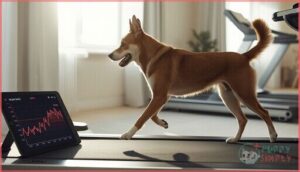
Building stamina takes patience — small, consistent steps beat big leaps every time. Add time or speed gradually each week using Incremental Speed Increases, then layer in Incline Load Progression once your dog adapts.
Interval Tempo Cycling keeps sessions fresh without overloading canine health. Always schedule Recovery Day Planning between workouts, and use Heart Rate Monitoring to catch fatigue early on your dog treadmill.
Integrating Treadmill Workouts Into Daily Routines
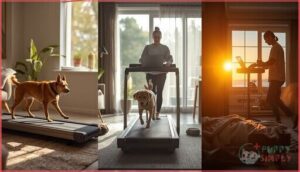
dog treadmill part of everyday life keeps exercise simple and predictable.
- Use Morning Exercise Slots, Lunch Break Sessions, and Evening Cooldown Routines as Consistent Timing Cues for dogs.
- Pair treadmill time with Post-Meal Walk Pairings to weave pet care, fitness, and exercise together.
- Keep sessions short, repeatable, and calm so the dog treadmill feels safe indoors daily.
Dog Treadmill Safety and Maintenance
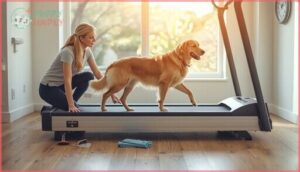
Keeping your dog safe on a treadmill starts with the right features and simple, consistent maintenance.
You don’t need to be an expert, but you do need to know what to look for and what to check over time.
Next, we’ll walk through the key safety details and upkeep steps to focus on.
Essential Safety Features to Prioritize Before Buying
Not all safety features are created equal. Before buying a dog treadmill, check for non-slip feet that keep the unit stable on smooth floors, a strap attachment point for proper alignment, and automatic brake capability for quick stops.
Belt texture matters too — a textured, cushioned surface protects joints and prevents slips. Overheat protection rounds out the essentials for smart canine rehabilitation and long-term pet care and health.
Emergency Stop Buttons and Auto Shutoff Functions
Think of the E‑stop Design as your dog’s seatbelt on a treadmill: a big red button that cuts power instantly and needs clear Reset Mechanisms to prevent surprise restarts.
Pair that with Auto‑Shutoff Sensors, Redundant Safety Circuits, and Compliance Standards from industrial safety, and Dog Treadmills become safer for everyday Pet Care and Health, Animal Wellness, and honest Treadmill Reviews.
Side Panels, Fences, and Leash Attachment Points
Side panels, fences, and leash points are your dog’s guardrails on a dog treadmill, a Dog Treadmill and other Treadmills for Dogs.
Look for 2–3 inch Panel Height, edges, and Impact Materials like plastic or powder‑coated steel, plus Quick‑Release Latches for access.
Chest‑level Leash Swivel Hooks, Anti‑Chew Coatings, and enclosures support Pet Care and Maintenance, and Animal Training and Behavior.
Non-slip, Cushioned Belt Surfaces for Joint Protection
Beyond guardrails, the belt your dog walks on matters just as much for animal health. Cushion thickness — usually 3 to 8 millimeters — manages impact absorption with every step. Material composition usually combines rubber compounds with foam layers for traction patterns that grip wet and dry paws equally.
For pet wellness, these Fitness Products in dog treadmills deliver real durability testing benefits:
- Non-slip surfaces maintain grip from 0.5 to 6.0 mph
- Cushioned layers reduce hip and knee joint stress noticeably
- Rubber composite belts resist daily claw wear reliably
Cleaning Hair and Debris for Smooth Belt Movement
Hair is sneaky — it collects along belt edges fast.
Daily Belt Edge Brushing with a soft bristle brush keeps fibers from embedding in your dog treadmill’s weave.
Microfiber Cloth Use to lift fine particles the brush misses.
Keep a Cleaning Schedule Log weekly, and clear any Debris Funnel Maintenance points so your treadmill runs quietly and smoothly.
Regular Inspections for Wear, Noise, and Overheating
Clean belts are just the start — keeping your dog’s treadmill running safely means staying on top of regular checks.
- Belt Tension: Look for fraying edges or looseness weekly.
- Noise Diagnostics: Rising squeals often signal bearing wear; target under 50 dB indoors.
- Temperature Checks: Use an infrared thermometer during the first five minutes.
- Frame Integrity and Safety Barrier Inspection: Tighten loose bolts, check rails quarterly for pet wellness during exercise.
When to Pause Treadmill Use and Call Your Vet
Even with a well-maintained dog treadmill, your pup’s body tells you when to stop.
Watch for limping signs, severe panting that won’t settle, or collapse symptoms — that means off the belt immediately.
Gastrointestinal distress, such as vomiting after sessions, or heart warning signs, such as sudden weakness or fainting, all warrant a vet call. Don’t wait.
Frequently Asked Questions (FAQs)
What type of treadmill is best for dogs?
motorized dog treadmill with low speeds, Noise Reduction, Adjustable Incline, side rails, cushioned Belt Material, modest Power Consumption, Portability features
best enhances Animal Fitness, Health and Wellness in daily dog treadmill training.
What words do dogs hear best?
Dogs hear short, sharp words best. Plosive cues like "sit," "come," and "stay" cut through noise instantly. Name recognition and food-related triggers like "treat" get the fastest responses every time.
Is it worth buying a dog treadmill?
Yes, if your dog struggles to get consistent exercise, a dog treadmill delivers real value.
Weigh the cost vs value, space requirements, and training time investment against alternative exercise options for your pup.
What does a 30 minute walk do for a dog?
30-minute walk gives your dog cardiovascular boost, builds muscle tone, helps reduce stress, and provides social exposure.
steady energy expenditure that genuinely improves animal wellness through simple, consistent fitness and exercise.
How do I find the best dog treadmills?
How do you choose a dog treadmill for your dog’s exercise—by weighing Space requirements, Energy consumption, Safety certifications, Training accessories, Brand reputation, Dog Treadmills treadmill reviews and comparisons, and Pet Owner Product Reviews carefully?
Are dog treadmills safe?
Dog treadmills are safe when used with proper Supervision Practices, correct Safety strap Fit, and access to an Emergency Stop.
Avoid Belt Gap Risks by choosing dog-specific designs, and watch for Noise Sensitivity in anxious pups.
What size treadmill for a small dog?
For small dogs, aim for a belt length of 38–45 inches and 16–18 inches wide. Use stride measurement and chest dimension to confirm fit, and a foldable design saves space.
How much does a dog treadmill cost?
Spoiler: you won’t find a dog treadmill in a cereal box.
Prices range from $200 for Budget Manual Models to $5,000 for High‑End Luxury Costs, with Motorized Price Ranges and Midrange Value Options sitting comfortably between.
Why should you buy a dog treadmill?
For owners, Dog Treadmills give dogs Year‑round fitness and Weather‑proof workouts.
They support Energy burn management, Controlled rehab, Mental stimulation.
They turn exercise into Pet Health Products for Fitness and Exercise when outdoor activity is limited.
How do I Make my Dog’s treadmill more comfortable?
A comfortable dog makes a willing student. Pair a cushioned belt with a quiet motor, add climate control, use an adjustable strap, and place soft padding nearby for rest breaks.
Conclusion
A tired dog is a good dog—and the best dog treadmills make that tiredness achievable on your schedule, not the weather’s.
You’ve now got the specs, the safety steps, and the shortlist to make a confident choice.
Whether your dog is recovering from surgery or simply burning off boundless energy, consistent indoor exercise isn’t a luxury—it’s a lifeline.
Pick the right machine, introduce it patiently, and watch your dog’s restlessness quietly transform into calm.