This site is supported by our readers. We may earn a commission, at no cost to you, if you purchase through links.
Most pet owners don’t realize AAFCO doesn’t actually certify dog food. This nonprofit organization sets nutritional standards that manufacturers follow, but it doesn’t test products or award seals of approval.
The AAFCO statement on your dog food label confirms the formula meets established nutrient profiles for specific life stages. These standards prevent nutritional deficiencies and guarantee your dog receives adequate protein, fat, vitamins, and minerals.
State regulators enforce AAFCO guidelines, making them the backbone of pet food safety in the United States. Understanding what AAFCO compliance means helps you select dog food that promotes your pet’s health through every life stage.
Table Of Contents
- Key Takeaways
- What is AAFCO Dog Food Certification
- The Role of AAFCO in Pet Nutrition
- How AAFCO Standards Are Developed
- Key Requirements for AAFCO Compliance
- Understanding The AAFCO Statement on Labels
- AAFCO Certification Vs. FDA Regulation
- How Dog Foods Achieve AAFCO Certification
- Benefits of Choosing AAFCO Certified Dog Food
- Top AAFCO Certified Dog Food Brands
- Tips for Selecting AAFCO Certified Dog Food
- Frequently Asked Questions (FAQs)
- Conclusion
Key Takeaways
- AAFCO doesn’t certify dog food but sets the nutritional standards that manufacturers must meet through lab analysis or feeding trials, with enforcement handled by state regulators and the FDA.
- The “complete and balanced” label statement confirms your dog’s food meets AAFCO nutrient profiles for specific life stages, ensuring adequate protein, fat, vitamins, and minerals to prevent deficiencies.
- AAFCO nutrient profiles vary by life stage—puppies need at least 22% protein and 8% fat for growth, while adult maintenance formulas require only 18% protein with lower fat minimums.
- You can verify AAFCO compliance by locating the AAFCO statement on the label and consulting your veterinarian to match the food’s nutrient profile to your dog’s age, breed size, and health needs.
What is AAFCO Dog Food Certification
AAFCO certification is one of the most misunderstood terms in pet food. The organization doesn’t actually certify products—it sets the nutritional standards that dog food manufacturers must meet.
Many owners also confuse AAFCO guidelines with protein requirements for dogs, which vary significantly based on age, activity level, and health status.
AAFCO doesn’t certify dog food—it sets the nutritional standards manufacturers must meet
Understanding what AAFCO does and doesn’t do helps you make informed choices about your dog’s nutrition.
Definition and Purpose of AAFCO Certification
AAFCO certification signals that your dog’s food meets defined nutritional standards for specific life stages. The Association of American Feed Control Officials establishes nutrient profiles through expert collaboration, ensuring pet food safety and labeling requirements align with regulatory compliance.
When you see “complete and balanced” on packaging, it confirms the product satisfied AAFCO’s nutritional adequacy benchmarks via feeding trials or laboratory analysis of nutrient standards. Understanding the complete and balanced pet food concept can help pet owners make informed choices for their animals.
Difference Between Certification and Compliance
Many pet owners confuse certification with compliance, but they’re not the same. Certification requires third-party verification with formal documentation, while compliance means your dog’s food adheres to AAFCO’s regulatory standards through internal quality assurance and compliance checks.
AAFCO doesn’t actually certify products—manufacturers demonstrate regulatory compliance through the certification process, which includes lab testing to meet food labeling requirements and industry regulations for pet food regulation.
To better understand these differences, you can review the certification process and ongoing compliance in the context of product safety and quality standards.
Role in Pet Food Industry
AAFCO acts as the backbone of pet food regulation in the United States. Your dog’s food relies on AAFCO’s industry standards to define ingredients, establish nutrient guidelines, and guarantee food safety.
Manufacturers use these frameworks for manufacturing compliance and food labeling consistency. While AAFCO doesn’t enforce laws directly, the pet food industry depends on its animal nutrition expertise to guide product development and quality control across all brands.
The Role of AAFCO in Pet Nutrition

AAFCO doesn’t regulate pet food directly, but it shapes how the entire industry operates. The organization brings together state officials, veterinarians, and scientists to create the standards that guide dog food formulation and labeling.
Understanding AAFCO’s role helps you make sense of what you’re actually feeding your dog and why it matters.
AAFCO’s Mission and Membership
Understanding who runs the show helps you trust the regulatory process. AAFCO brings together government officials from state agriculture departments and federal agencies like the FDA to collaborate on animal nutrition standards.
Annual membership costs five hundred dollars per agency. This regulatory collaboration creates consistent pet food guidelines across North America through industry partnerships and a governance structure of regional committees that update ingredient definitions and model regulations.
How AAFCO Sets Nutritional Standards
Your dog’s nutrition depends on rigorous standards AAFCO develops through expert consensus. Nutrient Profiles specify minimum and maximum levels for protein, fat, minerals, and vitamins across life stages like puppy and adult dog food.
Scientific Reviews and Regulatory Updates guarantee these standards reflect current research on Nutritional Adequacy. AAFCO also establishes Labeling Requirements, ingredient definitions, and Feed Safety criteria to support Regulatory Compliance across the pet food industry.
Influence on State and Federal Regulations
Through its voluntary standards, AAFCO shapes the Regulatory Framework that both State Policies and Federal Oversight use to protect your dog. States adopt AAFCO nutrient profiles into law, while the FDA references them during inspections.
These Harmonization Efforts create Compliance Mechanisms that guarantee Regulatory Compliance across Regulatory Pathways for Pet Food:
- Your state likely enforces AAFCO standards as binding law
- Federal agencies rely on AAFCO definitions during safety reviews
- Manufacturers face dual scrutiny from state and federal inspectors
- Pet Food Regulation Updates cascade from AAFCO to your local shelves
How AAFCO Standards Are Developed

AAFCO standards don’t appear out of thin air. They’re built through a rigorous scientific process that brings together veterinarians, nutritionists, and regulatory experts.
Here’s how these guidelines take shape and what they cover for your dog’s specific needs.
Scientific Review and Expert Collaboration
AAFCO relies on expert panels drawn from veterinary nutrition, animal science, and regulatory fields to build its standards. These multidisciplinary teams use collaborative research and scientific methodology to review ingredient safety, feeding trials, and data analysis from laboratory results.
Their work ensures nutrient profiles support nutritional adequacy and that complete and balanced claims align with regulatory expectations at both state and federal levels.
Nutrient Profiles for Different Life Stages
Your dog’s needs shift as they age, which is why AAFCO nutrient profiles address specific growth stages. Puppies require at least 22 percent protein and 8 percent fat to support rapid development. Adult formulas drop to 18 percent protein for maintenance. Senior diets often include higher fiber and joint support nutrients.
- Puppy nutrition emphasizes calcium, phosphorus, and DHA for brain and bone growth
- Active dogs need elevated fat (12 to 18 percent) and higher calorie density
- Large breed formulas control calcium ratios to prevent skeletal issues
These life stage categories guarantee nutritional adequacy and complete and balanced nutrition across your dog’s lifespan.
Key Requirements for AAFCO Compliance

AAFCO compliance isn’t just about meeting a single standard.
Pet food manufacturers must satisfy specific nutrient requirements, follow strict ingredient definitions, and formulate products for designated life stages.
Here’s what your dog’s food needs to qualify as AAFCO-compliant.
Minimum and Maximum Nutrient Levels
Your dog’s food must hit precise nutrient targets to earn the “complete and balanced” claim. AAFCO nutrient profiles set minimum protein levels at 18 percent for adult maintenance and 22 percent for puppies, with fat content starting at 5 percent.
Maximum limits protect against excess—calcium caps at 2.5 percent prevent skeletal issues, while phosphorus stays under 1.5 percent to support kidney health and nutritional adequacy.
Ingredient Definitions and Safety
Every ingredient in your dog’s bowl must meet AAFCO definitions before it earns a spot on the label. The organization’s Ingredient Submission and Approval process verifies safety standards through rigorous testing protocols.
- Animal Feed Safety evaluations screen for contaminants and toxins
- Food Additives receive approval limits for preservatives and colorants
- Ingredient Testing confirms protein, fat, and moisture specifications
- Label Compliance requires descending order by weight
- Pet Nutrition data backs nutrient profiles and food safety standards
Life Stage Categories (puppy, Adult, Etc.)
Once ingredients pass safety checks, they’re formulated to match your dog’s current growth stage. AAFCO defines two primary nutrient profiles: Growth and Reproduction aids puppy nutrition through rapid development, while Adult Maintenance covers mature dogs. Senior care isn’t a separate category but uses adult formulas adjusted for aging needs.
| Life Stage | Key Nutritional Focus |
|---|---|
| Puppy (Growth and Reproduction) | Higher protein and calcium for bone development |
| Adult Maintenance | Balanced calories to prevent obesity |
| Senior (uses Adult profile) | Lower calories, joint support supplements |
| All Life Stages | Must meet Growth requirements (highest standard) |
| Breeding/Lactating | Elevated fat and energy density |
Each formula undergoes feeding trials or lab analysis to verify nutritional adequacy. Complete and balanced claims require meeting minimum nutrient levels for the declared life stage feeding category.
Understanding The AAFCO Statement on Labels
When you check a dog food label, you’ll see an AAFCO statement that tells you if the food meets key nutrition standards.
Understanding this statement helps you make informed choices for your pet’s health. Here’s what you need to look for and what each part means.
Location and Wording of AAFCO Statements
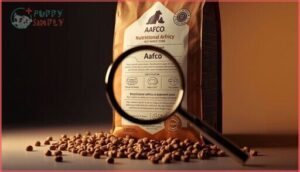
When you scan your dog’s food bag, look for the AAFCO statement on the principal display panel or back information panel.
The statement wording must specify life stage and substantiation method—either “formulated to meet the nutritional levels established by the AAFCO Dog Food Nutrient Profiles” or “feeding tests using AAFCO procedures substantiate.” This compliance marker confirms regulatory adherence and complete nutritional adequacy.
What “complete and Balanced” Means

That regulatory statement you just found guarantees complete and balanced nutrition. Complete means the food includes all essential nutrients your dog needs. Balanced means those nutrients appear in correct proportions to support growth, maintenance, and activity.
AAFCO nutrient profiles set specific minimums for protein, fat, vitamins, and minerals—ensuring your dog receives consistent nutritional adequacy across every batch.
- Protein and fat levels meet daily energy and muscle support needs
- Vitamins and minerals support metabolism, bone health, and immune function
- Calcium and phosphorus ratios prevent skeletal issues during growth
Verification Methods (lab Analysis, Feeding Trials)

If you want real assurance, look for foods verified by Lab Testing or Feeding Trials.
Lab Analysis checks Nutrient Analysis against AAFCO’s Guaranteed Analysis for your dog’s life stage.
Feeding Trials monitor growth, weight, and health using strict Safety Protocols.
The Verification Process includes documentation, batch records, and compliance files—giving you confidence in Nutritional Adequacy and product safety.
AAFCO Certification Vs. FDA Regulation

Many pet owners confuse AAFCO with a regulatory body like the FDA. AAFCO doesn’t enforce pet food laws or inspect manufacturing facilities.
Understanding how AAFCO and the FDA work together helps you make informed decisions about your dog’s nutrition.
AAFCO’s Advisory Role
AAFCO doesn’t enforce pet food laws—it writes the playbook. This advisory network develops model regulations and nutrient profiles that state agencies adopt into their own rules. Through collaboration with regulatory agencies, AAFCO refines industry standards and feed safety definitions.
Your state’s pet food oversight likely mirrors AAFCO’s pet nutrition framework, giving you consistent protection no matter where you shop.
| AAFCO Function | What It Does | Who Enforces It |
|---|---|---|
| Develops nutrient profiles | Sets minimum and maximum levels for pet nutrition | State feed control officials |
| Defines ingredients | Standardizes what goes into pet food | FDA and state agencies |
| Creates labeling models | Guides “complete and balanced” statements | State regulatory agencies |
FDA’s Enforcement Responsibilities
While AAFCO writes the standards, the FDA brings enforcement muscle to pet food safety. The agency conducts inspections of manufacturing facilities, collects product samples for laboratory testing, and issues warning letters when violations surface. If your dog’s food fails inspection protocols, the FDA can mandate recalls, seize contaminated batches, or pursue legal action to protect public health.
| FDA Action | Purpose | Example Trigger |
|---|---|---|
| Facility inspection | Verify regulatory compliance with safety laws | Routine schedule or consumer complaint |
| Warning letter | Document violations and demand corrections | Mislabeled nutrients or contamination risk |
| Product recall | Remove unsafe food from market | Salmonella detection or foreign objects |
| Seizure or injunction | Stop distribution of hazardous products | Repeated noncompliance or public health threat |
How The Two Agencies Collaborate
Through a joint liaison team, AAFCO and the FDA share nutrient data, coordinate compliance timelines, and publish synchronized guidance on pet food labeling and compliance. Both regulatory agencies and oversight bodies use a common portal for validation processes, cross-check lab analyses, and host stakeholder meetings on animal nutrition standards.
This regulatory alignment ensures manufacturers receive consistent signals when updating formulations to meet information sharing and joint outreach goals.
| Collaboration Element | Purpose |
|---|---|
| Joint liaison team | Coordinates communications between regulatory agencies and oversight bodies |
| Common data portal | Allows for real-time information sharing on nutrient results |
| Synchronized guidance | Aligns pet food labeling and compliance expectations |
| Cross-validated analyses | Assists validation processes for animal nutrition standards |
| Stakeholder meetings | Promotes joint outreach to manufacturers and veterinarians |
How Dog Foods Achieve AAFCO Certification

Dog food manufacturers use two primary methods to demonstrate their products meet AAFCO nutrient standards. Each approach involves specific testing protocols and documentation requirements.
The verification process ensures the food provides complete and balanced nutrition for the intended life stage.
Laboratory Nutrient Analysis
Think of lab testing as a nutritional X-ray for your dog’s food. Analytical methods measure protein, fat, moisture, and ash using standardized procedures to guarantee nutritional adequacy.
These quality control measures generate the guaranteed analysis you see on every label. Lab analysis confirms nutrient profiles match AAFCO standards, giving you confidence that what’s promised is actually delivered.
Feeding Trial Procedures
Ever wonder how feeding trials prove nutritional adequacy? Your dog’s food goes through a rigorous process to meet AAFCO life stage standards for complete and balanced nutrition.
Feeding Trial Design includes:
- Defined trial protocols for daily intake and portion sizes
- Nutrient Analysis matched to life stage
- Animal Welfare monitoring by veterinary staff
- Data Verification through daily records
Documentation and Verification Process
Proper record keeping builds the foundation for AAFCO standards compliance. Your dog’s food manufacturer must document every verification step through detailed audit trails and compliance checks.
| Verification Element | Required Documentation | Regulatory Purpose |
|---|---|---|
| Nutritional adequacy | Lab analysis reports with nutrient concentrations | Proves complete and balanced formulation |
| Feeding trials | Daily intake records and health monitoring data | Validates real-world performance |
| Labeling rules | Product label drafts with AAFCO statement wording | Ensures accurate life stage claims |
| Data validation | Cross-referenced ingredient specifications | Confirms consistency with stated facts |
| Record keeping | Timestamped files retained per policy requirements | Backs regulatory compliance audits |
Document verification establishes traceability from formulation through final packaging.
Benefits of Choosing AAFCO Certified Dog Food

AAFCO compliance gives you more than a label to check off. It offers practical advantages that directly affect your dog’s health and your confidence as an owner.
Here’s what you gain when you choose foods that meet these standards.
Ensuring Complete and Balanced Nutrition
AAFCO-compliant pet food meets established nutrient profiles that define minimum and maximum levels for protein, fat, vitamins, and minerals. Your dog receives nutritional adequacy through complete and balanced formulas verified by lab analysis or feeding trials.
This ensures:
- Proper nutrient ratios support healthy metabolism and energy
- Essential amino acids and fatty acids meet dietary needs
- Balanced diets prevent deficiencies that compromise pet food safety
Supporting Specific Life Stages and Health
Your dog’s age and health status determine nutrient needs. AAFCO nutrient profiles define life stage categories—puppy, adult, senior—that match formulas to growth, maintenance, or aging demands.
Puppies require higher protein and fat for development. Senior dogs benefit from adjusted calories and joint support. Complete and balanced labeling ensures nutritional adequacy at each life stage, supporting targeted health conditions through precise nutrient balance.
Peace of Mind for Pet Owners
When you select dog food with an AAFCO statement, you remove guesswork from pet nutrition. The label confirms nutrient adequacy and compliance with established profiles, giving you owner confidence. Clear feeding guidelines help you serve correct portions.
Three key advantages:
- Consistent protein and energy levels support steady growth patterns
- Standardized food labeling simplifies brand comparisons
- Alignment with industry standards reinforces pet wellness decisions
Top AAFCO Certified Dog Food Brands
Several well-established brands meet AAFCO nutritional standards for dogs. These products have proven compliance through laboratory analysis or feeding trials.
The following examples represent different life stages and protein sources to help you compare options.
1. Hill’s Science Diet Puppy Food
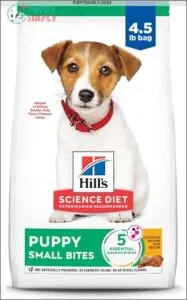
You’ll find Hill’s Science Diet Puppy Food formulated with DHA from fish oil to support your puppy’s brain and eye development during early growth. The chicken-based recipe provides high-quality protein for developing muscles and balanced calcium-to-phosphorus ratios for healthy bones and teeth.
This veterinarian-recommended formula meets AAFCO nutrient profiles for growth and reproduction. It includes whole grains for energy and digestibility. The kibble size is optimized for small breed puppies to encourage proper chewing while supporting dental development.
| Best For | Owners of small breed puppies who want vet-recommended nutrition that supports brain development, muscle growth, and bone health during the critical early months. |
|---|---|
| Primary Protein | Chicken |
| Form | Dry Food |
| Age Range | Puppy |
| Package Weight | 4.5 lbs |
| Brain Development | DHA from fish oil |
| Made In | USA |
| Additional Features |
|
- Contains DHA from fish oil to help with brain and eye development
- High-quality chicken protein supports growing muscles and active play
- Balanced minerals promote healthy bone and teeth development
- Higher price point compared to other puppy food brands
- May not work for puppies with grain sensitivities or food allergies
- Some picky eaters might reject the taste or texture
2. Eukanuba Large Breed Puppy Food
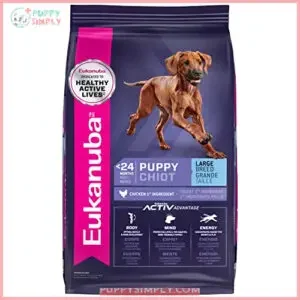
You’ll notice Eukanuba Large Breed Puppy Food features chicken as the first ingredient to support lean muscle development. The formula contains calibrated calcium and phosphorus levels designed specifically for large breed skeletal growth up to 18 months.
DHA is included at clinically proven levels to support brain function and trainability during critical development periods. Glucosamine and chondroitin help protect growing joints while prebiotic fibers promote healthy digestion.
The product meets AAFCO nutrient profiles for growth and reproduction in large breed puppies.
| Best For | Owners of large breed puppies who want a chicken-based formula with targeted DHA for brain development and balanced calcium-phosphorus ratios for healthy bone growth. |
|---|---|
| Primary Protein | Chicken |
| Form | Pellet |
| Age Range | Puppy |
| Package Weight | 16 lbs |
| Brain Development | Clinically proven DHA |
| Made In | Not specified |
| Additional Features |
|
- Chicken as the first ingredient provides high-quality protein for muscle development
- Clinically proven DHA levels support brain function and make training easier
- Calibrated calcium and phosphorus specifically formulated for large breed skeletal health
- Price point can add up quickly, especially for larger dogs or multi-dog households
- Some puppies may get bored with the taste over time
- Contains fillers and isn’t human-grade quality
3. Purina Pro Plan Lamb Dog Food
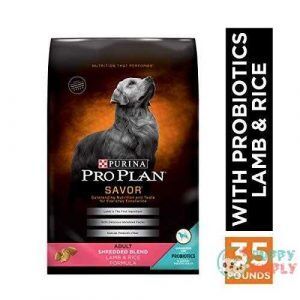
Real lamb appears as the first ingredient in Purina Pro Plan Lamb formulas to deliver high protein for adult dogs. You’ll find rice or oatmeal providing digestible carbohydrate energy alongside omega fatty acids that nourish skin and coat health.
The formula includes live probiotics to support digestive balance and immune function. Added vitamin A and omega-6 fatty acids work together to maintain healthy skin appearance.
This product meets AAFCO nutrient profiles for adult maintenance when fed according to package guidelines.
| Best For | Dog owners looking for a high-protein lamb formula with probiotics to support their adult dog’s digestive health and coat condition. |
|---|---|
| Primary Protein | Lamb |
| Form | Hard Kibble |
| Age Range | Adult |
| Package Weight | 35 lbs |
| Brain Development | High antioxidants |
| Made In | Not specified |
| Additional Features |
|
- Real lamb as the first ingredient provides quality protein and palatability for most dogs
- Live probiotics support digestive and immune system health
- Omega fatty acids and vitamin A help maintain healthy skin and a shiny coat
- Contains grains like wheat and rice, which may not suit dogs with sensitivities
- Some reports of quality control issues with individual batches causing digestive upset
- Kibble size and texture may not appeal to all dogs’ preferences
Tips for Selecting AAFCO Certified Dog Food

Finding AAFCO certified dog food is straightforward once you know what to look for on the label.
However, choosing the right product for your specific dog requires attention to a few key factors. Here’s what you need to take into account when selecting certified food for your pet.
Matching Food to Your Dog’s Life Stage
Your dog’s life stage drives its nutrient needs, so check the AAFCO statement for puppy nutrition, adult maintenance, or senior diets.
Puppies require higher protein and calcium for dog development, while seniors benefit from lower calories and joint support. Choose complete and balanced dog food matched to your pet’s age, breed size, and activity level for ideal life stage feeding.
Consulting With Your Veterinarian
Your veterinarian brings clinical expertise to pet nutrition advice, so schedule regular vet visits to discuss AAFCO-compliant foods suited to your dog’s health needs.
Prepare for symptom discussion and treatment planning by keeping detailed health record keeping notes. Proper vet visit prep ensures you receive customized veterinary care recommendations that support ideal dog health and wellness through evidence-based veterinary nutrition and health guidance.
Frequently Asked Questions (FAQs)
Can AAFCO certification expire or be revoked?
Unlike a license plate with a fixed renewal date, AAFCO compliance doesn’t expire on a calendar.
Instead, you’ll find ongoing certification depends on manufacturers maintaining current nutrient profiles and accurate label verification through regulatory oversight.
How often does AAFCO update nutrient profiles?
AAFCO revises nutrient profiles roughly every 5 to 10 years following expert review and member consensus. The 2016 dog food standards update took eight years of deliberation before official adoption and implementation.
Are grain-free foods AAFCO compliant?
Think of it like building a house without wood—you can still meet code if the structure’s sound.
Grain-free options achieve AAFCO compliance when nutrient profiles align with complete and balanced standards through verification, ensuring pet food safety regardless of ingredients used.
Does AAFCO regulate homemade dog food recipes?
No, AAFCO doesn’t regulate homemade nutrition. Pet food safety standards guide commercial products, but custom diets fall outside regulatory gaps.
Nutrient deficiencies emerge without veterinary oversight to meet AAFCO standards for complete dog food.
What happens if food fails AAFCO testing?
Roughly 10 percent of pet food batches undergo repeat testing each year.
If your dog’s food fails AAFCO standards, manufacturers must reformulate it, remove the complete and balanced claim, and possibly recall deficient products.
Conclusion
You won’t find AAFCO inspectors showing up at factories with clipboards and gold stars. The organization simply provides the blueprint manufacturers follow to meet nutritional standards.
Reading that AAFCO dog food certification statement on your pet’s food means the formula contains adequate nutrients for your dog’s life stage. Cross-reference this information with your veterinarian’s recommendations to make informed choices that support your dog’s long-term health and vitality.