
This site is supported by our readers. We may earn a commission, at no cost to you, if you purchase through links.

The Dogo Argentino stands as one of the few modern dog breeds engineered specifically for a singular, formidable purpose: hunting wild boar, puma, and other dangerous game across Argentina’s unforgiving terrain. Dr. Antonio Nores Martinez created this white-coated powerhouse in the 1920s by selectively merging extinct fighting dogs with mastiff genetics, crafting an animal that balanced raw power with calculated courage.
What emerged wasn’t merely a hunting companion but a breed that demands respect, extensive training, and an owner who understands the weight of managing 100 pounds of muscle, loyalty, and protective instinct. Owning a Dogo means managing breed-specific legislation, committing to rigorous socialization protocols, and accepting that this dog’s intensity—both physical and emotional—will reshape your daily life in ways few other breeds can match.
Table Of Contents
- Key Takeaways
- Dogo Argentino Origins and History
- Physical Characteristics and Breed Standard
- Temperament and Behavior
- Health and Lifespan Considerations
- Training and Living Requirements
- Frequently Asked Questions (FAQs)
- What is the typical lifespan of a Dogo Argentino?
- How often should a Dogo Argentino be bathed and brushed?
- What are the common health issues faced by Dogo Argentinos?
- How much exercise does a Dogo Argentino require daily?
- What is the recommended diet for a Dogo Argentino?
- Can Dogo Argentinos live comfortably in apartments?
- How much does a Dogo Argentino puppy cost?
- Are Dogo Argentinos good with other pets?
- What activities best suit a Dogo Argentino?
- Do Dogo Argentinos suffer from separation anxiety?
- Conclusion
Key Takeaways
- The Dogo Argentino was engineered in 1920s Argentina specifically for hunting dangerous game like wild boar and puma, combining extinct fighting dog genetics with mastiff, pointer, and bulldog bloodlines to create a powerful, courageous hunter that demands experienced ownership and extensive training.
- This breed’s physical specifications include a distinctive all-white coat (with limited dark facial patches allowed), muscular build weighing 80-100 pounds, standing 23.5-27.5 inches tall, and requiring 60-90 minutes of vigorous daily exercise to maintain cardiovascular health and prevent destructive behaviors.
- Dogo Argentinos face significant health vulnerabilities including up to 25% congenital deafness (linked to their white coat gene), hip dysplasia, gastric bloat, skin allergies, and thyroid issues—all requiring proactive veterinary care, strategic nutrition (1,600-2,400 calories daily), and regular health screenings throughout their 10-12 year lifespan.
- Ownership carries substantial legal and practical barriers, with outright breed bans in the UK, Denmark, Norway, Australia, and Singapore, plus strict regulations in numerous U.S. municipalities requiring specialized insurance, muzzle mandates, and ownership permits—making this breed unsuitable for casual owners or those unwilling to commit to intensive socialization and professional training protocols.
Dogo Argentino Origins and History

The Dogo Argentino’s story begins in 1920s Argentina, where two brothers engineered a breed that would transform big-game hunting in South America.
Their creation combined the tracking instincts of scent hounds with the grip strength needed to hold dangerous prey, earning the Dogo a spot among the best hunting dog breeds for bears in challenging terrain.
Understanding this breed’s origins reveals why these dogs possess such remarkable strength, courage, and hunting instincts today.
Today’s Central Asian Shepherd dogs still carry those ancient guarding instincts, making them naturally suspicious of strangers and incredibly loyal to their families.
From its foundation breed to international recognition, the Dogo’s history explains the powerful animal you’re considering bringing into your life.
Development in Argentina
Dr Antonio Nores Martinez engineered the Dogo Argentino in 1920s Córdoba, Argentina, transforming a local fighting breed into a powerful big-game hunter through selective breeding. His detailed program documented every cross and test, proving these dogs against wild boar and puma across Argentine terrain.
The breed’s formidable jaw strength, ranking among dog breeds with the strongest bite, made it especially effective when cornering dangerous prey in the wild.
By 1964, the breed achieved national recognition from Argentina’s Federación Cinológica Argentina, cementing its place in hunting culture and breed development history. To learn more about the breed’s origins and, visit the official Dogo Argentino history page.
The breed’s distinctive white coat and muscular build, developed through careful selection, are detailed on the official English Cocker Spaniel breed history page.
Breeds Used in Creation
Antonio Nores Martinez’s creation blended calculated genetics to forge a hunting machine. The extinct Cordoba Fighting Dog provided raw power, while mastiff genetics added size and steadiness.
Prospective owners considering similar powerful crossbreeds for active households should research grooming needs and health maintenance thoroughly before committing.
He wove in Pointer traits for scenting ability, Bulldog characteristics for jaw strength, and Great Dane sighthound heritage for speed and reach. This Argentine Mastiff emerged from careful crosses that balanced aggression with control, producing a breed built to dominate dangerous game.
For more about the breed’s journey, see its global recognition and history.
Purpose as a Hunting Dog
This breed’s carefully engineered DNA unlocked its destiny as one of the most formidable big-game hunting dogs on earth.
You’ll find working Dogos tracking wild boar across ranches, using pack dynamics to corner prey that weighs over 200 pounds, then employing catch techniques that immobilize dangerous animals until hunters arrive—proving their mastery in hunting and sports demands endurance training few breeds can match.
Recognition by Kennel Clubs
Your Dogo’s formidable hunting prowess didn’t translate into instant mainstream acceptance; the American Kennel Club Recognition journey required meeting strict criteria, including a national breed club, 300 to 400 registered dogs across 20 or more states, and approval of breed standards through field observations by AKC staff.
The Federation Cynologique Internationale recognized this first Argentinean breed in 1973, while the full AKC Registration Process concluded in 2020.
Physical Characteristics and Breed Standard
The Dogo Argentino’s physical presence demands notice the moment you encounter one, combining raw power with a distinctive appearance that sets it apart from nearly every other working breed.
Your ability to recognize authentic breed standards—from precise height measurements to coat specifications—becomes essential whether you’re evaluating a potential companion or simply understanding what makes this Argentinian hunter so uniquely built for its original purpose.
Let’s examine the specific physical traits that define this exceptional breed, starting with the foundational measurements that distinguish males from females.
Size and Weight Range
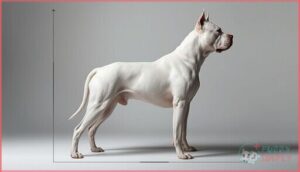
You need to understand how impressive these large breed dogs truly are—most adult Dogo Argentinos stand 23.5 to 27.5 inches at the shoulder, with males topping the height standards at 24 to 27 inches and females slightly shorter at 23 to 25 inches. Weight limits range from 80 to 120 pounds, though breed standard ideals hover around 88 to 100 pounds for males.
Growth patterns reveal rapid early development, with puppies hitting half their adult weight by four months. Muscle mass continues building until 18 to 24 months, when chest depth and neck thickness finally catch up to height.
Size variations appear between working and show lines, as breeders balance power with agility to meet canine health and performance goals in this exceptional dog breed.
Distinctive White Coat and Markings

Your Dogo Argentino’s gleaming white coat isn’t just striking—it’s central to breed standards and registration, reflecting coat color genetics that demand a near-total absence of pigment across the body. You’ll notice acceptable dark “pirata” patches on the head (under 10 percent of skull area), while nose pigment remains black with well-defined eye coloration in brown tones.
These features serve both aesthetic and functional purposes, protecting against sun damage and meeting strict dog breed characteristics for shows and health.
Muscular Build and Athleticism

Your Dogo Argentino’s raw power stems from thick musculature designed for explosive bursts during big-game hunts, demanding structured physical conditioning and vigorous exercise needs (60–90 minutes daily) to maintain peak athletic ability and prevent destructive restlessness.
This powerful dog’s muscle structure includes:
- Broad shoulders controlling struggling prey
- Deep chest housing sturdy cardiovascular capacity
- Strong hindquarters driving sprint acceleration
- Muscular neck sustaining grip endurance
- Balanced proportions enabling agility across varied terrain
Under-exercised specimens lose tone rapidly, compromising canine health and wellness while increasing behavioral issues.
Grooming and Maintenance Needs

Your Dogo’s sleek white coat demands surprisingly little intervention—weekly brushing removes loose hair while distributing natural oils for ideal coat maintenance and shedding control.
Pair this with monthly nail care to prevent splitting, routine ear cleaning using veterinarian-approved solutions, and daily dental brushing (dog grooming essentials supporting canine health and wellness).
Inspect skin regularly for dryness or irritation, as proactive dog health and care prevents minor issues from escalating.
Temperament and Behavior
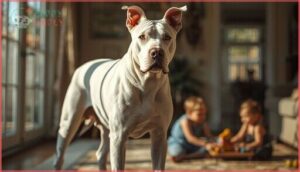
The Dogo Argentino’s temperament reflects its hunting heritage; this breed combines fierce loyalty with a protective instinct that can border on territorial aggression if not properly channeled through training and socialization.
You’ll find that understanding your Dogo’s behavioral tendencies isn’t just helpful—it’s essential for responsible ownership, particularly if you’re integrating this powerful dog into a home with children or other pets.
Let’s examine the key behavioral traits that define this breed and what they mean for your daily life as an owner.
Loyalty and Protective Instincts
Think of a Dogo Argentino as your shadow with teeth—this breed’s loyalty traits and protective instincts run deeper than most guard dogs you’ll encounter. Your Dogo forms an intense bond with one primary handler, often positioning itself between you and strangers as a living shield.
The Dogo Argentino bonds intensely with one handler, acting as a living shield between you and perceived threats
This guarding behavior stems from centuries-old threat response mechanisms, making proper training essential for channeling these protective dogs’ natural courage responsibly.
Interaction With Children and Family
Ever witnessed a dog become the heartbeat of a household? In your home, Family Bonding with a Dogo Argentino means constant companionship, but Child Safety demands vigilant supervision. Household Dynamics shift—this dog shadows daily routines, relaxes near children, and expects clear boundaries. Pet Interactions thrive with structured, Supervised Play and rules, ensuring responsible pet ownership and harmonious dog behavior.
- Central family presence, not a loner
- Supervised contact with young children
- Calm routines reduce rough play
- Clear rules foster safe pet care
Socialization Needs
You develop a stable, confident Dogo Argentino through structured Puppy Training between 3 and 14 weeks—the window when Environmental Exposure, Canine Interaction, and Social Skills cement lifelong dog behavior and training. Introduce strangers, surfaces, sounds, and controlled dog-to-dog meetings repeatedly; Fear Prevention depends on calm, positive reinforcement during this critical phase.
After puppyhood, continue real-world practice so your dog’s animal behavior remains adaptable, not reactive.
Aggression and Responsible Ownership
Aggression Triggers in your Dogo Argentino often stem from Fear Based Behavior, resource guarding, or territorial instincts rather than innate malice; watch for stiffened posture and defensive Canine Body Language before escalation occurs.
Proactive Training with positive reinforcement, early Conflict Resolution practice, and professional guidance transforms pet ownership and responsibility into a partnership grounded in animal welfare and ethics, not dominance or suppression.
Health and Lifespan Considerations

Your Dogo Argentino’s health journey isn’t just about reacting to problems—it’s about understanding the unique vulnerabilities that come with this powerful breed and taking charge before issues arise. Like many large, athletic dogs, Dogos face specific health challenges that you can actively manage through informed nutrition, strategic exercise, and preventive care.
Let’s break down what you need to know to keep your Dogo thriving for their full 10 to 12 year lifespan.
Common Health Issues
Your Dogo Argentino carries a genetic blueprint that demands vigilance—understanding these health challenges equips you to act decisively. Watch for:
- Deafness Risk: Up to 25% are born deaf in at least one ear due to white coat pigmentation
- Hip Dysplasia: Joint malformation causing arthritis and mobility loss
- Skin Allergies: Environmental and food sensitivities triggering chronic itching
- Thyroid Issues: Hypothyroidism slowing metabolism and energy
- Gastric Bloat: Life-threatening stomach twisting requiring emergency surgery
Nutrition and Dietary Requirements
Protecting your Dogo from those health threats starts with masterful nutrition and dietary supplements. You’ll want to feed 1,600 to 2,400 calories daily, split between two feeding schedules to prevent bloat while maintaining nutrient balance.
Protein sources should hit 25 to 30 percent for working athletes, with omega-3s strengthening joints and skin. Calorie intake adjusts based on your dog’s intensity, transforming fuel into raw power.
Exercise and Mental Stimulation
Beyond nutrition, you must channel your Dogo’s explosive energy through aerobic training and mental enrichment that match their working dog heritage. Interactive play and cognitive development sessions transform raw power into focused mastery:
- Daily vigorous runs or dog sports for 60 to 90 minutes to maintain cardiovascular health and muscle tone
- Puzzle feeders and scent work games that engage canine behavior instincts and problem-solving abilities
- Sophisticated dog training drills incorporating obedience and agility to sharpen focus and self-control
- Social stimulation with supervised canine companions to reduce boredom and destructive tendencies
- Rotating environmental challenges and new commands to sustain mental sharpness throughout their lifespan
Balanced dog care and maintenance routines prevent behavioral problems while supporting long-term brain function.
Routine Veterinary Care
Proactive veterinary care transforms your Dogo’s raw potential into sustained vitality through strategic health interventions. Extensive animal welfare protocols address breed-specific vulnerabilities while optimizing dog health across their lifespan.
Structured dog care and maintenance routines safeguard canine behavior stability while extending quality years.
| Veterinary Care Component | Frequency and Purpose |
|---|---|
| Vaccine Schedules (DAP, rabies) | Puppy series at 6-8 weeks; adult boosters every 1-3 years to prevent disease |
| Dental Care (scaling, polishing) | Annual cleanings starting at age 2; home brushing 3x weekly to combat tartar |
| Hearing Tests (BAER screening) | Puppies at 7-8 weeks to detect congenital deafness linked to white coat gene |
| Skin Evaluations and Parasite Control | Regular exams for sunburn susceptibility; monthly heartworm and flea prevention year-round |
Training and Living Requirements
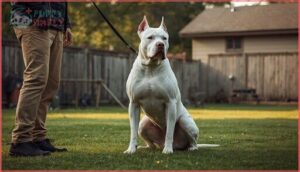
Training a Dogo Argentino isn’t for the faint of heart; this breed demands an owner who understands dominance, structure, and the psychology of a dog bred to hunt dangerous game. Beyond training techniques, you’ll need to think about whether your living situation can handle a powerful, protective animal with specific environmental needs.
Legal restrictions in many regions further complicate ownership, making it essential to understand what you’re signing up for before bringing one home.
Basic and Advanced Training Needs
Training a Dogo Argentino isn’t a weekend project—it’s a commitment that shapes a powerful companion into a reliable partner. You’ll need consistent positive reinforcement, clear behavioral management, and dedication to both obedience training and mental challenges. Complex commands and canine sports channel their raw drive productively.
Your training roadmap includes:
- Master core commands (sit, stay, heel) by 6–12 months
- Practice impulse control through structured daily routines
- Dedicate 60–90 minutes to physical plus mental work
- Rotate activities weekly to prevent boredom and frustration
- Consider professional support, especially during adolescence
Importance of Early Socialization
You’ll tap into your Dogo Argentino’s full potential by starting puppy socialization between 3 and 16 weeks—the critical fear imprint window. Early, positive exposure to people, animals, and environments builds confidence, teaches bite inhibition, and safeguards public safety.
This dog breed demands deliberate animal behavior and training work from day one; miss it, and lifelong management becomes exponentially harder once 90 pounds of muscle reaches maturity.
Suitable Living Environments
A 1,200-square-foot home with a six-foot fence transforms your space requirements from burden into freedom—this dog breed thrives where large dogs get room to move, not cramped corners. Your Dogo Argentino needs:
- Detached house with open floor plans for comfortable indoor movement
- Medium to large fenced yard (6+ feet high, dig-proof barriers)
- Urban adaptation through multiple daily park outings and structured exercise
- Climate control—indoor living with AC in summer, coats for winter walks
- Active household dynamics matching one to two hours of daily physical and mental work
Legal Restrictions and Breed Bans
Before you fall for this breed, know that ownership can slam into legal walls fast. The United Kingdom, Denmark, Norway, Cyprus, Singapore, and parts of Australia enforce outright breed bans on the Dogo Argentino under dangerous dog laws.
New Zealand and various U.S. municipalities layer on strict ownership rules, muzzle mandates, insurance impacts, and import laws that can block travel or even force rehoming.
Frequently Asked Questions (FAQs)
What is the typical lifespan of a Dogo Argentino?
How long will your powerful companion stay by your side? The Dogo Argentino commonly lives 9 to 12 years, though genetic factors, health screening, diet quality, exercise needs, and diligent veterinary care influence longevity substantially.
How often should a Dogo Argentino be bathed and brushed?
You’ll want to bathe your Dogo Argentino roughly once every four weeks, while brushing weekly with a soft bristle brush or rubber grooming mitt.
Increase brushing frequency during spring and autumn shedding peaks.
What are the common health issues faced by Dogo Argentinos?
Your dog’s deep chest invites gastric issues and bloat, while genetics predispose hip dysplasia, skin allergies, ear infections, and dental disease—conditions requiring vigilant veterinary oversight, preventive care, and customized management strategies throughout your Dogo Argentino’s lifespan.
How much exercise does a Dogo Argentino require daily?
Your hunting dog breeds demand vigorous Physical Activity Levels—usually 60 to 90 minutes of Daily Exercise Needs combining Outdoor Playtime, Mental Stimulation Methods, and Energy Release Techniques to prevent destructive behaviors in these powerful canine care specimens.
What is the recommended diet for a Dogo Argentino?
Your Dogo Argentino thrives on high-quality protein sources like chicken, beef, or fish, balanced nutrients including omega fatty acids, and a consistent feeding schedule—usually two meals daily for adults to maintain peak muscle mass and energy.
Can Dogo Argentinos live comfortably in apartments?
While these powerful Large Dogs can adapt to urban living with remarkable commitment, their size and energy demands make apartment life challenging; success requires extensive Urban Exercise, rigorous Apartment Training, careful Space Management, and unwavering dedication to canine companionship.
How much does a Dogo Argentino puppy cost?
Buckle up—Puppy Price Factors and Breeder Selection dramatically shape what you’ll invest in this majestic breed.
Dogo Argentino puppies usually range from $1,500 to $4,000, with show-quality lineages occasionally exceeding $5,000, reflecting dog breeding standards and ownership expenses.
Are Dogo Argentinos good with other pets?
Your success with multi-pet homes depends on early socialization and consistent training.
With proper management, these powerful dogs can coexist peacefully with other household pets, though their strong prey drive requires careful supervision and gradual introductions.
What activities best suit a Dogo Argentino?
You might think any exercise works, but these hunting breeds thrive through agility training, outdoor hiking, swim therapy, and structured pack hunts—activities that challenge working dogs mentally while channeling their protective instincts through purposeful dog sports and activities.
Do Dogo Argentinos suffer from separation anxiety?
Yes, Dogo Argentinos can develop separation stress due to their intense dog bonding with family members; anxiety triggers include departures, and calming techniques combined with gradual desensitization help manage emotional support needs effectively.
Conclusion
With great power comes great responsibility—and the Dogo Argentino embodies both in equal measure. This breed won’t adapt to your lifestyle; you must transform yours to meet its demands for structure, discipline, and unwavering leadership.
Before committing, ask yourself whether you’re prepared to navigate legal restrictions, invest in professional training, and accept that this white-coated guardian will test your resolve daily. Only then will you release the profound loyalty this exceptional breed offers.
- https://worldclassdogoargentino.com/history-of-the-dogo-argentino-breed/
- https://www.akc.org/dog-breeds/dogo-argentino/
- https://www.dialavet.com/blog/dogo-argentino-dog-breed-characteristics-care
- https://showsightmagazine.com/dog-breeds/dogo-argentino/
- https://www.kinship.com/uk/dog-lifestyle/dogo-argentino-uk