
This site is supported by our readers. We may earn a commission, at no cost to you, if you purchase through links.
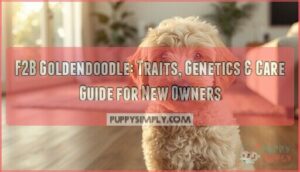
You’ve probably seen the ‘F2B Goldendoodle‘ label on breeder websites and wondered if it’s just marketing jargon or something that actually matters. Here’s the truth: that generation code tells you exactly what you’re getting—a dog that’s 62.5% Poodle and 37.5% Golden Retriever, created by crossing an F1 Goldendoodle with an F1B Goldendoodle.
This specific genetic mix isn’t random; breeders use it to dial in predictable traits, especially regarding shedding and coat type. For families dealing with allergies or anyone who’d rather not have tumbleweeds of fur rolling across their floors, that extra Poodle genetics can make all the difference.
Understanding what F2B actually means helps you figure out if this generation matches your lifestyle, grooming commitment, and what you need in a four-legged companion.
Table Of Contents
- Key Takeaways
- What is an F2B Goldendoodle?
- F2B Goldendoodle Genetics and Breeding
- Physical Characteristics of F2B Goldendoodles
- Temperament and Personality Traits
- Allergy-Friendly and Low-Shedding Qualities
- Grooming and Coat Maintenance
- Health and Lifespan Considerations
- Exercise and Mental Stimulation Needs
- Choosing The Right F2B Goldendoodle
- F2B Goldendoodle as a Family Pet
- Frequently Asked Questions (FAQs)
- What are the grooming requirements for an F2b Goldendoodle?
- How much exercise does an F2b Goldendoodle need?
- What type of coat does an F2b Goldendoodle have?
- How much does an F2b Goldendoodle cost?
- Are F2b Goldendoodles good with children?
- What does F2B Goldendoodle adoption typically cost?
- How do F2B Goldendoodles behave during car rides?
- Are F2B Goldendoodles prone to barking excessively?
- What vaccinations do F2B Goldendoodle puppies need?
- Conclusion
Key Takeaways
- F2B Goldendoodles carry 62.5% Poodle and 37.5% Golden Retriever genetics, delivering more predictable low-shedding coats and hypoallergenic potential than F1 or F2 generations while keeping the Golden’s friendly temperament.
- These dogs need 60-90 minutes of daily exercise plus mental stimulation to stay balanced, and their wavy-to-curly coats require brushing 2-3 times weekly with professional grooming every 6-8 weeks to prevent painful matting.
- While no dog is completely hypoallergenic, F2B Goldendoodles’ higher Poodle genetics make them better suited for allergy sufferers compared to earlier generations, though individual reactions vary and should be tested before committing.
- Expect to invest $2,000-$5,000 from reputable breeders who provide health testing and genetic screening, as responsible breeding practices directly impact your dog’s 10-15 year lifespan and reduce inherited health issues like hip dysplasia.
What is an F2B Goldendoodle?
If you’ve been researching Goldendoodles, you’ve probably stumbled across terms like F1, F1B, and F2B—and honestly, it can feel like you’re decoding some kind of secret breeder language. The F2B Goldendoodle sits in a sweet spot for people who want more Poodle traits, like a curlier coat and lower shedding, without going full Poodle.
Let’s break down what this generation actually means, where it comes from, and how it stacks up against other Goldendoodle types.
F2B Generation Explained
The F2B Goldendoodle represents a specific breeding method in the hybrid breed world, where one parent is an F1 Goldendoodle and the other is an F1B. This generation types approach gives you a dog with roughly 62.5% Poodle influence and 37.5% Golden Retriever.
Here’s what makes the F2B distinct:
- Genetic makeup leans heavily toward Poodle traits, enhancing coat curliness
- Hybrid vigor often produces healthier, more resilient dogs
- Goldendoodle generations guide places F2B between F1B and F2 in predictability
- Breeding methods aim for consistent low-shedding coats with Golden’s temperament
Understanding the genetic makeup requires careful consideration of scientific study methods to verify accuracy.
Parent Breed Lineage
To truly understand your F2B Goldendoodle, you’ll want to trace back the parent breed lineage. The foundation starts with purebred Golden Retrievers and Poodles, whose Poodle genetics combine to create F1 hybrids. When an F1 then crosses with an F1B—which already leans Poodle-heavy—you get that F2B blend.
This hybrid breed approach maximizes genetic diversity while capturing hybrid vigor’s health benefits. Understanding the breed’s lineage requires exploring language related concepts to better grasp the genetic terminology.
How F2B Differs From Other Generations
Now that you know the parent breed lineage, let’s talk about what makes F2B Goldendoodles stand out from their F1 or F2 cousins. This hybrid breed shows more coat predictability than F2 Goldendoodles, thanks to that second backcross to a Poodle.
Many families choose this generation specifically because they want a low-shedding Goldendoodle with a curlier, more hypoallergenic coat than earlier crosses typically offer.
You’ll notice stronger hypoallergenic traits and more consistent curly textures, while still keeping the Golden Retriever’s gentle temperament—a sweet spot in generational traits.
F2B Goldendoodle Genetics and Breeding

Understanding the genetics behind an F2B Goldendoodle helps you know exactly what you’re getting when you bring one home. The percentages of Poodle and Golden Retriever, the backcrossing process, and coat variations all play a role in shaping your dog’s appearance and temperament.
Let’s break down the key genetic factors that make F2B Goldendoodles unique.
These dogs inherit approximately 62.5% Golden Retriever traits, which often results in a calmer temperament similar to teacup Goldendoodle variations that families love.
Poodle and Golden Retriever Percentages
You’re probably wondering what’s actually running through your F2B Goldendoodle’s veins. The genetic makeup usually lands around 62.5% Poodle and 37.5% Golden Retriever, though breed proportions can shift based on individual ancestry testing and breeder goals.
If you’re deciding between breeds, comparing Goldendoodle traits with their Labradoodle cousins can help clarify which temperament and size suits your lifestyle best.
This percentage variance across hybrid dog breeds means your pup’s exact mix might surprise you—even within the same litter, thanks to the wonderful unpredictability of hybrid vigor.
Each Toy Australian Shepherd inherits a unique genetic blueprint, which is why early socialization and consistent positive reinforcement matter so much during their formative months.
Backcrossing in Goldendoodles
Backcrossing brings your F2B one step closer to the Poodle side, amplifying Poodle influence on coat traits and hypoallergenic potential. When breeders mate an F1B Goldendoodle with a purebred Poodle, they’re strategically chasing those low-shedding curls while preserving hybrid vigor.
Ethical breeding practices demand transparent health screening and genetic diversity management, since backcross benefits shine brightest when you’re not amplifying hereditary problems alongside desirable canine genetics.
Common Coat Types and Colors
You’ll spot three main coat textures in your F2B Goldendoodle: curly coats that lean heavily Poodle (low-shedding champs), wavy styles that balance maintenance and shedding patterns beautifully, or straight coats resembling Golden Retrievers.
Coat color genetics deliver cream, apricot, red, chocolate, and black variations, though colors often shift subtly during the first year as hypoallergenic potential and grooming needs stabilize across texture variations.
Physical Characteristics of F2B Goldendoodles
When you’re picturing your future F2B Goldendoodle, you’re probably wondering what they’ll actually look like—and honestly, there’s quite a bit of variety to cover. These dogs come in different sizes, each with their own weight ranges and physical traits that’ll affect everything from your living space to your daily routine.
Let’s break down the key physical characteristics you can expect, starting with size options and moving through coat details.
Size Variations (Toy, Mini, Standard)

When you’re choosing an F2B Goldendoodle, size comparison matters more than you might think—these low-shedding pups come in three distinct breed standards.
Toy varieties usually stay under 20 pounds, while Mini Goldendoodles range from 20 to 35 pounds at maturity.
Standard F2B Goldendoodle characteristics include exceeding 35 pounds, with growth patterns and weight factors influenced by your breeder’s specific parentage choices.
Typical Weight and Height Ranges

Understanding F2B Goldendoodle characteristics starts with knowing the numbers—your pup’s final size depends on their specific parentage and growth patterns. These weight factors and height proportions follow predictable breed standards, though individual variation happens.
Here’s what you can expect across size variations:
- Toy F2B: 8 to 20 pounds, standing 10 to 15 inches tall
- Mini F2B: 20 to 35 pounds, reaching 15 to 18 inches
- Standard F2B: 45 to 75 pounds, measuring 21 to 24 inches
- Growth usually plateaus between 12 to 18 months
Coat Texture and Shedding

Your F2B’s coat comes down to genetic lottery—wavy textures dominate at 50-60%, while curly coats appear in 20-30% and straight in just 10-20%. These coat genetics directly influence shedding patterns, with curly coats offering hypoallergenic, low-shedding advantages and wavy types providing moderate shedding. Proper grooming and mat prevention are essential for maintaining the health of all coat types.
| Coat Type | Shedding Level | Maintenance Needs |
|---|---|---|
| Straight | Moderate seasonal | Brush 2-3x weekly |
| Wavy | Light to moderate | Brush 3-4x weekly |
| Curly | Minimal/nonshedding | Daily brushing required |
| All Types | Varies by genetics | Pro grooming every 4-6 weeks |
| Poodle-heavy | Low-shedding | Higher mat risk |
Temperament and Personality Traits

F2B Goldendoodles blend the best personality traits from both Golden Retrievers and Poodles, creating dogs that are as loving as they’re smart.
You’ll find they adapt well to different family situations, though their energy and social needs are worth understanding before you bring one home.
Let’s look at what makes their temperament stand out and what you can realistically expect day-to-day.
Intelligence and Trainability
You’ll love how quick your F2B Goldendoodle picks up new tricks—these intelligent pups respond beautifully to positive reinforcement and consistent obedience training. Their problem-solving skills shine through early, especially with proper cognitive development and social exposure.
Keep learning strategies fresh with varied cues, and you’ll see their trainability tips pay off fast, though remember that canine genetics means each dog’s pace differs slightly.
Social Nature and Family Compatibility
Your F2B Goldendoodle craves human interaction and thrives on family bonding, making them outstanding family-friendly pets. Early social learning with children and other pets builds household harmony, and their intelligent and loyal nature means they respond beautifully to consistent routines.
Supervised play strengthens pet dynamics while positive reinforcement shapes their dog temperament and traits—just remember that these intelligent dogs need your presence to avoid separation anxiety.
Energy Levels and Exercise Needs
That social spark comes with serious stamina—your F2B Goldendoodle needs 60 to 120 minutes of daily exercise depending on their size. Energy monitoring helps you tailor activity levels to avoid boredom-fueled destruction, while varied physical stimulation keeps them mentally sharp.
Daily schedules should include:
- Morning and evening walks or runs
- Interactive puzzle toys between exercise routines
- Off-leash play in secure areas
- Water activities or agility basics for endurance
Allergy-Friendly and Low-Shedding Qualities

If you’re dealing with allergies, the F2B Goldendoodle might be your best bet in the Goldendoodle lineup. Thanks to that extra dose of Poodle genetics—about 62.5% to 75%, depending on the breeding—these dogs generally shed less and produce fewer allergens than their F1 or F2 cousins.
Let’s break down what makes them stand out for allergy sufferers and how they stack up against other generations.
Hypoallergenic Potential
You’ve probably heard F2B Goldendoodles called hypoallergenic dog breeds, but here’s the reality: no dog is 100% allergen-free. That said, their higher Poodle genetics—usually around 62.5% to 75%—gives them allergy-friendly, low-shedding coats that work well for many people.
Before you commit, spend time with the pup and consider allergy testing, since shedding factors vary and hypoallergenic benefits aren’t guaranteed for everyone.
Comparison to Other Goldendoodle Generations
When you compare F2B Goldendoodles to earlier generations, you’ll notice they often land somewhere between F1B and F2 regarding coat predictability. Here’s how breed comparison shakes out:
- F1 Goldendoodles (50/50 mix) show the most genetic variance—shedding can surprise you.
- F1B Goldendoodles (75% Poodle) offer strong hybrid vigor with reliable low-shedding coats.
- F2B Goldendoodles balance inheritance patterns, giving you more consistency than F2 but slightly more diversity than F1B.
Generation differences matter when you’re weighing allergy-friendly traits.
Suitability for Allergy Sufferers
If you’re a sensitive owner dealing with pet allergies, F2B Goldendoodles won’t guarantee relief—but they’re worth considering. Their wavy to curly coats trap dander better than straight fur, and regular grooming boosts dander reduction. Before committing, meet the specific pup to gauge your reaction. Allergy testing beforehand helps, too.
| Factor | Impact on Allergies | Your Action |
|---|---|---|
| Coat Type | Curly traps allergens better | Request breeder photos |
| Grooming Frequency | Weekly brushing reduces dander | Budget for pro grooming |
| Individual Dog | Protein levels vary per pup | Arrange in-person visit |
| Breeding Strategies | Poodle genetics increase hypoallergenic potential | Ask about parent lineage |
| Environment | Clean home lowers exposure | Use HEPA filters at home |
Allergy-friendly pets aren’t one-size-fits-all—your mileage will vary with each low-shedding dog.
Grooming and Coat Maintenance

That curly or wavy coat your F2B Goldendoodle sports is gorgeous, but it won’t stay that way without consistent care.
Regular grooming isn’t just about keeping your dog looking sharp—it’s about preventing painful mats, skin irritation, and the kind of tangles that turn a simple brushing session into a wrestling match.
Here’s what you need to know to keep that coat healthy and manageable.
Brushing and Mat Prevention
Your F2B Goldendoodle’s wavy or curly coat texture makes tangle prevention essential—skipping even a few days can lead to stubborn mats. To keep your low-shedding, hypoallergenic companion comfortable, commit to a consistent grooming frequency:
- Brush daily if your dog has a dense, curly coat
- Focus on mat-prone zones: behind ears, underarms, and inner thighs
- Apply detangling spray before each session to ease mat removal
- Always brush in the direction of hair growth
- Start this routine early so grooming becomes second nature
Recommended Grooming Tools
You’ll need a slicker brush with fine pins to tackle that wavy or curly Goldendoodle coat without damaging the topcoat, plus a pin brush for gentler work around delicate spots.
Grab a dual-tooth comb to detangle mats and check for debris, and keep stainless steel scissors handy for trimming paws and sanitary areas—these essentials make low-shedding, hypoallergenic coat care straightforward.
Professional Grooming Frequency
You’ll want to book professional grooming every 6 to 12 weeks for your F2B Goldendoodle, depending on coat density—curly coats need shorter intervals to prevent matting, while wavy types can stretch longer with consistent home brushing.
Each session covers trimming, bathing, nail care, and ear cleaning, keeping that low-shedding, hypoallergenic coat in top shape and shedding control manageable year-round.
Health and Lifespan Considerations

F2B Goldendoodles are generally healthy dogs, but like all breeds, they can inherit certain conditions from their parent lines. Understanding what health issues to watch for—and how long you can expect your dog to be by your side—helps you plan for the best care possible.
Let’s look at the common health concerns and typical lifespan you can expect with an F2B Goldendoodle.
Common Health Issues in F2B Goldendoodles
Like any crossbreed, your F2B Goldendoodle can inherit certain health challenges from both parent lines. Hip Dysplasia affects 6–16% of retriever-mix dogs, while Skin Allergies and Eye Problems show up in roughly 10–20% of doodle-type breeds.
Genetic Testing and Health Screening from reputable breeders help catch issues early, giving you peace of mind about your pup’s long-term canine health and genetics outlook.
Lifespan Expectations
Your F2B Goldendoodle can live anywhere from 10 to 15 years, depending on genetic factors, diet impact, and consistent health monitoring. Smaller sizes often see better longevity tips in action, while mortality rates drop when you catch inherited issues early through canine health and genetics screenings.
This dog breed information shows that proactive pet health care—good nutrition, exercise, regular vet visits—makes all the difference.
Exercise and Mental Stimulation Needs

Your F2B Goldendoodle isn’t going to be happy lounging on the couch all day—these dogs come wired with energy and brains that need regular outlets. Without proper exercise and mental challenges, you’ll likely end up with a bored, anxious pup who finds creative (and destructive) ways to entertain themselves.
F2B Goldendoodles need daily exercise and mental stimulation or they’ll turn boredom into destruction
Let’s break down what your dog actually needs to stay balanced and content.
Daily Activity Requirements
Your F2B Goldendoodle thrives on 60 minutes of daily exercise, split into manageable chunks to match their intelligent, family-friendly nature. This breed’s poodle heritage means they need consistent physical stimulation and energy management to prevent unwanted behaviors.
Daily walks and playtime activities should include:
- Two or three brief walks plus 20–40 minutes of interactive dog training and behavior games
- A mix of cardio (hiking) and mental challenges (puzzle toys)
- Supervised outdoor play with access to shade and water
- Varied exercise routines like swimming or fetch to prevent boredom
Suitable Activities and Toys
You’ll keep your intelligent F2B engaged with interactive games like treat-dispensing puzzles and nose-work challenges that reward problem-solving. Toy rotation prevents boredom—swap between fetch balls, tug ropes, and plush squeakers weekly.
Chew-resistant dental toys support oral health during teething phases, while agility courses and water play offer mental stimulation alongside exercise routines. These playtime essentials strengthen your family-friendly companion’s focus and prevent destructive habits.
Preventing Boredom and Anxiety
Beyond play sessions, anxiety prevention demands structured routines that build emotional support systems. Consistent scheduling reduces stress by up to 30%, while mental stimulation through scent work and rotating puzzles lowers pacing behaviors.
This intelligent, family-friendly breed thrives when boredom reduction meets predictable pet care rhythms.
- 60-minute daily exercise customized to your dog’s energy level
- 10–15 minute training blocks twice daily for impulse control
- Safe retreat spaces with cozy bedding during high-noise periods
Choosing The Right F2B Goldendoodle

Finding the right F2B Goldendoodle starts with understanding what size works for your lifestyle and making sure you’re working with someone who puts the dogs first. Size isn’t just about cute factor—it affects exercise needs, space requirements, and even how long your pup might live.
Let’s break down the key decisions you’ll face when choosing your F2B companion.
Full-Sized Vs. Mini F2B Goldendoodles
When you’re choosing between full-sized and mini F2B Goldendoodles, the size comparison boils down to more than just dimensions. Full-sized dogs usually weigh 50–90 pounds and need 60–90 minutes of daily exercise, while minis clock in at 25–40 pounds with 30–60 minutes required.
Both are low-shedding and hypoallergenic, but family dynamics shift—larger F2B Goldendoodles handle active kids better, whereas minis suit apartment living.
Training needs remain similar across sizes, though energy levels run noticeably higher in standards.
Assessing Breeder Reputation and Ethics
When vetting breeders, you’ll want proof of health guarantees and transparent contact info—hallmarks of responsible breeding that separate ethical sourcing from puppy mills. Reputable breeding program management includes genetic testing, verifiable references, and clean facilities with proper veterinary oversight.
Responsible dog breeding prioritizes dog breeding and genetics over profit, so don’t hesitate to ask tough questions about their practices and pet ownership responsibilities before committing.
F2B Goldendoodle as a Family Pet

If you’re wondering whether an F2B Goldendoodle will fit into your life, you’re probably asking the right questions. These dogs bring a mix of affection, energy, and adaptability that works for many families, but they’re not a one-size-fits-all solution.
Let’s look at how they handle kids, living spaces, and owners who are just starting out.
Living With Children and Other Pets
You’ll find that F2B Goldendoodles usually blend into family life with striking ease, especially when socialized early—ideally before 16 weeks. Their friendly, patient nature makes them solid family pets, but supervision with small kids prevents rough play and accidental bumps.
- Early socialization builds consistent, positive interactions with children and other pets
- Gradual introductions on neutral ground help resident pets accept your new Goldendoodle
- Positive reinforcement training with kids present reduces play-related incidents
- Supervised playdates sustain sociability and calm novelty-induced reactions
- Family-inclusive routines reinforce shared commands, boosting household harmony and pet care consistency
Apartment Vs. House Suitability
Space Requirements often decide whether you’ll thrive with an F2B Goldendoodle in an apartment or house. Standard and mini F2Bs need around 60 minutes of daily exercise—more manageable when you’ve got yard access or nearby parks—and their moderate noise levels won’t upset neighbors if you maintain consistent training and enrichment routines.
| Factor | Apartment | House |
|---|---|---|
| Daily Exercise Access | Requires planned outings to parks | Yard allows spontaneous play |
| Noise & Neighbor Impact | Moderate barking managed with training | More forgiving sound environment |
| Grooming Setup | Compact toolkit, professional grooming | Dedicated space for home grooming |
| Overall Suitability | Feasible with active lifestyle | Ideal for energy and space needs |
First-Time Owner Considerations
Your first F2B Goldendoodle arrives with a learning curve, but these pups reward owner preparation with loyalty and adaptability. Focus on puppy socialization early—introductions to kids, pets, and new sounds—since family dynamics hinge on calm exposure, not rushing.
- Schedule veterinary care within seven days of bringing your puppy home for baseline health checks.
- Enroll in basic training classes that emphasize positive reinforcement and socialization opportunities.
- Budget for grooming supplies and professional appointments every six to eight weeks to maintain their low-shedding, hypoallergenic coat.
- Establish consistent daily routines for feeding, exercise, and crate training from day one.
- Plan family-friendly activities that let everyone participate in training, reinforcing your F2B Goldendoodle’s role in pet ownership and household harmony.
Frequently Asked Questions (FAQs)
What are the grooming requirements for an F2b Goldendoodle?
Think of grooming like tending a garden—it needs consistent attention to thrive.
Your Goldendoodle requires brushing 2–3 times weekly, professional grooming every 6–8 weeks, plus routine nail care and ear cleaning to prevent matting.
How much exercise does an F2b Goldendoodle need?
Your F2B Goldendoodle needs 60 to 90 minutes of daily exercise combining physical activity and mental stimulation—think brisk walks, fetch sessions, and puzzle toys to keep boredom at bay.
What type of coat does an F2b Goldendoodle have?
Your F2B Goldendoodle will likely sport a wavy to curly coat that’s soft and fluffy, leaning toward low-shedding thanks to that stronger Poodle influence—though true hypoallergenic status isn’t guaranteed for everyone.
How much does an F2b Goldendoodle cost?
Puppy prices generally push $2,000 to $5,000 from reputable breeders, with breeder fees reflecting health screenings and lineage. Premium pedigrees occasionally exceed $6,
Cost variance depends on location, demand, and included pet care like vaccines and microchipping.
Are F2b Goldendoodles good with children?
Yes, F2B Goldendoodles usually excel with children thanks to their friendly, sociable temperament and trainable nature. You’ll want supervised interactions, early socialization, and consistent training to guarantee safe, positive family dynamics for everyone involved.
What does F2B Goldendoodle adoption typically cost?
Adoption fees for F2B Goldendoodles generally range from $2,000 to $4,500 from reputable breeders. Prices vary by lineage quality, health testing, and breeder reputation.
Additionally, you’ll want to budget for veterinary expenses and ongoing care.
How do F2B Goldendoodles behave during car rides?
Like their Golden Retriever and Poodle lineage, most F2B Goldendoodles handle car rides remarkably well once properly acclimated, though individual responses vary.
Some show car anxiety, requiring ride preparation, travel safety measures, and gradual dog training for canine comfort.
Are F2B Goldendoodles prone to barking excessively?
Most F2B Goldendoodles aren’t chronic barkers, but individual vocalization patterns depend on training strategies, noise sensitivity, and environmental enrichment.
Proper canine communication management through consistent dog training keeps barking triggers minimal.
What vaccinations do F2B Goldendoodle puppies need?
Your F2B Goldendoodle puppy shots follow the same vaccine schedules as any dog: distemper, parvovirus, hepatitis, and rabies prevention starting around six weeks, with boosters continuing through sixteen weeks for complete health records.
Conclusion
Think of an F2B Goldendoodle as a carefully tuned instrument—each genetic note designed to deliver predictability without sacrificing personality. You’re getting a companion bred for lower shedding, steadier temperament, and traits that align with what most families actually need.
The right breeder, consistent grooming, and understanding what that 62.5% Poodle mix really means will set you up for years of loyalty, laughter, and remarkably little fur on your couch.