This site is supported by our readers. We may earn a commission, at no cost to you, if you purchase through links.
Most people assume Dobermans come in one color—sleek black with those sharp tan markings. The reality covers four officially recognized combinations, and in a 2024 survey of over 14,000 Doberman owners, black-and-rust still dominated at 62%, but a surprising 14% preferred the dilute shades most buyers never even consider.
Those "dilute" colors—blue and fawn—carry a genetic mutation that affects more than just appearance; it can impact coat health in ways worth knowing before you choose a puppy. Color in this breed isn’t decoration. It’s a window into genetics, breed standards, and long-term care.
Table Of Contents
- Key Takeaways
- How Many Doberman Colors Exist?
- Standard Doberman Colors Recognized
- Rare and Non-Standard Colors
- Doberman Color Genetics Explained
- Do Colors Affect Health or Temperament?
- Choosing a Doberman by Color
- Frequently Asked Questions (FAQs)
- Why do Dobermans nudge you?
- Do Dobermans like snow?
- What is the average lifespan of a Doberman?
- Are Dobermans good family pets?
- Are Dobermans prone to health problems?
- What is the ideal weight for a Doberman?
- How much exercise does a Doberman need?
- Can Dobermans develop new colors through crossbreeding?
- Are certain colors more popular in specific countries?
- How do melanistic Dobermans perform in agility competitions?
- Conclusion
Key Takeaways
- The AKC recognizes four standard Doberman color combinations—black and rust, red and rust, blue and rust, and fawn and rust—but breeders also encounter non-standard variants like melanistic and white dogs that are disqualified from conformation shows.
- Blue and fawn coats aren’t separate pigments; they’re diluted versions of black and red caused by a recessive MLPH gene mutation that also raises the risk of color dilution alopecia, a condition causing patchy hair loss and skin irritation with no cure.
- Coat color carries real health implications—dark coats absorb more solar heat and overwhelm a dog’s cooling system faster, while white Dobermans have almost no natural UV protection and face elevated skin cancer risk.
- Color won’t change your dog’s temperament or drive, but it will directly shape your grooming routine, sun-protection habits, and vet conversations—so choosing informed beats choosing by looks alone.
How Many Doberman Colors Exist?
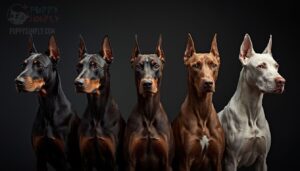
Dobermans come in more color combinations than most people expect, and the differences go deeper than just looks. The AKC recognizes four standard combinations, but breeders and owners regularly encounter colors that fall outside that list.
From rare blues to fawn shades, a full breakdown of Doberman coat colors and what sets each apart makes the variety much easier to understand.
Here’s a clear breakdown of what those colors actually are and how to tell them apart.
The Four Standard Color Combinations
The AKC recognizes exactly four standard Doberman color combinations: black and rust, red and rust, blue and rust, and fawn (Isabella) and rust.
Each pairing follows strict color pairing rules — one base coat, one rust accent.
A 2024 popularity survey of 14,568 voters confirmed black and rust Doberman as the clear favorite at 62%, with red and rust Doberman following at 24%.
What Makes Rust Markings Essential
Rust markings aren’t just a cosmetic detail — they’re a breed standard marker built into the Doberman’s genetic blueprint. Those tan patches on the eyes, muzzle, chest, legs, and tail base serve as a visual distinction confirming correct pigmentation expression.
Under conformation rules, a dog without them won’t qualify for AKC shows, regardless of base coat color.
Why Color Names Can Be Confusing
Even when you know the standard combinations, naming a coat correctly isn’t always straightforward. Lighting influence alone can shift how rust reads on camera, and screen calibration differences mean the same photo looks gray on one device and blue on another. Language variance adds another layer — "red" means different things to different people.
Watch for:
- Warm indoor light pushing coat tones toward orange
- Marketing labels like "rare isabella" obscuring standard fawn
- Subjective perception shifting where brown ends and red begins
- International color naming differences between European and American communities
Common Mistakes When Identifying Coat Colors
Misreads happen more often than you’d think.
Lighting Misinterpretation is the biggest culprit — warm indoor light pushes black coats toward brown.
Photo Angle Bias exaggerates rust contrast, while Undercoat Shadowing makes dilute colors read lighter.
Rust Marking Overlook or Dilution Shade Confusion can blur the line between standard versus nonstandard Doberman coat colors entirely.
| Mistake | What It Distorts |
|---|---|
| Warm indoor lighting | Black looks brown or rusty |
| Flash photography | Rust markings appear exaggerated |
| Undercoat shadowing | Blue coat reads as fawn |
| Seasonal shedding | Dilute colors seem washed out |
| Wet coat glare | Base color looks uneven |
Standard Doberman Colors Recognized
The AKC officially recognizes four standard Doberman color combinations, and each one follows a specific genetic pattern that determines everything from coat shade to marking placement.
Knowing what sets them apart helps you identify any Doberman at a glance and understand what you’re getting into health-wise.
Here’s a closer look at each standard color.
Black and Rust Dobermans
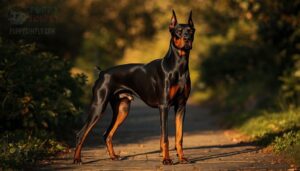
Black and rust is the most popular Doberman color by a wide margin — 62% of owners prefer it.
The solid black base coat paired with crisp rust points at the muzzle, chest, legs, and tail base defines the breed standard.
The black & rust variant dominates global Doberman registrations.
As a health note, this dark coat absorbs more UV radiation, so sun safety and shade management matter during warm months.
Applying dog-safe sunscreen for Australian Shepherds to exposed areas like the nose and ears adds an extra layer of protection during those peak midday hours.
Red and Rust Dobermans
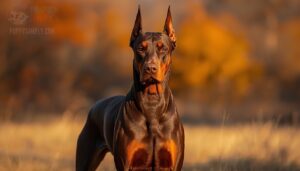
Red and rust Dobermans run a warm, rich brown across the body — sometimes called "chocolate" or "brown" by owners who don’t realize these are just informal names for the same standard color.
What makes this coat coat unmistakable:
- Deep rust-brown base dominates the body
- Tan points frame the brows, muzzle, and chest
- Rust symbolism signals AKC-standard genetic pairing (bb + D)
- Market demand stays strong at 24% owner preference
- color dilution gene means full, stable pigmentation
Breeding trends favor this combination for its warmth and show eligibility.
Blue and Rust Dobermans
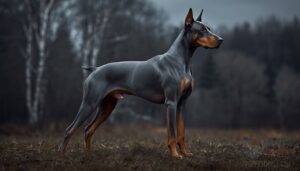
Blue and rust Dobermans sit in an interesting middle ground — officially AKC-standard, yet only around 8–15% of the population carries the recessive color dilution gene that produces this cooler, bluish-gray coat.
rust markings contrast noticeably against that muted base.
Worth knowing: this dilution gene also raises the risk of color dilution alopecia, causing patchy hair thinning and skin irritation.
Fawn and Rust Dobermans
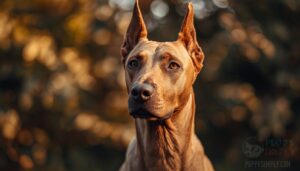
Fawn and rust Dobermans — sometimes called Isabella and rust Dobermans — are the rarest of the four AKC‑recognized standard colors, carrying the recessive bbdd genotype that dilutes red to a soft beige. Coat color perception can be tricky here: rust contrast issues are real, since the markings blend into the lighter base.
That same dilution gene also raises your dog’s risk of color dilution alopecia.
How Each Standard Color Looks in Adulthood
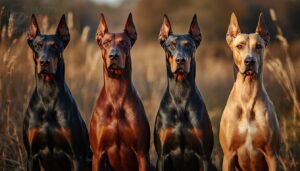
Adult coat sheen tells you a lot about what you’re working with. Black and Rust Dobermans develop deep, high-contrast coats where rust point prominence is hard to miss. Red and Rust dogs warm up noticeably in bright light. Blue and fawn coats show seasonal color shift more visibly.
Grooming impact is real too — aging contrast sharpens when coats stay clean and brushed regularly.
Rare and Non-Standard Colors
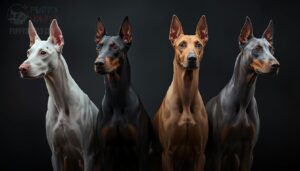
Beyond the four AKC-recognized standards, a handful of Doberman colors exist that you won’t see winning ribbons at official breed shows. These non-standard colors — including several melanistic variants and the striking white — come with their own genetics, controversies, and health considerations worth knowing.
Here’s a closer look at each one.
Melanistic Black Dobermans
Melanistic Black Dobermans wear a coat that looks like a black velvet curtain — no rust, just solid jet from nose to tail.
eye color consistency, always deep brown to black, is one easy identifier.
darker undercoat concealment of hidden tan markings explains the clean look.
Breeder health screening matters here, just as with any Doberman.
Market demand trends show growing curiosity, and rescue adoption rates occasionally surface these rare dogs.
Melanistic Red Dobermans
Shift from black to red, and the melanistic version is just as striking. Melanistic Red Dobermans carry the standard red base, but with pigment intensity cranked up — think deep mahogany edging toward burgundy.
The tan points stay, just muted. Contrast under sunlight is vivid.
Breeding challenges make them scarce, which drives market demand.
For photography, natural light reveals the richest tone variation.
Melanistic Blue Dobermans
Blue goes deeper with the melanistic variant. Melanistic blue Dobermans carry the same dilution gene that creates standard blue-and-rust, but with heightened melanin producing a richer steel-gray-blue hue. Rust markings remain present, though sometimes muted.
Eye color variation is common here. Health screening for color dilution alopecia matters, as owner preferences increasingly drive market demand despite ongoing breeding ethics concerns.
Melanistic Fawn Dobermans
Fawn takes on a whole new depth here. Melanistic Fawn Dobermans display a dusky, chocolate-toned coat with subtle red highlights in sunlight — richer than standard fawn, yet still carrying rust markings.
Coat Color Evolution continues into adulthood as pigment settles.
Health Screening Protocols mirror standard fawn requirements.
Market Rarity Impact is real: extreme scarcity raises prices, and Breeding Ethics Concerns follow closely given the genetics involved.
White Dobermans and Leucism
White Dobermans sit at the far end of the color spectrum. Their cream-to-white appearance comes from leucism — a genetic mutation that reduces pigment production without eliminating it entirely.
That’s what separates leucistic genetics from true albinism: pigment retention patterns remain partially intact, so you’ll often notice pigmented nose leather and eye color variation ranging from blue to light brown.
Health monitoring protocols matter here, since white Dobermans carry elevated skin cancer and photosensitivity risks.
Most kennel clubs classify them as non-standard, and ethical breeding practices strongly discourage selecting for this trait given the documented health concerns of white Dobermans.
Why Albino Dobermans Remain Theoretical
Unlike leucism, true albinism requires both parents to carry a rare recessive albino allele — and that pairing simply hasn’t produced a stable, documented Doberman line. Genetic marker absence in testing panels makes verification difficult, and the health risk concerns are significant.
- Tyrosinase mutation would fully block melanin production
- Breeding viability challenges arise from strict recessive inheritance
- Ethical breeding debates discourage selecting for albino traits
- Health concerns mirror, and likely exceed, those of white Dobermans
Doberman Color Genetics Explained
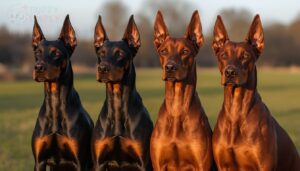
Color in Dobermans isn’t random — it follows a predictable genetic blueprint that’s actually pretty straightforward once you see the pieces.
Two key genes do most of the work, and everything from your dog’s base coat to those distinctive rust markings traces back to them.
Here’s what those genes are doing and what it means for the color you see.
Dominant Pigment Genes in Dobermans
Every Doberman color traces back to a handful of genes working as a team. B locus dominance determines whether your dog produces black or red base pigment, while MC1R extension controls which melanin type gets expressed.
K locus interaction then shapes how those pigments distribute across the coat.
SLC45A2 influences ocular pigmentation, explaining lighter eyes in some dogs.
Together, these form the genetic basis of Doberman coloration.
Recessive Dilution and Lighter Coats
Here’s where genetics gets genuinely interesting.
Blue and fawn coats aren’t separate pigments — they’re diluted versions of black and red, controlled by a recessive MLPH gene at the D locus.
This gene disrupts melanosome transport, scattering pigment particles instead of packing them tightly.
Dilution inheritance pattern requires two recessive copies, and because eumelanin dilutes more strongly than phaeomelanin, rust markings stay visibly warm while the base coat shifts gray or sandy.
How Puppies’ Colors Develop Over Time
Doberman puppies don’t arrive wearing their final coat. During early coat maturation stages, black-born pups can look almost blue under certain lighting, and rust marking evolution happens gradually — soft and pale at birth, then sharpening into crisp points as adult guard hairs replace puppy fur.
Seasonal shade shifts and lighting influence can fool you too, making early misidentification surprisingly common.
Wait for at least one full coat change before judging color with confidence.
When DNA Testing Can Help
DNA testing cuts through the guesswork when your eyes aren’t enough. A $50–$150 blood or cheek swab test helps carrier detection, revealing hidden dilution alleles even in visually standard coats.
That matters for puppy color prediction and breeding strategy — two carriers can produce diluted offspring unexpectedly. It also simplifies registration verification and lineage confirmation, giving you objective documentation rather than a visual best guess.
Why Rust Markings Appear on All Standard Colors
Rust markings aren’t a coincidence — they’re the result of a single rust-associated allele that activates along the same pigment pathway in every standard coat. Whether you’re looking at black, red, blue, or fawn, Uniform Gene Expression drives identical placement every time.
- Rust Allele Consistency ensures markings appear on the muzzle, chest, and legs across all standard colors.
- Coat Development Timing locks rust distribution in place from birth.
- Genetic Marker Stability keeps placement predictable across litters.
Do Colors Affect Health or Temperament?
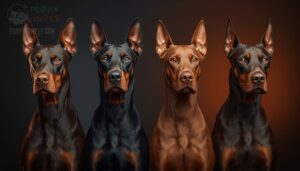
Yes, coat color can influence certain health risks — and it’s worth knowing what to watch for before you bring a Doberman home. The connection isn’t dramatic, but it’s real enough to affect your daily care routine.
Here’s how each color plays out with respect to your dog’s health.
Color Dilution Alopecia in Blue and Fawn Dogs
If you own a blue or fawn Doberman, color dilution alopecia is something worth knowing about. A melanophilin mutation disrupts how melanin forms inside the hair shaft, causing patchy hair loss, flaky skin, and skin irritation.
Alopecia onset age usually falls between six months and three years.
There’s no cure, but skin health management — moisturizing shampoos, omega supplements, and vet‑guided treatment options — helps considerably.
Heat Sensitivity in Dark-coated Dobermans
Dark coats absorb considerably more solar radiation than lighter ones — and for a black and rust Doberman, that means heat builds up faster at skin level. Melanin pigmentation is the driver here. Dogs rely almost entirely on panting for thermoregulation, so when coat heat absorption accelerates warming, that system gets overwhelmed quickly.
Black and rust Dobermans absorb more solar heat, overwhelming their panting-based cooling system faster than lighter-coated dogs
Keep these four practical steps in mind:
- Activity timing — walk during early morning or evening, not midday.
- Hydration management — offer water every 20–30 minutes outdoors.
- Sun protection strategies — stick to grass and shade; hot pavement causes paw pad burns in seconds.
- Heat sensitivity monitoring — watch for heavy panting or seeking shade as early warning signs.
Sun and Skin Risks in White Dobermans
White Dobermans face a different kind of sun problem than black-coated dogs. Their reduced pigmentation offers almost no natural UV protection, leaving the nose, ear tips, and eyelid margins genuinely vulnerable to sunburns and, over time, skin tumors.
UV protection strategies: apply dog-safe sunscreen to exposed areas, limit midday outdoor time, and schedule regular skin tumor screening with your vet — photosensitivity is serious here.
Minor Skin Issues in Red Coats
Red and rust Dobermans don’t face the dramatic risks of white or dilute coats, but they’re not entirely in the clear.
This color sees a slightly higher rate of minor skin conditions — think contact dermatitis from fabric friction, follicle blockages, or occasional yeast overgrowth in warm skin folds.
Barrier disruption from repeated rubbing can keep irritation going longer than expected.
Why Coat Color Does Not Change Behavior
Here’s a myth worth clearing up: coat color doesn’t rewire a dog’s brain.
Temperament differences by Doberman type trace back to breeding goals, training influence, and environmental factors — not pigment. Owner expectations and perception bias often do the heavy lifting here.
If you raise two Dobermans identically, their behavioral traits converge. Color is just packaging.
Choosing a Doberman by Color
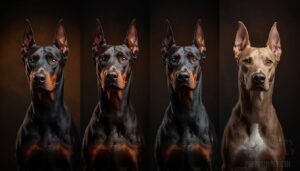
Picking a color isn’t just about looks — it touches on show rules, health considerations, price, and daily care. Each color comes with its own set of practical trade-offs worth knowing before you commit.
Here’s what to think about as you narrow down your choice.
Show Eligibility Versus Pet Ownership
Color choice hits differently depending on whether you’re heading to the show ring or on your couch. Here’s what actually changes:
- Show Registration requires AKC-recognized standard colors only — black, red, blue, or fawn, all with rust markings.
- Disqualification Rules exclude melanistic and white variants from conformation classes.
- Vaccination Proof and health clearances are mandatory for dog show eligibility for Doberman colors.
- Possession Timeline requirements apply to exhibitors before competition.
- Pet Licensing is your only real paperwork if pet ownership considerations are your focus — breed standard compliance simply doesn’t matter.
American Vs European Color Differences
Where you source your Doberman matters more than most people realize. European lines follow tighter regional standards, generally accepting only black-and-rust and red-and-rust, with noticeably deeper color saturation and richer rust contrast.
American Kennel Club standards also permit blue and fawn variants.
Naming discrepancies between regions add confusion, but the real difference comes down to pigment depth — European dogs simply carry a more intense, uniform coat tone.
How Rarity Affects Puppy Prices
Rare and melanistic Doberman color varieties carry real price premium factors. Limited litter size — often just 4 to 6 puppies — combined with geographic scarcity pushes puppy price estimates 10 to 40 percent above common coats.
Genetic testing fees add another layer.
Buyer perception of uniqueness sustains market demand for rare Doberman colors, so cost differences among Doberman color varieties reflect supply pressure more than the dog’s actual worth.
Coat Care for Different Doberman Colors
Every Doberman coat has its own quirks. Blue and fawn dogs face color dilution alopecia, making shampoo selection and seasonal moisturizing non‑negotiable.
Skin health issues linked to light coat colors also demand UV protection gear and careful sun protection strategies for light‑colored Dobermans.
Smart grooming and care for Doberman coats includes:
- Spot cleaning rust markings after outdoor play
- Gentle, residue‑free rinsing with every bath
- Prompt drying techniques to prevent skin irritation
Grooming, Sunscreen, and Winter Sweater Needs
Your Doberman’s short coat offers almost no insulation — winter care for short-haired dogs isn’t optional.
| Care Need | Color Priority |
|---|---|
| Winter UV Protection | White, Fawn |
| Moisturizing Grooming | Blue, Fawn (alopecia risk) |
| Sweater Fit Guidelines | All colors |
| Dampness Drying Routine | All colors |
Post-Walk Skin Checks catch early redness before skin conditions worsen, especially in dilute coats prone to color dilution alopecia.
Frequently Asked Questions (FAQs)
Why do Dobermans nudge you?
Think of a nudge as a tap on the shoulder — your Doberman’s way of saying "I’m here."
It signals attention seeking, bonding contact, need communication, or a quiet protective check‑in.
Do Dobermans like snow?
Some do, some don’t — it really depends on the individual dog. Many Dobermans will happily chase snowballs, but their short coats mean cold tolerance runs low.
Keep outings brief and use a winter coat.
What is the average lifespan of a Doberman?
Most Dobermans live 10 to 13 years, though gender longevity differences, weight management effects, and heart disease impact from dilated cardiomyopathy can shift that range noticeably in either direction.
Are Dobermans good family pets?
Yes — with the right family.
Their loyalty, intelligence, and protective instincts shine when training consistency, early socialization needs, and daily exercise requirements are met. They’re genuinely good with kids in structured, supervised living environments.
Are Dobermans prone to health problems?
They’re prone to several inherited health issues — Dilated Cardiomyopathy, Hip Dysplasia, Von Willebrand Disease, Intervertebral Disc Disease, and Gastric Torsion among them. Regular health screening helps catch problems early.
What is the ideal weight for a Doberman?
Adult males usually run 75–100 lbs; females, 60–90 lbs. Age-based targets, body condition scoring, sex differences, nutrition guidelines, and exercise impact all matter more than the scale alone.
How much exercise does a Doberman need?
A healthy Doberman needs 1 to 2 hours of Daily Exercise Duration, split into two sessions. Match Intensity Levels to age, and adjust for seasonal heat or cold.
Can Dobermans develop new colors through crossbreeding?
Crossbreeding can introduce new pigment genes through genetic introgression risks, but novel color stability rarely holds across generations.
Hybrid coat inheritance is unpredictable, and breed compatibility concerns make ethical color breeding the standard most clubs enforce.
Are certain colors more popular in specific countries?
Yes.
Black and rust lead in European show lines and the US. Red and rust are popular in Latin America, while fawn and rust appear more often across Southeast Asian markets.
How do melanistic Dobermans perform in agility competitions?
Coat color doesn’t win agility courses — training does.
Melanistic Dobermans compete fully in dog sports agility competitions; structural conformation benefits and agility training strategies matter far more than whether a masking pattern affects their rust markings.
Conclusion
Choosing a Doberman by coat alone is a bit like judging a book by its cover—except this cover carries real genetic information. Understanding Doberman colors means knowing that blue and fawn coats signal dilution genes linked to skin vulnerability, while black and red remain the most predictable long-term.
Color won’t shape your dog’s loyalty or drive.
But it will shape your grooming routine, vet conversations, and sun-protection habits. Choose informed, not just by aesthetics.