
This site is supported by our readers. We may earn a commission, at no cost to you, if you purchase through links.

My first dog, a beagle named Biscuit, spent years eating from a bowl I grabbed off a shelf without thinking. He’d finish every meal with wet ears and kibble scattered across the floor—and I assumed that was normal.
The bowl was too wide, too shallow, and two sizes too small for his portion. This setup caused unnecessary mess and discomfort.
A properly sized bowl holds your dog’s full meal with room to spare, fits their muzzle comfortably, and keeps food contained. The right fit depends on your dog’s weight, breed shape, and diet.
Table Of Contents
Key Takeaways
- Bowl size starts with your dog’s weight — small dogs (1–20 lbs) need 1–2-cup bowls, medium dogs (21–50 lbs) need 3–5 cups, and giant breeds (90+ lbs) need 10 cups or more.
- The bowl’s opening should clear your dog’s muzzle by 0.25–0.40 inches, and depth should match their snout length — shallow for flat-faced breeds, deeper (2.5–4 inches) for long-nosed ones.
- Set bowl height roughly six inches below your dog’s shoulder (Withers) to prevent neck strain, but avoid raised feeders for deep-chested breeds prone to bloat.
- Stainless steel is the safest, most durable bowl material — plastic can scratch and harbor bacteria, and ceramic needs regular crack checks to stay hygienic.
Your Dog Needs Four Times Meal Size
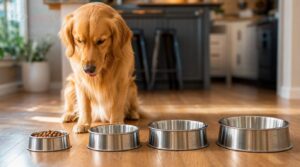
Most people eyeball their dog’s bowl and call it good enough — I did the same thing for years.
Turns out choosing the right dog food bowl for large breeds — material and all — makes a bigger difference to hygiene and durability than I ever expected.
The size actually matters more than you’d think, and there is a simple formula that takes the guesswork out completely. Here is what to keep in mind when finding the right fit for your dog.
Largest Single Meal Volume
Most dogs eat far less than history’s Record Meal Size — a jaw-dropping 19-pound single sitting documented in medical records — but even a modest 2-cup meal needs proper bowl capacity. Calorie Overload and Bloat Risk are real concerns when your feeding strategy ignores volume.
Measuring dog bowl capacity in ml or cups helps you match bowl size to what your dog actually eats, ensuring a balanced Feeding Strategy that prioritizes health.
Spillage Prevention
Once you’ve nailed the right capacity, keeping that food in the bowl is the next battle. A lip spill guard with a spill-edge height of 1.5–2.5 cm catches most whisker-contact drips, while an overflow trough adds a second line of defense for fast eaters.
Pair these with a drip-catch mat and a rubberized base for solid bowl stability — no more sliding across your kitchen floor.
Comfortable Eating Space
Beyond spill control, your dog’s eating space matters just as much as dog bowl dimensions. Think of it like your own dining setup — ergonomic chair height and rounded table edges make meals more comfortable. The same applies to your dog’s setup.
- Use anti-slip matting under the bowl
- Allow clearance width around the feeding zone
- Keep ambient lighting calm and consistent
- Match ideal bowl size for dogs to the space available
Wet Versus Dry Food
What you feed your dog changes how you size the bowl. Wet food, with its 75–85% moisture content, has lower calorie density per cup, making portions appear larger. Conversely, dry kibble is calorie-dense and simpler to measure, containing only 8–12% moisture. Both types influence the required dog bowl capacity differently.
| Food Type | Key Trait |
|---|---|
| Wet food | 75–85% moisture content |
| Dry kibble | 8–12% moisture |
| Wet food | Lower calorie density per cup |
| Dry kibble | Higher calorie density |
| Mixing strategy | Affects total bowl volume needed |
A smart mixing strategy also impacts dental health and necessitates recalculating daily portions in ounces or milliliters to accommodate varying food types and their volumetric demands.
Portion Control Accuracy
Portion control for dogs starts with measuring — not guessing. Use a kitchen scale with a tare function to account for differences in caloric density between dry and wet food. Meal timing matters too: splitting daily portions into two meals improves accuracy.
Log each serving through portion logging and cross-check with weekly weight tracking. Reassess the dog’s bowl capacity every few weeks as changes in activity or weight occur.
Dog Bowl Size Chart by Weight
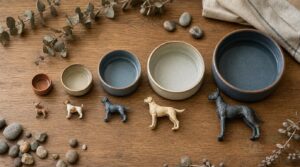
Weight is the easiest starting point when picking a bowl. Once you know how much your dog weighs, the right capacity and diameter basically pick themselves.
Here’s a simple breakdown by weight range.
1–20 Lb: 1–2 Cups
Small dogs — those weighing between 1 and 20 pounds — require bowls that hold 1 to 2 cups of food or water. This serves as a starting point for determining the appropriate bowl size, as factors like meal timing, weight monitoring, and snack portioning influence daily portion sizes.
For quick reference, use the following small dog bowl size chart:
| Dog Weight | Capacity (Cups) | Bowl Diameter |
|---|---|---|
| 1–5 lb | 1 cup | 4 in |
| 6–12 lb | 1.5 cups | 5 in |
| 13–20 lb | 2 cups | 6 in |
21–50 Lb: 3–5 Cups
Medium dogs — those between 21 and 50 pounds — do best with bowls holding 3 to 5 cups.
| Dog Weight | Feeder Capacity | Dog Bowl Size |
|---|---|---|
| 21–30 lb | 3 cups | 6 in |
| 31–40 lb | 4 cups | 7 in |
| 41–50 lb | 5 cups | 8 in |
Split that daily amount across two meals, roughly 8 to 12 hours apart. Bowls with portion markings simplify calorie tracking and help you spot seasonal adjustments quickly.
A slow feeder bowl designed for portion control pairs perfectly with this two-meal routine, keeping pace manageable and digestion on track.
51–90 Lb: 6–8 Cups
Large dogs—those between 51 and 90 pounds—require bowls holding 6 to 8 cups daily, depending on their weight. This capacity is split across two meals roughly 12 hours apart for optimal feeding.
| Dog Weight | Bowl Capacity |
|---|---|
| 51–60 lb | 6 cups |
| 61–70 lb | 7 cups |
| 71–80 lb | 7–8 cups |
| 81–90 lb | 8 cups |
A kibble flow design with raised inner walls helps contain portions and reduces scatter, enhancing feeding efficiency.
90+ Lb: 10+ Cups
Giant breeds—those topping 90 pounds—require at least 10 cups of bowl capacity for effective planning. Stomach capacity and calorie density are crucial factors in determining the appropriate size.
| Dog Weight | Capacity Cups |
|---|---|
| 91–110 lb | 10 cups |
| 111–130 lb | 12 cups |
| 131–150 lb | 14 cups |
| 150+ lb | 16+ cups |
Follow dog bowl size recommendations with veterinarian consultation for GDV prevention.
Inches and Centimeters
Shopping overseas or reading a product label in centimeters? Conversion Basics are simpler than they look. Multiply any inch measurement by 2.54 for an exact dog bowl size in cm — Metric-Imperial Rounding keeps it practical.
| Standard Bowl Sizes | Bowl Diameter |
|---|---|
| 4 in | 10 cm |
| 6 in | 15 cm |
| 8 in | 20 cm |
Your dog bowl size chart works in both systems with Precision Measurement and clear Labeling Conversions for bowl height too.
Measure Muzzle, Depth, and Opening
Weight tells you how much the bowl should hold — but shape tells you whether your dog can actually eat from it comfortably.
A few quick measurements of your dog’s muzzle and the bowl’s depth and opening can make a real difference at mealtime. Here’s what to look for.
Muzzle Width Plus Clearance
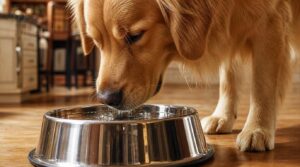
The bowl’s opening must fit your dog’s snout shape — not just loosely, but with real gap tolerance standards in mind. Aim for 0.25 to 0.40 inches of clearance beyond the widest muzzle point, enabling active clearance testing during yawning or movement.
For adjustable muzzle fit, choose stiff materials — hard steel or rigid plastic — which hold their shape longer.
Monitor clearance wear regularly.
Toy Breed Bowl Depth
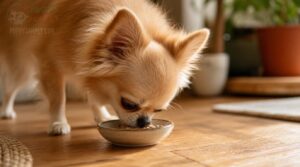
Depth matters just as much as opening width. Choosing a properly sized bowl reduces neck strain. For toy breeds, the ideal shallow depth sits between 1.0 and 1.5 inches — deep enough to hold a small portion, yet shallow enough to prevent a dog’s nose from pressing against the bottom. This depth also improves portion visibility and accommodates snout shape.
Wet-dry balance is equally critical: mixed meals remain accessible at depths of 1.0 to 1.25 inches without becoming messy. Maintaining this balance ensures meals stay neat while preserving functionality.
Stick with a diameter of 4 to 6 inches for small dog bowls. This size provides adequate space for food while keeping portions appropriately proportioned, aligning with the needs of toy breeds.
Large Breed Bowl Depth
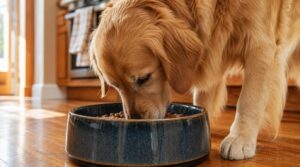
Large breeds flip the script entirely. Where toy breeds need barely an inch of depth, your big dog’s bowl should sit between 2.5 and 4.5 inches deep — with 3.0 to 4.0 inches hitting the sweet spot for most.
This ideal depth range provides giant breeds with essential postural support, food splatter control, and mixed-diet capacity, while avoiding an awkward snout angle.
Preventing Whisker Discomfort
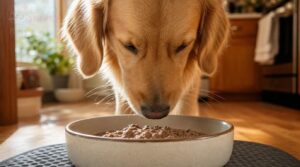
Whisker fatigue is real — and often overlooked. Wide shallow bowls with smooth rim edges fix this fast.
The bowl opening should be 2–3 inches wider than your dog’s muzzle so whiskers never brush the sides.
A stable non-slip base keeps the bowl still during meals.
For flat-faced breeds and brachycephalic dogs, presenting moist food in low-profile bowls helps considerably.
Avoiding Cramped Eating
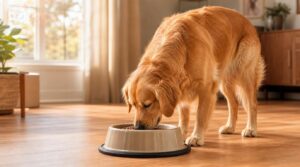
Even the right-sized bowl fails your dog if the eating space feels cramped.
Keep these three things in mind:
- Leave at least 6 inches of open space around the bowl
- Choose a Shallow Bowl Profile with Wide Rim Design for relaxed head movement
- Use an Anti-Tip Base with a Flexible Bowl Placement or Adjustable Height Stand
This promotes healthy posture — and matches sound dog bowl size guidelines.
Choose The Right Bowl Height
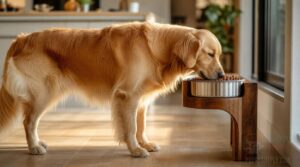
Bowl height matters more than most people think — and it’s easy to get wrong. A bowl that’s too low forces your dog to hunch over for every meal, which adds up to real strain on the neck and joints over time.
A bowl set too low forces your dog to hunch at every meal, turning daily feeding into long-term neck and joint strain
Here’s how to find the right height for your dog.
Measure Shoulder Height
Start with your dog standing squarely on a flat surface — calm and still. Use rigid measuring tools, like a straight ruler or tape, held in a vertical position from the floor to the highest point of the shoulder (height at the withers). Record precise values to the nearest half-inch.
Re-measure after growth spurts, as your dog’s shoulder height changes. Your dog bowl size chart includes dog bowl height recommendations tied directly to this number.
Floor Bowls Versus Raised Bowls
Once you have your dog’s shoulder height, the choice between floor and raised bowls comes down to size and health needs.
Floor accessibility works well for small dogs — offering a natural head angle, easy reach, and simple cleaning around the bowl.
For medium to large breeds, raised dog feeder height improves neck alignment and arthritic joint support, reducing joint stress during meals.
Six Inches Below Withers
Here’s a measurement that cuts through the guesswork: place the bowl top roughly six inches below your dog’s withers — that’s the highest point of the shoulders. Think of it like saddle fit on a horse, where back support zone and spinal clearance matter equally. For dog bowl height, this elevation marker keeps eating natural.
Withers alignment reduces unnecessary neck flex, while proper raised feeding station height bolsters the spine. This spot doubles as your go-to elevation marker for any dog bowl size chart that includes bowl height.
- Withers alignment reduces unnecessary neck flex
- Proper raised feeding station height bolsters the spine
- This spot doubles as your go-to elevation marker for any dog bowl size chart that includes bowl height
Neck and Joint Strain
Bowls set too low force your dog into forward head posture at every meal — and over time, that repeated downward stretch creates real cervical muscle fatigue. Poor spinal alignment during feeding puts quiet stress on neck joints, and neck joint instability can quietly worsen with each meal.
Elevated feeding station height isn’t just comfort — it’s genuine dog feeding ergonomics protecting your dog’s posture during meals and long-term neck joint health.
Deep-chested Breed Caution
Raised bowls ease neck and back strain — but for deep-chested breeds like Great Danes or Boxers, elevation can increase GDV prevention challenges.
Bloat risk rises when stomach mobility combines with fast eating. Focus on meal frequency: two to three small meals daily, post-meal rest of one to two hours, and careful activity timing around feeding.
Ask your vet about gastropexy consideration if your breed is high-risk.
Match Bowl Shape to Breed
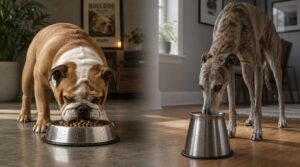
Your dog’s breed shape matters more than most people realize for bowl design. A flat-faced Bulldog and a long-nosed Greyhound have very different needs — and the wrong bowl makes mealtime more difficult than it should be.
Here’s how to match the right shape to your dog.
Flat-faced Dog Bowls
Flat-faced breeds like Pugs and French Bulldogs need a bowl that works with their muzzle shape — not against it. Eating becomes uncomfortable quickly when the bowl is too deep or narrow.
Look for these three features:
- Wide Mouth opening for easy access without nose-pressing
- Shallow Depth and a Tilted Angle to reduce head strain
- Anti-tip Base with Whisker Relief so meals stay calm and comfortable
Long-snouted Dog Bowls
Long-snouted breeds like Greyhounds need the opposite of what flat-faced dogs require. Their snout length calls for a deeper bowl — usually 2.5 to 4 inches — with a gentle interior curve and a slanted rear edge that keeps food centered.
Wide rim cleaning stays easy to clean, and stainless steel durability holds up well. Always match bowl depth to your dog’s actual measurements to ensure proper fit.
Floppy-eared Dog Bowls
Floppy ears — think Cocker Spaniels, Basset Hounds, Beagles — need a completely different setup. Narrow openings with ear-channel walls and a raised rim design prevent ears from dragging through food. Look for ear-guard rims that funnel ears outward naturally.
Need something portable? A portable travel ear bowl works well on trips.
Adjust sizing using your dog-bowl size chart — aim for roughly 4–6 inches in diameter for smaller floppy-eared breeds.
Giant Breed Bowl Needs
Giant breeds — Great Danes, Saint Bernards, Mastiffs — need bowls built for serious volume. Your large breed dog bowl size starts at 10+ cups capacity with a diameter of 10 inches or more.
- Adjustable elevation to align with shoulder height
- Eco-friendly materials with non-slip bases
- Capacity matching four times the largest single meal
Check your dog bowl size chart before buying.
Puppy Growth Adjustments
Puppies don’t stay small for long. As your dog moves through growth stages, their bowl needs change too — and so do their portions. Calorie scaling, stage-specific portions, and growth curve monitoring all signal when it’s time for an adult bowl switch.
Use a puppy bowl size guide to track feeding frequency shifts and adjust bowl size before cramped eating becomes a habit.
Size Food and Water Bowls Differently
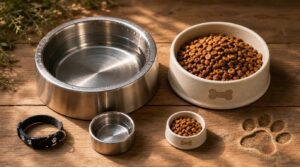
Most people grab one bowl type and fill it with whatever — food today, water tomorrow. But food and water bowls actually work better when they’re sized for their specific job.
Here’s what to look for based on your dog’s size and needs.
Small Dog Water Bowls
Small dogs don’t need a lake — just a reliable 1–2-cup bowl with a 4–6-inch diameter. Your dog bowl size chart includes both capacity and diameter for good reason: too much water invites mess; too little means constant refilling.
Here’s what makes a small dog water bowl work:
- Floating disk design limits splashing mid-drink
- Anti-slide rubber base keeps the bowl from skidding on tile
- Leak-proof cap for travel-friendly tote convenience on the go
- Ultra-quiet pour spout for calm, stress-free refills
- 32-oz minimum water bowl capacity for steady daily hydration
Medium Dog Water Bowls
Most medium dogs — those weighing 21–50 lbs — need a water bowl holding 64 oz (½ gallon). That’s your baseline for Capacity Calibration.
| Feature | Spec | Why It Matters |
|---|---|---|
| Water bowl capacity | 64 oz (8 cups) | Prevents constant refilling |
| Bowl diameter | 6–8 inches | Fits medium snouts comfortably |
| Dog bowl size in oz | 64–80 oz | Aids daily hydration |
| Adjustable Height Stand | 3–6 inches | Reduces neck strain |
| Antimicrobial Coating | Food-grade lining | Slows bacterial growth |
Look for medium dog bowl dimensions with an Integrated Drip Edge — it catches splashes before they hit your floor. A Travel-Friendly Design with a non-slip base manages errands easily.
Large Dog Water Bowls
Large breeds drink a lot — and a small bowl empties fast. For dogs over 50 lbs, aim for a water bowl holding 128–192 oz (1–1.5 gallons). Your large dog bowl size chart should prioritize Weighted Rim Design and Modular Base System for stability.
Look for Lidless Spill Guard features, Outdoor UV Resistance, and a wide bowl diameter — these make dog bowl capacity planning straightforward.
Hot Weather Hydration
Hot weather turns your dog’s hydration needs into a daily priority. Dog water intake can double when temperatures rise — and a warm bowl often means a dog that skips drinking.
- Shade Placement keeps water cooler longer than you’d expect
- Bowl Insulation slows heat transfer on sunny concrete
- Frequent Refills every few hours maintain water temperature
- Dehydration Signs — tacky gums, sluggishness — mean you should call your vet immediately
Slow Feeder Sizing
A slow feeder bowl works best when its bowl capacity actually matches your dog’s full meal — no overflow, no frustration. Use your dog bowl size chart, which includes capacity measurements, as your starting point.
Then consider ridge pattern depth and maze complexity: deeper ridges for large breeds, gentler ones for small dogs. These design elements directly impact feeding speed and engagement.
Material durability matters too — stainless steel outlasts plastic every time. Choose robust materials to withstand prolonged use and cleaning.
Pick Safe, Stable Bowl Materials
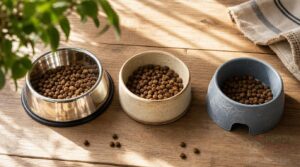
The bowl material matters more than most people think. A scratched plastic bowl or a cracked ceramic one can quietly harbor bacteria — and that’s the last thing you want near your dog’s food.
Here’s what to look for when choosing a bowl that’s both safe and built to last.
Stainless Steel Bowls
Stainless steel dog bowls are the top choice for good reason. They offer serious rust resistance, withstand dishwasher-safe cycles up to 70°C without warping, and won’t harbor bacteria like scratched plastic.
A brushed finish elegantly conceals everyday wear, while their heavy-duty and eco-friendly design ensures longevity—lasting 5–10 years.
Your dog bowl size chart should always start here.
Ceramic Bowl Weight
Ceramic dog bowls offer a different kind of reassurance — weight you can actually feel. A typical 6-inch bowl weighs 0.6 to 0.9 kg, and that heft delivers real stability benefits during mealtime.
Glaze influence is mostly cosmetic, but wall thickness drives the weight range significantly.
For dog bowl size and capacity, just check for cracks — bacteria hide there fast.
Plastic Bowl Risks
Plastic dog bowls look practical, but they hide real risks.
Scratches trap bacteria fast — and that’s where bacterial growth in bowls becomes a genuine health concern.
Chemical leaching and microplastic contamination occur as plastic degrades, especially with heat warping from dishwashers. BPA alternatives still fall short on regulatory compliance.
When a bowl looks worn, replace it.
Non-slip Bowl Bases
Even the right bowl can become a hazard if it slides across the floor mid-meal. A nonslip base fixes that fast. Look for these features when checking your dog bowl size chart — bowl diameter and stability go hand in hand.
- Rubber Grip rings — Replaceable rings and dishwasher-safe designs keep cleanup simple
- Suction Seal bases — best floor compatibility on tile or hardwood
- Weighted nonslip pet bowls — broad nonslip base resists tipping on smooth surfaces
Personalized and Slow Feeders
Want to slow down a speed-eater? Slow feeder bowls use maze customization to extend feeding duration by 2–3 times. Adjustable difficulty settings grow with your dog’s needs—a true adjustable feeding solution.
| Feature | Benefit | Best For |
|---|---|---|
| RFID Portioning | Accurate ±5g portions | Multi-pet homes |
| App‑Integrated Tracking | Logs meals via app | Monitoring intake |
| Adjustable Difficulty | Scales with training | All breeds |
Frequently Asked Questions (FAQs)
What words do dogs hear best?
Dogs hear short, sharp words best — "sit," "come," "treat."
Consistent tone and cue timing matter more than volume.
Pair each word with positive reinforcement every time, and your dog learns fast.
How often should I replace my dogs bowl?
Replace plastic bowls every 6–12 months; their lifespan shortens quickly once scratches appear.
Swap ceramic bowls every 1–2 years to adhere to their fracture schedule.
Stainless steel experiences minimal wear, but inspect regularly for damage and odor.
Does bowl color affect a dogs appetite?
Bowl color barely matters — yet it quietly shapes dog mealtime behavior.
Yellow bowls spark more interest; high contrast between bowl and food boosts visibility.
Stick with one color for consistent behavioural cue consistency.
Should travel bowls match my dogs home bowl?
Aim for the same capacity your dog uses at home. Matching meal sizes keeps portions consistent, ensuring familiarity during travel.
A familiar shape eases anxiety, helping your dog feel secure in new environments.
Prioritize lightweight stability and leak-resistant design for practicality on the road.
Can the wrong bowl size cause dental problems?
Oddly enough, yes.
A bowl that’s too deep or too narrow affects bite angle strain and chewing efficiency.
This can lead to plaque accumulation and uneven tooth wear — quietly stressing your dog’s jaw muscles daily.
Conclusion
Picture your dog settling into mealtime—no scrambling for kibble, no wet ears, no strained neck dipping toward the floor. That small shift starts with one practical decision. Knowing what size dog bowl your dog needs means choosing a bowl that fits their muzzle, holds their full portion, and sits at the right height.
Measure once, choose well, and every meal becomes something your dog can enjoy comfortably—without the mess or the guesswork.
- https://www.houndsy.com/blogs/modern-tails/what-size-dog-food-bowl-do-i-need-a-comprehensive-guide-for-pet-owners?srsltid=AfmBOor8TkzKEGUaTAVOdYgz_LP2B3WAe-xxuNiyrgv4M38YhOvQTtzo
- https://www.uahpet.com/blogs/post/dog-bowl-size-by-breed-a-comprehensive-guide-for-pet-owners?srsltid=AfmBOop_XTFSkjvgpSCBX-CJy4kC2Ocp8o06TZNjC5e2QKlR2jtt1VAn
- https://www.barneysranch.com/the-perfect-dog-food-bowl/
- https://www.dogsdogsdogs.co.uk/pages/stainless-steel-dog-bowl-size-guide
- https://bearwoodessentials.com/pages/dog-bowl-size-chart?srsltid=AfmBOoqQjuW6Tyc8b5RQwjsLqudZV099oiwxnIdgg67_M5lSILg1VGKW