This site is supported by our readers. We may earn a commission, at no cost to you, if you purchase through links.

Most people eyeball it. They grab a crate that looks about right, bring it home, and then watch their dog curl into a corner because there’s nowhere to stretch out—or pace anxiously because the space feels more like a warehouse than a den.
Getting the wrong size is more common than you’d think, and the consequences go beyond comfort. crate that’s too small strains your dog’s spine. One that’s too large can undermine house training entirely.
Knowing what size dog crate you need comes down to two things: a tape measure and a few minutes of your time.
Table Of Contents
- Key Takeaways
- How to Measure Your Dog for a Crate
- Choosing The Correct Dog Crate Size
- Special Crate Sizing Considerations
- Top 5 Dog Crates for Every Size
- Frequently Asked Questions (FAQs)
- How do I choose a dog crate?
- Do I need to measure my dog for a crate?
- What size dog crate do I Need?
- How do I find the right dog crate size?
- How big should my dog’s crate be?
- What size crate for a Coton de Tulear?
- What is the 2 1 rule for crate training?
- Can two dogs share the same crate?
- How often should a dog use its crate?
- What materials are best for outdoor crates?
- Conclusion
Key Takeaways
- Measure your dog’s length (nose to tail base) and height (floor to top of head), then add 3–4 inches to each number to find the right crate size.
- A crate that’s too small strains your dog’s spine, while one that’s too large can cause anxiety and derail house training.
- For puppies, buy for the adult size upfront and use a removable divider to shrink the space while they’re still growing.
- Don’t forget to account for bedding thickness, since a bulky pad can reduce usable interior height and throw off your sizing.
How to Measure Your Dog for a Crate
Getting your dog’s measurements right is the first step to picking a crate that actually works. You only need a soft measuring tape and a couple of minutes.
Once you have those numbers, matching them to the right fit is straightforward with a guide like dog crates for senior dogs, which walks you through exactly what to look for.
Here’s exactly how to do it.
Measuring Length and Height Accurately

Grab a soft tape measure and a helper with treats. For length, stand your dog on all four paws and measure a straight line from nose tip to tail base — no curving around the body.
For height, measure vertically from floor to top of the head. Use wall alignment to keep them steady, and avoid compressing the fur when pulling the tape snug.
Accurate standing height measurement ensures a proper fit for crates.
Tips for Measuring Puppies Vs. Adult Dogs

Puppies rarely cooperate. That’s where treat-assisted measurements come in — have someone hold a treat at nose level while you measure. Puppy stance tips matter here: they need to stand fully upright, not sit or crouch.
For adult posture checks, it’s much simpler — most dogs hold still long enough.
Key differences to keep in mind:
- Remeasure puppies every 2–3 weeks
- Factor in growth rate estimation by breed
- Use your Dog Crate Size Guide alongside vet weight projections
- Account for seasonal size adjustments if weight fluctuates
- Match Dog Weight and Breed to expected adult Crate Size for Crate Training success
Check the dog crate size guide for detailed measurement tips.
Recording and Using Your Dog’s Measurements

Once you have those numbers, write them down — both in inches and centimeters. Unit Conversion Tips matter more than you’d think, since crate brands use different systems.
A simple Measurement Log Template works fine: date, nose-to-tail length, floor-to-head height, plus your 2–4 inch buffer. Digital Tracking Apps like Google Keep or Notes let you do Growth Chart Updates monthly, keeping your Dog Crate Sizing Guide choices accurate as your dog changes.
Choosing The Correct Dog Crate Size

Getting the size right comes down to few key factors — dog’s weight, their measurements, and how much they’ll grow.
Once you understand those, picking a crate gets a lot easier.
Here’s what you need to know to make the right call.
Why Crate Size Matters for Comfort and Safety
Crate size isn’t just about fit — it directly affects your dog’s health and wellness.
For tips on finding the ideal crate size to support your dog’s comfort and safety, check out this guide to choosing the right crate for your Cavapoo.
A too-small crate forces hunching, which strains the spine and causes joint health issues over time. Go too large, and anxiety reduction goes out the window — dogs feel exposed, not cozy.
A crate too small hunches your dog’s spine; too large, and comfort gives way to anxiety
The right size provides mobility freedom, injury prevention, temperature control, and genuine canine comfort.
Common Crate Size Categories by Dog Weight
Weight‑based sizing takes the guesswork out of choosing the right dog crate.
XS crate limits cap at about 10 pounds — think Chihuahuas and Yorkies. Small crates handle 11–25 pounds, medium breed fits covers 26–40 pounds for dogs like Beagles, and large dog capacity reaches 70 pounds for Labs and Boxers.
For travel crate dimensions, these same crate dimensions apply.
Crate Sizing Mistakes to Avoid
Even small crate sizing mistakes can make your dog miserable. Here are four to watch for:
- Underestimating height — measure to the ears, not the shoulders, or your dog will hunch
- Excess floor space — too much room encourages bathroom accidents
- Improper divider use — skipping it leaves puppies with adult-sized crate dimensions
- Ignoring bedding bulk — thick pads reduce interior height, affecting dog weight capacity and breed fit
Adjusting Crate Size as Your Dog Grows
As your puppy grows, your crate strategy needs to grow with it.
Buy for the adult size upfront — use a removable divider for growth divider adjustment, blocking off space while your pup is small.
Check the crate sizing chart regularly for seasonal size reassessment.
Adult size forecasting based on breed and expected dog weight keeps crate dimensions right without buying multiple crates.
Special Crate Sizing Considerations

Getting the right crate size isn’t always a one-size-fits-all situation.
A few extra factors — like your dog’s breed, travel plans, or a bed you want to toss inside — can shift your sizing decision pretty quickly.
Here’s what to keep in mind before you buy.
Breed-Specific Crate Size Requirements
Every breed has different space needs — and breed-specific crate sizing takes the guesswork out of crate selection.
- Small companion crates (18–22″) fit toy breed dimensions like Chihuahuas and Yorkies under 12 lbs
- Medium breeds like Beagles need 30″ crates
- Large sporting sizes (42″) suit Labs and Goldens
- Working breed needs push toward 42–48″ for Shepherds
- Mixed breed adjustments rely on measured weight and body length
Crate Sizing for Travel and Airline Rules
Flying with your dog means playing by strict rules. Airlines follow IATA measurements — nose to tail, elbow height, shoulder width, standing height — to set minimum crate dimensions.
Cabin limits cap carriers at around 18×11×11 inches and 20 lbs combined. Cargo crate specs vary by aircraft size. Airline weight caps and travel bedding clearance matter too, so always confirm pet travel requirements and exact crate dimensions directly with your airline before booking.
Using Dividers for Growing Puppies
A divider turns one full-size crate into the perfect puppy crate — no extra purchase needed. Correct divider placement blocks off unused space so your dog can’t toilet at one end and sleep at the other, keeping your training routine consistent.
- Crate Size: Allow enough room to stand, turn, and lie flat
- Adjusting Size: Move the divider back every few weeks as dog weight increases
- Safety Edges: Check for bent wires or sharp clips before each use
- Airflow Management: Never let the panel block ventilation openings
- Crate Selection Tips: Choose wire crates with included dividers for long-term use
Factoring in Bedding and Accessories
Once you’ve sorted the divider, think about what’s going in the crate. Bedding fit matters more than most people realize — a bulky dog bed eats into your crate dimensions fast.
flat crate mat or memory foam pad sized to the floor.
Add clip-on water bowls to avoid soggy bedding, swap in puzzle toy rotation to keep things fresh, and use a crate cover to help your dog settle.
Top 5 Dog Crates for Every Size
Now that you know size your dog needs, the next step is finding a crate that actually delivers on comfort, safety, and convenience.
There are a lot of options out there, so we’ve narrowed it down to five solid picks that cover every size range. Here’s a closer look at each one.
1. MidWest iCrate Double Door Dog Crate
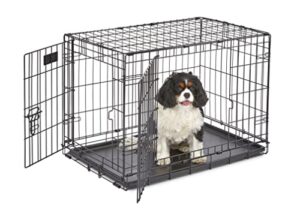
The MidWest iCrate Double Door is a solid everyday pick for medium-breed owners.
At 30.5 x 19.25 x 21.5 inches, it comfortably fits dogs between 21 and 40 pounds — think French Bulldogs or Dachshunds.
Two doors mean flexible placement, and the fold-flat design makes storage genuinely painless.
It comes with a divider panel, so you can size it down for a puppy and open it up as they grow.
Cleanup is easy too, thanks to the slide-out leak-proof tray.
| Best For | Medium-breed dog owners (21–40 lbs) who want a reliable crate for training, travel, or everyday use. |
|---|---|
| Material | Metal |
| Dimensions | 30.5 x 19.25 x 21.5 in |
| Weight | 17 lbs |
| Dog Size Fit | Medium (21-40 lbs) |
| Easy Cleaning | Leak-proof tray |
| Door Access | Double door |
| Additional Features |
|
- Two doors give you flexible placement options depending on your space
- Folds flat quickly and the divider grows with your pup from puppy to adult
- Slide-out leak-proof tray makes cleanups fast and hassle-free
- At 17 lbs, it’s a bit bulky if you’re moving it around often
- Not the best fit for escape-prone or high-anxiety dogs
- Sizing can be tricky — worth double-checking the size chart before buying
2. Petsfit Collapsible Dog Travel Crate
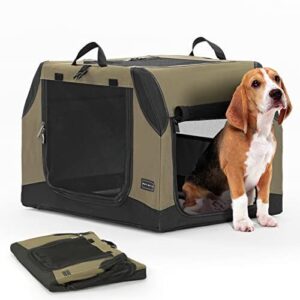
If you need something built for the road, the Petsfit Collapsible Dog Travel Crate is worth a look. It measures 29.92 x 19.88 x 18.9 inches and suits small to medium dogs up to about 30 pounds.
Three mesh doors keep airflow steady, and the waterproof bottom makes cleanup after muddy adventures simple.
It folds flat for easy storage between trips.
Just note it’s not ideal for escape artists or high‑energy dogs who push limits.
| Best For | Small to medium dogs (up to ~30 lbs) who travel often and do best with a cozy, enclosed space. |
|---|---|
| Material | Oxford Cloth & Alloy Steel |
| Dimensions | 29.92 x 19.88 x 18.9 in |
| Weight | 7.05 lbs |
| Dog Size Fit | Small to Medium |
| Easy Cleaning | Waterproof bottom |
| Door Access | Three mesh doors |
| Additional Features |
|
- Folds flat and packs away easily, so it won’t eat up your trunk space
- Three mesh doors keep air moving and let your pup see what’s going on
- Waterproof bottom makes post-adventure cleanup a breeze
- Not a good fit for escape-prone or high-energy dogs
- Can tip over in the car if it’s not strapped down or wedged in
- Sizing can be hit or miss—worth double-checking before your order ships
3. Petmate Vari Dog Kennel Medium Carrier
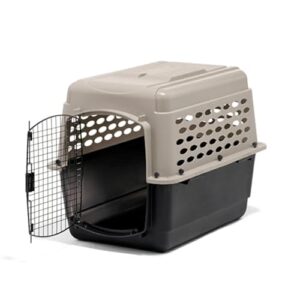
For dogs who travel more than just occasionally, the Petmate Vari Dog Kennel is a step up in durability. It’s built from recycled hard plastic with a metal wire door, so it manages bumps and pressure far better than soft-sided options.
At 32 × 22.5 × 24 inches, it fits medium dogs between 30 and 50 pounds comfortably. It also meets most airline cargo requirements, making it a solid pick for flights.
The interior moat keeps accidents contained, and cleanup takes minutes.
| Best For | Medium dog owners who fly with their pets and want a sturdy, airline-approved kennel that’s easy to clean. |
|---|---|
| Material | Plastic |
| Dimensions | 32 x 22.5 x 24 in |
| Weight | 12.5 lbs |
| Dog Size Fit | Medium (30-50 lbs) |
| Easy Cleaning | Stay-dry moat |
| Door Access | Single wire door |
| Additional Features |
|
- Meets most airline cargo specs, so you’re not scrambling at the gate
- The interior moat keeps messes contained and cleanup is quick
- Hard plastic shell holds up to bumps and pressure better than soft-sided crates
- On the heavier side at 12.5 lbs — awkward to lug through a busy airport
- Some owners find the plastic thinner than expected for the price
- Not the best fit if your dog likes to stretch out or is on the larger end of 50 lbs
4. Casual Home Wooden Dog Crate End Table
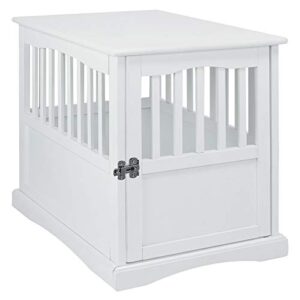
If your living room doubles as your dog’s bedroom, the Casual Home Wooden Dog Crate End Table is worth a serious look.
It’s built from 100% solid pine with a white finish that actually blends into your furniture — not an eyesore in the corner.
The interior measures 24.5 inches long in the smaller version, making it suitable for dogs up to 25 pounds.
It includes a lockable door and wipes clean easily.
Style and function without sacrificing either.
| Best For | Small dog owners who want a crate that looks like real furniture and doesn’t ruin the vibe of a well-decorated room. |
|---|---|
| Material | Wood |
| Dimensions | 27.5 x 20 x 24 in |
| Weight | Not specified |
| Dog Size Fit | Small to Medium |
| Easy Cleaning | Wipe-clean surface |
| Door Access | Lockable gate door |
| Additional Features |
|
- Solid pine with a clean white finish that blends in like a piece of actual furniture
- Doubles as an end table or nightstand, so it earns its floor space
- Lockable door and easy-to-clean surface make daily use a breeze
- Not a great fit for dogs over 25 pounds or pets that like to push their luck with doors
- Assembly needs careful attention — small parts can go missing fast
- Dogs prone to crate anxiety won’t be any happier just because it looks nice
5. MIM Safe Crash Tested Dog Crate
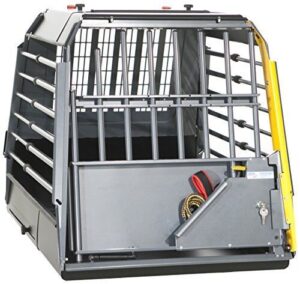
If your dog travels in the car regularly, this one’s worth every penny.
The MIM Safe Variocage is crash tested for front, rear, and rollover collisions — not just marketed as "safe." It’s built from powder-coated carbon steel with a built-in crumple zone, telescopic tubes for adjustable length (29.92 to 40.55 inches), and an emergency escape hatch if the main door gets blocked.
It comes in 18 sizes. Assembly takes effort, but the protection it offers on the road is genuinely hard to match.
| Best For | Dog owners who drive regularly and want serious, crash-tested protection for their pet — not just a basic crate. |
|---|---|
| Material | Carbon Steel |
| Dimensions | 40.55 x 21.85 x 25.59 in |
| Weight | 46.3 lbs |
| Dog Size Fit | All sizes (18 options) |
| Easy Cleaning | Not specified |
| Door Access | Locking doors |
| Additional Features |
|
- Crash tested for front, rear, and rollover collisions, so the safety claim actually holds up
- Adjustable length and 18 size options mean it fits a wide range of vehicles and breeds
- Emergency escape hatch is a smart detail that could matter in a real accident
- Assembly is a hassle and may need extra tools or a second set of hands
- Some owners report rattling and noise on the road, which can get annoying fast
- It’s pricier than most dog crates, so the upfront cost is a real consideration
Frequently Asked Questions (FAQs)
How do I choose a dog crate?
Picture your dog curled up somewhere that feels just right — not too roomy, not too tight. Choose a crate where your dog can stand, turn around, and lie flat comfortably.
Do I need to measure my dog for a crate?
Yes, you do. Weight alone won’t cut it — two dogs can weigh the same but have completely different body shapes.
Measuring length and height takes two minutes and saves you from buying the wrong crate.
What size dog crate do I Need?
Think of it like buying shoes — size is everything.
Most dogs need a crate that matches their weight and measurements.
A 30-pound dog, for example, fits comfortably in a 30 x 20 x 23-inch crate.
How do I find the right dog crate size?
Measure your dog’s length and height, add 3 to 4 inches to each, then match those numbers to a standard crate size. That’s really all there is to it.
How big should my dog’s crate be?
Your dog’s crate should be big enough to stand up, turn around, and lie down flat — but not so roomy it feels like an empty warehouse. Snug, not squished.
What size crate for a Coton de Tulear?
Most adult Coton de Tulears fit comfortably in a small 24-inch crate.
It gives them enough room to stand, turn, and stretch out without feeling lost in too much empty space.
What is the 2 1 rule for crate training?
The 2:1 rule means your dog spends roughly two hours resting in the crate for every one hour of active, supervised time outside it — building a calm, predictable daily routine.
Can two dogs share the same crate?
Technically, yes — but should they? Most trainers say no. Shared crates create stress, limit personal space, and can spark fights. Each dog deserves its own den.
How often should a dog use its crate?
Most dogs do well with 4 to 6 hours of crate time daily. Puppies need shorter stretches — sometimes just 30 minutes. Seniors top out around 3 to 4 hours. Always factor in age.
What materials are best for outdoor crates?
Galvanized steel and aluminum hold up best outside. Steel resists chewing and rust for years. Aluminum stays lighter and corrosion-free, even near the coast. Both beat plastic in long-term durability.
Conclusion
A crate that fits just right is invisible to your dog—they simply walk in, circle once, and settle. A crate that doesn’t fit is something they never stop noticing.
Now you know exactly what size dog crate you need, and more importantly, why each measurement matters. Two numbers—length and height—make the difference between a space your dog avoids and one they actually choose. That’s worth the five minutes it takes to measure correctly.
- https://www.boulderbarks.com/blogs/dog-blog/how-to-choose-the-right-size-dog-crate-for-your-dog
- https://www.petsmart.com/learning-center/dog-care/dog-crate-size-chart-finding-the-perfect-fit
- https://www.travelwithcats.net/iata-cat-travel-crates-for-cargo-long-haul-sizes-setup-top-picks-2025/
- https://www.petmd.com/dog/general-health/crate-sizing-for-dogs
- https://www.petcratesdirect.com/pages/dog-crate-sizes