This site is supported by our readers. We may earn a commission, at no cost to you, if you purchase through links.
When a major dog food recall swept through stores in 2007, affecting more than 150 brands and sickening thousands of pets, federal regulators quickly learned that the existing patchwork of oversight wasn’t enough to protect the 65 million households relying on commercial dog food.
Today, dog food safety regulations form a thorough framework administered primarily by the FDA’s Center for Veterinary Medicine, working alongside state departments of agriculture to enforce manufacturing standards, ingredient approvals, and labeling requirements that didn’t exist two decades ago.
Understanding how these agencies collaborate—and what specific protections they’ve established for your dog’s food—gives you the knowledge to navigate recalls confidently, interpret labels accurately, and recognize when a manufacturer is cutting corners on safety protocols that directly affect your pet’s health.
Table Of Contents
Key Takeaways
- The 2007 dog food recall affecting over 150 brands exposed critical gaps in oversight, prompting the FDA’s Center for Veterinary Medicine and state agriculture departments to establish comprehensive safety protocols including ingredient approvals, manufacturing standards, and mandatory preventive controls under the Food Safety Modernization Act.
- Federal regulations require every ingredient to serve a legitimate nutritional purpose while prohibiting toxic substances, with manufacturers obligated to follow Good Manufacturing Practices, conduct hazard analysis at each production step, and maintain detailed traceability documentation from supplier origin through finished product distribution.
- Dog food labels function as legally mandated transparency tools that must display mandatory elements including product name, net quantity, manufacturer contact information, ingredient lists in descending weight order, and guaranteed analysis showing minimum protein and fat percentages alongside maximum fiber and moisture limits.
- The regulatory framework depends on active FDA facility inspections, escalating enforcement actions from warnings to product seizures, structured recall procedures requiring swift manufacturer notification, and informed consumer practices including proper food storage, hand hygiene, and toxic substance prevention to protect companion animal health.
Overview of Dog Food Safety Regulations
When you choose dog food for your pet, you’re trusting that what’s inside the bag won’t harm them—and a complex regulatory system works behind the scenes to make that trust worthwhile.
From sourcing ingredients to final packaging, manufacturers follow strict dog food manufacturing standards designed to keep harmful contaminants out of your pet’s bowl.
Federal and state agencies collaborate to set standards that keep commercial dog food safe, properly labeled, and nutritionally sound, protecting both your dog and your peace of mind.
Understanding how these regulations came to be, which agencies enforce them, and why they matter can help you make informed decisions about what goes into your dog’s bowl.
Purpose and Importance of Regulations
The regulatory framework governing your dog’s food isn’t just bureaucratic red tape—it’s a thorough safety net built on public health priorities, consumer trust, and animal welfare principles. When you understand why these regulations exist, you’ll see how FDA oversight and ethical standards work together to protect what matters most.
Dog food regulations aren’t bureaucratic red tape—they’re a safety net built on public health priorities and animal welfare principles
The regulations exist to:
- Safeguarding pet health through rigorous ingredient testing and contamination prevention
- Enabling informed choices via truthful labeling and guaranteed nutrient disclosures
- Ensuring fair market competition by standardizing manufacturing and traceability requirements
- Protecting dogs from harmful substances through enforceable nutritional adequacy standards
- Supporting rapid emergency response when food safety incidents threaten your companion’s well-being
Understanding the impact of regulations on society helps explain why such detailed rules exist for pet food safety. These pet food safety measures create the foundation for every meal you serve.
Key Agencies Involved in Oversight
The Food and Drug Administration (FDA) leads federal oversight through its Center for Veterinary Medicine, enforcing Food Safety Regulations under the FD&C Act and FSMA.
State departments of agriculture handle facility licensing and inspection within their borders, ensuring Regulatory Compliance with aligned standards.
Industry Standards emerge from trade associations like AAFCO, which develops model regulations.
Agency Collaboration between federal and state authorities coordinates recalls, inspections, and enforcement actions that protect your dog’s food supply.
The structure of oversight is built upon clear government accountability measures that support public safety and regulatory transparency.
Historical Development of Dog Food Laws
Commercial dog food didn’t appear overnight—canned products emerged in 1922, with dry formulas arriving shortly after in 100-pound bags.
Today’s dry formulas need proper storage after opening to maintain the nutritional quality those early manufacturers worked hard to develop.
The AAFCO’s formation in the early 20th century laid the groundwork for ingredient standardization and labeling rules that states could adopt uniformly. The FDCA established federal authority over pet food safety, while ongoing reforms have sharpened preventive controls, nutrient profiles, and enforcement protocols you rely on today.
Federal Oversight of Dog Food Safety
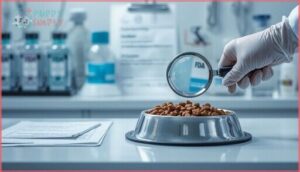
When you’re standing in the pet food aisle trying to pick the best option for your dog, you mightn’t think about the federal agencies working behind the scenes to keep those products safe.
The U.S. Food and Drug Administration (FDA) acts as the primary watchdog over dog food manufacturing, safety, and labeling, wielding authority granted through several key pieces of legislation that have evolved over decades. Understanding how the FDA operates and which laws empower its oversight will help you make more informed decisions about what you’re feeding your four-legged family member.
FDA’s Role and Authority
You mightn’t realize it, but the FDA wields substantial regulatory oversight over your dog’s food through its Center for Veterinary Medicine, enforcing safety standards and compliance monitoring under broad federal authority.
The agency’s enforcement powers include facility inspections, label approval, product recalls, and legal actions against manufacturers who violate pet food safety regulations or produce misbranded products.
The Federal Food, Drug, and Cosmetic Act (FD&C Act)
Since 1938, the Federal Food Act has served as your primary safeguard against unsafe or misbranded dog food, establishing foundational regulatory standards that require products to be manufactured under sanitary conditions, contain no harmful substances, and display truthful labeling.
This regulatory framework authorizes FDA oversight through facility inspections, compliance enforcement actions, mandatory recalls, and legal penalties when manufacturers violate established safety standards and consumer protection requirements.
Food Safety Modernization Act (FSMA) Impact
In 2011, the Food Safety Modernization Act transformed pet food safety from a reactive recall system into a proactive hazard prevention framework, fundamentally shifting regulatory compliance expectations for manufacturers handling animal foods across domestic and imported supply chains.
This FDA enforcement strategy requires you to understand four critical FSMA provisions affecting dog food safety:
- Preventive Controls Implementation – Facilities must conduct thorough hazard analysis identifying biological, chemical, and physical risks, then establish science-based controls at critical production points to reduce contamination before distribution occurs.
- Mandatory Recall Authority – When hazards are identified in pet food products, the FDA can issue mandatory recalls rather than waiting for voluntary manufacturer action, accelerating consumer protection responses.
- Enhanced Import Oversight – Foreign facilities exporting dog food to U.S. markets must demonstrate compliance with American food safety standards through verification programs and strengthened traceability documentation.
- Record-Keeping Requirements – Manufacturers maintain detailed documentation tracking ingredients from supplier origin through finished product distribution, ensuring supply chain safety and regulatory transparency throughout production cycles.
Ingredient Standards and Manufacturing Practices
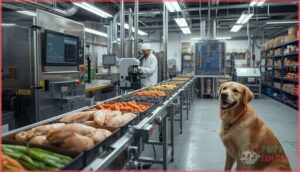
When you’re choosing food for your dog, the ingredients inside that bag or can must meet strict federal standards that govern both what manufacturers can include and how they must produce it.
The FDA requires that every ingredient provides a legitimate nutritional or functional purpose, while manufacturers must follow thorough protocols to prevent contamination and guarantee consistent quality throughout production. Understanding these ingredient standards and manufacturing practices gives you the foundation to make informed decisions about what you’re feeding your companion.
Approved and Prohibited Ingredients
You need to know which ingredients the FDA and AAFCO allow in your dog’s bowl—and which substances are strictly off-limits. Understanding approved food additives, toxic substances, and nutrient standards isn’t just regulatory compliance, it’s about pet food safety you can trust.
| Category | Approved Examples | Prohibited Examples |
|---|---|---|
| Preservatives | Potassium sorbate, mixed tocopherols | Formaldehyde-releasing agents |
| Colorants | Caramel color (within limits) | Unapproved synthetic dyes |
| Sweeteners | Generally avoided | Xylitol (severe toxicity) |
| Contaminants | Trace minerals (controlled) | Lead, arsenic above thresholds |
Only ingredients listed as Generally Recognized As Safe or approved for dog foods may be used, ensuring ingredient safety through rigorous evaluation. Each approved additive must appear on nutrition and labeling declarations with exact functional class and concentration when required, protecting your pet from harmful exposure while meeting defined nutritional profiles.
Good Manufacturing Practices (GMPs)
Manufacturing regulations under GMPs establish the backbone of food safety for every kibble your dog eats, enforced by the FDA through systematic sanitation protocols, process validation, and facility design standards.
You’ll find quality metrics embedded in supply chain management to track:
- Documented batch records with timestamps for full traceability
- Environmental monitoring programs testing surfaces and air for microbial contamination
- Equipment qualification through installation, operational, and performance verification
- Personnel training and hygiene practices including gowning and restricted production access
Hazard Analysis and Preventive Controls
You’re required to identify biological hazards, chemical hazards, and physical hazards at every production step under FSMA’s Hazard Analysis framework, documenting severity and likelihood to prioritize Risk Assessment and Preventive Measures.
Control Verification through monitoring procedures, critical limits, and corrective actions ensures Safety Protocols function as intended, while FDA oversight mandates written preventive controls, supplier verification programs, and recall plans integrated into your thorough Food Safety system with complete Hazard Mapping across the manufacturing chain.
Dog Food Labeling Requirements
When you pick up a dog food bag, the label isn’t just marketing—it’s a legally mandated roadmap that tells you exactly what’s inside and whether the product meets federal safety standards. Every element, from the product name to the ingredient list, must comply with strict FDA regulations designed to prevent misbranding and guarantee you’re making informed decisions about your dog’s nutrition.
Understanding these labeling requirements gives you the transparency you need to compare products, spot red flags, and choose food that truly backs your pet’s health.
Mandatory Label Elements
You’ll find that every dog food package carries a set of mandatory label elements designed to protect pet food safety and guarantee consumer information transparency. Federal labeling requirements establish strict packaging requirements that manufacturers must follow, transforming nutrition labels into powerful tools for product identification and informed decision-making.
- Product name displayed prominently on the principal display panel, adhering to percentage-based naming conventions
- Net quantity statement presented in both metric and US customary units for accurate measurement
- Manufacturer or distributor contact information, including the responsible party’s name and physical address for traceability
- Nutritional adequacy statement or feeding directions that communicate the product’s intended life stage and nutritional purpose
Ingredient Listing and Guaranteed Analysis
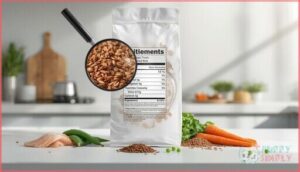
Beyond identifying the package basics, you’ll encounter two critical disclosure mechanisms that enforce ingredient transparency and nutrient disclosure: the ingredient list and guaranteed analysis. The ingredient list presents all components in descending order by pre-processing weight, establishing label compliance through complete disclosure of what’s actually in the formula, while the guaranteed analysis provides minimum protein and fat percentages alongside maximum fiber and moisture limits.
| Nutrient Parameter | Guarantee Type |
|---|---|
| Crude Protein | Minimum percentage |
| Crude Fat | Minimum percentage |
| Crude Fiber | Maximum percentage |
| Moisture Content | Maximum percentage |
| Optional Nutrients (Ca, P) | Variable disclosure |
These nutrition labels don’t tell you everything about ingredient quality or bioavailability, but they establish baseline food safety standards and help you compare products on nutrient requirements.
Truthful Claims and Misbranding Prevention
While nutrient percentages and ingredient lists define what’s in the bag, regulations governing label claims determine what manufacturers can say about it—and what happens when they don’t tell the truth.
Claim substantiation requirements under FDA regulations demand that every marketing statement, from “promotes joint health” to “veterinarian recommended,” be backed by reproducible evidence, with misbranding penalties including warning letters, mandatory recalls, and civil enforcement actions that protect pet food safety through rigorous advertising standards and label compliance verification.
Compliance, Recalls, and Consumer Protection

Even with rigorous standards in place, the regulatory system depends on active oversight, swift corrective action when problems arise, and informed practices at home to protect your dog’s health.
The FDA conducts facility inspections to verify compliance with manufacturing requirements, initiates enforcement actions against violators, and oversees a structured recall process that requires manufacturers to promptly notify the public when contaminated or mislabeled products reach the market. Understanding how these enforcement mechanisms work—and knowing how to safely handle dog food in your own kitchen—enables you to make decisions that safeguard your pet while holding manufacturers accountable.
Inspection and Enforcement Actions
When FDA inspectors show up at a dog food facility, they’re not just checking boxes—they’re following rigorous inspection protocols to verify regulatory compliance with food safety regulations. You should know that enforcement actions escalate based on severity.
- Verbal or written warnings prompt immediate corrections for minor infractions discovered during safety audits
- Administrative penalties deter repeated violations through structured penalty structures
- Product seizures and legal action address willful noncompliance that threatens animal health
These enforcement tools protect your dog’s bowl.
Recall Procedures and Reporting
When a contamination or safety hazard triggers a recall, manufacturers must follow strict notification protocols under FSMA and FDA oversight.
You’ll see companies halt distribution, document corrective actions through detailed hazard analysis, and communicate transparently with regulators and consumers. Recall effectiveness depends on swift reporting, thorough food safety documentation, and coordinated removal of affected products—procedures designed to protect your dog before harm occurs.
Safe Handling Tips for Pet Owners
Even with rigorous food safety regulations and safe handling practices in place, your responsibility for preventing pet foodborne illness extends beyond purchasing compliant products—proper food storage safety, pet hygiene tips, and toxic substance prevention at home complete the protective framework.
- Wash your hands with soap and water for 20 seconds before and after handling dog food to prevent transfer of harmful bacteria between you and your pet.
- Store dog food in a sealed container in a cool, dry place and discard opened packages within 4 to 7 days, following package guidelines to maintain freshness and reduce contamination risks.
- Remove toxic foods such as chocolate, grapes, and onions from reachable areas and secure cabinets where pet snacks or cleaning agents are stored to prevent accidental ingestion.
- Establish emergency preparedness protocols including your veterinarian’s contact information, poison control numbers, and a clearly marked first aid kit to respond swiftly if contamination or illness occurs.
Frequently Asked Questions (FAQs)
What are the FDA regulations for dog food?
You’ll find the FDA oversees pet food through the Federal Food and Cosmetic Act and FSMA, requiring safe ingredients, truthful labeling, good manufacturing practices, and preventive controls to protect your dog’s health.
Are homemade dog foods legally regulated?
You’d think whipping up your pup’s dinner would be as simple as scrambling eggs, but homemade dog foods sold commercially face FDA oversight for safety and labeling—while your personal kitchen creations remain unregulated.
How do organic dog food certifications work?
You’ll find organic dog food certification requires third-party verification of ingredient sourcing, production practices, and label claims, ensuring at least 95 percent organic content meets USDA standards through annual inspections and compliance documentation.
What regulations govern dog food imported internationally?
Your imported dog food faces more scrutiny at the border than most human foods—ironic, considering we won’t eat it ourselves.
The FDA, customs clearance, foreign suppliers, border inspections, and trade agreements determine what crosses into the pet food industry.
Can veterinary prescription diets bypass standard regulations?
No, veterinary prescription diets don’t bypass standard Pet Food Regulations—FDA still enforces the FD and C Act, requiring truthful labeling and AAFCO nutrient standards, though enforcement discretion sometimes allows therapeutic claims within Compliance Risks boundaries.
How are online dog food sellers monitored?
Like watchdogs guarding a henhouse, the FDA, State Enforcement agencies, and FTC Advertising monitors oversee online sellers through Platform Policies, Import Controls, and Traceability Systems.
Ensuring Pet Food Regulations, Food Safety Standards and Compliance, and Consumer Protection and Awareness.
Conclusion
The framework protecting what fills your dog’s bowl has evolved considerably since regulators confronted widespread contamination, though no system eliminates every risk entirely.
Your vigilance—reading labels, monitoring FDA alerts, and choosing manufacturers with transparent safety records—complements the dog food safety regulations enforcing ingredient standards, manufacturing controls, and recall protocols.
When agencies and informed pet owners work together, you create the strongest defense against the quality lapses that compromise your companion’s health and longevity.