
This site is supported by our readers. We may earn a commission, at no cost to you, if you purchase through links.

Your dog sits on command for the first time, and you fumble to praise them—but the moment’s already gone, and they’re sniffing the floor again. That split-second disconnect happens to every new trainer, and it’s exactly why clicker training transforms how dogs learn.
The click captures the precise instant your dog does something right, creating a crystal-clear bridge between behavior and reward that verbal praise can’t match. Dog training clickers for beginners eliminate guesswork, turning fuzzy communication into a language your dog understands immediately.
You don’t need perfect timing or years of experience to start seeing results—just a small device that clicks, some treats, and the willingness to practice consistently.
Table Of Contents
- Key Takeaways
- What is Clicker Training for Dogs?
- Key Features of Beginner-Friendly Clickers
- Top 10 Dog Training Clickers for Beginners
- 1. HoAoOo Pet Training Clicker
- 2. PetSafe Training Clicker Tool
- 3. Dog Training Clicker with Wrist Strap
- 4. TreatPod Leash Treat Holder and Clicker
- 5. Crmada Box Training Clicker
- 6. Brightkins Dog Training Clicker
- 7. Dog Training Clicker Kit
- 8. Diyife Dog Training Clicker
- 9. Left And Right Dog Training Kit
- 10. Szo Dog Training Treat Pouch
- How to Start Clicker Training Your Dog
- Common Beginner Mistakes to Avoid
- Tips for Successful Clicker Training Sessions
- Frequently Asked Questions (FAQs)
- Conclusion
Key Takeaways
- Clicker training works by marking the exact moment your dog performs a desired behavior with a distinct click sound, creating a clear bridge between action and reward that verbal praise can’t match—most dogs show reliable responses within 2 to 4 weeks of daily practice.
- Beginner-friendly clickers should produce a crisp, consistent sound (1.2–2.0 kHz with less than 3 dB variance), fit comfortably in your hand without causing fatigue, and include features like wrist straps or clips for easy access during training sessions.
- The most common mistakes beginners make include clicking too late (timing must align within one second of the correct action), inconsistent rewarding patterns that confuse your dog about which behaviors matter, and overusing the clicker during everyday moments, which weakens its training value.
- Success comes from charging the clicker first by pairing the sound with treats 10 to 20 times, starting in quiet environments with high-value rewards delivered within 0.5 seconds of each click, then gradually increasing difficulty by adding distance, duration, or mild distractions one element at a time.
What is Clicker Training for Dogs?
Clicker training is a positive reinforcement method that uses a small handheld device to mark the exact moment your dog does something right. The click sound acts as a bridge between the behavior and the reward, helping your dog understand precisely what earned the treat.
Before you choose your first clicker, you need to understand how this training method works, why it’s so effective, and what makes it perfect for beginners like you.
You’ll also want to create a calm environment when introducing your puppy to new training tools, so check out these stress-free puppy introduction techniques to set the right foundation.
How Clicker Training Works
Clicker training works by marking the exact moment your dog performs a desired behavior with a distinct click, then immediately following that sound with a reward. This process, rooted in operant conditioning and reinforcement theory, creates a clear communication bridge between you and your dog.
Through repeated training phases, your dog learns that the click predicts something good, making behavior marking precise and effective. For an overview of the positive reinforcement techniques that underpin clicker training, visit this resource.
Positive Reinforcement Principles
At the heart of this method lies positive reinforcement, a learning theory principle where you increase desired behaviors by offering something your dog values immediately after the action occurs. The clicker marks the exact moment your dog gets it right, and the reward that follows—whether treats, praise, or play—strengthens that behavior through operant conditioning.
Timing your reward within one to two seconds ensures your dog connects the click with the correct action, making behavior shaping clear and effective across different reinforcement schedules.
For a deeper understanding of how rewards can boost learning, explore the core principles behind operant conditioning in psychology.
Benefits for Beginners
This approach cuts the learning curve because you deliver precision without needing expert timing right away. Beginners often struggle with vocal praise—too vague, too late—but clicker technique offers instant clarity your dog can understand.
Clickers cut the learning curve by delivering instant precision that beginners can’t achieve with vague, mistimed vocal praise
- Clicker Basics require minimal skill, so you can focus on reading your dog’s signals instead of worrying about complex commands.
- Training Outcomes improve faster when each click consistently marks the exact behavior you want to reward.
- Reward Systems become predictable, building trust and motivation session after session.
Key Features of Beginner-Friendly Clickers
Not all clickers are created equal, and when you’re just starting out, the right features can make or break your training experience. You’ll want to look for a clicker that’s comfortable to hold, produces a clear sound, and fits seamlessly into your training routine.
Let’s break down the three essential features that separate beginner-friendly clickers from the rest.
Sound Clarity and Consistency
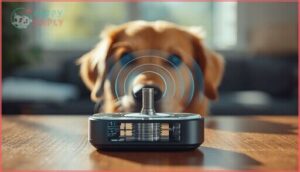
A reliable clicker speaks the same language every time you press it. For clicker training for beginners, sound clarity matters because your dog learns to connect that sharp, distinct click with rewards. Look for a device producing a crisp tone without buzzing or whistling, and test acoustic consistency across different rooms to guarantee your clicker technique remains effective regardless of background noise.
| Feature | Why It Matters | What to Look For |
|---|---|---|
| Peak Frequency | Dogs hear high-pitched sounds clearly | Short pop under 0.5 seconds |
| Volume Consistency | Maintains cue strength in any environment | Stable decibel range across sessions |
| Sound Waveforms | Avoids confusing mixed signals | Clean transient without distortion |
| Acoustic Testing | Confirms clarity in typical training spaces | Clear over ambient noise (SNR above 20 dB) |
| Audio Consistency | Prevents learning confusion over time | Uniform click across hundreds of uses |
Comfort and Ease of Use
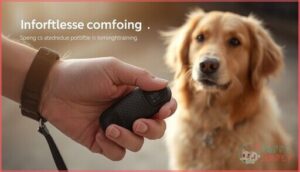
Your hand shouldn’t ache halfway through a training session. A well-designed clicker fits naturally in your palm, letting you focus on your dog instead of fumbling with the device. Ergonomic design transforms clicker training from awkward to automatic, so you can deliver precise reward timing without distraction.
- Grip styles vary from button-top models for thumb presses to side-squeeze options that suit different hand sizes and finger strength
- Hand comfort improves when the clicker weighs under three ounces and features a rubberized or textured surface to prevent slipping during rapid training sessions
- Clicker placement matters—wrist straps and lanyards keep the device accessible so you maintain smooth user experience without searching pockets mid-cue
Portability and Design Options
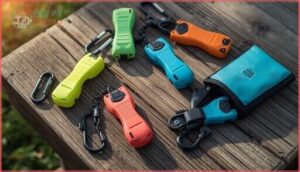
Compact designs let you train anywhere without weighing down your pockets.
Mini clickers measuring under 2.5 inches slip into treat pouches or clip onto belts with built-in carabiners, so you’re always ready for spontaneous training moments.
Look for adjustable straps that fit different hand sizes, ergonomic grips with non-slip surfaces, and durable clicker materials like water-resistant ABS plastic that withstand outdoor pet training sessions.
Top 10 Dog Training Clickers for Beginners
You’ve learned what makes a good beginner clicker, so now it’s time to see which models actually deliver on those features.
The clickers below cover different styles, from basic button designs to all-in-one kits with treat pouches and training guides. Each option has been selected to help you start training with confidence, whether you’re working on simple commands or shaping more complex behaviors.
1. HoAoOo Pet Training Clicker
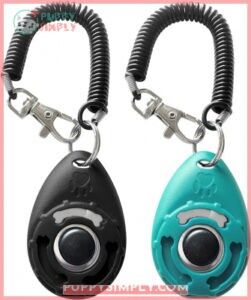
The HoAoOo Pet Training Clicker comes in a convenient two-pack with wrist straps, giving you black and blue options. You’ll appreciate the metal construction, which holds up through countless training sessions without wearing down.
The large button clicks easily from any grip position, and the loud sound cuts through distractions to mark the exact moment your dog gets it right. At under 6 inches with a stretchy wrist strap, you can keep it secure during movement and reach it quickly when your dog nails that new behavior.
| Best For | Dog owners who want a durable, affordable tool for positive reinforcement training and correcting unwanted behaviors like barking. |
|---|---|
| Weight | 41 Grams |
| Wrist Strap | Yes |
| Button Design | Big button |
| Training Use | Obedience and tricks |
| Multi-Pet Compatible | Dogs primarily |
| Sound Type | Loud |
| Additional Features |
|
- Comes as a 2-pack with wrist straps in two colors, so you always have a backup or can train multiple dogs
- Metal construction makes it sturdy enough to handle regular use without breaking down
- Large button and loud click work well for getting your dog’s attention, even during distractions
- Some users reported the clicker felt cheap or didn’t work as expected for their training needs
- The loud sound might be too harsh for noise-sensitive dogs or certain indoor environments
- Effectiveness varies by dog, so it may not be the right fit for every training situation
2. PetSafe Training Clicker Tool
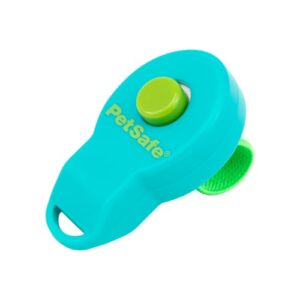
The PetSafe Clik R features an ergonomic design that fits comfortably in your hand during extended sessions, with a finger band that keeps it secure when you’re moving through drills.
The click produces a sharp sound that cuts through background noise and marks behavior instantly. At just over an ounce and less than 4 inches long, it slips into your pocket easily. You’ll find the teal color option practical for spotting it quickly on your training table or in your gear bag.
| Best For | Pet owners looking for a simple, portable clicker that delivers a clear sound for training dogs, cats, or other animals at any skill level. |
|---|---|
| Weight | 1.13 ounces |
| Wrist Strap | No |
| Button Design | Compact button |
| Training Use | Obedience and agility |
| Multi-Pet Compatible | Dogs, cats, small pets |
| Sound Type | Loud/sharp |
| Additional Features |
|
- Ergonomic grip with a secure finger band makes it comfortable to hold during long training sessions
- Loud, consistent click cuts through distractions and marks good behavior right away
- Super lightweight and compact enough to carry anywhere without thinking about it
- The click can be too loud or harsh for pets that are sensitive to sharp sounds
- Finger band might feel tight or uncomfortable if you have larger hands
- Takes a bit of hand strength to press the button, which can get tiring for some people
3. Dog Training Clicker with Wrist Strap

The elastic wrist band keeps this clicker right where you need it, preventing drops when you’re juggling treats or managing a leash.
You’ll press a large, clearly defined button that delivers a crisp click loud enough to cut through moderate noise without startling sensitive dogs. At under 2 ounces and built with a metal mechanism, it withstands daily bumps and outdoor conditions reliably.
The compact design slips into your pocket when you’re not training, and the bright finish helps you spot it quickly.
| Best For | Pet owners and trainers who need a reliable, hands-free clicker for teaching basic commands and correcting behaviors in dogs, cats, birds, or horses. |
|---|---|
| Weight | 68 Grams |
| Wrist Strap | Yes |
| Button Design | Push button |
| Training Use | Behavioral training |
| Multi-Pet Compatible | Dogs, cats, birds, horses |
| Sound Type | Distinct click |
| Additional Features |
|
- Wrist strap keeps the clicker accessible during training sessions so you won’t drop it while handling treats or a leash
- Crisp, consistent click sound is loud enough to be heard clearly without being too harsh for noise-sensitive pets
- Lightweight and pocket-friendly design makes it easy to carry and use for daily training sessions
- Button can feel stiff or difficult to press for some users, especially during longer training sessions
- Build quality may not hold up as well over time due to cheaper plastic materials
- Click volume might be too loud for very sensitive animals or too quiet in noisier outdoor environments
4. TreatPod Leash Treat Holder and Clicker

When you need treats and clicker in one hand, the TreatPod leash attachment solves that puzzle by clipping directly onto standard 1-inch leashes. You’ll dispense single treats through a moisture-resistant slot while the built-in clicker emits a crisp, audible tone for clear marking.
The pivoting mount reduces snags during movement, and the lightweight, impact-resistant housing won’t wear you down during longer sessions. It’s particularly useful for sit-stay drills when you can’t fumble with separate pouches or risk dropping equipment mid-cue.
| Best For | Trainers who want hands-free access to treats and a clicker during leash work without juggling multiple tools. |
|---|---|
| Weight | 3.2 ounces |
| Wrist Strap | Yes |
| Button Design | Standard button |
| Training Use | On-the-go training |
| Multi-Pet Compatible | Dogs primarily |
| Sound Type | Audible |
| Additional Features |
|
- Clips right onto your leash so you can mark behavior and reward in seconds without digging through pockets
- Moisture-resistant container keeps treats fresh even during outdoor training sessions
- Lightweight design won’t add bulk or fatigue your arm during longer walks
- Container can be tricky to unscrew quickly when you need to refill mid-session
- Build quality feels flimsy to some users, with reports of straps breaking or plastic cracking
- Clicker volume may be too quiet for noisy environments or hearing-impaired dogs
5. Crmada Box Training Clicker
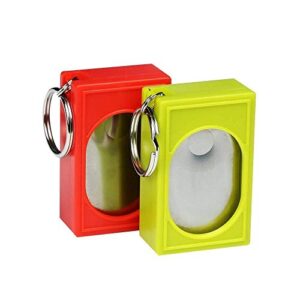
If you prefer a compact grip over a leash attachment, the Crmada box clicker gives you a smooth, palm-sized case in red or lime green for easy color-coding.
The metal click mechanism produces a crisp, consistent tone that marks behavior without startling sensitive dogs, and its rust-resistant build holds up through repeated outdoor sessions. At 2 × 1.26 × 0.47 inches and just 0.52 ounces, it won’t fatigue your hand during longer drills, making it a solid pick for shaping sequences or basic obedience work.
| Best For | Trainers who want a pocket-friendly clicker with a consistent, crisp sound for marking behavior in dogs, cats, birds, and other pets without needing a wrist strap. |
|---|---|
| Weight | 0.52 ounces |
| Wrist Strap | No |
| Button Design | In-box clicker |
| Training Use | Basic obedience |
| Multi-Pet Compatible | Dogs, cats, birds, fish |
| Sound Type | Metal click |
| Additional Features |
|
- Compact 2-inch design fits comfortably in your palm and won’t tire your hand during long training sessions
- Rust-resistant metal clicker delivers a sharp, reliable tone that cuts through distractions
- Comes in two bright colors (red and lime green) so you can color-code for different pets or training stages
- Click volume may be too loud or startling for anxious or noise-sensitive animals
- Thin metal construction raises durability concerns for trainers who use it multiple times daily
- Some users report the build quality feels cheap and may not hold up to heavy, long-term use
6. Brightkins Dog Training Clicker
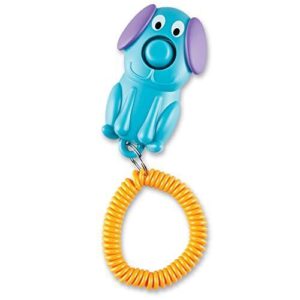
When you want a bit more personality in gear, the Brightkins clicker offers three playful designs—including Hot Dog and Bone styles—that add visual fun to your sessions without compromising function.
It produces a crisp, consistent click through a single prominent button, and the BPA-free plastic construction keeps handling safe around your dog. At 2 × 2 × 2 inches and 1.6 ounces, it includes a wrist strap so you can keep it accessible during walks, though some users note the button requires slightly more pressure than competing models.
| Best For | Dog owners who want an affordable, visually fun clicker for basic positive reinforcement training and don’t mind applying a bit of extra button pressure. |
|---|---|
| Weight | 1.6 ounces |
| Wrist Strap | Yes |
| Button Design | Standard button |
| Training Use | Positive reinforcement |
| Multi-Pet Compatible | Dogs primarily |
| Sound Type | Clear click |
| Additional Features |
|
- Comes in three playful designs (Hot Dog, Bone, etc.) that add personality to your training gear
- Produces a clear, consistent click sound that works well for marking good behaviors
- Includes a wrist strap for easy access during walks and training sessions
- Button requires more pressure to click compared to some competing models
- Build quality may not hold up well with heavy, long-term use
- Click sound isn’t as loud as some trainers expect, which may not work for all dogs
7. Dog Training Clicker Kit
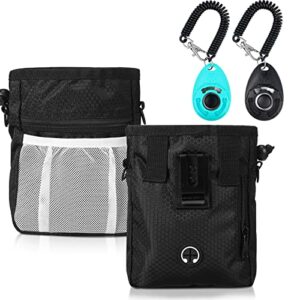
All-in-one training kits combine multiple tools in a single package, and this clicker kit pairs two loud clickers with wrist straps alongside a treat pouch that holds essentials during sessions.
The 9.29 × 4.25 × 2.28 inch pouch features a built-in poop bag dispenser and space for toys, weighing just 6.4 ounces for comfortable wear. The hexagonal black pattern adds a professional look, though the snap closure and waist fit work best for smaller frames rather than thicker builds.
| Best For | Dog owners who want a complete training setup with clickers and storage in one lightweight, hands-free pouch. |
|---|---|
| Weight | 6.4 ounces |
| Wrist Strap | Yes |
| Button Design | Standard button |
| Training Use | Dog training |
| Multi-Pet Compatible | Dogs primarily |
| Sound Type | Standard click |
| Additional Features |
|
- Includes two clickers with wrist straps plus built-in poop bag dispenser for all-in-one convenience
- Lightweight at 6.4 ounces with enough room for treats, toys, and training essentials
- Professional hexagonal pattern looks polished during training sessions
- Waist strap may not fit comfortably on thicker builds
- Snap closure might not stay secure for all body types
- Limited capacity compared to larger standalone treat pouches
8. Diyife Dog Training Clicker
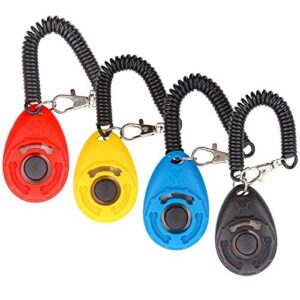
The Diyife four-pack offers color-coded clickers with elastic wrist straps, making it easy to keep a trainer within reach during outdoor sessions or multi-dog households.
Each unit measures 6 × 4 × 2 cm and features a large button paired with a stainless steel striker that delivers a clear, stable tone across thousands of clicks. The ABS plastic body resists impact and minor scratches, while the matte surface provides non-slip handling.
You’ll receive four colors—black, yellow, red, blue—plus a storage bag for $9.99.
| Best For | Multi-dog households and trainers who want spare clickers in different colors to keep around the house, in the car, or with multiple family members. |
|---|---|
| Weight | Not specified |
| Wrist Strap | Yes |
| Button Design | Large button |
| Training Use | Basic obedience |
| Multi-Pet Compatible | Dogs, cats, birds, horses |
| Sound Type | Loud and stable |
| Additional Features |
|
- Four clickers for under $10 means you can stash them everywhere—by the back door, in your training bag, or give one to each family member
- Wrist straps keep the clicker handy during walks or outdoor training sessions when you need both hands free
- Color coding helps if you’re training multiple dogs with different commands or want to assign each family member their own clicker
- Several buyers found the click sound too quiet or weak for outdoor use or getting a dog’s attention from a distance
- Quality control seems hit-or-miss—at least one reviewer received a pack where only one clicker actually worked
- Won’t do much good if you don’t already understand clicker timing and positive reinforcement basics
9. Left And Right Dog Training Kit

The Left And Right Dog Training Kit gives you two distinct clickers—one for each hand—so you can mark different behaviors or teach side-specific cues like left-paw targeting without swapping tools mid-session.
Each clicker delivers a consistent 1.2–2.0 kHz tone with less than 3 dB variance, ensuring your dog hears the same auditory signal every time. The lightweight palm-sized units feature ergonomic grips and optional wrist straps, while color-coded indicators help you distinguish left from right during fast-paced drills.
| Best For | Trainers who want to mark different behaviors simultaneously or teach side-specific commands like left-paw and right-paw targeting without switching devices. |
|---|---|
| Weight | 100 Grams |
| Wrist Strap | No |
| Button Design | Standard button |
| Training Use | Obedience and behavior |
| Multi-Pet Compatible | Dogs, cats, birds, chickens |
| Sound Type | Distinct click |
| Additional Features |
|
- Two clickers let you reinforce separate behaviors at once or train left-vs-right cues in the same session
- Consistent 1.2–2.0 kHz tone with minimal variance keeps your timing clear and reliable
- Ergonomic grips and wrist straps make extended training sessions comfortable, even when you’re holding treats or a leash
- Some users find the clickers bulky and tiring to hold for long stretches
- The silicone pouch closure can pop open unexpectedly, spilling treats if you bend over or move quickly
- The clip attachment may disappoint trainers who prefer a carabiner for stronger belt hold
10. Szo Dog Training Treat Pouch
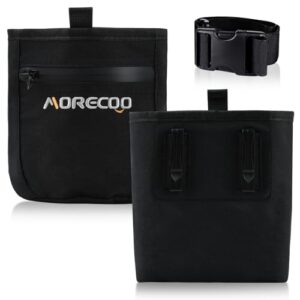
The Szo Dog Training Treat Pouch combines hands-free storage with a built-in clicker, so you can deliver rewards without fumbling through pockets.
Its magnetic closure lets you grab treats with one hand while managing the leash, and the adjustable waist belt keeps everything secure during quick turns or energetic sessions.
The 600D nylon construction holds up to 2 cups of treats, plus the front zipper pocket stashes your phone or waste bags, making it a solid all-in-one solution for beginner trainers who need organized, efficient access during drills.
| Best For | Beginner trainers who want a hands-free setup that keeps treats, a clicker, and essentials in one compact pouch during obedience sessions. |
|---|---|
| Weight | 3.52 ounces |
| Wrist Strap | No |
| Button Design | Standard button |
| Training Use | Obedience and behavior |
| Multi-Pet Compatible | Dogs, cats, birds, horses |
| Sound Type | Standard click |
| Additional Features |
|
- Magnetic closure lets you grab treats one-handed while holding the leash
- Built-in clicker saves you from carrying extra gear
- Front zipper pocket holds your phone, keys, or waste bags
- Waist strap feels flimsy and may not hold up with heavy use
- 2-cup capacity won’t fit larger treats or bulky items
- Treat pouch can detach from the belt unexpectedly
How to Start Clicker Training Your Dog
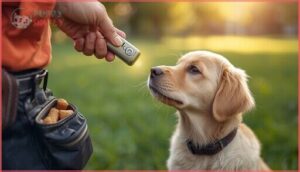
Once you’ve picked your clicker, the next step is actually using it with your dog. The process starts with teaching your dog what the click means, then building from there with treats and timing.
Here’s how to get started with three essential steps that set you up for success.
Charging The Clicker Step-by-Step
Charging the clicker means teaching your dog that the click sound predicts a reward. Hold treats ready, then click and immediately deliver a high-value treat within 0.5 seconds.
Repeat 10 to 20 times in a quiet, distraction-free training environment. Your dog has formed the sound association when they consistently look at you after hearing the click, signaling successful clicker conditioning.
Introducing The Clicker to Your Dog
Once you’ve charged the clicker, start introducing it during behaviors your dog already performs, such as sitting or making eye contact. Click at the precise moment the desired dog behavior occurs, then follow immediately with the reward to strengthen the dog association.
Keep your training environment calm and distraction-free, gradually adding a verbal cue before each action to link command, clicker, and reward timing together.
Using Treats and Rewards Effectively
The right treat choice can make or break your clicker training success. Choose small, soft treats of 5 to 10 calories each that your dog can swallow quickly, keeping sessions flowing smoothly.
Deliver each reward within 1 second of the click event to create crystal-clear connections between action and outcome. Start with a reward after every correct behavior, then gradually shift to intermittent rewards as skills develop.
Common Beginner Mistakes to Avoid
Even experienced trainers slip up from time to time, so if you’re just starting out with clicker training, you’re bound to make a few mistakes along the way.
The good news is that most beginner errors are easy to fix once you know what to watch for. Let’s look at the most common pitfalls that can slow down your progress and how to steer clear of them.
Timing Errors and Late Clicks
One of the most common pitfalls in clicker training is clicking too late, which creates feedback gaps that confuse your dog about which behavior earned the reward. Click timing should align within one second of the correct action to prevent synchronization issues and training interruptions.
Late clicks cause reward delays, making it harder for your dog to connect the verbal cue with the desired behavior.
Inconsistent Rewarding
Beyond timing, inconsistent rewarding patterns can stall your clicker training progress. If you skip treats after some clicks or offer different reward values unpredictably, you’ll create uneven motivation that impairs learning and confuses your dog about what behavior actually matters.
- Skipping rewards after clicks teaches your dog the clicker doesn’t always mean something good is coming
- Mixing high-value and low-value treats randomly shifts focus from mastering the behavior to chasing better rewards
- Using intermittent rewards too early makes positive reinforcement less effective during initial training phases
Overusing or Misusing The Clicker
Clicking constantly during everyday moments can create clicker fatigue and reward inflation, weakening the link between sound and specific behavior. When you overuse the tool, your dog may stop working for verbal cues or become dependent on the click itself, leading to training plateaus and overreliance issues. Reserve clicks for precise moments when you’re actively shaping a new skill, and phase out clicker training gradually to build lasting habits.
| Overuse Problem | Impact on Dog | Training Consequence |
|---|---|---|
| Excessive clicks | Expects rewards constantly | Reduces click value |
| Clicking wrong behavior | Reinforces mistakes | Confuses correct response |
| Tool dependency | Ignores verbal cues | Stalls skill transfer |
| Rapid-fire pacing | Loses focus quickly | Hampers retention |
Tips for Successful Clicker Training Sessions

Setting up the right environment and keeping your dog engaged makes all the difference between frustrating sessions and real progress.
You’ll need to start simple, build gradually, and know when your dog is ready to move forward without the clicker. Here are three essential tips to help you run training sessions that actually work.
Setting Up Effective Training Environments
Your training space sets the foundation for clicker training success. Choose a quiet, distraction-free zone where your dog can focus on learning new behaviors through positive reinforcement.
- Remove toys and food bowls to eliminate competing rewards during sessions
- Use consistent lighting and temperature to keep your dog comfortable and relaxed
- Control noise with closed doors, limiting foot traffic and scent distractions
- Place treats within arm’s reach so you can reward immediately after each click
- Practice in the same spot initially, then introduce new rooms for environmental consistency
Gradually Increasing Training Difficulty
As your dog masters behaviors in a controlled space, start raising the bar with incremental learning. Skill scaling means you add one small challenge at a time—extend duration by seconds, increase distance by a foot, or introduce mild distractions. This behavioral progression keeps your dog confident and motivated through reward-based training.
| Training Phases | Difficulty Levels | Progression Strategy |
|---|---|---|
| Foundation | Simple cues, close range | Click every success, high-value treats |
| Intermediate | Add distance, mild distractions | Extend 1 foot per session, vary rewards |
| Expert | Complex chains, public settings | Link behaviors, phase treats gradually |
| Mastery | Real-world environments | Random reinforcement, verbal praise dominates |
Knowing When to Phase Out The Clicker
Gradually, you’ll notice your dog responding reliably to cues across different locations—that’s your signal to begin fading the clicker. Phase out when behaviors stay consistent over three consecutive sessions, replacing the click with verbal cues or hand signals while maintaining rewards.
- Dog performs sit on cue without needing the click mark
- Behavior remains stable across your home, yard, and park settings
- You’ve shifted from continuous treats to occasional praise and play
- Verbal “yes” or gesture replaces the click as your marker
- Refresher sessions keep skills sharp without constant clicking
Move to variable reward schedules during this shift, tying praise to the cue rather than the click alone. If consistency drops, pause fading and resume frequent marking—this prevents confusion and maintains your positive reinforcement foundation in dog training.
Frequently Asked Questions (FAQs)
Do clickers work for dog training?
In the context of the rubber meeting the road, clicker training delivers real results.
Dogs learn faster with precise markers, making clickers highly effective tools for positive reinforcement and behavior modification.
How do you clicker train a dog for beginners?
You’ll charge the clicker by pairing the sound with treats, then mark desired behaviors instantly with precise click timing.
Keep training sessions short, use high-value rewards, and practice positive reinforcement methods consistently.
Can clicker training fix aggressive dog behavior?
You can’t wave a magic wand and erase aggression overnight, but clicker training paired with desensitization techniques helps modify behavior by marking calm responses near triggers, gradually building positive reinforcement through consistent trigger management.
How long until my dog responds reliably?
Most dogs show reliable responses to a verbal cue within 2 to 4 weeks with daily clicker training, though your dog’s readiness depends on breed, age, motivation, and how consistent you’ve been with reward schedules.
Do clickers work for older or deaf dogs?
Teaching an old dog new tricks isn’t impossible—you just need the right signal.
Yes, clickers work for older or deaf dogs when you adapt your training methods using visual cueing, vibrations, or LED markers instead of sound.
Can multiple family members use different clickers?
Yes, each family member can use their own clicker as long as the sound stays consistent and everyone follows the same timing, reward system, and training rules to avoid confusing your dog.
What happens if I lose my clicker?
If you lose your clicker, use a verbal cue or hand signal temporarily until you get a replacement.
Keep a backup clicker in your training kit to avoid disrupting your dog’s progress.
Conclusion
Your dog won’t care which clicker you choose—they’ll respond to the consistency behind it, not the brand label or ergonomic grip. What matters is your commitment to click at the exact right moment, reward immediately, and practice daily.
The best dog training clickers for beginners are the ones you’ll actually use, session after session, until that distinctive sound becomes your dog’s favorite word. Pick one, charge it with treats tonight, and start building the communication you’ve been missing.