
This site is supported by our readers. We may earn a commission, at no cost to you, if you purchase through links.

A crate that’s too small turns a safe haven into a stress trap. Dogs forced into cramped spaces show elevated cortisol levels and develop anxiety around confinement.
The right fit lets your dog stand without hunching, turn around comfortably, and stretch out while lying down. Getting the measurements wrong doesn’t just affect comfort—it derails housetraining, triggers behavior problems, and puts your dog’s physical health at risk.
Choosing the right size means measuring your dog’s length and height accurately, then matching those numbers to crate dimensions that account for bedding, growth, and your dog’s specific needs.
Table Of Contents
- Key Takeaways
- Why Crate Size Matters
- How to Measure Your Dog for a Crate
- Crate Size Charts and Breed Guidelines
- Choosing The Best Crate for Your Dog
- Comparing Crate Types and Their Sizing Needs
- Special Considerations for Puppies and Unique Breeds
- Tips for Crate Placement and Travel
- Frequently Asked Questions (FAQs)
- Conclusion
Key Takeaways
- A crate that’s too small causes physical stress, anxiety, and elevated cortisol levels, while one that’s too large undermines housetraining by allowing dogs to eliminate in one corner.
- Measure your dog’s length from nose to tail base and shoulder height when standing, then add 2-4 inches to ensure they can stand without hunching, turn around, and stretch out comfortably.
- Puppies need crates with removable dividers that adjust as they grow, preventing the need to buy multiple crates while maintaining proper sizing that discourages accidents.
- Wire crates offer the best adjustability and ventilation for most dogs, but anxious dogs often prefer plastic crates with solid walls, and all types must meet specific airline requirements for travel safety.
Why Crate Size Matters
Getting the crate size right isn’t just about convenience—it directly affects your dog’s comfort, safety, and ability to learn. A crate that’s too small can cause physical stress and anxiety, while one that’s too large can undermine housetraining and create insecurity.
The right crate size protects your dog’s comfort, safety, and learning—too small causes stress, too large sabotages training
Here’s what you need to know about why proper sizing matters for your dog’s well-being.
Impact on Dog Comfort and Well-being
The right crate size directly shapes your dog’s comfort and overall wellness. When dogs have enough room to stretch, turn around, and lie down naturally, their stress drops—research shows lower cortisol levels in properly sized spaces.
Good crate ventilation promotes healthy breathing, while adequate comfort zones help your dog relax instead of pacing or whining. Think of it as their personal retreat, not a tight box.
Properly evaluating the space requires considering research methodology to guarantee the best fit.
Safety Risks of Incorrect Sizing
When the fit is off, your dog faces real risks. Too small a crate restricts standing, turning, and natural resting postures—leading to muscle strain and pressure sores. Too large? Your dog may eliminate in one corner, sabotaging housetraining.
Watch for these crate hazards:
- Narrow doors trap limbs or cause entrapment injuries
- Poor ventilation increases overheating and respiratory stress
- Tight spaces trigger crate anxiety and fear-based aggression
- Rubbing against restrictive edges can cause self-injury
To write about dog crate safety effectively, consider using clear science guidelines.
Role in Training and Stress Reduction
Beyond safety, the right crate size plays a direct role in crate training and stress relief. A well-fitted space becomes a calm environment that lowers anxiety-related pacing and aids behavior modification.
When your dog can stretch out comfortably, crate training builds positive associations instead of fear. Routine crate use tied to rewards accelerates impulse control, steadies cortisol during transitions, and reinforces housetraining cues effectively.
How to Measure Your Dog for a Crate
Getting the right crate size starts with knowing your dog’s exact measurements. You’ll need a measuring tape and a few minutes while your dog is standing and calm.
Here’s what to measure and how to do it accurately.
Essential Measurements (Length, Height, Weight)
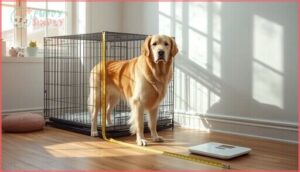
Three simple dog measurements lock in the perfect crate size. Here’s what to know:
- Length: Measure from your dog’s nose to the base of the tail, then add 2 to 4 inches for comfort zones and bedding.
- Height: Capture shoulder height when standing, plus 1 to 2 inches for upright posture.
- Weight: Check the manufacturer’s crate dimensions range and select one supporting your dog’s current weight with about 10% safety margin.
Measuring Puppies Vs. Adult Dogs
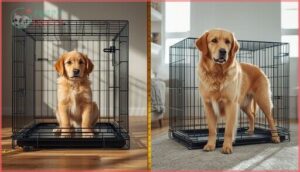
Puppies present a sizing challenge you won’t face with adult dogs. When measuring your puppy, target their current dimensions plus 2 to 4 inches, then use a crate with a removable divider to expand space as they hit new puppy development stages.
Compare your breed-specific measurements against adult size estimation charts every two to four weeks—this crate adjustment strategy prevents buying multiple crates while supporting dog comfort throughout growth.
Allowing Space for Bedding and Movement
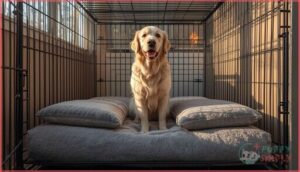
Your dog needs room to change postures and settle in without fighting their bedding. Here’s what to know about space allocation:
- Crate bedding shouldn’t reduce standing height by more than 1.5 inches—your dog still needs headroom.
- Dog movement requires enough floor space for a full turn without hitting crate walls.
- Crate ventilation depends on proper airflow around bedding materials to prevent overheating.
Crate Size Charts and Breed Guidelines

Once you’ve measured your dog, the next step is matching those numbers to the right crate. Size charts break down options by breed group and weight range, making it easier to narrow your choices.
Here’s what to know about standard sizing and how to use these guides effectively.
Crate Sizes for Toy, Small, Medium, Large, and Giant Breeds
Choosing the right dog crate size starts with understanding breed categories. Here’s what to know: toy breeds usually need 18 to 24 inches, while giant breeds often require 48 inches or more.
| Breed Category | Crate Length Range |
|---|---|
| Toy | 18–24 inches |
| Small | 24–30 inches |
| Medium | 30–36 inches |
| Large | 36–42 inches |
| Giant | 42–48+ inches |
These dimensions guarantee dog comfort and pet safety while maintaining space efficiency inside your home.
Weight and Breed-Specific Recommendations
Your dog’s weight offers a starting point, but breed-specific sizes matter more. A 40-pound Basset Hound won’t fit comfortably in the same crate as a 40-pound Border Collie—body proportions differ.
| Weight Range | Typical Crate Length | Example Breeds |
|---|---|---|
| Up to 10 kg | 24–30 inches | Chihuahua, Yorkshire Terrier |
| 20–40 kg | 30–42 inches | Beagle, Cocker Spaniel |
| Over 40 kg | 36–48+ inches | Labrador, German Shepherd |
Always measure your dog’s actual length and height for true crate comfort.
Using Size Charts Effectively
Size charts are guides, not gospel—breed builds differ, so cross-check multiple sources to spot patterns. Focus on crate dimensions and measuring tips over weight alone, because a stocky Bulldog and lean Whippet at 25 pounds need different crate sizing. Here’s how chart interpretation works:
| Factor | Why It Matters | Your Action |
|---|---|---|
| Measurement methods | Ensures consistency | Follow each chart’s instructions |
| Size variations | Accounts for breed builds | Compare 3+ manufacturer charts |
| Crate dimensions | Length/height trump weight | Pick upper range for comfort |
Accuracy protects your dog’s well-being.
Choosing The Best Crate for Your Dog
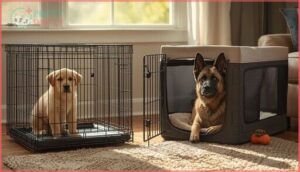
Once you’ve nailed down the right size, the next step is finding a crate that works for your dog’s stage of life and your daily routine.
Some features make a bigger difference than you’d expect, especially if you’re dealing with a growing puppy or a dog who’s hard on gear.
Here’s what to look for when you’re ready to buy.
Removable Dividers for Growing Puppies
As your pup grows, a dog crate with a removable divider lets you adjust space without buying new gear. Start small during crate training to prevent accidents, then reposition the divider as your puppy grows.
Secure it properly for divider safety and crate hygiene. Track puppy growth milestones and shift the panel when measurements call for it—this space planning keeps your puppy crate functional from eight weeks to adulthood.
Space Adjustments and Comfort Enhancements
Once you’ve set up the divider, focus on dog comfort with the right bedding options—a washable mat or memory foam pad that fits snugly without crowding your pup.
Crate placement matters too: choose a quiet spot away from direct sun for temperature control and noise reduction. Good crate ventilation keeps air fresh, and a breathable cover at night helps anxious dogs settle during crate training.
Durability and Cleaning Considerations
Beyond comfort, your crate material determines how long it’ll last and how easy cleaning will be. Wire crates with powder-coated steel resist rust and stand up to 300-pound loads without bending—ideal for heavy chewers. Plastic models handle drops from four feet without cracking, while removable trays make sanitizing a breeze.
Check welds and latches quarterly to maintain structural integrity and keep your dog safe.
Comparing Crate Types and Their Sizing Needs
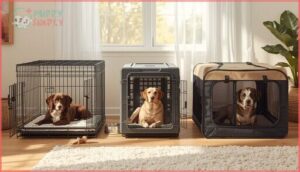
Not all crates are built the same, and the type you choose affects how you approach sizing. Wire, plastic, and soft-sided models each have unique strengths and limitations that influence space requirements and adjustability.
Here’s what to know about each option and how it impacts your dog’s fit.
Wire Crates and Adjustability
Wire crates offer flexibility you won’t find elsewhere. Adjustable panels let you resize as your dog grows, while folding designs collapse for compact storage when travel calls. Modular extensions expand the frame without buying a new unit, and ventilation systems keep air flowing freely.
This adaptability makes wire crates a smart choice for changing needs—whether you’re managing crate sizing for a puppy or accommodating multiple dogs over time.
Plastic and Hard-Sided Crates
Plastic crates and hard-sided crates provide solid walls that anxious dogs often prefer. Their molded polymer construction resists chewing and simplifies cleaning after accidents. When you measure for these units, add 2–4 inches beyond your dog’s length and height to guarantee proper crate sizing.
- Crate material: Non-porous surfaces prevent odor retention
- Ventilation systems: Side vents maintain airflow despite sealed walls
- Travel regulations: Airlines require IATA-compliant crate dimensions
- Pet safety features: Reinforced doors and secure latches boost crate durability
Soft-Sided and Hybrid Crates
Soft-sided crates and hybrid crates fold flat for storage yet deliver the ventilation systems anxious dogs need. Their fabric panels and mesh windows keep air moving while foldable designs let you transport them easily.
When you’re doing crate sizing, match internal dimensions to standard wire measurements, then confirm weight limits reach 15–45 pounds depending on your pet’s breed and the travel features you require.
Special Considerations for Puppies and Unique Breeds

Not every dog fits neatly into a standard size chart. Puppies grow quickly, some breeds have unusual proportions, and certain dogs need extra space due to anxiety or chewing habits.
Here’s what to keep in mind when your dog doesn’t match the typical guidelines.
Planning for Growth and Adult Size
Puppies grow fast, so plan ahead. Use breed-specific sizes and dog weight to estimate adult dimensions—check breed standards or look at the parents.
Choose a crate that fits the full-grown size, then use removable dividers for puppy development. This crate flexibility lets you make size adjustments as your pup grows without buying new crates.
Growth projections matter—too much space now encourages accidents, but adult accommodations mean long-term value.
Accommodating Anxious or Chewing-Prone Dogs
Anxiety reduction starts with escape prevention—secure latches and reinforced corners stop chewing through bars. Here’s what to know about crate selection for anxious dogs:
- Choose a dog crate with escape-proof, chew-resistant construction for crate security
- Use durable bedding and crate mats that won’t encourage destructive behavior
- Introduce gradual conditioning sessions to support stress management
- Consult a behaviorist if dog behavior concerns persist despite proper crate size
Breeds With Special Size or Space Needs
Great Danes and Saint Bernards can’t settle in standard crates—their height demands extra-long models with reinforced latches. Dachshunds need balanced length-to-height ratios to prevent shoulder strain, while high-energy breeds like Huskies require better ventilation and movement space.
Match crate sizing to your dog’s weight and unique body type, not just breed-specific sizes. Anxious breed solutions often mean sturdier walls that resist chewing under stress.
Tips for Crate Placement and Travel

Getting the right crate is only half the battle—you also need to think about where it’ll go and whether you’ll be taking it on the road.
Placement affects your dog’s comfort and your home’s flow, while travel brings a whole new set of size and safety rules.
Here’s what to know about fitting a crate into your space and life.
Measuring Space in Your Home
Even the perfect dog crate won’t help with house training if it doesn’t fit where you need it. Before choosing your crate size, measure your home’s floor space carefully. Here’s what to check:
- Width and depth of the area where the crate will sit
- Door clearance so you can open and position it without blocking pathways
- Ventilation needs around furniture and walls to maintain airflow
- Floor surface stability to support the crate’s weight safely
Smart crate placement makes all the difference.
Travel and Airline Sizing Requirements
If you’re flying with your dog, airline requirements can feel like maneuvering a maze. Most carriers demand crates that let your dog stand, turn, and lie down comfortably, plus airline-approved materials with secure closures. Check crate dimensions and dog weight limits early—in-cabin restrictions differ sharply from checked baggage.
Label the crate clearly with your contact details and include recent health documentation for smooth travel safety.
Portability and Multi-Use Crates
Once you’re home, portability matters just as much. Foldable crates and wire crates collapse flat for storage or car trips, while soft-sided crates slip into tight spots. Look for travel features like grips, wheels, or lightweight frames.
Multi-purpose portable designs work indoors, outdoors, or on the road. Match crate size to your dog’s measurements and add crate accessories like bowls or pads for comfort anywhere.
Frequently Asked Questions (FAQs)
Can two dogs share one large crate?
Most experts advise against shared confinement. It can spark conflicts over space and resources, even between bonded dogs.
Individual crates reduce stress and injury risk while supporting better crate training outcomes.
How often should I replace my dogs crate?
Most crates last years without replacement unless bent bars, broken latches, or sharp edges appear.
Replace when structural damage risks safety, hygiene can’t be maintained, or your dog outgrows the crate size.
Do crates work for senior dogs with arthritis?
Yes, when properly sized, your senior dog needs room to stand, turn, and stretch without strain. Add supportive bedding to cushion joints.
Crates complement arthritis management and pain relief but don’t replace veterinary care.
Whats the best crate for extreme chewers?
For extreme chewers, look for heavy-duty crates with chew-proof materials like reinforced steel wire frames. Durable designs resist gnawing, while crate accessories and chew-redirecting toys help protect the structure during crate training sessions.
Should I crate train my rescue dog differently?
Coming from uncertain backgrounds, these pups often carry invisible baggage that shapes their crate introduction.
Go slower with training pace, watch for anxiety triggers, and prioritize post-adoption care over rushing confinement milestones.
Conclusion
The idea that any crate will do falls apart the moment you see a dog hunched and miserable in the wrong space.
How to choose the right dog crate size comes down to three measurements—length, height, and honest assessment of your dog’s needs. Match those numbers to a crate that allows standing, turning, and stretching.
You’re not just buying a box. You’re building a space where your dog can truly settle.
- https://academichelpexpress.blog/2024/08/please-use-the-bulleted-points-and-the-rubric-below-to-guide-your-work-your-pa/
- https://www.writingclearscience.com.au/category/writing-guides/writing-research-papers/page/2/
- https://www.sciencedirect.com/science/article/pii/S0749208123000268
- https://pmc.ncbi.nlm.nih.gov/articles/instance/9553038/bin/pone.0275964.s005.docx