This site is supported by our readers. We may earn a commission, at no cost to you, if you purchase through links.
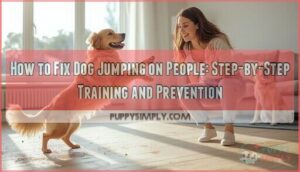
Your dog launches at every visitor like they’re a long-lost friend, muddy paws landing squarely on nice clothes and startled guests. You’ve tried saying “no,” pushing them down, even turning your back—but within minutes, they’re airborne again.
Here’s what most dog owners don’t realize: every reaction you give, even negative attention, can accidentally reward the exact behavior you’re trying to stop. Dogs jump because it works—they’ve learned that four paws in the air gets them what they crave most.
The good news? You can teach your dog that keeping all four paws on the floor is actually the fastest path to attention, treats, and affection.
Table Of Contents
Key Takeaways
- Dogs jump because every reaction you give—even pushing them away or scolding—accidentally rewards the behavior with the attention they crave, creating a self-reinforcing cycle that punishment only makes worse.
- The fastest path to stopping jumping is withdrawing all attention (no eye contact, touch, or words) when paws leave the ground, then immediately rewarding calm “four on the floor” behavior with treats and praise.
- Consistency across every family member and visitor is non-negotiable—mixed messages where some people allow jumping while others correct it can increase incidents by 35% and tank your success rate by up to 32%.
- Most dogs master polite greetings within 4-8 weeks using positive reinforcement, but about 40% relapse without ongoing practice, making it essential to maintain training protocols long-term and seek professional help if jumping persists beyond three months.
Why Dogs Jump on People
Dogs have their own reasons for bouncing up to greet you at the door. Understanding what’s really going on helps you know where to start with training.
Let’s break down the most common reasons behind all that jumping.
Natural Canine Greeting Behaviors
Greeting rituals are at the heart of canine behavior; dogs naturally seek connection using body language, facial expressions, and, yes, jumping. This greeting behavior is more than enthusiasm—it’s learned through social learning and shaped by breed differences.
You’ll often notice:
- Quick pawing or springy jumps.
- Nose-to-face sniffing.
- High tail wags.
- Excited vocalizations.
Recognizing these tells helps you start preventing jumping with alternative behaviors. Understanding AP study resources can also help in developing a training plan.
Attention-seeking and Reward Cycles
Jumping up isn’t just excitement—it’s a well-oiled reward system at work. Dogs are quick studies; if jumping up earns your gaze, touch, or a laugh, that attention becomes gold. Attention seeking becomes their go-to greeting, driven by years of canine behavior shaped by positive reinforcement.
By redirecting that energy into calm behaviors and offering rewards for paws-on-the-floor, you’re starting true behavior modification, not just suppressing attention-getting behavior. Understanding the dog’s behavior requires analyzing theme development to tackle the underlying reason for jumping up.
Common Mistakes That Reinforce Jumping
That attention-seeking behavior can be sneaky—sometimes you don’t even realize you’re fueling it. Petting, soothing, or even talking to your dog during a jump teaches them that “jumping up” works.
Inconsistent rewards—like sometimes letting a jump lead to a greeting—build a powerful jump reinforcement cycle.
To truly stop dog jumping, reward removal and gentle corrections must become your go-to strategies for every greeting behavior.
Negative Effects of Jumping Behavior
Before you can change your dog’s habit of jumping up, it helps to see why this behavior causes more trouble than most people realize.
There are a few areas where things can quickly go wrong, for both you and your dog. Let’s take a closer look at what’s at stake.
Safety Concerns for People and Dogs
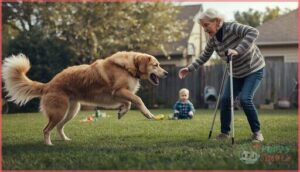
When your dog launches at visitors, you’re not just dealing with muddy paws—you’re facing real injury statistics. Preschool-aged children make up 50% of dog bite victims in homes, and even friendly dogs can inadvertently cause harm. In fact, 45% of dog bites involve dogs with no prior aggression history.
Dog jumping isn’t just annoying—it poses real injury risks, especially to young children who make up half of home bite victims
Jumping behavior creates household risks by invading personal space and can escalate into more serious canine behavior issues, making Dog Bite Prevention essential for dog safety and wellbeing.
Social and Behavioral Consequences
Beyond the immediate physical risks, social learning creates ripple effects you can’t ignore. In multi-dog households, 62% of dogs escalate jumping when greeting strangers—that’s contextual reinforcement at work. Without structured training, about 40% relapse within months, reverting to old behavioral patterns. Inconsistent household rules spike jumping episodes by 35% during guest arrivals.
Teaching alternative canine communication reduces incidents by 48% in four weeks, making relapse prevention achievable through consistent dog behavior training.
Why Punishment Can Make Things Worse
Aversive training can backfire in ways you mightn’t expect. Punishment-based methods increase cortisol and increase fear-related behaviors that persist for weeks. They also damage trust, reducing cooperative canine behavior by up to 40%. Repeated corrections may trigger learned helplessness, where your dog stops trying alternative greetings altogether.
To stop dog jumping effectively, positive reinforcement training and behavior modification outperform negative reinforcement every time.
Preparing to Stop Jumping

Before you start training your dog to stop jumping, you need to set up the right foundation. That means eliminating what’s been rewarding the behavior, getting everyone in your household on the same page, and using the right tools to manage your dog while they’re still learning.
Let’s look at three key areas that’ll make your training actually stick.
Removing Rewards for Jumping
Ever notice how your dog jumps higher if you scold or laugh? That’s Reward Removal at work—dogs thrive on reactions.
To stop jumping, cut off all rewards: no eye contact, no petting, not a word when paws leave the ground. Redirect your dog’s energy by reinforcing Calm Behavior with treats and praise, instead.
With consistent training, even the bounciest greeter can trade those jumping cues for polite, four-on-the-floor hellos.
Setting Consistent Household Rules
Picture your home as a team—each member needs to play by the same rulebook for household rule setting to work. Set clear greeting protocols at every entrance:
- Agree on a no-jump policy and stick with it.
- Cue a sit or “four on the floor” before anyone says hello.
- Praise and reward calm greetings—consistency counts.
Family cooperation and reward management are the foundation of great dog training.
Tools and Management Strategies (leashes, Gates, Etc.)
Think of smart management tools as your early defense in the battle against jumping. Leash training cuts jumping by nearly half, while strategic gate management and barrier systems shape every greeting at the door. Collar options boost your grip and help reinforce “four on the floor.”
Entry protocols—like keeping dogs behind a gate until calm—let you take charge, combining practical dog training techniques with a real understanding of canine behavior and psychology.
Teaching Alternative Greeting Behaviors

Helping your dog greet people politely starts with teaching new habits that feel rewarding and easy to repeat. You’ll want to show your dog that calm behavior gets your attention, not jumping.
Here are a few practical ways to get started.
Training “four on The Floor”
Did you know that “four on the floor” can cut jumping by up to 75% in a few short weeks? Floor Training means rewarding only when all paws stay down, setting the stage for Calm Greetings.
Use a leash for those first few greetings—this simple Leash Technique helps you catch mistakes. Pair clear Greeting Cues with timely rewards, and you’ll stop jumping before it begins.
Teaching a Reliable “sit” for Greetings
Teaching a dog to offer a reliable Sit Command sets the foundation for Calm Greetings. Instead of springing up, your dog learns polite greetings through clear canine obedience. Here’s how:
- Clip the leash—practice Leash Training for control.
- Ask for a sit before every greeting.
- Use a consistent sit cue.
- Reward Systems: reinforce the first sit with gentle praise.
- Repeat with every guest—consistency stops dog jumping for good.
Rewarding Calm Behavior With Treats and Praise
Once your dog nails that polite sit, the real magic happens through Calm Reinforcement. Catch those steady moments—four paws on the floor—and reward instantly with low-calorie treats or Positive Praise.
Well-timed treats matter; a quick reward after calm greetings speeds up dog behavior modification and strengthens trust. Consistent Reward Schedules and clear cues, whether with clicker training or gentle words, weave powerful results into your daily dog training routine.
Step-by-Step Training Plan
Ready to start real change? With a little practice and the right steps, you can guide your dog toward calmer greetings.
Here’s how to make the process work at home, one stage at a time.
Ignoring Jumping and Reinforcing Alternatives

Silence in the face of a bouncing pup isn’t neglect—it’s strategy. Ignoring jumping, coupled with Calm Reinforcement, rewires greeting habits through Positive Training. Consistent Ignoring removes old rewards, making room for Alternative Greetings.
To stop dog jumping, focus on:
- Turn away when jumping starts.
- Wait for “four on the floor.”
- Calmly reward paws-down.
- Offer treats for sitting.
- Repeat every greeting.
Practicing Greetings With Family and Visitors

Waiting out that jump is one thing—prepping the whole family and visitors makes it stick. Start by sharing Calming Signals, Greeting Protocols, and Visitor Etiquette with everyone. Practice sessions utilize Family Training and Socialization Techniques. Use a leash or gate at first; reward polite greetings and paws down. Here’s a snapshot:
| Who Greets | Handler Action |
|---|---|
| Kids | Guide with treats |
| Adults | Cue “sit” calmly |
| Visitors | Ignore, then reward |
| Guests w/anxiety | Calm, brief greet |
| All | Praise four paws |
Gradually Increasing Difficulty and Distractions

Distraction Training turns a calm living room into a real-world test. Once your dog nails greetings at home, Gradual Exposure to tougher scenarios—doorbell rings, runners passing, excited kids—builds rock-solid skills. Research shows 64% of dogs master Calm Greetings after four weeks of staged challenges in Controlled Environments.
Positive reinforcement through each Difficulty Level ensures your dog’s success transfers everywhere.
- Practice with slow-moving visitors first
- Add mild distractions like toys nearby
- Progress to lively greetings with movement
- Test in parks or busy sidewalks
Maintaining Success and Preventing Relapse

Getting your dog to stop jumping is just the beginning—the real challenge is making sure those good habits stick. Without consistent follow-through, it’s easy for your dog to slip back into old patterns, especially when routines change or new people come around.
Let’s walk through how to keep your training on track, handle setbacks when they happen, and know when it’s time to bring in expert support.
Consistency Across All Interactions
Here’s where many training plans fall apart: everyone in your household must respond the same way, every single time. When one person allows jumping while another corrects it, you’re basically teaching your dog that the rules are negotiable.
Research shows that 89% of trainers emphasize uniform responses across family members—and for good reason. Cross-member agreement improves success rates by 25–35% compared with inconsistent household rules, cutting jumping incidents by 32% within four weeks.
Troubleshooting Setbacks
Backsliding happens—about 41% of households see jumping return within three months without ongoing reinforcement strategies. When your dog experiences an extinction burst (a temporary spike in the unwanted behavior before it fades), stay the course. Here’s your setback prevention playbook:
- Pause all interaction for 3–5 seconds after each jump—55% reduction in incidents after just four repetitions per session
- Reintroduce food lures or prompts within two weeks when 68% of dogs show hesitation
- Reset your baseline: require five consecutive calm greetings before advancing further
When to Seek Professional Help
If your dog’s jumping persists beyond three months despite consistent training, expert consultation may be your smartest move. About 59% of owners seek professional guidance within six months, especially with high-arousal episodes lasting over eight seconds.
A certified trainer or veterinary behaviorist brings behavior assessment expertise that increases success rates by 32% through thorough intervention timing and targeted animal behavior modification strategies customized to your dog’s specific canine aggression or reactivity patterns.
Frequently Asked Questions (FAQs)
Can jumping indicate anxiety or fear issues?
A trembling Chihuahua leaps at a visitor’s knees, tail tucked—classic fear, not joy. Yes, jumping can signal anxiety.
Dogs with elevated stress show twice the greeting jumps of calm dogs, often alongside pacing and lip-licking stress signals.
How to stop jumping in multi-dog households?
Training multiple dogs requires coordinated household dynamics and canine communication skills. Use leash training individually first, then together, establishing consistent reward systems.
Multi-dog management prevents competition-driven jumping while teaching each dog calm greetings separately before group practice sessions.
What if my dog only jumps outside?
Many dogs reserve their wildest greetings for yards, parks, or sidewalks. Outdoor jumping triggers often include excitement from fresh air, other dogs, or strangers passing by.
Managing dog behavior outdoors requires consistent leash training tips and calm greeting cues.
Does breed or size affect training timeline?
Your dog’s size and energy levels shape the training duration more than breed alone. Small breeds often need 6–8 weeks, while larger dogs may require 8–12 weeks for consistent calm greetings.
How to handle jumping during leash walks?
When your pup launches at passersby during leash walks, teach a “four on the floor” cue before greetings. Use a front-clip chest strap, redirect with treats, and practice calm hellos regularly—consistency cuts jumping by 60–80%.
Conclusion
Ironically, the solution to dog jumping on people fix isn’t about stopping your dog—it’s about teaching them what actually works. The moment you withdraw attention from jumping and lavish it on four paws down, everything shifts.
Your dog learns that calm gets rewarded, chaos gets ignored. Consistency transforms this from wishful thinking into reliable behavior. Soon, that enthusiastic greeter becomes the polite companion you’ve always wanted, no wrestling required.